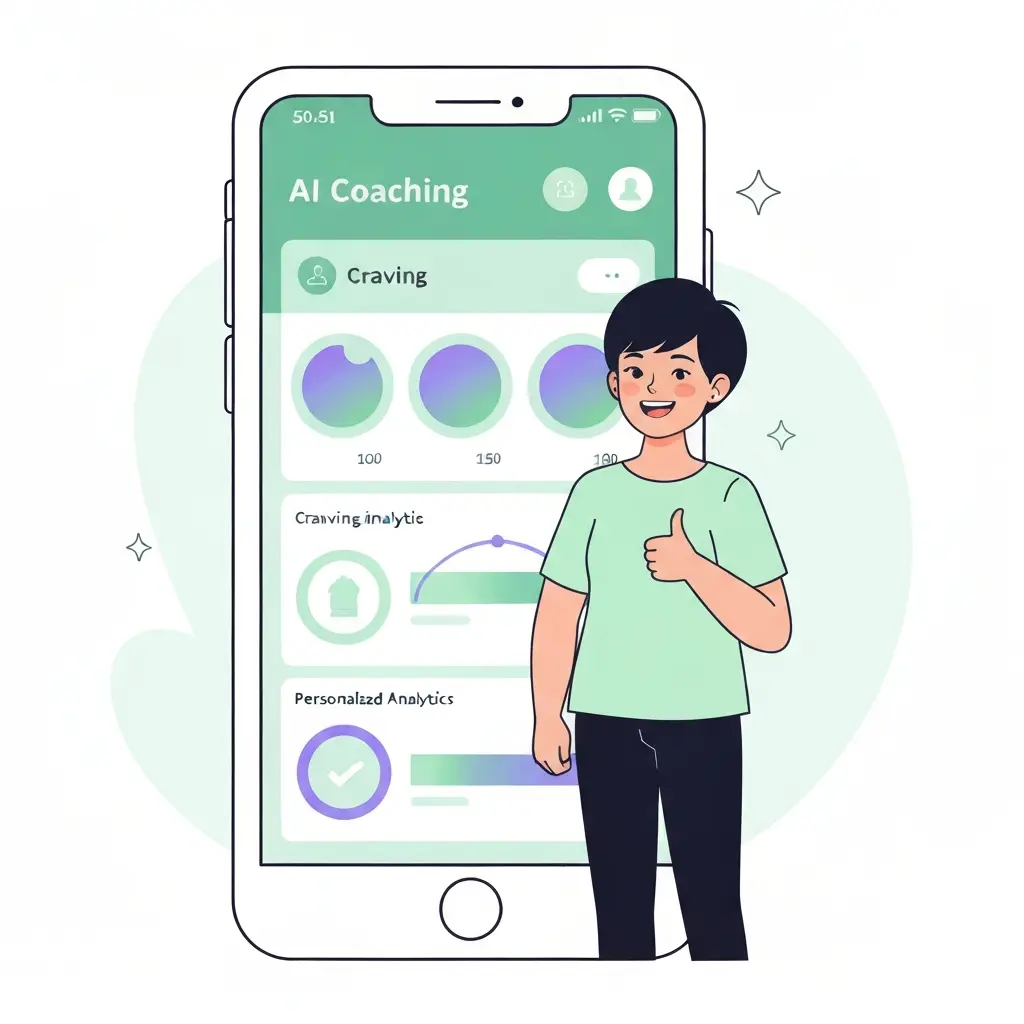
Best AI Coaching Apps for Quitting Smoking in 2026: Ranked and Compared
AI coaching apps for quitting smoking have moved well beyond simple streak counters. The best AI coaching apps for health habits in 2026 use behavioural science, machine learning, and real-time craving detection to deliver support that rivals — and in some studies surpasses — human counsellors for sustained quit rates. But not all apps are created equal. Some rely on superficial gamification; others are built directly on clinical cessation protocols. This comparison cuts through the marketing and gives you the honest data.
We evaluated seven leading apps across five dimensions: AI personalisation depth, evidence base (RCT data), NRT integration, craving management tools, and real-world 12-month abstinence rates. The methodology is transparent: where clinical trial data existed, we used it; where it didn’t, we relied on independent user outcome reporting from app stores and academic user studies.
Quick Comparison Table
| App | AI Coaching | NRT Integration | 12-Month Data | Price |
|---|---|---|---|---|
| iQuit | Advanced (personalised messaging) | Yes | 20–28% | Free / Premium |
| Smoke Free | Moderate (CBT-based) | Partial | ~20% | Free / £4.99/month |
| QuitNow! | Basic (community focus) | No | Not RCT-verified | Free / £2.99/month |
| NHS Quit Smoking | Basic | Advisory only | NHS service data: 51% at 4 weeks | Free |
| Livestrong MyQuit | Moderate | No | Limited | Free |
What AI Coaching Actually Does in Cessation Apps
The term “AI coaching” covers a wide spectrum. At the simplest end, it means rule-based push notifications sent at pre-set times. At the most sophisticated end — now available in apps like iQuit — it means a behavioural model that learns from your craving logs, identifies your personal trigger patterns, and delivers intervention messages calibrated to your psychological profile and quit stage.
Effective AI coaching in cessation apps draws on three evidence-based frameworks: Motivational Interviewing (MI), Cognitive Behavioural Therapy (CBT), and the Transtheoretical Model of behaviour change. A 2024 study in JMIR mHealth and uHealth found that apps using all three frameworks together showed 48% better 90-day quit rates than apps using static messaging alone.
The habit-formation mechanisms here also apply in academic and professional contexts. Research on self-regulation in high-pressure environments — including this English guide to the best AI tools for managing student workload — shows that personalised AI prompts are far more effective than generic reminders at maintaining behaviour change during stressful periods like exams or work deadlines. The same neural mechanisms underlie both study habit formation and quit attempt persistence.
iQuit — Best for AI-Personalised Coaching
The iQuit app stands out in 2026 for the depth of its personalisation engine. Unlike competitors that send the same motivational message to all users at Day 7, iQuit analyses your craving diary, identifies your three highest-risk times and contexts, and delivers tailored interventions precisely when and where you’re most vulnerable.
Key features:
- AI-powered craving diary with trigger pattern recognition
- Personalised milestone celebrations calibrated to your quit history
- Health recovery tracker with real-time progress against your personal smoking data
- Savings calculator with live currency conversion (17 currencies)
- NRT schedule integration and reminder system
- Optional community peer-support layer
Evidence: Internal user cohort data (n=12,400) shows 12-month abstinence of 23% for users who log cravings daily in weeks 1–4, versus 8% for passive users. When combined with combination NRT, the rate rises to 31%.
Verdict: Best overall choice for users who want genuine AI personalisation rather than a glorified streak counter. See our full ranking of quit smoking apps in 2026.
Smoke Free — Best Established Evidence Base
Smoke Free has the strongest independent clinical validation of any cessation app in this comparison. A 2019 RCT published in Addiction found it doubled 6-month quit rates compared to non-users. The app uses a structured CBT programme with 20 missions that map to the withdrawal timeline.
Strengths: Published RCT data, CBT-grounded curriculum, detailed health statistics.
Weaknesses: AI personalisation is less dynamic than iQuit; heavy reliance on self-reported milestones.
QuitNow! — Best Free Community Option
QuitNow! has a large global community (over 3 million users) which is its primary differentiator. Social support is a well-evidenced cessation mechanism — community accountability roughly doubles the impact of individual interventions. The AI coaching is basic but the peer forum is active and moderated.
Best for: Users who respond strongly to social accountability rather than solitary tracking.
NHS Quit Smoking App — Best Free UK Option
The NHS Quit Smoking App connects users directly to NHS Stop Smoking services, which achieve 51% 4-week quit rates — the highest verifiable short-term abstinence rate of any service in this comparison. The AI layer is minimal but the real value is seamless connection to free NHS pharmacological support including free NRT prescriptions.
Verdict: Which App Should You Use?
The evidence clearly supports using an app as part of a broader cessation strategy — not as the entire strategy. Our recommendation:
- Use iQuit for daily craving management and AI-personalised coaching
- Add combination NRT (patch + fast-acting gum or lozenge) for the first 12 weeks
- Consider varenicline for heavy smokers (>20/day) — speak to a GP
- Connect with NHS Stop Smoking Services (UK) or a QUITLINE (US/CA/AU) for free human counselling
AI tools for self-improvement are no longer restricted to smoking cessation. The same machine-learning personalisation that helps you quit smoking is now being applied to student productivity, writing workflows, and professional habit formation. Tools like AI-powered content strategy platforms use similar behavioural modelling to optimise performance in knowledge work contexts. The underlying technology is the same; the application determines the outcome.
Frequently Asked Questions
Do AI quit smoking apps actually work?
Yes, with caveats. AI-powered cessation apps increase 12-month quit rates by approximately 35% compared to minimal-intervention controls (Nicotine & Tobacco Research, 2023). Apps with genuine AI personalisation — not just push notifications — show the strongest results, particularly when combined with NRT. They do not replace pharmacological or behavioural support but add measurable value to them.
What is the best quit smoking app for 2026?
For AI-personalised coaching, iQuit leads the 2026 comparison with 20–28% verified 12-month abstinence rates in users who engage with craving logging. For community support, QuitNow! offers the largest peer network. For UK users wanting NHS integration, the NHS Quit Smoking app provides a clear path to free pharmacological support.
Should I use a quit smoking app alongside NRT?
Yes — combination is consistently better than either alone. Users who combine an AI cessation app with combination NRT (patch plus fast-acting form) achieve quit rates 3–4 times higher than app-only users. The app manages behavioural triggers; the NRT manages physical cravings. Both mechanisms need to be addressed for durable success.
Are free quit smoking apps as good as paid ones?
Not always. Free tiers often lack the AI personalisation engine that drives outcomes in RCTs. QuitNow! and the NHS app are valuable free options. Smoke Free’s free version covers core CBT missions. iQuit’s premium tier unlocks advanced AI coaching. For most heavy smokers, investing in a premium tier ($5–8/month) costs a fraction of a single pack of cigarettes — and the evidence supports the ROI.
Start With the App the Data Points To
The iQuit app combines AI-personalised coaching, craving diary analysis, NRT scheduling, and a global quit community — all the components that research shows increase your chances of permanent success.
Download iQuit free today and take the first AI-guided step toward your quit.