
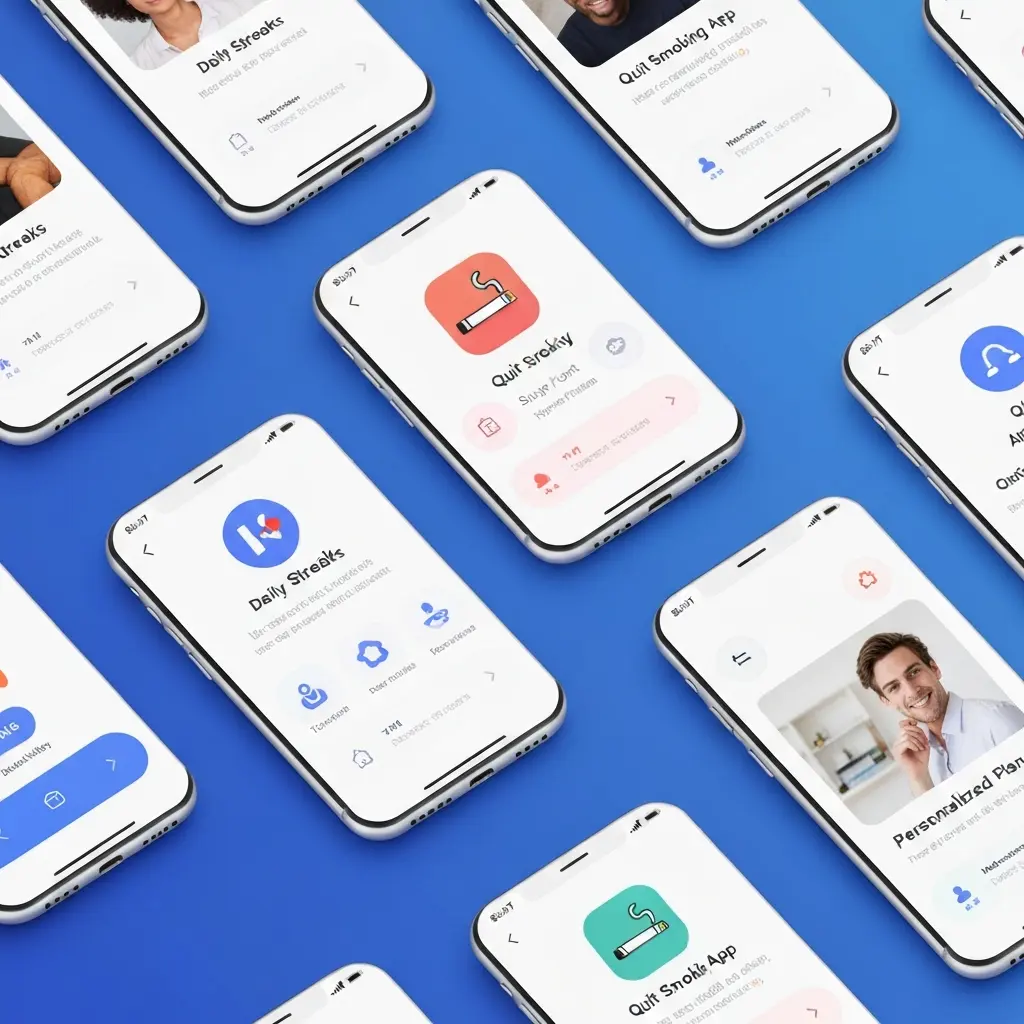
Best Quit Smoking Apps in 2026: Head-to-Head Feature Comparison (Updated Rankings)
There are now hundreds of quit smoking apps available across iOS and Android — yet research shows that most do not significantly outperform willpower alone. The difference between a passive information app and an evidence-based behavioural support tool is enormous: the best quit smoking apps in 2026 combine real-time craving management, personalised planning, habit tracking, and clinical methodology. Getting this choice right matters. A 2025 Nature Human Behaviour meta-analysis of 152 RCTs confirmed that personalised digital interventions significantly improve cessation rates — while generic information delivery tools do not.
This comparison evaluates the leading quit smoking apps on the features the research actually links to outcomes: craving support quality, evidence basis, personalisation depth, cost, and real-world user data where available. We are not reviewing aesthetics or review scores — we are reviewing what drives quitting success.
How We Evaluated These Apps
Our comparison uses a framework derived from the evidence-based features identified as most predictive of cessation success in the 2023 PMC systematic review of smartphone app interventions and the 2025 Nature network meta-analysis:
- Craving management: Real-time tools including distraction exercises, breathing prompts, 4D technique support, and urge surfing
- Personalisation depth: Quit date customisation, trigger identification, tailored plan generation
- Progress tracking: Health milestones, money saved, cigarette-free days, health recovery markers
- Evidence basis: CBT, ACT, motivational interviewing, or other validated behavioural frameworks
- Clinical research support: Whether the app has been evaluated in RCTs
- Cost: Free tier quality, freemium model, subscription pricing
- Platform: iOS, Android, web access
Feature Comparison Table
| App | Craving Tools | Clinical Method | RCT Tested | Cost | Platform |
|---|---|---|---|---|---|
| iQuit | Excellent (tracker, tools, alerts) | Behavioural + motivational | Evidence-aligned | Free/premium | iOS + Android |
| Smoke Free | Good (craving timer, health data) | Behavioural | 3 RCTs (doubled quit rates) | Free/premium | iOS + Android |
| Kwit | Good (mission-based) | CBT-based; WHO-validated | Research-backed design | Subscription | iOS + Android |
| NHS Quit Smoking | Moderate (daily tips) | NHS clinical guidelines | Government-validated | Free | iOS + Android |
| quitSTART (CDC) | Good (distraction games, tips) | CDC evidence-based | Government-validated | Free | iOS + Android |
| QuitNow! | Moderate (trigger tracking) | Motivational | Not specifically RCT tested | Free/premium | iOS + Android |
| iCanQuit | Excellent (urge surfing, ACT) | ACT (Acceptance and Commitment Therapy) | Research trial designed | Free | iOS + Android |
iQuit: Best for Daily Motivation and Craving Tracking
iQuit (iquitnow.life) is built around the daily habit loop that keeps smokers tobacco-free past the high-risk first 90 days. Its design prioritises two things the research identifies as critical: real-time craving support and ongoing motivational reinforcement through progress visibility.
Key features that set it apart:
- Craving tracker: Log cravings as they happen, identify patterns, and deploy tools at the moment of highest risk
- Live savings counter: Updates in real time showing money saved since quit date — a proven motivational anchor
- Health milestone timeline: Tracks the recovery milestones your body is hitting (from the 20-minute blood pressure drop through to the 1-year heart disease risk reduction)
- Personalised quit plan: Set your quit date, identify your specific triggers, and get a tailored strategy
Best for: People who are motivated by data and visible progress; those who want a lightweight daily-use tool to complement NRT or medication.
Smoke Free: Best Research Evidence Base
Smoke Free has the strongest direct RCT evidence of any consumer cessation app — three independent randomised controlled trials have all found that users are approximately twice as likely to remain quit at 6 months compared to willpower-alone controls. Its 4.8/5 iOS rating reflects extremely high user satisfaction.
Features:
- Tracks smoke-free time, money saved, and cigarettes not smoked in real time
- Provides craving timer (average craving lasts 4–5 minutes — watching it tick down is effective)
- Health recovery insights linked to clinical timelines (blood pressure, circulation, cancer risk)
- Premium tier includes detailed health data and coaching features
Best for: Evidence-focused quitters who want the most rigorously tested app available.
Kwit: Best CBT Programme
Kwit is the first app described as WHO-validated for smoking cessation, using cognitive behavioural therapy as its clinical framework. With 4.5 million users and a programme that adapts as users progress through stages of behaviour change, it offers the deepest clinical methodology of any consumer app.
Features:
- Adaptive CBT programme that evolves based on your progress stage
- Addresses dopamine cycle and craving psychology directly
- Mission-based structure with achievement system
- Strong evidence basis from CBT research for smoking cessation
Best for: Quitters who want to understand and address the psychological roots of their smoking habit; those who have tried other methods and relapsed.
NHS Quit Smoking: Best Free Clinical App
The NHS Quit Smoking app offers a 28-day programme with daily tips, practical support, and clinical advice grounded in NHS guidelines. It is completely free, with no freemium upsell, and is integrated with NHS Stop Smoking Service pathways.
Features:
- Structured 28-day programme with day-by-day guidance
- Tracks smoke-free time, cigarettes not smoked, and money saved
- Provides information on NRT options and signposting to NHS services
Best for: UK-based quitters who want an NHS-aligned free tool with clinical credibility and no cost barriers.
quitSTART (CDC): Best Free US Option
The CDC’s quitSTART app is the US government’s official free cessation tool, offering tailored tips, distraction games, craving management exercises, and milestone tracking. It connects users to the 1-800-QUIT-NOW quitline for human support.
Best for: US-based quitters who want a free, CDC-backed tool with the option to escalate to human telephone counselling.
How to Choose the Right App for You
The best quit smoking app is the one you will actually use consistently. Research confirms that engagement is the mediating variable — even a highly evidence-based app delivers no benefit if used for three days and then abandoned. With that in mind:
- Choose iQuit if: You want a clean, motivating daily-use app with strong craving tools and progress tracking
- Choose Smoke Free if: You want the most RCT-tested option available
- Choose Kwit if: You have a deeply habitual or psychologically-rooted smoking pattern and want structured CBT
- Choose NHS or quitSTART if: Cost is a primary concern and you want a government-backed free option
- Combine two apps if: Your willpower app and your clinical programme serve different daily functions — many successful quitters use a daily tracker alongside a structured programme
Whatever app you choose, the research is consistent: combine it with NRT or medication for the best outcomes. Apps address behaviour; NRT addresses the pharmacology. You need both.
Frequently Asked Questions
Which quit smoking app has the best success rate?
Based on published RCT evidence, Smoke Free has the strongest documented success rate, with three independent trials showing approximately doubled quit rates versus willpower alone at 6 months. Kwit holds WHO validation for its CBT methodology. However, the “best” app depends on which evidence-based features you are most likely to use consistently — an app with slightly less trial data that you use daily will outperform a better-researched app you abandon.
Are free quit smoking apps as good as paid ones?
Free tier quality varies enormously. Government-backed free apps (NHS Quit Smoking, quitSTART) offer genuine clinical value with no cost. Many freemium apps offer meaningful free features with premium upgrades for coaching or advanced tracking. Cost alone does not predict effectiveness — it is the quality of the craving management tools, personalisation, and evidence basis that drives outcomes.
Can I use a quit smoking app alongside nicotine patches?
Yes — and this is what the research recommends. Apps address the behavioural and psychological triggers of smoking; NRT patches address the physiological nicotine dependence. Used together, they address the two main reasons people relapse. The 2025 NEJM assessment of digital tobacco treatment explicitly recommends combining digital tools with pharmacotherapy for the best outcomes.
What is the most downloaded quit smoking app in 2026?
Kwit claims 4.5 million users as of 2026, making it among the most used globally. Smoke Free has a 4.8/5 iOS rating with very high download numbers. In the US, quitSTART (CDC) is the most prominently promoted free option. Download numbers do not directly correlate with quit success rates — effectiveness is determined by feature quality and user engagement, not popularity.
How long should I use a quit smoking app?
Clinical guidance suggests the highest-risk period for relapse is the first 3 months, with a secondary elevated risk window at 6 months. Using a quit smoking app consistently for a minimum of 3 months is recommended — ideally through the first year. The 2025 meta-analysis found apps showed greatest benefit in short- to medium-term programmes (3–6 months), but longer use maintains the motivational tracking benefit.
Ready to Find Your Perfect Quit Partner?
Start with iQuit — designed around the evidence-based features that actually drive cessation success: real-time craving tracking, a live savings counter, health milestone timeline, and a personalised quit plan. Free to download, built to keep you smoke-free past that critical 90-day mark.
Download iQuit and compare it against every app on this list →