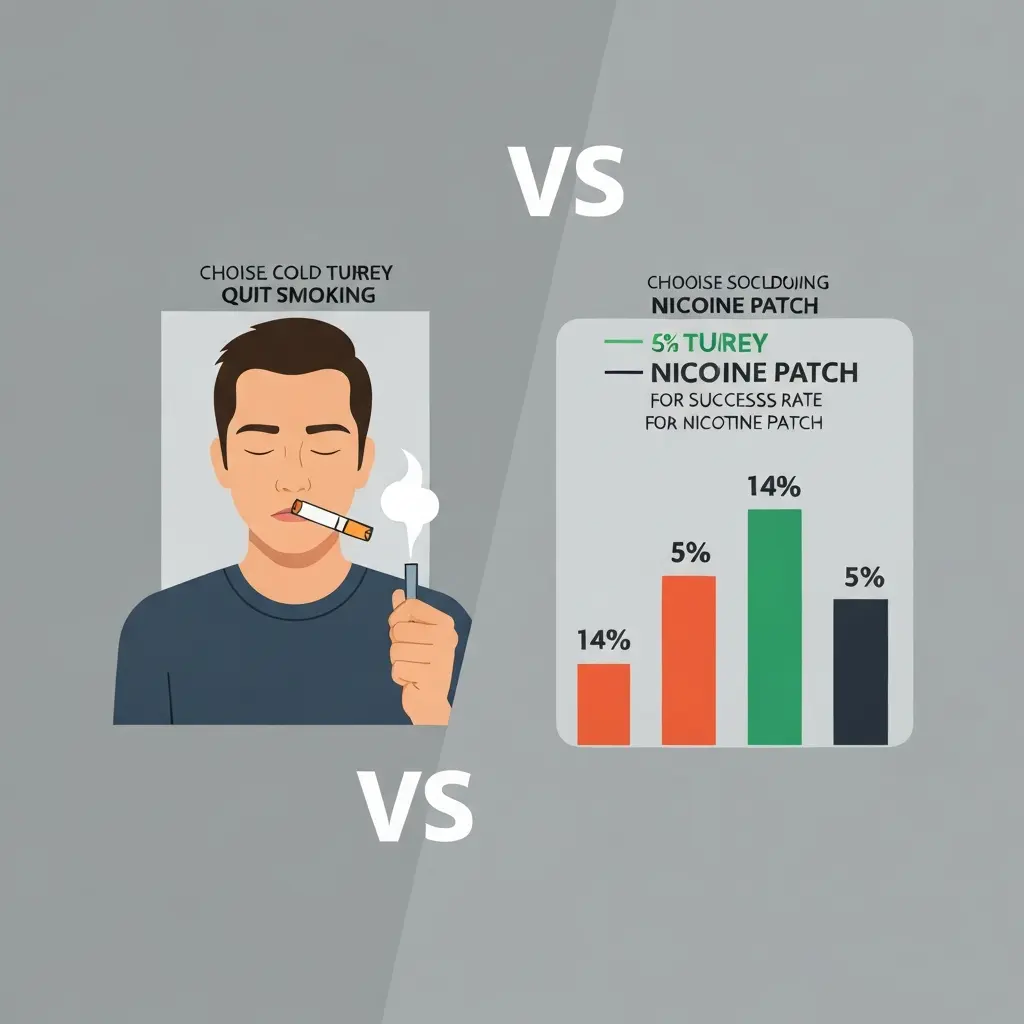
Cold Turkey vs Nicotine Patches: A Research-Led Head-to-Head for 2026
The cold turkey vs nicotine patches debate is one of the most common questions in smoking cessation — and the answer the data gives is more nuanced than either camp typically acknowledges. Cold turkey advocates are right that it is used by more successful quitters in absolute numbers (because it is attempted more often). NRT advocates are right that patches statistically improve your odds of success per attempt. Understanding which works better requires disentangling these two facts.
This comparison applies a strictly evidence-based lens to the quit smoking cold turkey vs nicotine patches question, drawing on clinical trial data, Cochrane reviews, Truth Initiative research, and NHS guidance to give the most accurate picture for someone deciding their quit strategy in 2026.
The Cold Turkey Myth: Debunking the “Character” Narrative
Cold turkey carries cultural weight. The idea that quitting smoking by sheer willpower demonstrates strength of character is deeply embedded in popular understanding of addiction. But this framing fundamentally misunderstands what nicotine dependence is: a neurological condition involving receptor upregulation that creates physiological withdrawal when supply is withdrawn.
The Truth Initiative, a major US public health organisation, states plainly: “The brain’s neurological dependence on nicotine makes unassisted cessation extraordinarily difficult for most people.” Choosing cold turkey over NRT is not a demonstration of willpower; it is a choice to handle one of the physiological components of quitting without pharmacological assistance — a handicap, not a virtue.
This matters because the framing affects quit behaviour. People who believe NRT is a “cheat” delay using it; people who fail cold turkey feel shame rather than recognising that they tried a lower-probability method and need a better-supported strategy. Both outcomes are harmful to public health.
Cold Turkey: What the Clinical Data Shows
Cold turkey in the clinical literature typically means abrupt cessation with no pharmacological aid — no NRT, no prescription medication, no nicotine. Here is what the research consistently finds:
- 4–7% of cold turkey attempts result in continuous abstinence at 6 months (CDC; Truth Initiative)
- Most relapses occur in the first 3 months, with the first week showing the highest relapse rate
- A 2017 Lancet paper found that abrupt cold turkey slightly outperformed gradual reduction among people not using NRT — but both groups had very low absolute success rates
- The American Lung Association estimates that only about 4–7% of people who try to quit without help are successful long term
One frequently cited but methodologically questionable study reported a 72% cold turkey success rate — this has been widely criticised for its non-representative population and self-selection bias. The robust population-level data consistently points to 4–7% as the realistic baseline.
Nicotine Patches: Clinical Evidence
Nicotine patches are the most studied form of NRT, with multiple Cochrane-level reviews:
- The Cochrane 2018 review (136 trials, 64,000+ participants) found all NRT forms, including patches, increase quit likelihood by approximately 50–60% relative to placebo
- In absolute terms: ~14% of patch users achieve 6-month abstinence in controlled trials, versus ~9% for placebo (which itself typically outperforms pure cold turkey due to trial support effects)
- Patches have the highest compliance rate of all NRT forms, largely due to the simplicity of once-daily application
- Step-down dosing (21mg → 14mg → 7mg over 8–12 weeks) is the standard protocol and is well-tolerated by most users
Head-to-Head: Same Quit Attempt, Different Tools
| Factor | Cold Turkey | Nicotine Patches |
|---|---|---|
| 6-month success rate | 4–7% | ~14% |
| Relative improvement vs cold turkey | Baseline | ~2x better |
| Addresses physical withdrawal? | No | Yes (reduces intensity) |
| Addresses psychological/behavioural patterns? | Only with willpower | No (NRT doesn’t address this) |
| Cost | Zero | ~£15–40/month OTC; free on NHS prescription (UK) |
| Requires prescription? | No | No (OTC) / Yes for NHS free supply |
| Peak withdrawal intensity | High (days 2–3) | Moderate (reduced by patch) |
| Compliance burden | None (passive) | Very low (once daily) |
Who Succeeds with Cold Turkey?
Despite the low average success rate, cold turkey does work for some people. Research identifies predictors of cold turkey success:
- Lower nicotine dependence: Light smokers (<10 cigarettes/day) have substantially better cold turkey success rates than heavy smokers. The Fagerström Test for Nicotine Dependence (FTND) is a clinical tool for assessing this — lower scorers are better cold turkey candidates.
- Strong social support: Quitters with a non-smoking partner or a committed support network show higher cold turkey success rates
- Short smoking history: People who have smoked for fewer than 5 years tend to have less deeply established neurological and habitual dependency
- High intrinsic motivation: Health events (a diagnosis, a pregnancy) that create strong personal motivation boost cold turkey success rates in population studies
Who Should Use Patches?
Patches are particularly well-suited for:
- Heavy smokers (15+ cigarettes per day)
- Those who smoke within 30 minutes of waking (high physical dependence marker)
- People who have tried and failed cold turkey one or more times
- Anyone experiencing severe withdrawal symptoms in previous quit attempts (intense irritability, difficulty concentrating, physical anxiety)
- People who want the simplest, lowest-effort pharmacological support
The Research-Optimal Approach in 2026
Neither cold turkey nor patches alone represents the research-optimal approach. The current evidence hierarchy points to combination NRT (patch + fast-acting form) plus behavioural support as the strategy with the best outcomes for most smokers. That said:
- Patches alone are approximately twice as effective as cold turkey per quit attempt
- Adding a fast-acting NRT (gum, spray, lozenge) to the patch increases success rates by a further ~3 percentage points
- Adding a behavioural support tool (NHS Stop Smoking Service, counselling, or an evidence-based app) doubles outcomes again
For most people who have smoked for years, the pragmatic recommendation is: start with a patch, add gum or lozenges for acute cravings, and use a tracking app like iQuit to manage the behavioural side. Cold turkey is not a virtuous choice — it is simply a lower-probability one.
Frequently Asked Questions
Is quitting cold turkey better than using nicotine patches?
Based on clinical trial data, nicotine patches perform better than cold turkey per quit attempt — approximately 14% 6-month success rate versus 4–7% for cold turkey. Patches roughly double the probability of success per attempt. The idea that cold turkey is superior or more “authentic” is not supported by the evidence. That said, cold turkey does succeed for a minority of people, particularly lighter smokers with lower physical dependence.
Why do so many people try cold turkey if success rates are so low?
Cold turkey requires no planning, no prescription, and no cost — making it the path of least resistance for an impulsive quit attempt. Cultural narratives around “willpower” also glamourise the cold turkey approach. Additionally, most smokers underestimate the neurological power of nicotine dependence. Studies show that when smokers are given objective information about success rates by method, NRT uptake increases significantly.
Can I switch from cold turkey to patches if I am struggling?
Yes — and this is strongly recommended. There is no clinical reason to complete a cold turkey attempt if you are struggling. Starting a nicotine patch during a cold turkey attempt (even on day 3 when cravings peak) can significantly reduce withdrawal intensity and improve your chance of success. The NHS and CDC both support switching to NRT at any point during a quit attempt rather than waiting to restart.
How many times do most people try to quit before succeeding?
Research suggests the average smoker makes 8–10 quit attempts before achieving long-term abstinence. Each attempt is not a failure — it is data. Studies show that each subsequent quit attempt increases the cumulative likelihood of eventual success, particularly when the person reflects on what caused the previous relapse and addresses it (by choosing a better-supported method or adding behavioural support).
Do nicotine patches work if you smoke while wearing them?
Patches are intended for use after you have set your quit date and stopped smoking. Smoking while wearing a high-dose patch can cause nicotine overconsumption symptoms — nausea, dizziness, rapid heartbeat. However, using a patch while reducing cigarettes before your quit date (rather than post-quitting) is a validated NHS strategy. If you smoke a cigarette while wearing a patch, remove the patch for 2 hours before replacing it.
Give Your Patches the Best Chance of Working
Patches handle the pharmacology. iQuit handles the rest — tracking your craving patterns, showing your health and financial milestones building, and keeping you connected to why you are quitting. Use both together for the research-backed combination approach.