Grounding Exercises for Smoking Anxiety: Calm Cravings in Minutes
A smoking craving and anxiety share the same nervous system pathway. When a craving hits — especially in stressful moments — the body’s fight-or-flight response activates: heart rate rises, breath shallows, attention narrows to the object of desire. Grounding exercises for anxiety interrupt this cycle by redirecting the nervous system’s attention from the internal alarm to the present reality of the physical world around you.
These techniques are not about distraction — they are neurological interventions. They work by activating the prefrontal cortex and parasympathetic nervous system, directly counteracting the amygdala-driven anxiety that amplifies cravings. And they take minutes, not hours.
Why Grounding Works for Smoking Anxiety
During a craving, your nervous system is in a state of sympathetic activation — the same biological response as encountering a physical threat. Cortisol and adrenaline are elevated. The prefrontal cortex (rational thinking, impulse control) is partially suppressed. The amygdala (emotional reactivity, threat response) is dominant.
This is why cravings can feel impossible to reason with. The part of your brain that would objectively evaluate “I don’t need a cigarette” is precisely the part being bypassed by the stress response.
Grounding exercises work by:
- Activating the prefrontal cortex through deliberate sensory attention tasks that require cognitive engagement
- Stimulating the parasympathetic nervous system (the “rest and digest” response) through controlled breathing and physical contact techniques
- Breaking the rumination cycle that amplifies anxiety by occupying conscious attention with present-moment perception
- Reducing cortisol — the stress hormone that drives both anxiety and nicotine cravings — through parasympathetic activation
Research published in SciTechnol confirms the 5-4-3-2-1 technique works by counteracting the fight-or-flight response, bringing the nervous system back to a more balanced state. The key is consistent practice — these techniques work best if practiced regularly, as remembering them in a moment of stress is difficult if they are not habitual.
The 5-4-3-2-1 Grounding Technique
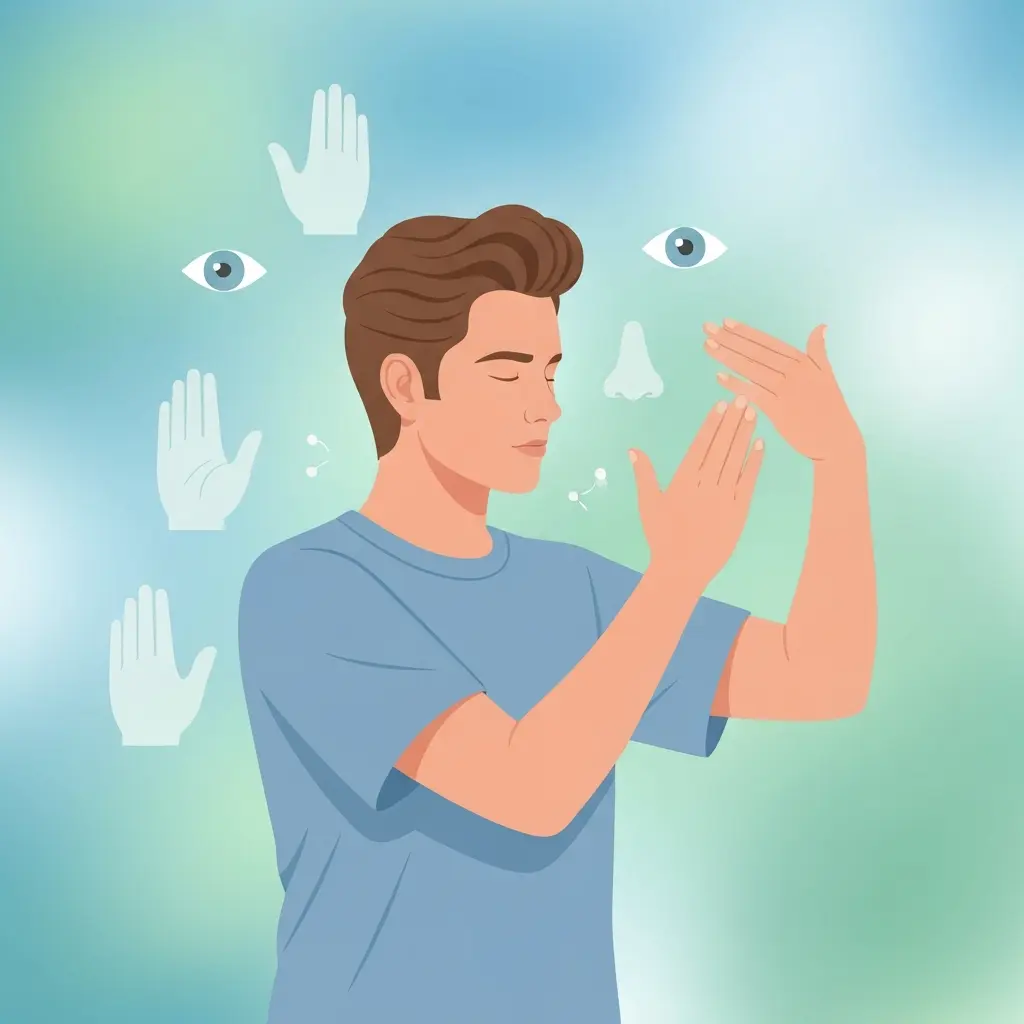
The 5-4-3-2-1 technique is the most widely studied and used grounding exercise, documented by UR Medicine and taught in clinical anxiety and addiction settings globally. It engages all five senses in sequence, systematically anchoring attention to the present moment.
When a craving or anxiety spike hits, work through this sequence:
| Step | Instruction | Why It Helps |
|---|---|---|
| 5 things you can SEE | Name each one specifically: “A blue coffee mug, a window, sunlight on the wall…” | Activates visual cortex; occupies conscious attention; orients to present environment |
| 4 things you can TOUCH | Touch each one and notice the texture, temperature, and pressure | Physical sensation input overrides internal anxiety signals; activates somatosensory cortex |
| 3 things you can HEAR | Listen carefully: “Traffic outside, keyboard typing, air conditioning hum…” | Auditory attention requires present-moment focus; expands awareness beyond the craving |
| 2 things you can SMELL | Notice any smells in your environment — coffee, fresh air, food, products | Olfactory sense has direct limbic connection; smell can rapidly shift emotional state |
| 1 thing you can TASTE | Notice any taste present in your mouth, or take a sip of water and taste it deliberately | Completes the full sensory sweep; final anchor to present moment |
The entire sequence takes two to three minutes. At the end, most people find the craving has significantly diminished or passed entirely — because the nervous system has been brought out of sympathetic overdrive, and the craving itself has followed its natural arc toward subsiding.
Breathing Grounding Exercises
Breathing-based grounding exercises are particularly powerful for smoking anxiety because controlled breathing directly activates the parasympathetic nervous system through the vagus nerve — one of the fastest physiological pathways to reducing anxiety.
The 4-7-8 Breath
Developed by Dr. Andrew Weil based on yoga pranayama practice:
- Inhale through the nose for 4 counts
- Hold the breath for 7 counts
- Exhale completely through the mouth for 8 counts
- Repeat 3 to 4 times
The extended exhale is the key mechanism — it stimulates the vagus nerve and activates the parasympathetic response rapidly. Many people find this technique effective within one full breath cycle.
Box Breathing (4-4-4-4)
Used by military special forces for high-stress regulation:
- Inhale for 4 counts
- Hold for 4 counts
- Exhale for 4 counts
- Hold for 4 counts
- Repeat 4 to 6 times
The equal-time structure creates a rhythmic pattern that the nervous system finds inherently calming. The brief hold after exhale is particularly effective at breaking the shallow, rapid breathing pattern of anxiety.
Physical Grounding Techniques
Physical techniques use the body itself as an anchor to the present moment:
Cold Water
Running cold water over your wrists or splashing it on your face activates the mammalian dive reflex — a hardwired biological response that slows heart rate and reduces anxiety. It is fast, effective, and accessible in almost any environment.
Progressive Muscle Relaxation (Quick Version)
Deliberately tense and release major muscle groups in sequence — feet, calves, thighs, stomach, hands, shoulders, face. The physical process of releasing tension activates the parasympathetic response and breaks the physical manifestation of anxiety in the body. A quick version (hands and arms only) can be done invisibly at a desk.
The 5-Point Ground
Stand or sit firmly and focus on five points of physical contact with surfaces: both feet on the floor, both thighs on the chair, back against the chair. Press each contact point deliberately and feel the solid support. This physical anchoring is particularly effective for cravings that arise with a feeling of restlessness or unreality.
Cognitive Grounding Methods
Cognitive grounding techniques use mental activity to redirect attention from anxiety to present-moment engagement:
Category Naming
Choose a category — animals, countries, fruits, brands — and name as many as you can. The cognitive demand of retrieval occupies the anxious mind and breaks the craving rumination cycle. This works particularly well for mentally active people who find sensory exercises less engaging.
The Anchor Phrase
Develop a personal grounding phrase that you repeat during a craving: “This craving will pass. I have surfed this wave before. I am staying quit.” Repeat it slowly and deliberately, meaning each word. The combination of verbal repetition and the specific content (affirming competence and commitment) is both grounding and motivational.
Color Scan
Choose a color and scan your environment to find every object of that color. Count them. This requires focused visual attention and present-moment awareness that effectively interrupts anxious craving thoughts without the emotional complexity of other techniques.
When to Use Each Technique
| Situation | Best Technique |
|---|---|
| High-stress craving (work, conflict) | 4-7-8 breathing or box breathing — fast parasympathetic reset |
| Mild to moderate craving anywhere | 5-4-3-2-1 technique — comprehensive sensory grounding |
| Intense restlessness or panic | Cold water on wrists + deep breathing — physiological intervention |
| Mentally occupied (in a meeting, driving) | Category naming or color scan — requires minimal overt behavior |
| Evening relaxation craving | Progressive muscle relaxation — whole-body release |
Combining Grounding With Other Quit Tools
Grounding exercises are most effective as one component of a comprehensive craving management toolkit:
- Grounding + craving surfing: Use grounding first to regulate the nervous system, then craving surfing to observe the wave non-reactively. Grounding reduces intensity; surfing completes the resolution. See our guide on Craving Surfing Technique.
- Grounding + NRT: When physical withdrawal is intense, NRT reduces the pharmacological craving while grounding manages the psychological and anxiety components simultaneously.
- Grounding + tracker app: After a successful grounding session, log it in your iQuit app as a managed craving. Watching managed cravings accumulate is powerful evidence of your growing capability.
- Grounding + understanding: Understanding why cravings happen — the neuroscience behind addiction — makes grounding more effective. See our guide on Why Is It Hard to Quit Smoking for the brain science context.
Grounding Tools in Your Pocket, Whenever You Need Them
The iQuit app includes guided breathing exercises, craving timers, and a craving log — everything you need to practice grounding and track your growing confidence managing cravings.
Frequently Asked Questions
How quickly do grounding exercises reduce smoking anxiety?
The 5-4-3-2-1 technique takes approximately two to three minutes and most people notice significant reduction in anxiety by the end of the sequence. Breathing techniques like the 4-7-8 breath can begin reducing anxiety within the first cycle — roughly 20 to 30 seconds. Physical grounding techniques such as cold water on the wrists activate the mammalian dive reflex within seconds. The total time to significant craving relief using these techniques is typically two to five minutes — comparable to the natural arc of a craving.
Can grounding exercises replace NRT for managing cravings?
Grounding exercises address the psychological and anxiety components of cravings, not the physical nicotine withdrawal. NRT addresses the physiological dependence. They target different dimensions of the same problem. For moderate to heavy smokers, using both together is more effective than either alone. For lighter smokers or those further into their quit journey, grounding techniques may be sufficient for managing occasional cravings without NRT.
How often should I practice grounding exercises when quitting smoking?
Research recommends practicing daily — morning practice for two to three minutes builds the skill so it is accessible during high-craving moments. Clinical guidelines suggest practicing every morning for two to three months to establish the habit. Beyond scheduled practice, use techniques whenever a craving or anxiety spike occurs. The more you practice in low-stakes moments, the more naturally the technique activates when you truly need it.
Are grounding exercises effective for people with panic attacks related to quitting?
Yes, grounding techniques are used clinically for panic disorder and are well-established as a first-response tool during panic attacks. For smokers experiencing panic-level anxiety during cessation withdrawal, the 5-4-3-2-1 technique and breathing exercises are appropriate interventions. If you are experiencing frequent panic attacks during cessation, speak with your doctor — this may indicate that additional support such as short-term anxiolytic medication or more structured therapy is needed during the transition period.
Can I use grounding exercises at work without others noticing?
Yes, most grounding techniques are completely invisible. The 5-4-3-2-1 technique can be done silently while appearing to look around the room normally. Breathing techniques require only slightly deeper, slower breathing — imperceptible to others. Category naming and cognitive techniques are entirely internal. The only technique that requires visible behavior is cold water or physical grounding exercises — these can be done discreetly by excusing yourself to a bathroom briefly if needed.