Health Recovery Timeline After Quitting Smoking: Complete Data and Milestones
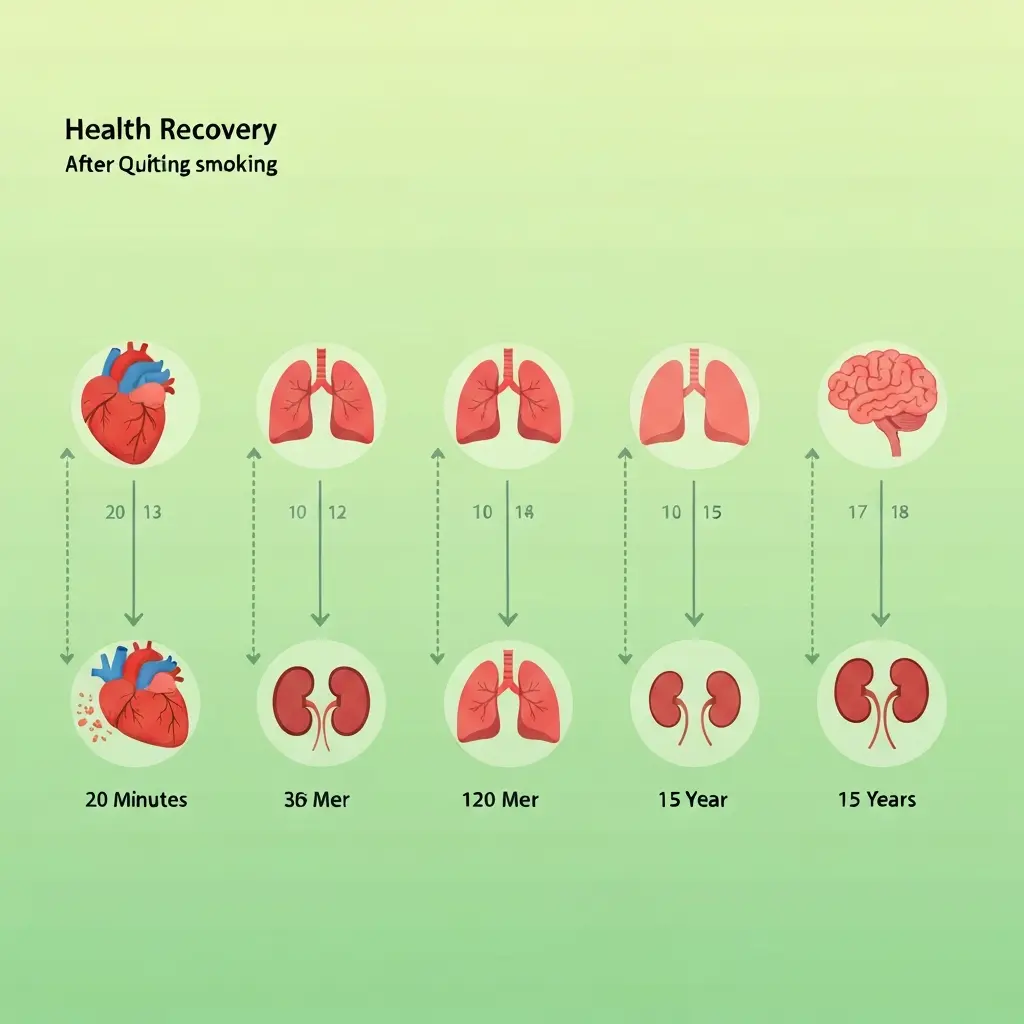
The health recovery timeline after quitting smoking is one of the most well-documented and quantified in medical science. Unlike many health interventions where benefits are uncertain or distant, stopping smoking produces measurable, independently verified physiological improvements at every stage — from 20 minutes to 15 years. This article presents the complete data-backed timeline, with specific clinical measurements and study references at each milestone.
What makes this timeline particularly powerful is its specificity. It’s not “your health improves over time” — it’s “within 12 hours, blood carbon monoxide drops by 50%; within 1 year, your heart attack risk halves; within 10 years, your lung cancer risk is half that of a continuing smoker.” These are measured, validated outcomes from clinical studies and large population cohorts.
Minutes to 24 Hours: Cardiovascular Data
Days 2–14: Physiological Data
| Timepoint | Physiological Change | Clinical Measurement |
|---|---|---|
| Day 2 | Nicotine fully cleared from blood | Blood/urine cotinine approaches zero |
| Day 2–3 | Nerve ending regeneration begins; taste and smell improve | Self-reported taste/smell recovery; verified in sensory studies |
| Day 3–7 | Bronchial tubes begin relaxing and widening | FEV1 (forced expiratory volume) improves measurably in spirometry tests |
| Days 3–14 | Cilia in airways begin recovering function | Ciliary beat frequency increases toward non-smoker levels |
| Day 14 | Circulation improvement in extremities | Peripheral perfusion measures normalize in most people |
1–9 Months: Pulmonary Data
The pulmonary recovery data is among the most well-documented in cessation research:
1 Year: Cardiovascular Milestone Data
The 1-Year Cardiovascular Milestone
Coronary heart disease risk is now half that of a continuing smoker.
This is one of the most validated data points in cessation science, replicated across multiple large cohort studies including the Framingham Heart Study, UK Biobank, and European prospective studies. The mechanism: platelet aggregation normalizes (reducing clotting risk), atherosclerotic plaque formation slows, and endothelial function improves.
The 50% reduction in 1 year represents one of the fastest and most clinically significant risk reductions achievable by any health intervention — including medication, dietary changes, or exercise programs.
Additional 1-year data points:
- Endothelial function (ability of blood vessels to dilate normally) has substantially normalized
- Levels of inflammatory markers (CRP, fibrinogen) in the blood have declined toward non-smoker levels
- In people with stable COPD, annual rate of FEV1 decline significantly slows (lung function stabilizes rather than continuing to deteriorate)
- In diabetic smokers, glycemic control improves (smoking impairs insulin sensitivity)
2–5 Years: Cancer Risk Data
| Timepoint | Cancer Type | Risk Reduction vs. Continuing Smoker | Source |
|---|---|---|---|
| 2–5 years | Oral and pharyngeal cancer | -50% | American Cancer Society |
| 5 years | Bladder cancer | -50% | American Cancer Society |
| 5 years | Cervical cancer | Returns to non-smoker risk | American Cancer Society |
| 5 years | Stroke risk | Returns to non-smoker level | American Heart Association |
The 2–5 year window is when the body’s cellular repair mechanisms have had time to replace or repair pre-malignant changes. In some tissue types (particularly the oral cavity, esophagus, and bladder), the risk reduction is rapid and dramatic.
10–15 Years: Long-Term Outcome Data
10-Year Milestone
Lung cancer risk is now 50% that of a continuing smoker.
This is the most impactful single data point at 10 years. Lung cancer is the leading cause of cancer death in most countries; a 50% reduction in risk from a single behavioral change (quitting) is remarkable. The mechanism involves replacement of pre-cancerous cells with normal cells and normalization of cellular repair mechanisms impaired by smoking carcinogens.
Pre-cancerous cells in the airways have largely been replaced by normal cells. The risk of cancers of the larynx and esophagus has also substantially reduced.
15-Year Milestone
Coronary heart disease risk equals that of a lifelong non-smoker.
At 15 years, the cardiovascular system has fully recovered from the effects of smoking in terms of risk profile. This is the culmination of 15 years of vascular repair — arterial elasticity improvement, plaque stabilization, endothelial normalization, and inflammatory marker normalization. For someone who smoked a pack a day for 20 years and quit at 40, their cardiovascular risk profile at 55 is equivalent to someone who never smoked.
Life Expectancy Data
The most comprehensive analysis of smoking cessation and life expectancy comes from a landmark BMJ study (Doll et al.) following British doctors for 50 years, and confirmed by multiple subsequent population studies:
| Age at Quitting | Life Years Gained vs. Continuing to Smoke |
|---|---|
| 30 | ~10 years gained (full recovery to non-smoker life expectancy) |
| 40 | ~9 years gained |
| 50 | ~6 years gained |
| 60 | ~3 years gained |
| Any age | Meaningful improvement in quality of life and reduction in disability |
The critical message: it is never too late to quit. Even quitting at 60 gains 3 years and substantially reduces the number of years spent in smoking-related disability. But quitting earlier produces dramatically more benefit — quitting at 30 recovers the full decade of life that smoking would otherwise remove.
Tracking this recovery journey — seeing where you are in the timeline — is exactly what tools like the iQuit app make possible. Making invisible physiological recovery visible is one of the most powerful motivational interventions available. The same principle that makes analytics tools valuable — turning invisible data into actionable visible insights — applies to tracking your personal health recovery timeline.
Frequently Asked Questions
How quickly does health improve after quitting smoking?
Health improvement begins within 20 minutes of the last cigarette. Within 8–12 hours, blood carbon monoxide normalizes. Within 24 hours, heart attack risk begins declining. Within 1 year, heart attack risk is halved. Within 5 years, stroke risk equals that of a non-smoker. The body’s capacity for recovery is remarkable, and it begins immediately.
Does lung function fully recover after quitting smoking?
Lung function improves substantially — by up to 10% within 9 months according to American Lung Association data. However, pre-existing structural damage (such as emphysema from destroyed alveoli) does not reverse. What improves dramatically is the rate of further decline, inflammation, mucociliary function, and infection risk. For most smokers without advanced COPD, lung function improves meaningfully and the trajectory of decline halts.
When does heart attack risk return to normal after quitting?
Heart attack risk halves within 1 year of quitting. It continues declining and returns to approximate non-smoker levels at 15 years for coronary heart disease risk. Within 2–5 years, the risk of a cardiac event is substantially lower than that of a continuing smoker, and continuing to fall.
How much does quitting smoking reduce cancer risk?
Risk reduction varies by cancer type and duration of cessation. Oral, pharyngeal, and bladder cancer risk drops by 50% within 5 years. Lung cancer risk drops by 50% at 10 years. The risk never returns completely to that of a lifelong non-smoker for most cancers, but the reductions are clinically and practically significant — a 50% risk reduction in lung cancer is a major health outcome.
Can you see health recovery after quitting smoking?
Yes, some recovery is physically visible. Skin tone and hydration typically improve within 1–3 months as circulation normalizes. Nicotine staining on teeth and fingers fades. Eye whites often become whiter as oxidative stress reduces. Hair and nail health improves. Breath freshens as sulfur compounds from tobacco clear. These visible changes are encouraging markers of the more profound systemic recovery occurring simultaneously.
Is it worth quitting smoking if you’ve smoked for 30 years?
Absolutely. Research shows meaningful health improvements and life expectancy gains even for people who quit after decades of heavy smoking. The cardiovascular recovery in particular is substantial — halving heart attack risk within 1 year — regardless of prior smoking history. Quitting at 60 after 40 years of smoking still gains approximately 3 years of life and significantly reduces years lived with smoking-related disability.
What happens to the brain after quitting smoking?
PET imaging studies show that nicotinic receptor density in the brain normalizes to near-non-smoker levels within approximately 6–12 weeks of cessation. Dopaminergic system function recovers over weeks to months, improving baseline mood, stress resilience, and cognitive function. Long-term ex-smokers show lower rates of anxiety and depression than active smokers — contrary to the perception that smoking helps with these conditions.
Does quitting smoking reverse cardiovascular damage?
Partially. The rate of atherosclerotic progression halts and partially reverses. Endothelial function normalizes. Platelet aggregation and clotting risk decrease. Pre-existing arterial plaque doesn’t fully dissolve, but it stabilizes and progression stops. The net effect is dramatic cardiovascular risk reduction — the 50% reduction in heart attack risk at 1 year is evidence of genuine vascular recovery, not just statistical adjustment.
See Your Recovery Timeline in Real Time
The iQuit app maps your personal health recovery timeline against this clinical data — showing you where you are at every stage, what’s recovering right now, and what milestone is coming next. Download free and watch your body heal, milestone by milestone.