Health Recovery Timeline After Quitting Smoking: Organ-by-Organ Data from Medical Research
The health recovery timeline after quitting smoking is one of the most motivating datasets in cessation research — and one of the most frequently oversimplified. “Your lungs start recovering in 20 minutes” is technically true, but it glosses over the genuinely remarkable scale of biological repair that unfolds over months and years. For people who have smoked heavily for a decade or more, understanding the real, evidence-based recovery data by organ system provides both a realistic picture and a compelling reason to stick with the quit.
This article presents organ-specific recovery data sourced from NHS guidance, WHO cancer research, CDC data, and peer-reviewed medical literature. It goes beyond the standard “X minutes” timeline to examine what the science says about how much recovery is possible, how long it takes, and what factors influence the depth of repair.
Minutes to Hours: Immediate Cardiovascular and Chemical Changes
The body begins to repair itself from the moment the last cigarette is extinguished — this is not motivational fiction, it is measurable physiology.
- 20 minutes: Blood pressure begins to drop toward normal levels. Heart rate decreases. The extreme vasoconstriction caused by nicotine begins to ease, improving blood flow to the extremities.
- 2 hours: Nicotine has largely cleared from the bloodstream (half-life ~2 hours). Peripheral circulation continues to improve — hands and feet may feel warmer. The first withdrawal symptoms (irritability, cravings) begin as brain receptor upregulation from nicotine starts to reverse.
- 8–12 hours: Carbon monoxide levels in the blood normalise. CO competes with oxygen on haemoglobin — when it clears, oxygen-carrying capacity rises. Oxygen saturation of the blood improves measurably within hours.
- 24 hours: Risk of acute cardiac event begins to decline. Mucus production in the lungs begins to mobilise as the cilia (hair-like cleaning structures) start to reactivate.
Days and Weeks: Circulation, Taste, and Lung Function
The days-to-weeks period is the most turbulent for withdrawal but also the time of rapid early recovery:
- 48–72 hours: Nicotine withdrawal peaks for most people on day 3. Simultaneously, nerve endings begin to regenerate, and many ex-smokers report improved taste and smell within this window — sometimes dramatically so.
- 2 weeks: Circulation continues to improve. Walking distance without breathlessness begins to improve for heavy smokers. Lung function tests (FEV1) may show measurable improvement within 2–3 weeks in some individuals.
- 1–3 months: Cilia in the airways — paralysed by tobacco toxins — progressively regain function. This is the mechanism behind the “smoker’s cough” that sometimes increases early after quitting: the lungs are actively clearing accumulated mucus. This is a positive health sign, not a reason to worry.
- 3 months: Blood circulation to the gums and teeth improves, reducing risk of gum disease progression. Skin circulation improves, affecting complexion.
One Year Out: Heart Disease Risk
The 12-month milestone is medically significant for cardiovascular risk:
- The risk of coronary heart disease is reduced to approximately half that of a current smoker at the 1-year mark (NHS / American Heart Association)
- Blood platelet stickiness — elevated by smoking and a key contributor to clot formation — normalises substantially within the first year
- HDL (“good”) cholesterol levels, suppressed by smoking, begin to recover
- Erectile dysfunction from smoking-related vascular damage shows improvement in some studies within 1–2 years of cessation
The cardiovascular benefit of cessation is one of the most robust and fastest-emerging benefits in the entire timeline. Even for people who have smoked for 30+ years, quitting at 60 still halves heart disease risk within 12 months compared to continuing to smoke.
The Lungs: What Actually Recovers and What Does Not
Respiratory recovery deserves the most nuanced treatment, because the lungs respond very differently depending on prior damage level:
What Recovers
- Cilia function (largely restored within 3–6 months)
- Mucus clearance efficiency
- Susceptibility to respiratory infections decreases
- FEV1 (forced expiratory volume) — lung function — improves modestly but measurably in the first year for most ex-smokers
- Bronchial hyper-responsiveness (the reactive airways that cause smoker’s wheeze) decreases over time
What May Not Fully Recover
- COPD (Chronic Obstructive Pulmonary Disease): Structural lung damage from severe COPD is permanent. However, quitting stops further decline — the disease progression rate drops to that of a never-smoker after cessation. This makes quitting the single most effective intervention available for COPD patients.
- Lung tissue scarring from very long-term heavy smoking
- Established emphysema: alveolar destruction does not reverse
The NHS guidance on this is clear: “Stopping smoking is the only effective way to slow the progress of COPD.” Even partial recovery of lung function is biologically significant for quality of life and exercise capacity.
Cancer Risk: The Long-Game Data
Cancer risk reduction after quitting is one of the most compelling and well-documented aspects of cessation research. The WHO International Agency for Research on Cancer (IARC) provides the clearest long-term data:
| Cancer Type | Risk at Cessation | Risk at 10 Years | Risk at 15–20 Years |
|---|---|---|---|
| Lung cancer | Active smoker baseline | ~50% of current smoker | ~80–90% risk reduction vs smoking |
| Mouth / throat | Active smoker baseline | Significant reduction | Near-normalisation in 15+ years |
| Bladder cancer | Active smoker baseline | Halved vs current smoker | Further decline |
| Oesophageal cancer | Active smoker baseline | Substantial reduction | Near-normalisation possible |
| Cervical cancer | Active smoker baseline | Significant reduction | Similar risk to never-smoker |
A key Lancet analysis found that people who quit before age 40 reduce their excess risk of tobacco-related death by approximately 90%. Even quitting at 60 still confers significant risk reduction across multiple cancer types. There is no point at which quitting stops delivering health benefits.
Beyond Heart and Lungs: Brain, Skin, Fertility, and More
Brain and Mental Health
Nicotine dependency rewires dopamine receptor density. Studies show that after a period of 3 months+ of abstinence, dopamine receptor expression begins to normalise. Many ex-smokers report improved concentration and mood stability after the initial withdrawal period subsides — the opposite of what they feared, given that smoking was used as a stress management tool.
Skin
Smoking dramatically accelerates skin ageing through collagen destruction and reduced blood flow. Studies measuring skin elasticity and collagen content show measurable improvement within 4–12 weeks of cessation. The yellow discolouration of fingers and teeth begins to fade.
Fertility
Smoking impairs fertility in both men and women. Research shows sperm motility and morphology begin to improve within 3 months of cessation. In women, ovarian function recovery can occur within 1–2 menstrual cycles after quitting, and research links cessation before pregnancy to lower risks of low birth weight and preterm birth.
Immune System
Tobacco suppresses immune function, elevating susceptibility to infections. CDC and NHS data indicate that within 1 year of quitting, respiratory infection rates among ex-smokers decrease substantially. The risk of sepsis, which is significantly elevated in smokers, begins to fall relatively quickly after cessation.
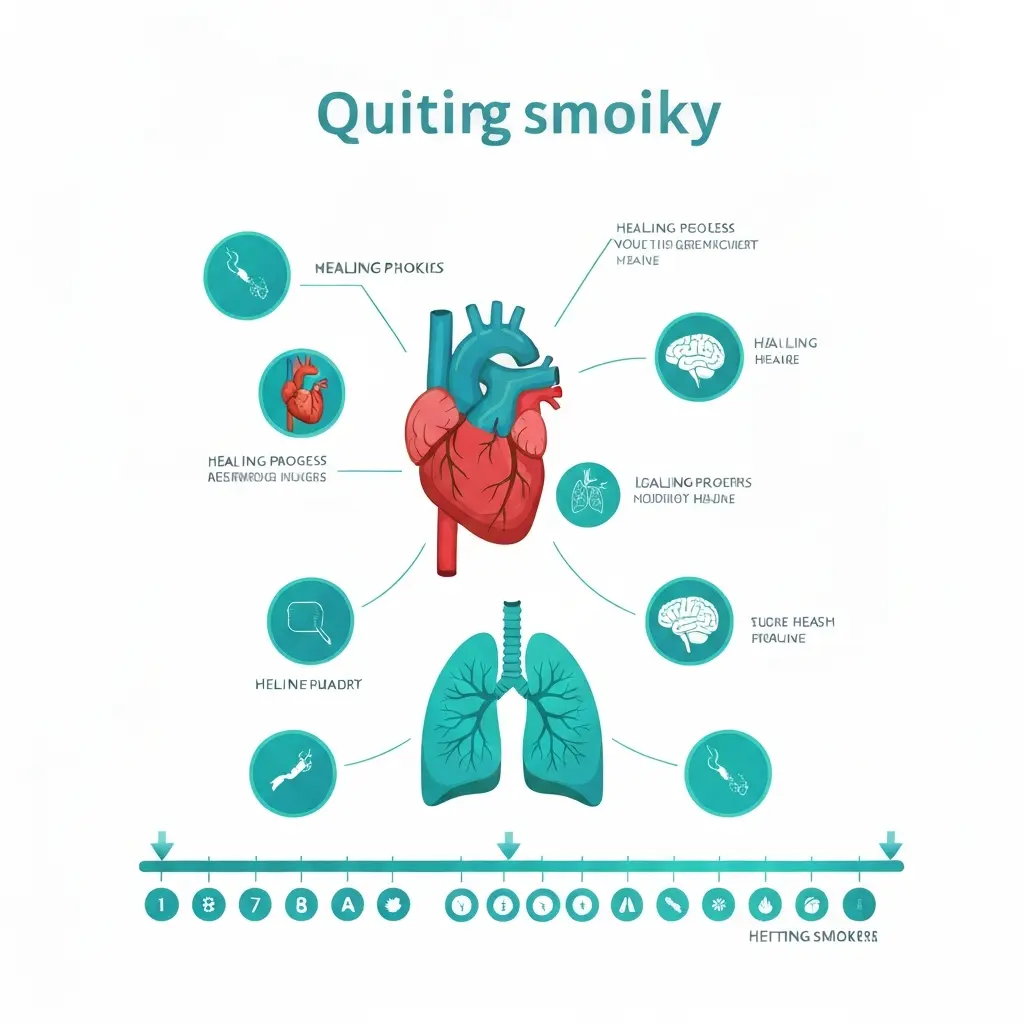
Master Recovery Timeline Table
| Time After Quitting | What Changes | Source |
|---|---|---|
| 20 minutes | Blood pressure and heart rate drop | NHS |
| 12 hours | Carbon monoxide normalises; oxygen improves | CDC |
| 48 hours | Taste and smell begin to sharpen | NHS / ACS |
| 2–12 weeks | Circulation improves; cilia begin reactivation | NHS |
| 3–6 months | Lung clearance improves; cough may peak then ease | NHS / ALA |
| 1 year | Heart disease risk halved vs current smoker | NHS / AHA |
| 5 years | Stroke risk falls to that of a non-smoker | NHS |
| 10 years | Lung cancer risk ~50% of current smoker | NHS / IARC |
| 15+ years | Heart disease risk near that of never-smoker | NHS / AHA |
Frequently Asked Questions
How quickly does health improve after quitting smoking?
Measurable health improvements begin within 20 minutes of quitting (blood pressure drops), and continue across weeks, months, and years. The most clinically significant milestones are: carbon monoxide normalisation at 12 hours, halved heart disease risk at 1 year, and halved lung cancer risk at 10 years. No matter how long someone has smoked, quitting produces health benefits.
Do lungs fully recover after quitting smoking?
Partial but meaningful lung recovery occurs in most ex-smokers. Cilia function and mucus clearance restore substantially within 3–6 months. Lung function (FEV1) shows measurable improvement in the first year. However, structural damage from severe COPD or emphysema does not fully reverse. The critical benefit of quitting for COPD patients is halting further progression — the rate of lung function decline drops to that of a never-smoker after cessation.
When does cancer risk return to normal after quitting?
Cancer risk reduction is time-dependent. Lung cancer risk falls to approximately half that of a current smoker within 10 years. For some cancers (cervical, oral cavity, oesophageal), risk approaches that of never-smokers at 15–20 years post-cessation. There is no single “normalisation” point; risk continues to decline throughout life after quitting, with the greatest benefits for those who quit at younger ages.
Is quitting at 60 worth it for health recovery?
Yes. The research is unambiguous: quitting at any age delivers meaningful health benefits. A Lancet analysis confirms that quitting before age 40 reduces tobacco-related mortality by ~90%, but quitting at 50 still reduces it by ~50%, and quitting at 60 delivers substantial reductions in heart disease risk within 12 months. The NHS and WHO both emphasise that it is never too late to benefit from cessation.
Why is there a “smoker’s cough” right after quitting?
Tobacco smoke paralyses cilia — the microscopic hair-like structures that clear mucus and debris from the airways. When you quit, cilia reactivate and begin clearing the accumulated mucus, which can temporarily increase coughing in weeks 2–8 after quitting. This is a sign of lung recovery, not deterioration. The cough typically peaks around weeks 3–4 and then subsides as clearance normalises.
Track Your Recovery Milestones in Real Time
The iQuit app maps your personal recovery timeline from the moment you set your quit date — showing the exact health milestones your body is hitting as you move from hours to days to months smoke-free. Turn data into daily motivation.