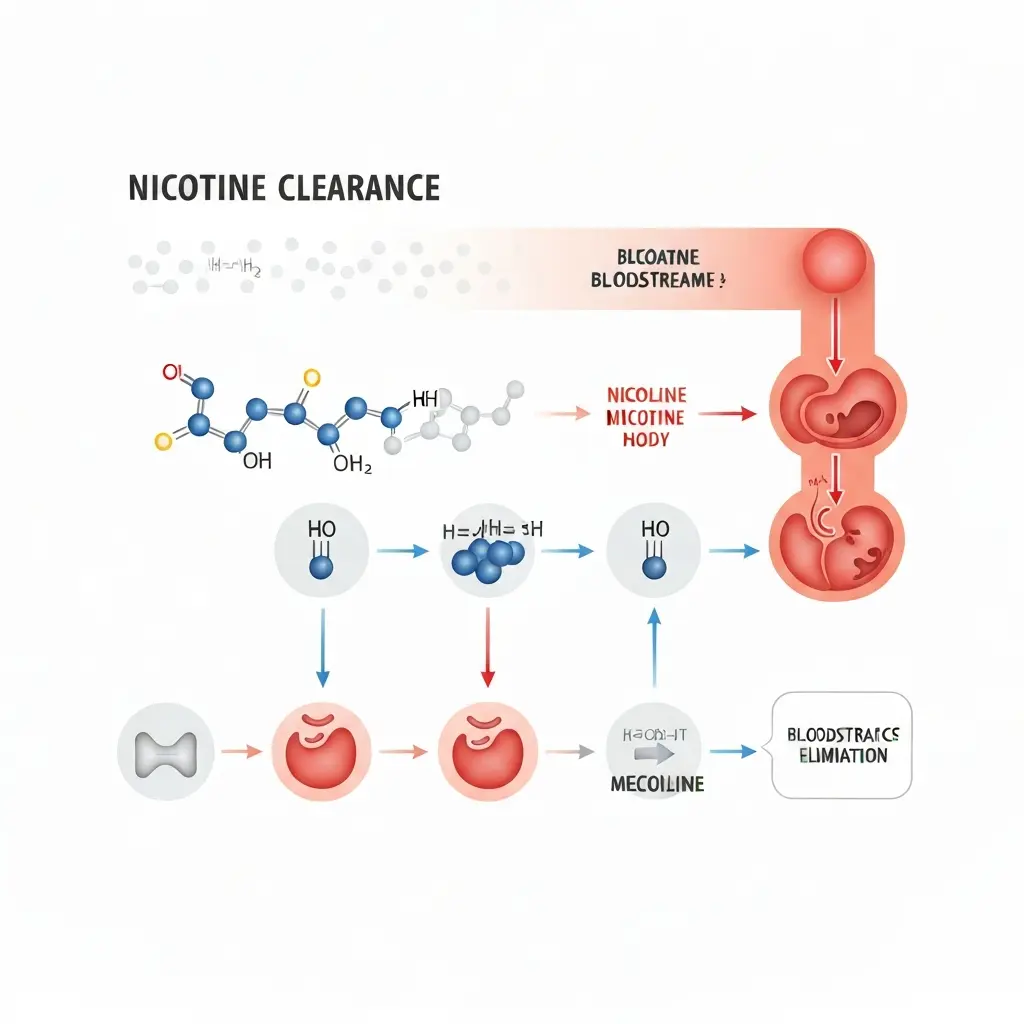
How Long Does It Take for Nicotine to Leave Your Body? The Complete Guide
How long does it take for nicotine to leave your body is a question with several answers, depending on what you are measuring. Nicotine in the blood clears remarkably quickly — within 1–3 days. But its primary metabolite, cotinine, remains detectable for up to 4 weeks. Hair follicles can retain evidence of nicotine exposure for 90 days or more. And the brain’s addiction-related changes — the receptor density changes, the reward system recalibration — take 3–4 weeks to resolve. This guide covers every form of nicotine clearance, why it matters, and what it means for how you feel during the quit process.
Nicotine’s Half-Life: The Basics
Nicotine has a half-life of approximately 1–2 hours in the blood. This means that every 1–2 hours, half of the remaining nicotine is metabolised and cleared. For a regular smoker, this rapid clearance is what drives the need to smoke every 30–60 minutes — as nicotine levels fall, the brain registers withdrawal distress and triggers the urge to smoke.
The liver is the primary site of nicotine metabolism. It converts approximately 70–80% of nicotine into cotinine — a stable metabolite that remains in the body for much longer than nicotine itself. Cotinine is the compound measured in most nicotine tests (urine, blood, and saliva tests) precisely because it is far more stable than nicotine.
The Cleveland Clinic confirms that while nicotine clears from blood within days, the neurological and psychological effects of nicotine dependence persist for weeks after the substance is physically gone.
Nicotine in Blood: Clearance Timeline
- 30 minutes after last cigarette: Blood nicotine has dropped by approximately 25%
- 2 hours: Blood nicotine is at approximately 50% of post-cigarette peak
- 6 hours: Blood nicotine is at approximately 12.5% of peak — most withdrawal symptoms beginning to appear
- 24 hours: Blood nicotine levels are negligible
- 72 hours (3 days): Nicotine is essentially undetectable in blood
This rapid blood clearance is why nicotine replacement therapy (NRT) works: NRT provides a steady, lower level of blood nicotine that prevents the sharp fall-and-craving cycle, allowing the withdrawal process to be managed more gradually.
Cotinine: The Key Metabolite
Cotinine has a much longer half-life than nicotine — approximately 16–20 hours. This means it accumulates in the body during regular smoking and takes significantly longer to clear after quitting. Cotinine is the standard marker used in:
- Insurance company nicotine tests (for life insurance premium calculations)
- Employment drug screening for tobacco use (where relevant)
- Clinical research to verify cessation compliance
- Secondhand smoke exposure studies
For a heavy daily smoker (20 cigarettes/day), cotinine levels peak at approximately 250–350 ng/mL in blood. After stopping:
- 24 hours: Cotinine has dropped by approximately 30–40%
- 3–4 days: Cotinine is at low levels in occasional light smokers
- 1–2 weeks: Cotinine is below typical test detection thresholds for moderate smokers
- 3–4 weeks: Cotinine is effectively undetectable even in heavy daily smokers
Nicotine and Cotinine in Urine
Urine tests for nicotine typically measure cotinine (not nicotine directly). Detection windows:
| Smoking Level | Cotinine Detection in Urine |
|---|---|
| Occasional/light smoker (1–5/day) | 3–7 days after last cigarette |
| Moderate smoker (5–15/day) | 1–2 weeks after last cigarette |
| Heavy smoker (15–30/day) | 2–4 weeks after last cigarette |
| Very heavy smoker (30+/day) | Up to 4 weeks after last cigarette |
Important note: If you are using NRT, cotinine will still be detectable in urine tests — because NRT contains nicotine, which the body metabolises to cotinine. If you need to clear cotinine for a nicotine test, you need to stop both smoking AND NRT.
Nicotine in Hair
Hair follicle tests are the most sensitive and long-term nicotine detection method. Hair grows approximately 1 cm per month, and each centimetre of hair contains a chemical record of substances in the bloodstream during that growth period. For nicotine/cotinine:
- Standard hair tests examine 3 cm of hair — representing approximately 90 days of exposure
- Nicotine exposure can be detected in hair for up to 90 days after the last cigarette
- Even secondhand smoke exposure can sometimes be detected in hair follicle tests of heavy passive smokers
Hair follicle nicotine testing is used primarily in research settings and by some insurance companies. It is not a standard clinical cessation verification method.
When the Brain Clears Nicotine: The Most Important Timeline
For people trying to quit smoking, the most relevant nicotine clearance question is not “when will I pass a test?” but “when will my brain stop craving nicotine?” These are different timelines.
The brain’s nicotinic acetylcholine receptors — upregulated by years of nicotine exposure — begin to downregulate (return to pre-addiction density) within days of stopping. However, full receptor normalisation takes approximately 3–4 weeks. This is why:
- Withdrawal symptoms peak at days 2–3 (when blood nicotine hits zero and receptor systems are maximally dysregulated)
- Physical withdrawal symptoms largely resolve within 3–4 weeks (when receptor density has substantially normalised)
- Conditioned psychological cravings persist longer — for months — because they are maintained by learned associations, not receptor chemistry
Research from Medical News Today and the NIH nicotine withdrawal review both confirm this 3–4 week physical recovery timeline. The critical takeaway: the hardest phase is not the month after quitting — it is the first 3 days.
Factors That Affect Nicotine Clearance Speed
Individual differences in nicotine clearance are substantial, driven primarily by genetic variation in the CYP2A6 enzyme (the liver enzyme responsible for metabolising nicotine to cotinine):
- Fast metabolisers: Clear nicotine and cotinine approximately 30–40% faster than average. More likely to need higher-dose NRT; may need more frequent dosing.
- Slow metabolisers: Retain nicotine and cotinine for longer. Experience longer but potentially milder withdrawal symptoms. May respond better to lower-dose NRT.
- Pregnancy: Nicotine metabolism speeds up during pregnancy — pregnant smokers typically need higher NRT doses.
- Menthol cigarettes: Menthol inhibits CYP2A6, slowing nicotine metabolism — leading to higher nicotine blood levels from the same number of cigarettes.
Frequently Asked Questions
How long does nicotine stay in your blood?
Nicotine itself clears from blood within 1–3 days of the last cigarette. However, its primary metabolite cotinine — which is what most nicotine tests actually detect — remains in the blood for 1–4 weeks depending on how heavily you smoked. For a 20-a-day smoker, cotinine is typically undetectable in blood within 2–3 weeks of quitting.
Will I fail a nicotine test if I use NRT?
Yes. NRT contains nicotine, which the body metabolises to cotinine — the same compound measured in nicotine tests. If you are using NRT patches, gum, or lozenges, cotinine will be detectable in urine and blood tests. If you need to pass a nicotine test, you must stop both smoking and NRT use for the relevant clearance period.
Why do I still crave cigarettes after nicotine has left my body?
Cravings persist after nicotine has cleared because addiction has two components: physical (nicotine-dependent receptor chemistry) and psychological (conditioned associations between smoking and situations, emotions, and habits). The physical component resolves within 3–4 weeks as brain receptors normalise. The psychological component — triggered by situational cues like coffee, stress, or places associated with smoking — can persist for months, decreasing with each non-smoking experience of the trigger.
Does drinking water help clear nicotine faster?
Staying well-hydrated supports kidney function and can modestly assist the clearance of nicotine metabolites through urine. However, the primary nicotine clearance mechanism is liver metabolism (via the CYP2A6 enzyme), not renal excretion. Drinking extra water will not significantly accelerate nicotine clearance, but it is beneficial for general health and has modest benefits for craving management during withdrawal.
How long does nicotine stay in hair?
Nicotine and cotinine can be detected in hair follicles for up to 90 days after the last cigarette. Hair tests examine the most recently grown 3 cm of hair, representing approximately 3 months of exposure. Hair follicle testing is more sensitive and has a longer detection window than urine or blood tests, which is why it is used in research and some insurance contexts.
Track Your Body’s Nicotine Clearance with iQuit
iQuit shows you in real time when your blood pressure normalises, when carbon monoxide clears, and when your circulation improves — all the markers of your body clearing the effects of smoking. Track your recovery, day by day, with the iQuit app.