How Long Does It Take for Nicotine to Leave Your Body? (2026 Medical Guide)
If you have recently smoked your last cigarette — or you are preparing for a nicotine test — you are probably wondering exactly how long nicotine stays in your body. The honest answer depends on which body fluid is being tested, how much you smoked, and your individual metabolism. Understanding how long it takes for nicotine to leave your body gives you realistic expectations during the withdrawal period and removes the guesswork from drug testing timelines.
This guide draws on data from Mayo Clinic, the American Academy of Family Physicians (AAFP), and peer-reviewed PubMed literature to give you accurate, up-to-date figures for 2026.
Nicotine Half-Life: The 2-Hour Rule
Pharmacokinetically, nicotine has a half-life of approximately 1.5 to 2.5 hours in most adults, with a mean commonly cited at 2 hours (Mayo Clinic Proceedings; PubMed PMID 9311015). A half-life describes the time needed for the concentration of a substance in the body to fall to half its original level.
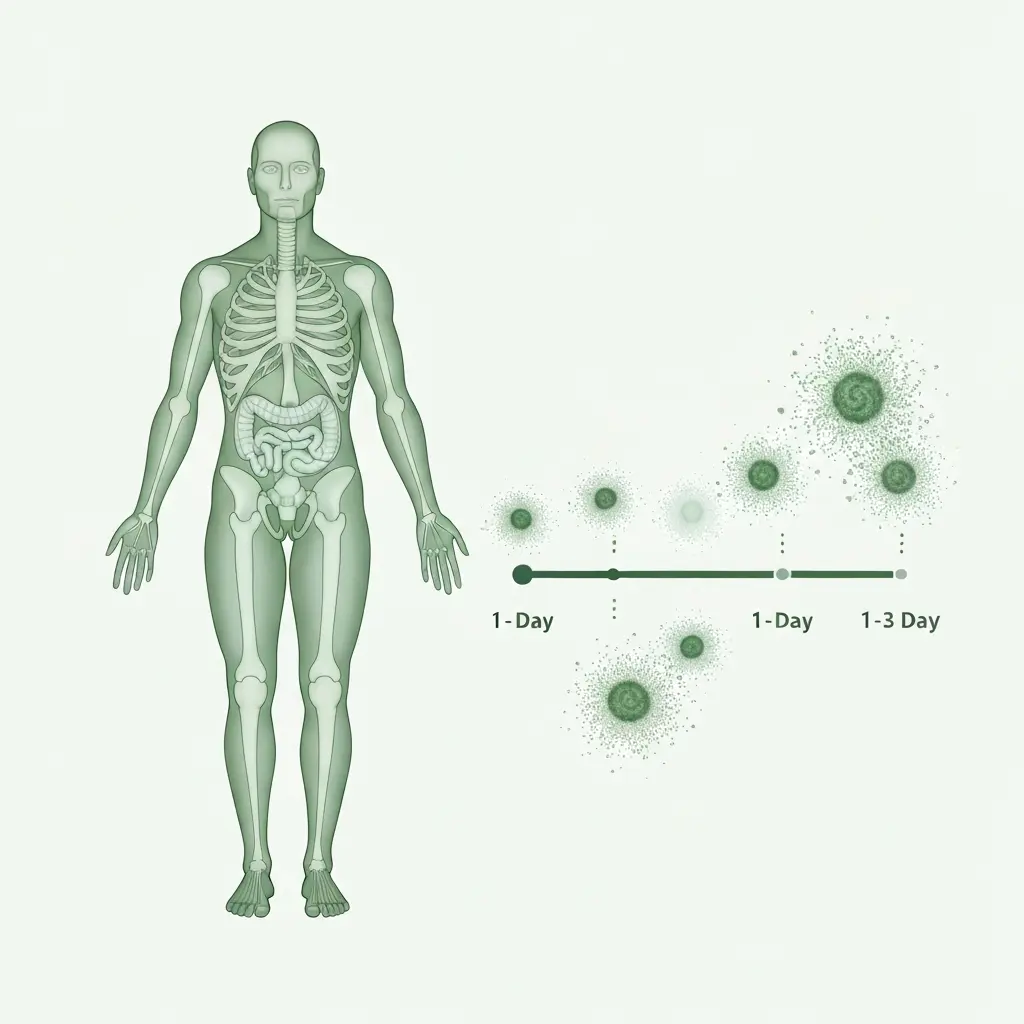
This means that 2 hours after your last cigarette, you still have roughly 50% of the absorbed nicotine circulating. After 4 hours, about 25%. After 10 hours, under 2%. By the end of 24 hours the concentration is negligible. Nicotine itself is largely undetectable in blood within 1–3 days of cessation in most people.
| Time After Last Cigarette | Approximate Nicotine Remaining |
|---|---|
| 2 hours | ~50% |
| 4 hours | ~25% |
| 8 hours | ~6% |
| 24 hours | ~0.1% |
| 3 days | Effectively zero |
Why then do nicotine tests catch smokers days and even weeks later? The answer lies in cotinine.
Cotinine Half-Life: Why It Matters More
When your liver metabolises nicotine, the primary byproduct is cotinine — a stable metabolite that lingers far longer in the body. Cotinine has a half-life of approximately 15 to 20 hours, with 16 hours being the most widely cited figure in the medical literature (AAFP; Journal of Analytical Toxicology).
Because cotinine is present at concentrations up to 10 times higher than nicotine and clears much more slowly, it is the compound that most laboratory tests screen for. Cotinine is also a more reliable biomarker of recent tobacco exposure because its level correlates directly with the quantity smoked.
Detection Windows by Body Fluid
The practical answer to how long nicotine stays in your body depends entirely on which fluid is tested. Here is a comprehensive breakdown.
Blood
Nicotine is detectable in blood for 1–3 days. Cotinine remains detectable in blood for up to 10 days in regular smokers. Blood tests are the most accurate but least commonly used outside clinical or legal settings.
Urine
Urine is the most common testing medium. Cotinine in urine is detectable for:
- 3–4 days in occasional or light smokers (<10 cigarettes/day)
- Up to 3 weeks (15–20 days) in heavy, long-term smokers (20+ cigarettes/day)
The standard urine cotinine cut-off in workplace or insurance testing is 200 ng/mL, though some sensitive tests use 50 ng/mL.
Saliva
Saliva tests detect cotinine for 1–4 days in light users and up to 7 days in heavy smokers. Oral fluid tests are increasingly used by insurance companies because they are non-invasive and difficult to adulterate.
Hair
Hair follicle tests provide the longest detection window. Nicotine and cotinine can be detected in hair for up to 90 days (3 months) after the last cigarette, as the chemicals become incorporated into the hair shaft as it grows (approximately 1 cm per month). Hair tests are rarely used for routine testing but may appear in life insurance underwriting.
| Fluid | Light Smoker | Heavy Smoker |
|---|---|---|
| Blood | 3–5 days | Up to 10 days |
| Urine | 3–4 days | Up to 20 days |
| Saliva | 1–4 days | Up to 7 days |
| Hair | Up to 90 days | Up to 90 days |
Factors That Affect Clearance Speed
Nicotine and cotinine clearance is not uniform. Several biological and lifestyle variables shift these timelines significantly.
Genetics and CYP2A6 Enzyme Activity
The liver enzyme CYP2A6 is responsible for converting nicotine to cotinine and cotinine to 3-hydroxycotinine. People with highly active CYP2A6 variants (fast metabolisers) clear nicotine and cotinine roughly 30–50% faster than slow metabolisers. Approximately 3–5% of Europeans and North Americans are slow metabolisers; this proportion is higher in East Asian populations (PubMed PMID 22182507).
Age
Liver and kidney function decline gradually with age. Older adults (65+) typically clear cotinine more slowly than younger adults, meaning detection windows may extend by 1–3 days.
Kidney Function
Cotinine is primarily excreted via the kidneys. Impaired kidney function (e.g., chronic kidney disease) significantly prolongs detection times. Conversely, people with highly efficient kidneys and high urine output may clear cotinine faster.
Hydration
Higher fluid intake increases urine output and modestly speeds cotinine excretion. However, the effect is limited — you cannot meaningfully “flush out” cotinine by drinking large quantities of water, and diluting urine below the creatinine validity threshold will flag a urine test as adulterated.
Quantity and Frequency of Use
Heavy smokers accumulate higher cotinine loads. Someone smoking 30 cigarettes a day will take longer to clear cotinine than someone who smoked five. Similarly, daily smokers clear more slowly than occasional social smokers, because chronic use leads to cotinine accumulation in tissues.
Body Composition
Nicotine is lipophilic (fat-soluble) and distributes into adipose tissue. People with higher body fat percentages may have slightly longer clearance times as nicotine and cotinine are released gradually from fat stores.
Menthol Cigarettes
Research published in Cancer Epidemiology, Biomarkers & Prevention found that menthol cigarette smokers tend to have higher cotinine levels per cigarette smoked, likely because menthol inhibits CYP2A6 activity — slowing nicotine metabolism and extending detection windows.
Drug Test Detection Thresholds
Most nicotine tests screen for cotinine, not nicotine itself. Standard cut-off values vary by context:
- Workplace/insurance urine test: 200 ng/mL (some use 50 ng/mL for high-sensitivity screening)
- Clinical cessation research: Often 10–15 ng/mL, distinguishing complete abstinence from NRT use
- Passive smoke exposure threshold: Typically below 10 ng/mL in non-smokers
Note: if you are using nicotine replacement therapy (NRT) such as patches, gum, or lozenges, your cotinine will still test positive — because cotinine is a metabolite of all nicotine sources, not just cigarettes. Inform the testing party if you are using NRT.
When Do Cravings Subside?
Nicotine clearance from the blood is relatively fast. But the experience of quitting is governed by your brain’s dopamine system recalibrating after years of nicotine stimulation. Understanding the relationship between nicotine’s physical clearance and withdrawal timing helps set realistic expectations.
According to the nicotine withdrawal timeline, physical cravings typically peak during days 1–3 (coinciding with cotinine dropping below the brain’s threshold for triggering craving signals) and become much more manageable by week 2. The full spectrum of withdrawal symptoms — irritability, difficulty concentrating, increased appetite — follows a similar arc but can persist for 4–8 weeks in heavy, long-term smokers.
Psychological cravings, triggered by situational cues (stress, social settings, certain times of day), can surface months after physical nicotine is long gone. These are behavioural rather than pharmacological and respond well to strategies covered in resources like the body recovery FAQ.
Can You Speed Up Nicotine Clearance?
There is no clinically validated method to dramatically accelerate cotinine clearance beyond your body’s natural metabolic rate. That said, several evidence-consistent steps provide modest benefits:
- Hydration: Drink 2–3 litres of water daily to support kidney excretion. Do not overdo it — extreme over-hydration will not increase clearance and can invalidate a test.
- Exercise: Aerobic exercise increases metabolic rate and renal blood flow. A 2014 study in Psychopharmacology found that exercise also reduces nicotine cravings acutely. Aim for 30–45 minutes of moderate cardio daily.
- Avoid further nicotine: This is obvious but critical — any NRT, vaping, or “just one” cigarette resets the clock entirely, as cotinine accumulates from all nicotine sources.
- Antioxidant-rich diet: While not proven to speed cotinine metabolism, a diet rich in vitamin C (citrus, bell peppers) supports liver health generally.
Commercially marketed “nicotine detox” products have no peer-reviewed evidence supporting their efficacy. Save your money.
If you want a structured, science-backed way to manage the quitting process while your body clears nicotine, the iQuitNow app tracks your personal clearance milestones, manages cravings in real time, and provides daily motivation through the hardest first weeks. Based on evidence from the most effective quit-smoking methods, digital coaching tools can increase quit rates by up to 30% compared to willpower alone.
Frequently Asked Questions
How long does nicotine stay in your blood?
Nicotine itself is cleared from the bloodstream within 1–3 days of your last cigarette. Its primary metabolite cotinine remains detectable in blood for up to 10 days in regular smokers. Blood tests are the most accurate measurement of recent tobacco use.
How long does nicotine show up in a urine test?
Urine tests detect cotinine for 3–4 days in occasional smokers and up to 3 weeks in heavy or long-term smokers. The standard detection threshold is 200 ng/mL for cotinine. This is the most commonly used test for insurance and workplace nicotine screening.
What is the half-life of nicotine?
The half-life of nicotine is approximately 2 hours, meaning your body eliminates half of any given nicotine dose every two hours. Cotinine, its main metabolite, has a half-life of approximately 16 hours — which is why it remains detectable long after nicotine itself is gone.
Can nicotine show up in a hair follicle test?
Yes. Hair follicle tests can detect nicotine and cotinine for up to 90 days (approximately 3 months), making them the longest-window detection method. Hair grows at about 1 cm per month, so a 3 cm sample represents approximately the last 3 months of exposure.
How long does nicotine stay in saliva?
Cotinine is detectable in saliva for 1–4 days after the last nicotine use in occasional users, and up to 7 days in heavy smokers. Saliva tests are increasingly favoured by insurance companies because they are non-invasive and hard to adulterate.
What factors make nicotine leave your body faster?
Good hydration, regular aerobic exercise, healthy kidney function, younger age, and high CYP2A6 enzyme activity all accelerate nicotine and cotinine clearance. Genetic fast metabolisers can clear cotinine up to 50% faster than slow metabolisers.
Does drinking water flush nicotine out faster?
Staying well-hydrated supports kidney function and modestly increases cotinine excretion via urine. However, it cannot override your metabolic rate. Drinking excessive water will not meaningfully speed up clearance and may dilute urine enough to invalidate a test.
How long until nicotine cravings go away after quitting?
Physical cravings peak during days 1–3 and become significantly less intense within 2–4 weeks as the brain’s dopamine system readjusts. Psychological cravings triggered by situational cues can persist for several months but diminish steadily. Most ex-smokers report cravings as manageable or absent by months 3–6.
Will NRT (nicotine patch, gum) cause a positive nicotine test?
Yes. Any nicotine-containing product — patches, gum, lozenges, inhalers, or e-cigarettes — will produce cotinine and cause a positive result on a nicotine test. Tests cannot distinguish between tobacco-derived and NRT-derived cotinine. Always inform the testing party if you are using NRT.