How to Create a Quit Smoking Plan That Actually Works in 2026
Most quit attempts fail not because quitting is impossible, but because they are unplanned. Research shows that smokers who have a structured written plan are significantly more likely to stay quit at 6 months than those who quit impulsively. Learning how to create a quit smoking plan that works takes less than one hour, and that hour may be the most important investment you make in your health in 2026.
This guide provides a proven, practical quit-smoking plan template — built on NHS, CDC, and WHO evidence — that you can adapt to your own smoking history, triggers, and lifestyle.
Why Having a Plan Doubles Your Success Rate
Implementation intentions — specific “if-then” plans for how you will respond to anticipated challenges — are one of the most rigorously studied and consistently effective behaviour change techniques. A meta-analysis of 94 studies found that implementation intentions doubled the rate of goal achievement compared to simple goal setting.
For smoking cessation specifically, a planned quit attempt addresses the two most common failure points: not having a cessation aid ready when needed, and not knowing how to respond to a craving in the moment. Planning converts abstract intention (“I should quit smoking”) into specific executable actions (“When I feel a craving after my morning coffee, I will use my nicotine spray and go for a 5-minute walk”).
The structure of a good quit plan mirrors the approach used in any successful complex project. Just as writing a thesis requires a structured plan to manage a complex, long-term challenge, quitting smoking requires mapping milestones, resources, and contingency responses.
Step 1: Set Your Quit Date
Choose a specific date 1–2 weeks from today. This window is important:
- Too immediate (today or tomorrow): Insufficient time to prepare cessation aids, tell your support network, or mentally commit. Impulsive quit attempts have lower success rates.
- Too distant (more than 3 weeks away): Motivation may wane; the quit date feels abstract; too much time to find reasons to delay.
Choose a date with low scheduled stress. Avoid major deadlines, travel, or social events in your first week if possible. A Monday works well for many people — it creates a clean weekly break and aligns with the “fresh start” psychology of new beginnings.
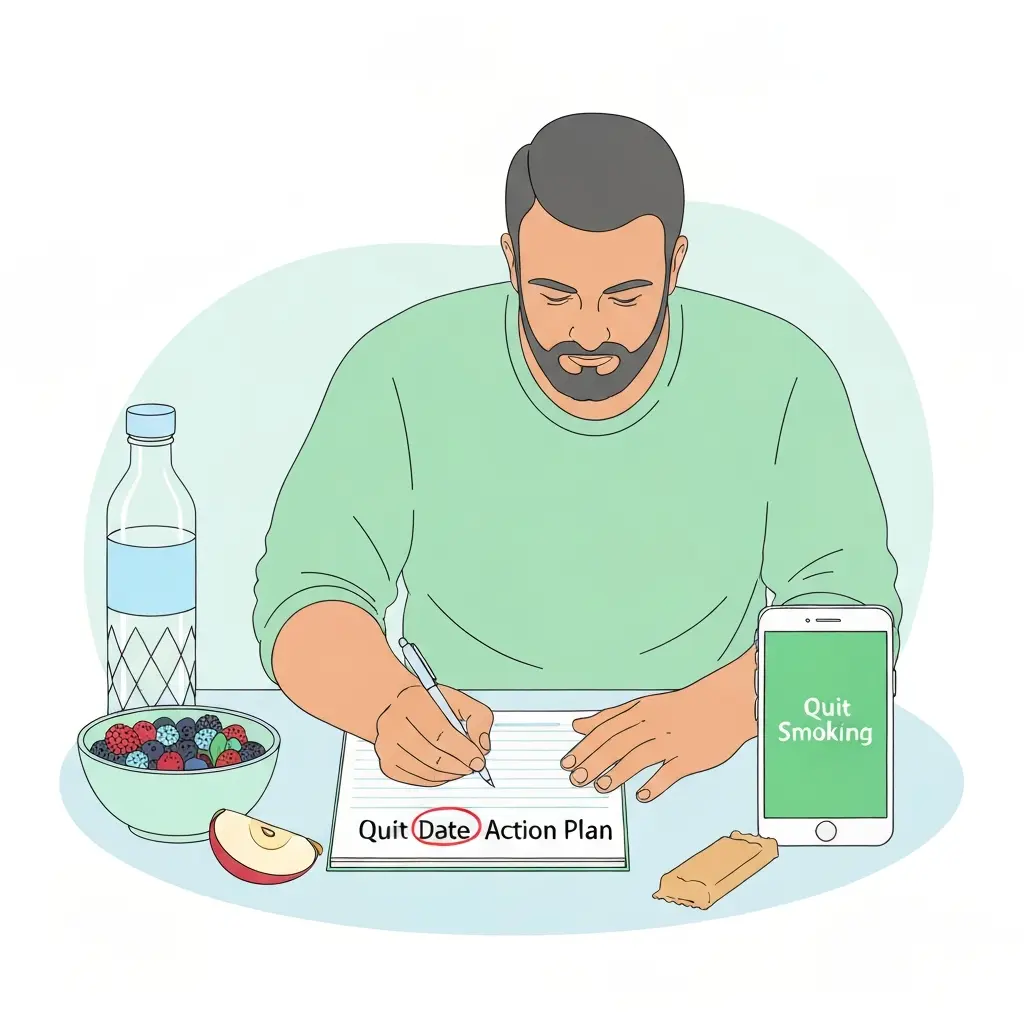
Write your quit date here (literally): __________________
Once you have set it, tell at least three people immediately. This social commitment dramatically strengthens follow-through.
Step 2: Choose Your Cessation Method
The evidence is clear: using a cessation aid significantly outperforms going cold turkey alone. Choose at least one:
| Method | Best For | Where to Get |
|---|---|---|
| Nicotine patch | Background craving control; regular smokers | Pharmacy, over-the-counter |
| Nicotine gum or lozenge | Acute craving management | Pharmacy, over-the-counter |
| Quit-smoking app with AI coach | Behaviour change support; anyone | App Store / Google Play |
| Varenicline (Champix/Chantix) | Heavy smokers; previous failed attempts | Prescription from GP |
| Combination NRT (patch + fast-acting) | Heavy smokers; best NRT results | Pharmacy |
The best approach for most people: combine an app (for behavioural support) with NRT (for physical craving control). This two-pronged approach addresses both the psychological and physiological dimensions of addiction.
Step 3: Map Your Smoking Triggers
Your triggers are the specific situations, emotions, and contexts that create the urge to smoke. List yours honestly:
- Situation triggers: After coffee? During work breaks? After meals? In the car?
- Emotional triggers: Stress? Boredom? Social anxiety? Celebration?
- Social triggers: Around specific friends who smoke? At certain venues?
- Time triggers: First thing in the morning? After 5pm?
For each trigger, write a specific alternative behaviour. “When I feel stressed at work, instead of stepping out for a cigarette, I will take 3 deep breaths, drink a glass of water, and use my quit app’s craving tool.”
This if-then structure converts intention into automatic response — exactly how automation replaces manual decision-making in business, your planned responses replace impulsive smoking with a healthier behaviour.
Step 4: Build Your Support Network
Social support is one of the strongest independent predictors of quit success. Your support network should include:
- An accountability partner: Someone you check in with daily in the first 2 weeks — a friend, family member, or partner who knows your quit date and will ask about your progress.
- Your GP or pharmacist: Professional support doubles quit rates. Book an appointment before your quit date to discuss cessation aids and get a follow-up appointment for week 2.
- An online community: Forums like r/stopsmoking or app-based communities provide around-the-clock peer support from people who understand exactly what you are going through.
- The people in your home: If other household members smoke, discuss your quit plan with them. Ask them not to smoke in front of you, or — ideally — to quit together.
Step 5: Prepare Your Environment
Environmental preparation on the day before your quit date:
- Remove all cigarettes, lighters, and ashtrays from your home, car, and workplace.
- Wash clothes and clean your home to remove the smell of smoke.
- Stock up on healthy snacks (crunchy foods satisfy the oral fixation), gum, or lozenges.
- Set up your quit app and enter your smoking data.
- Put your NRT where you will see it first thing in the morning.
- Plan your morning routine specifically — the first cigarette of the day is often the hardest to replace.
Step 6: Create Your First-Week Action Plan
The first 7 days are the most intense. A day-by-day plan:
| Day | Focus | Action |
|---|---|---|
| Day 1 (Quit Day) | Commitment | Start NRT; log your first craving; tell people; change morning routine |
| Day 2 | Expect difficulty | Plan for the 24-hour mark — the first big craving wave; have your response ready |
| Day 3 (Peak) | Survival | This is typically the hardest day; use NRT proactively; stay busy; ask for support |
| Days 4–5 | Recovery | Physical symptoms easing; celebrate 72 hours; continue daily app engagement |
| Days 6–7 | Building confidence | Celebrate one week; reward yourself; review your trigger log; plan week 2 |
Frequently Asked Questions
How long should a quit smoking plan be?
A quit smoking plan needs to cover at minimum the first 4 weeks in detail — the acute physical withdrawal period. It should also include a 3-month strategy for managing psychological cravings, and a relapse prevention plan for high-risk situations. The plan itself can be as brief as a single page, but must include your quit date, cessation method, trigger list, and alternative responses.
What is the most important part of a quit smoking plan?
The trigger-response mapping is arguably the most important element. Knowing your personal smoking triggers in advance and having a specific planned alternative behaviour for each trigger converts a vague intention to quit into an executable action plan. This is the difference between “I’ll try not to smoke when stressed” and “When I feel stressed at 3pm, I will go for a 10-minute walk and call my accountability partner.”
Should I tell everyone I’m quitting smoking?
Yes — telling your social circle creates accountability and activates support. Research shows that social accountability is one of the strongest independent predictors of quit success. Tell your close friends, family, and at least one person at work. The social commitment effect is most powerful when people will regularly ask about your progress.
Can I quit smoking without a plan?
Yes, but the chances of success are substantially lower. Approximately 95% of unassisted, unplanned quit attempts fail within the first year. A planned attempt with cessation aids improves this to 15–30% success at 12 months — still challenging, but 3–6 times higher than going in without preparation. Planning takes one hour; quitting takes a lifetime.
What if I don’t stick to my quit smoking plan?
Slipping from your plan does not mean failing. Most successful quitters deviated from their plan at some point. Review what went wrong — which trigger caught you off guard? Which part of the plan didn’t work in practice? Update your plan with this information and re-commit to your quit date immediately. Each iteration improves the plan.
Sources: NHS Quit Smoking — Making a plan; CDC Smoking Cessation — Tips From Former Smokers; Psychological Bulletin — Implementation intentions meta-analysis; WHO Tobacco cessation step-by-step guidance 2024.