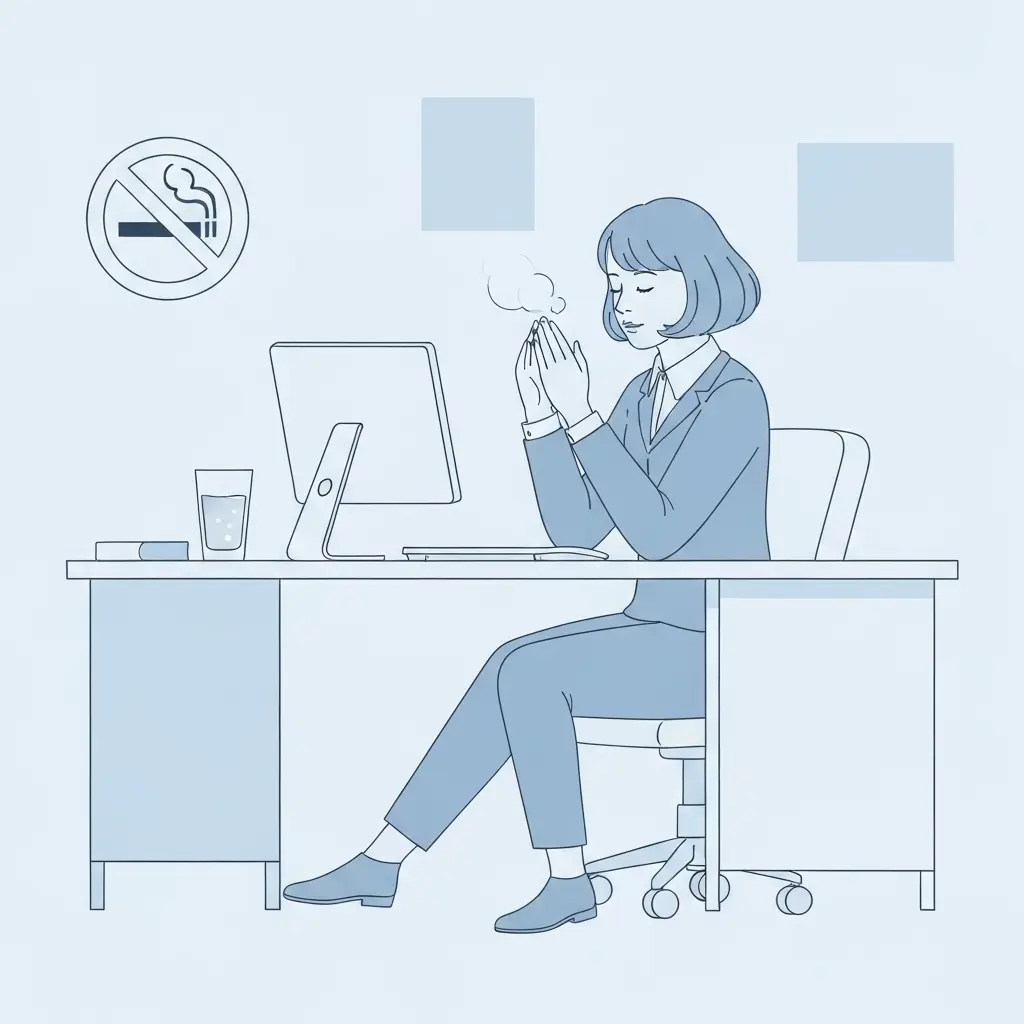
How to Handle Smoking Urges at Work: Practical Strategies for 2026
For most smokers, the workplace is a minefield of craving triggers. The stress of deadlines, the ritual of a “smoke break,” coffee in hand with colleagues — these ingrained associations make knowing how to handle smoking urges at work one of the most critical skills for anyone trying to quit. Studies show that work-related stress is responsible for a significant proportion of workplace cigarette consumption and relapse events.
The good news is that most workplace cravings last only 3–5 minutes. With the right strategies ready in advance, you can ride out every urge without ever stepping outside for a cigarette again.
Why Work Triggers Smoking Cravings
The brain builds powerful associations between smoking and the contexts in which it occurs. If you have smoked at your desk during stressful moments, in the car park at 10am, or on a bench outside after lunch for years, your brain has wired “work context” to “expect nicotine reward.” These cue-conditioned associations are neurologically real — brain imaging shows that work-related cues activate the same dopamine circuits as cigarette images themselves.
Three types of work cravings are particularly common:
- Habit cravings: The automatic urge at specific times (10am break, lunch, 3pm) because you always smoked then.
- Stress cravings: Triggered by difficult situations — a tense meeting, a deadline, a conflict.
- Social cravings: Triggered by seeing colleagues go to smoke together, or being invited to join.
Immediate Craving-Relief Strategies for the Workplace
These strategies can be used discreetly at your desk or in a meeting:
- The 5-minute rule: Tell yourself you will wait 5 minutes before acting on the craving. The physiological peak of a craving typically lasts 3–5 minutes. Most cravings fade without any intervention if you simply delay acting on them. Each successful delay weakens the cue-conditioned pathway.
- Box breathing: Breathe in for 4 counts, hold for 4, breathe out for 4, hold for 4. This activates the parasympathetic nervous system, directly reducing the stress component of a craving. Can be done completely invisibly at your desk.
- Nicotine replacement: Keep nicotine gum, lozenges, or a nasal spray in your desk drawer. These are discreet and provide rapid nicotine delivery to address physical cravings on demand.
- Water: Drink a large glass of cold water when a craving hits. The physical sensation addresses the oral component of the urge and the act of reaching for something replaces the cigarette-reaching habit.
- A quick physical task: Stand up, walk to a colleague’s desk, make a cup of tea, or reorganise something on your desk. Physical movement breaks the rumination cycle that amplifies cravings.
How to Replace Your Smoke Break Ritual
The smoke break ritual is about more than nicotine — it is about a change of scene, social connection, and a legitimate reason to step away from the screen. You can preserve all of these benefits without the cigarette:
- Take your break anyway: At your usual smoke-break time, step away from your desk — but go for a 5-minute walk instead of standing with a cigarette. The break itself was providing rest value; keep that.
- Make yourself a hot drink: The ritual of making and drinking coffee or tea provides many of the same sensory elements as smoking — something to hold, a reason to pause, a warm sensation.
- Step outside anyway: Fresh air, a change of scene, and brief physical movement are genuinely beneficial for concentration and stress. You do not need a cigarette to justify going outside.
- Use your quit app during breaks: Your quit-smoking app can be a positive substitute for the phone time that often accompanies smoke breaks. Check your progress stats, read a motivational message, or log your success.
Managing Stress-Triggered Cravings at Work
Work stress is the most powerful workplace craving trigger. The key insight is that smoking does not actually reduce stress — it temporarily relieves the nicotine withdrawal that stress worsens. Studies consistently show that former smokers have lower baseline anxiety than current smokers once withdrawal resolves.
For stress-triggered cravings specifically:
- Name the emotion: “I’m feeling overwhelmed by this deadline” is more actionable than “I need a cigarette.” Identifying the actual emotion directs you toward real solutions.
- Use progressive muscle relaxation: Clench and release your fists, then shoulders, then jaw. This 2-minute technique significantly reduces physiological stress arousal.
- Triage your task list: Often stress cravings are triggered by feeling overwhelmed. Taking 5 minutes to write down your next three actions can restore a sense of control and defuse the stress trigger.
- Reach out: Tell your accountability partner by text that you are having a difficult moment. Even a brief exchange of support can diffuse the most powerful craving.
Telling Your Colleagues You’ve Quit
One of the most effective workplace strategies is simply telling your colleagues that you have quit. Social accountability works at work just as well as at home. Colleagues are unlikely to offer you a cigarette once they know you have quit. Telling them also creates a source of daily encouragement — small social reinforcement from coworkers is surprisingly powerful.
For colleagues who still smoke: you do not need to avoid them, but it is reasonable to opt out of smoke breaks during the first 2–4 weeks while your cravings are at their most intense. After the acute withdrawal phase, being around smoking colleagues becomes more manageable.
Frequently Asked Questions
How do I stop smoking at work without losing productivity?
Use nicotine replacement (gum, lozenge, spray) at your desk for immediate craving relief without leaving. Replace smoke breaks with short walks, which actually improve focus and concentration more than cigarette breaks. After the first 2–4 weeks, workplace cravings diminish significantly. Many former smokers report higher workplace productivity within a month of quitting.
What do I do when colleagues invite me to a smoke break?
Politely decline and suggest an alternative if you want the social connection: “I’ve quit, but I’ll come for a walk with you.” Having a simple, confident refusal phrase ready removes the awkward hesitation that can lead to accepting. Most colleagues will respect your quit attempt and stop offering within a few days.
Are nicotine patches or gum better for managing work cravings?
For work situations, fast-acting NRT (gum, lozenge, nasal spray, or mouth spray) is better for acute cravings because it delivers nicotine quickly on demand. Patches provide background nicotine coverage that reduces overall craving intensity throughout the day. The most effective approach is combining both: a patch for baseline coverage plus gum or spray for acute workplace cravings.
How long until I stop having cravings at work?
Work-specific cravings (tied to your workplace environment and schedule) typically diminish significantly within 2–4 weeks. However, strong work-related cravings triggered by stress or habit can recur at the 3-month mark. By months 4–6, most former smokers find workplace cravings are rare and brief. Changing some routine elements (a different desk position, altered break schedule) can accelerate extinction of cue-conditioned workplace urges.
Sources: Journal of Occupational Health — Workplace smoking cessation support; NHS — Managing cravings and triggers; CDC workplace cessation guidance; Nicotine and Tobacco Research — Cue-conditioned cravings in occupational settings.