How to Quit Smoking: A Science-Backed 8-Week Plan That Actually Works in 2026
Most people who quit smoking successfully have one thing in common: they had a plan before their quit date. Research consistently shows that planned quit attempts with structured support significantly outperform impulsive “I’ll stop today” decisions — not because planning is magic, but because it allows you to prepare the pharmacological, psychological, and environmental elements that the evidence identifies as critical. If you are searching for how to quit smoking step by step, this is the plan that the clinical data actually supports.
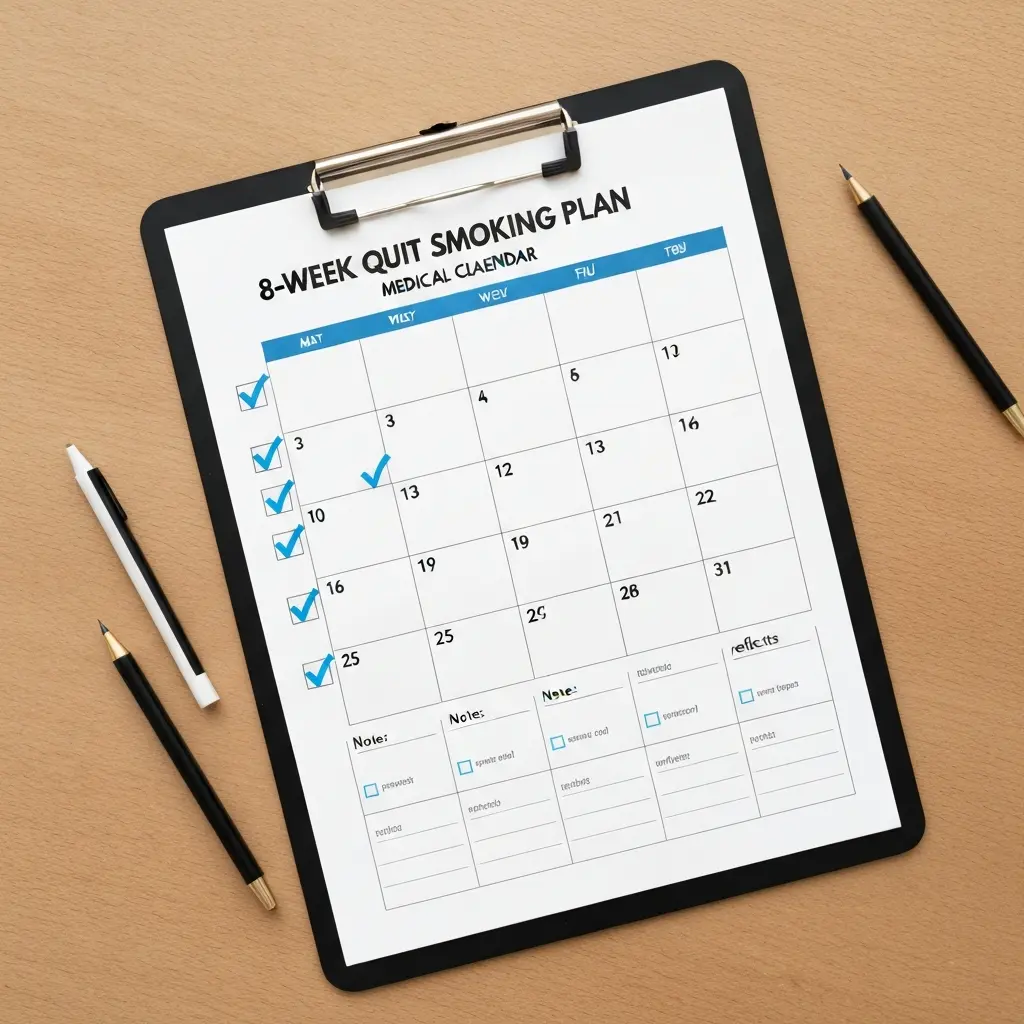
This 8-week programme is built on NHS guidelines, WHO cessation recommendations, and the evidence reviewed across the Cochrane Collaboration’s 136-trial NRT analysis and the 2025 Nature meta-analysis of digital cessation interventions. It gives you a week-by-week roadmap, honest expectations about difficulty, and practical craving strategies that are grounded in clinical reality.
Before You Start: What This Plan Requires
This plan works best when you bring three things to it:
- A firm quit date — not “soon,” but a specific day on the calendar, ideally within the next 2 weeks
- Chosen cessation support — NRT (patch, gum, or both), prescription medication if your GP recommends it, or at minimum an evidence-based app
- Basic trigger awareness — the 3 most common situations that make you reach for a cigarette
You do not need to feel ready. Research shows that “feeling ready” is not a prerequisite for successful quitting. What matters is having tools in place before the cravings arrive.
Weeks 1–2: Preparation Phase
Estimated time commitment: 1–2 hours total | Difficulty: Low
Step 1: Set Your Quit Date (Day 1)
Write it down. Tell one person. The act of public commitment measurably increases follow-through. Choose a date that is not during an unusually stressful period, but do not wait indefinitely for the “perfect” moment — it does not arrive.
Step 2: Choose Your NRT or Medication (Days 1–7)
Visit your GP or pharmacist. If you are in the UK, you are eligible for free NRT through NHS Stop Smoking Services. Options:
- Heavy smokers (20+/day): 21mg patch + 4mg gum combination (most effective OTC strategy)
- Moderate smokers (10–19/day): 14mg patch + 2mg gum or lozenges
- Light smokers (<10/day): 2mg gum or lozenges alone may suffice
- Prescription option: Ask your GP about varenicline (Champix) — clinical success rate of 33–44% at 24 weeks, the highest of any pharmaceutical option
Step 3: Identify and Plan Around Your Top 3 Triggers (Days 3–7)
Common triggers: morning coffee, after meals, driving, stress, alcohol, smoking breaks with colleagues. For each trigger, prepare a specific alternative response:
- Morning coffee: change your morning routine — switch to tea, take a different route, use your fast-acting NRT preemptively before the first coffee
- After meals: plan a 5-minute post-meal walk; brush your teeth immediately after eating
- Stress: have 3 specific stress management alternatives ready (deep breathing, brief exercise, cold water)
Step 4: Download and Set Up iQuit App (Days 3–7)
Enter your quit date, cigarettes per day, and price per pack. This sets up your real-time savings counter and health milestone tracker for quit day. Review the craving management tools so you know where to go during an acute craving.
Step 5: Prepare Your Environment (Days 7–14)
- Remove all cigarettes, lighters, and ashtrays from your home, car, and workplace
- Wash your clothes and bedding to remove tobacco smell (a powerful craving trigger)
- Stock fast-acting NRT (gum, lozenges, spray) in every location where cravings typically hit: car, desk, kitchen
- Tell close family and colleagues your quit date
Quit Day: Hour-by-Hour Guide
The night before: Put on your first nicotine patch before bed if using 24-hour patches — this pre-loads your system and reduces morning craving intensity. Throw away any remaining cigarettes.
First hour: Expect mild to moderate anxiety. This is normal. Apply your patch if not done overnight. Have your fast-acting NRT (gum/lozenge) immediately accessible. Do not have your morning coffee in your usual spot if that is a trigger location.
Hours 2–8: The first workday craving wave. When a craving hits:
- Use the 4D method: Delay (wait 10 minutes — the craving will pass), Distract (immediately change activity), Deep breathe (5 slow breaths), Drink water
- Use your fast-acting NRT if intensity is high
- Log the craving in iQuit — time, intensity, situation
Evening: Highest risk period for many people. Avoid alcohol on day 1 if it is a smoking trigger. Have an activity planned. Check your iQuit app — you are now several hours smoke-free and there is already money in your savings counter.
Week 3: Surviving the First Week
What to expect: Physical withdrawal peaks on days 2–3. Irritability, mild headache, difficulty concentrating, and intense cravings are all normal and are caused by nicotine receptor normalisation. These symptoms are time-limited — they peak at 72 hours and begin decreasing by day 5 for most people.
Evidence-based survival strategies:
- Exercise: Even 10–20 minutes of brisk walking reduces craving intensity and duration. A Cochrane review found exercise meaningfully reduces nicotine withdrawal symptoms in the acute phase.
- Stay hydrated: Dehydration amplifies withdrawal symptoms. Drink water proactively, not just when thirsty.
- Sleep: Many ex-smokers experience disrupted sleep in the first week (particularly with 24-hour patches — consider switching to 16-hour if this happens). Sleep deprivation dramatically increases craving intensity and reduces coping capacity.
- NRT compliance: Use your full prescribed NRT dose. The most common reason NRT fails is under-dosing. A craving that breaks through is a sign you may need the next strength level up.
Day 7 milestone: One full week smoke-free. Log this in iQuit and acknowledge it. Research shows that reaching 7 days significantly increases the probability of reaching 30 days.
Weeks 4–5: Navigating the Psychological Craving Period
What changes: Physical withdrawal symptoms largely subside by week 2–3. What remains is psychological and habitual craving. These cravings are shorter-lasting (typically 3–5 minutes) but can be surprising in how specific they are — you might have no urge to smoke all day and then hit a very specific trigger (a particular street, a social situation, a news event that would previously have been accompanied by a cigarette).
Strategies for this phase:
- Use your craving log: Review your iQuit craving log to identify which situations are still triggering urges. This data lets you prepare proactively for the next occurrence rather than being caught off-guard.
- Sit with the craving: CBT and ACT-based cessation approaches recommend “urge surfing” — observing the craving as a sensation that rises and falls without acting on it. Most cravings peak and subside within 5 minutes if you do not respond to them.
- Reduce fast-acting NRT gradually: Begin stepping down from maximum dose to moderate dose during this phase, replacing NRT reliance with behavioural coping for situations where craving intensity has reduced.
Weeks 6–7: Building a Smoke-Free Routine
By week 6, you have likely navigated most of the original trigger situations at least once. The task now is reinforcing new habitual responses to those situations — your brain is building the automatic “coffee → walk” or “stress → breathe” pathways that replace “coffee → cigarette.”
Key actions:
- Review your health milestones: at 6 weeks, circulation has significantly improved, cilia function is recovering, and taste/smell are substantially better
- Calculate your financial savings using the iQuit savings counter — by week 6, a pack-a-day UK smoker has saved approximately £250
- Handle alcohol and social situations with a specific plan: position yourself away from outdoor smoking areas, have a non-alcoholic drink ready if needed, use your gum proactively in social situations
Week 8: Consolidation and Long-Term Protection
Reaching 8 weeks smoke-free puts you in a dramatically better statistical position than you were at day 1. Research shows that each week of abstinence increases the cumulative probability of permanent quitting. Key consolidation steps:
- Plan your final NRT step-down — if using a 21mg patch, transition to 14mg, then 7mg over the following 4 weeks
- Identify your “high relapse risk” situations — holidays, high-stress events, alcohol — and have a specific action plan for each
- Continue iQuit app use for at least 3 months total — the research-identified minimum for sustained habit change
If You Have a Slip: The Evidence-Based Response
One or two cigarettes does not erase your quit. The evidence-based response to a slip:
- Do not catastrophise: “All-or-nothing” thinking causes full relapse after a single cigarette. One cigarette is a slip; continuing to smoke is a relapse. They are different.
- Analyse the trigger immediately: What happened? What time was it? Who were you with? This information is your next preparation step.
- Return to the plan the same day: Research shows that the length of time between a slip and returning to the plan is the strongest predictor of whether the slip becomes a full relapse.
- Increase NRT if needed: A slip often indicates under-dosing. Consider stepping back up to a higher NRT dose for the following week.
Frequently Asked Questions
What is the best step-by-step method to quit smoking?
The research-optimal approach combines: (1) a planned quit date 1–2 weeks away, (2) NRT started on or just before quit day (patch for background coverage, gum or lozenge for acute cravings), (3) behavioural support such as a quit smoking app or NHS Stop Smoking Service, and (4) a specific plan for each identified trigger situation. This multi-layer approach produces 20–40% 6-month abstinence rates in well-supported programmes versus 4–7% for cold turkey alone.
When is the hardest time when quitting smoking?
Physical withdrawal peaks on days 2–3 after quitting and begins to ease by day 5–7. Most people find this the hardest period. However, a second difficult period typically occurs around weeks 3–5 when physical symptoms have passed but psychological and habitual cravings remain strong. The good news: after day 7, each additional day smoke-free increases the probability of staying quit. After 90 days, the statistical picture changes dramatically.
How many quit attempts does the average person need?
Research suggests the average smoker makes 8–10 quit attempts before achieving long-term abstinence. This is not a reason for pessimism — it reflects the genuine difficulty of overcoming neurological nicotine dependence. Each attempt provides information: what worked, what triggered the relapse, and what to do differently next time. Using a more structured method with better support on each subsequent attempt increases cumulative success probability.
Should I tell people I am quitting smoking?
Yes. Research consistently shows that social support is a meaningful predictor of quit success. Telling people creates accountability, allows friends and family to offer specific support (not offering cigarettes, avoiding smoking in your presence), and creates a social commitment that increases follow-through. NHS guidance explicitly recommends telling close contacts your quit date and what kind of support would be helpful.
Can I quit smoking if I have tried many times before?
Yes — and each previous attempt provides valuable information if you reflect on it. The most important question after a previous failed attempt is: “What caused the relapse?” If the answer involves high-stress situations, a specific social trigger, or withdrawal becoming unmanageable, those are exactly the things to plan for and equip against on the next attempt. Most long-term ex-smokers made multiple attempts before succeeding — the attempt that succeeds is usually the one with the most structured support.
Your 8-Week Plan Starts Today
Download the iQuit app, set your quit date, and let the plan do the work. iQuit tracks your craving patterns, shows your growing health milestones, calculates your savings in real time, and provides craving management tools at every high-risk moment. Every week smoke-free is visible progress — and the science says reaching week 8 changes everything.