Lung Cancer Risk After Quitting Smoking: When Does It Drop and by How Much? (2026)
Lung cancer is the leading cause of cancer-related death globally, and smoking causes approximately 85% of all cases. If you are a current smoker — or a recent quitter — understanding exactly how lung cancer risk after quitting smoking changes over time is one of the most compelling reasons to keep going. The news, backed by decades of research from the NHS, CDC, American Cancer Society, and major oncology bodies, is genuinely good: quitting smoking meaningfully reduces lung cancer risk, and this reduction begins earlier than most people realise.
This guide maps the lung cancer risk reduction timeline, explains what factors affect the pace of risk reduction, and addresses the most common questions smokers and ex-smokers have about their cancer risk.
How Smoking Causes Lung Cancer
Cigarette smoke contains over 70 known carcinogens. These chemicals — including benzene, formaldehyde, and polycyclic aromatic hydrocarbons — cause direct DNA damage to cells lining the airways. With repeated exposure, this DNA damage accumulates. The body’s DNA repair mechanisms, initially able to correct much of this damage, become overwhelmed over years of smoking.
The process from initial DNA damage to clinical lung cancer typically takes 20-40 years — which is why most lung cancer diagnoses occur in people aged 55-80, and why the risk reduction timeline after quitting is measured in years rather than weeks. However, the process of DNA repair and cell renewal begins immediately after quitting, and the protection compounds over time.
Lung Cancer Risk Reduction Timeline After Quitting
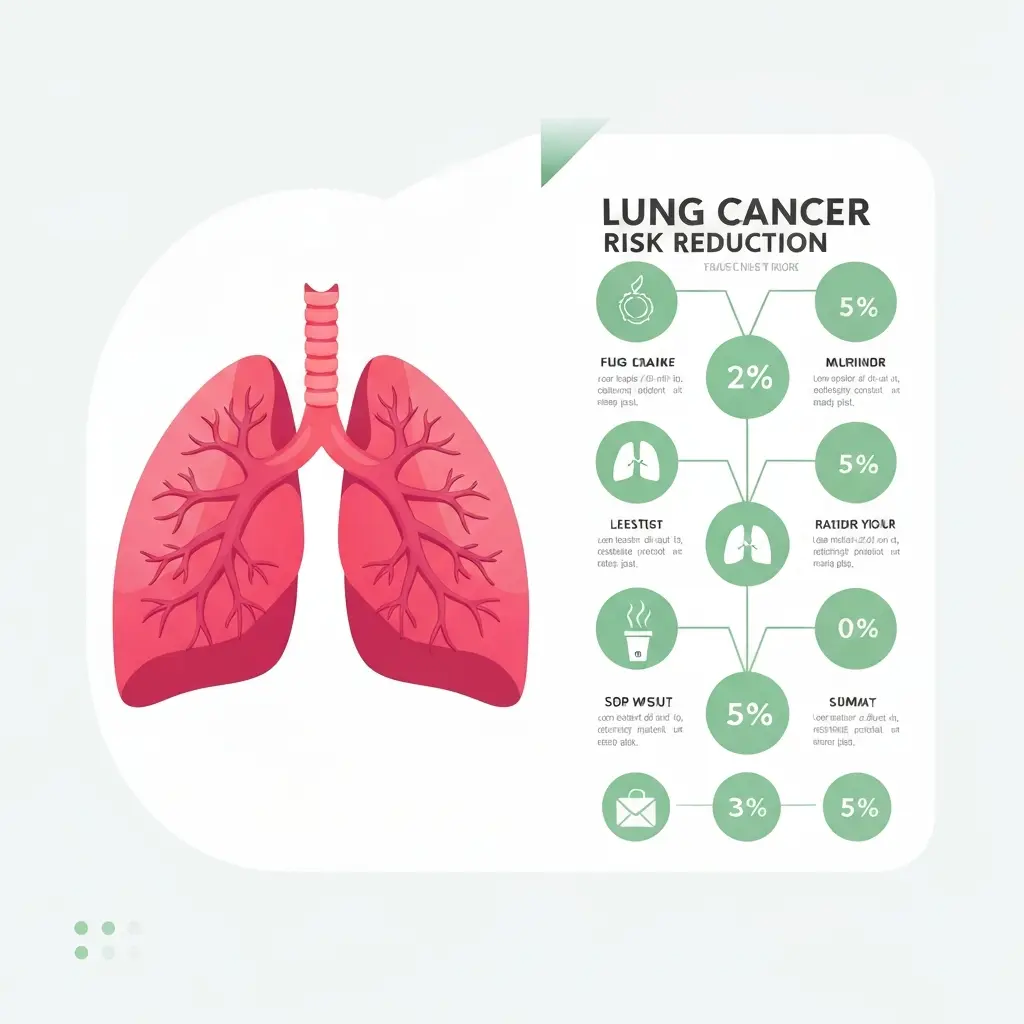
| Years Smoke-Free | Lung Cancer Risk Change | Source |
|---|---|---|
| 1-4 years | Risk still elevated; beginning to decline from peak smoking-era risk | CDC / NHS |
| 5 years | Significant reduction, particularly for squamous cell carcinoma | ACS / IARC |
| 10 years | Risk approximately halved compared to current smoker | NHS / CDC |
| 15+ years | Risk approaches (but does not fully reach) never-smoker levels for most histological types | Doll et al. BMJ 2004 |
The 10-year halving of lung cancer risk is the most-cited data point — but it is worth understanding what “halved” means in absolute terms. A person who smoked 20 cigarettes per day for 20 years has a substantially elevated absolute lung cancer risk compared to a never-smoker. Halving a 20% lifetime risk still leaves a 10% risk — far above never-smoker baseline. This is why earlier quitting produces more complete protection.
Factors That Affect the Rate of Risk Reduction
Age at Quitting
Quitting before age 40 eliminates approximately 90% of the excess lung cancer mortality risk associated with smoking, according to the landmark 2013 New England Journal of Medicine study following 200,000+ smokers. Quitting at 50 eliminates about 50%. The earlier you quit, the more complete the protection.
Smoking Intensity and Duration
Heavy, long-term smokers have more accumulated DNA damage. Research uses “pack-years” (see below) to quantify cumulative exposure. Higher pack-year totals are associated with a longer risk reduction timeline and higher residual risk even after extended cessation.
Type of Tobacco Product
Different products carry different risk profiles. Cigarettes carry higher lung cancer risk than cigars or pipes (for equivalent tobacco exposure), because cigarette smoke is more deeply inhaled. All combusted tobacco carries carcinogenic risk.
Family History and Genetics
People with a family history of lung cancer or known genetic variants associated with reduced DNA repair capacity may have higher baseline risk and slower risk reduction post-cessation. These individuals should discuss lung cancer screening with their GP regardless of current smoking status.
Pack-Years: Why Your Smoking History Matters
A “pack-year” is a unit used by clinicians to quantify cumulative tobacco exposure: one pack-year = 1 pack (20 cigarettes) smoked per day for one year. Examples:
- 10 cigarettes/day for 20 years = 10 pack-years
- 20 cigarettes/day for 20 years = 20 pack-years
- 40 cigarettes/day for 10 years = 20 pack-years
Lung cancer screening guidelines in both the UK and US use pack-year thresholds. NHS guidelines (2023) recommend low-dose CT scanning for people aged 55-74 with a 30+ pack-year history. If you meet this threshold, discussing screening with your GP is recommended regardless of whether you have quit — catching lung cancer early transforms survival outcomes.
Lung Cancer Screening for Ex-Smokers
Low-dose computed tomography (LDCT) scanning has been shown in the National Lung Screening Trial (NLST) to reduce lung cancer mortality by 20% in high-risk smokers and ex-smokers. Eligibility criteria vary by country:
- UK (NHS): Targeted Lung Health Checks program — ages 55-74, 30+ pack-year history, current smoker or quit within 15 years
- US (USPSTF 2021 guidelines): Annual LDCT for ages 50-80, 20+ pack-year history, currently smoking or quit within 15 years
If you are an ex-smoker who meets these criteria, speak to your GP about accessing screening. Early detection of lung cancer provides substantially better treatment options and survival rates.
Is It Ever Too Late to Benefit?
The short answer is no — and the research is emphatic on this point. Even people who have smoked for 40+ years benefit meaningfully from quitting. A large-scale study following 1.5 million participants (NEJM Evidence, 2023) found measurable mortality benefit from cessation at any age. At age 60, quitting still significantly reduces lung cancer risk, cardiovascular events, and all-cause mortality.
For people who have already developed smoking-related conditions like COPD, quitting remains the single most effective intervention to slow disease progression, even if structural lung damage cannot be reversed.
Frequently Asked Questions
Can I still get lung cancer even if I quit smoking?
Yes — ex-smokers still have an elevated lung cancer risk compared to never-smokers, particularly in the first decade after quitting and for heavy long-term smokers. About 50% of all new lung cancer diagnoses in the US occur in former smokers. This is why ex-smokers who meet screening criteria should access lung cancer screening programs. Quitting dramatically reduces risk but does not eliminate it entirely for many former smokers.
Does smoking just a few cigarettes per day significantly raise lung cancer risk?
Yes — there is no clinically “safe” level of cigarette smoking. A 2018 BMJ study found that smoking just one cigarette per day carries approximately half the lung cancer risk of smoking 20 per day, rather than 1/20th as many people assume. Even very light smoking involves meaningful carcinogen exposure. Quitting entirely, rather than reducing, provides a far superior risk profile.
Are there any supplements or foods that reduce lung cancer risk after quitting?
No supplement or food has been proven to reduce lung cancer risk in ex-smokers. Notably, high-dose beta-carotene supplements were found in multiple clinical trials to increase lung cancer risk in smokers and recent ex-smokers rather than reduce it. A diet rich in vegetables and fruits supports overall health, but no specific dietary intervention has demonstrated cancer risk reduction comparable to smoking cessation itself.
How does lung cancer screening work and who should get it?
Low-dose CT (computed tomography) scanning scans the lungs for nodules that may indicate early lung cancer, when it is most treatable. In the UK, screening is offered via NHS Targeted Lung Health Check programs to qualifying high-risk individuals (typically age 55-74, 30+ pack-years, current or recent ex-smoker). In the US, USPSTF guidelines recommend annual LDCT for age 50-80, 20+ pack-years, current or quit within 15 years. Talk to your GP to determine whether you qualify.
Protect Your Health from Today — with iQuit
Every smoke-free day reduces your future cancer risk. The iQuit app shows you your health recovery milestones in real time — including the long-term risk reductions that make quitting the most important health decision you’ll ever make. Start your timeline today.