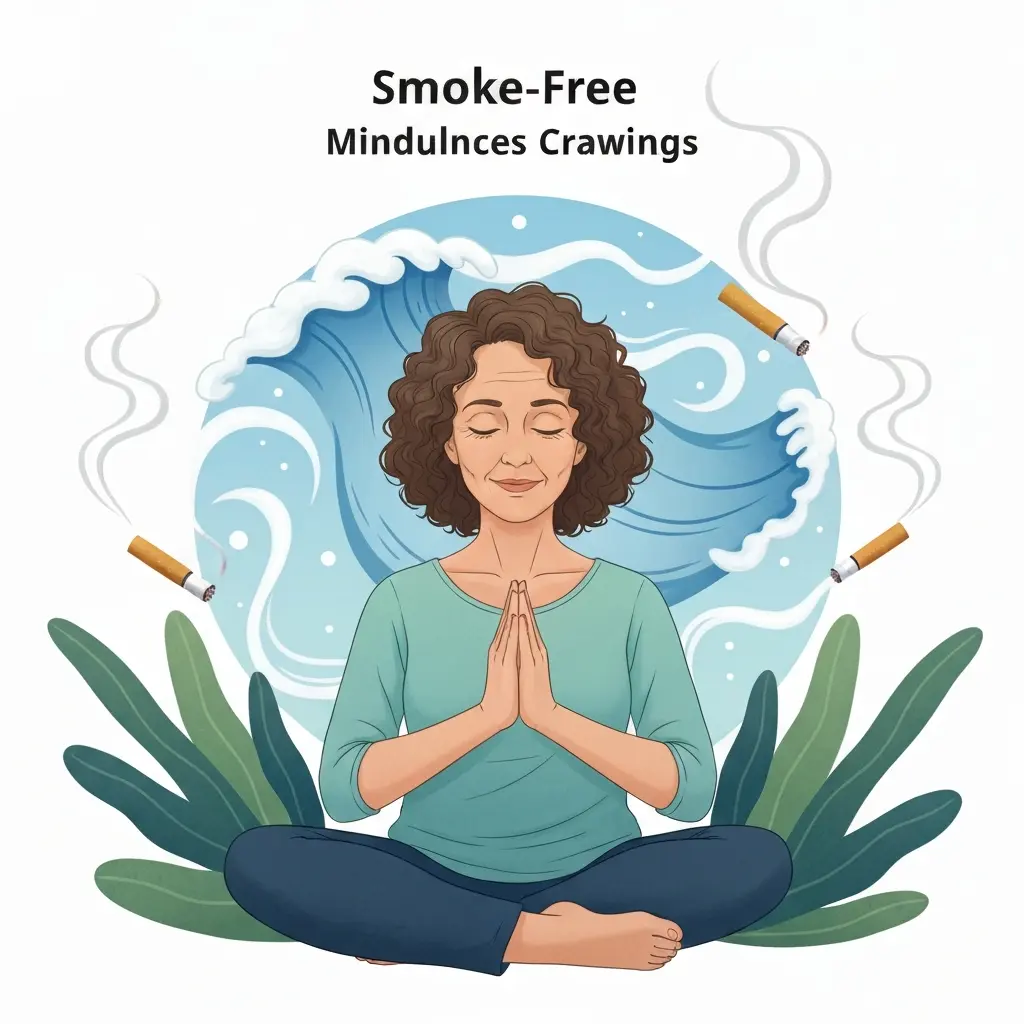
Mindfulness for Quitting Smoking: How Meditation Helps You Beat Cravings in 2026
Of all the psychological approaches to smoking cessation, mindfulness has emerged as one of the most evidence-supported in recent years. Mindfulness-Based Smoking Cessation (MBSC) programs have been studied in multiple randomized controlled trials, and the findings are consistently positive: mindfulness training significantly improves quit rates compared to standard behavioral approaches, particularly for managing cravings and preventing relapse. Understanding how mindfulness quit smoking programs work — and how to apply the core techniques yourself — gives you a powerful, drug-free tool in your cessation toolkit for 2026.
This isn’t about sitting cross-legged for hours. The mindfulness techniques most effective for smoking cessation are practical, brief, and specifically designed for the moments when a craving feels overwhelming.
How Mindfulness Changes Your Relationship with Cravings
Most smokers experience cravings as commands — imperatives that demand obedience. The craving feels like a fact of the world (“I need a cigarette”) rather than a mental event that can be observed and allowed to pass. This cognitive fusion with craving content is a central driver of relapse.
Mindfulness works by introducing a fundamental shift in perspective: instead of being inside the craving (experiencing it as a demand), you learn to observe the craving from a slight distance (experiencing it as a passing mental event). This is called “defusion” in Acceptance and Commitment Therapy (ACT) and “decentering” in Mindfulness-Based Cognitive Therapy (MBCT).
The practical implication is significant: a craving observed with curiosity (“interesting — I notice an urge to smoke. Where do I feel it in my body? How intense is it, on a scale of 1–10? Is it changing?”) is dramatically easier to manage than a craving experienced as an irresistible command. You haven’t eliminated the craving — you’ve changed its power over you.
The Clinical Evidence for Mindfulness Cessation
The evidence base for mindfulness-based smoking cessation has grown substantially:
- A landmark randomized controlled trial by Brewer et al. (2011) found that mindfulness training was more than twice as effective as the American Lung Association’s gold-standard Freedom from Smoking program at 17-week follow-up
- A 2020 meta-analysis of 13 studies found that mindfulness-based interventions significantly increased quit rates compared to control conditions, with effects maintained at long-term follow-up
- Brain imaging studies by Brewer’s group showed that mindfulness training reduced activity in the default mode network (associated with craving and automatic behavior) — providing a neurological mechanism for the behavioral effects
- A 2022 trial found that just 10 minutes of mindfulness practice per day for 2 weeks before a quit attempt significantly increased quit success rates at 6 months
What makes these results particularly impressive is that mindfulness programs in these trials were compared to active control conditions — not just no treatment. Mindfulness outperforms standard behavioral cessation support, not just placebo.
Craving Surfing: The Core Technique
Craving surfing, developed by Alan Marlatt, is the mindfulness technique most specifically designed for addiction. The metaphor: a craving is a wave. If you try to push the wave away, it knocks you down. If you give in to it, it carries you away. But if you learn to surf it — observe its rise, peak, and fall without acting — you discover that you can ride it out safely.
How to practice craving surfing:
- Notice the craving: When a craving begins, pause and acknowledge it: “I notice an urge to smoke.”
- Locate it in your body: Where does the craving live physically? Your chest? Your hands? Your throat? Describe the sensation without judgment.
- Rate its intensity: Give it a number from 1–10. This simple act creates cognitive distance between you and the craving.
- Breathe and observe: Take slow, deliberate breaths and watch the craving. Is it the same intensity? Is it changing? Most cravings peak within 3 minutes and begin declining within 5.
- Watch it pass: Without acting on the craving, observe it gradually diminishing. Notice that cravings have a natural arc — they rise, peak, and fall like a wave.
- After the craving passes: Take a moment to notice how you feel. Acknowledge that you rode it out.
With practice, this technique becomes faster and more automatic. Experienced mindfulness practitioners can defuse a craving within 60–90 seconds. Initial attempts may take longer — that’s normal and expected.
Mindful Breathing for Immediate Craving Relief
Mindful breathing is the simplest entry point into mindfulness practice for craving management. Unlike craving surfing (which requires some practice), basic mindful breathing is immediately accessible to anyone:
4-7-8 Breathing
Inhale for 4 counts, hold for 7, exhale slowly for 8 counts. The extended exhale activates the parasympathetic nervous system (the “rest and digest” response), reducing cortisol and adrenaline within minutes. This directly counteracts the stress-drive component of most cravings.
Box Breathing
Inhale for 4 counts, hold for 4, exhale for 4, hold for 4. Repeat 4 times. Used by Navy SEALs for stress management under extreme pressure — highly effective for workplace and high-stress craving situations.
Mindful Breath Focus
Simply focus all your attention on the sensation of breathing for 2–3 minutes. When your mind wanders to the craving (it will), gently bring it back to the breath. This practice of non-judgmental return is the core skill of mindfulness — and it directly applies to returning attention from craving thoughts to the present moment.
Body Scan for Withdrawal Awareness
The body scan is particularly useful during the early withdrawal period when physical symptoms — restlessness, tension, anxiety — can feel overwhelming and trigger relapse. A brief body scan (5–10 minutes) systematically brings gentle, curious attention to each part of the body, noticing physical sensations without judgment.
For quitters, the body scan serves two functions:
- Defusing physical discomfort: Symptoms experienced with mindful awareness are typically less overwhelming than symptoms experienced as threatening and requiring immediate relief
- Early warning system: Developing body awareness helps you notice stress building before it reaches a crisis point that triggers a craving
Guided body scan meditations are available in many apps and platforms. Starting with a 10-minute guided scan once per day during the first 2 weeks of your quit is a practical introduction.
Building a Daily Mindfulness Practice
The benefits of mindfulness for smoking cessation are cumulative — regular practice builds the skill, making craving defusion increasingly automatic. A practical daily practice for quitters:
- Morning (5–10 minutes): Start with a brief breathing meditation or body scan to set an intentional, mindful tone for the day before the first potential triggers arise
- During-craving practice: Apply craving surfing or mindful breathing immediately when a craving hits — this is the most high-impact moment for practice
- Evening (5–10 minutes): A brief loving-kindness or gratitude reflection, noting the health improvements and achievements of the smoke-free day, reinforces positive motivation
For many quitters, starting with guided meditations via an app is the easiest entry point. Headspace, Calm, and Waking Up all offer cessation-specific content. Combine these with the iQuitNow app‘s craving tracking to create a comprehensive behavioral support system. For building comprehensive new health habits and routines, Tesify provides AI-powered tools that complement a mindfulness-integrated quit plan. Organizations wanting to incorporate mindfulness-based cessation into wellness programs can explore CampaignOS for scalable delivery.
Frequently Asked Questions
Can mindfulness alone help me quit smoking?
Mindfulness-based cessation programs have shown strong quit rates in clinical trials — better than some standard behavioral approaches. However, for heavy or long-term smokers with significant physical dependence, combining mindfulness with NRT or prescription medication gives better results than either alone. Mindfulness alone is more likely to succeed for lighter smokers or those primarily psychologically dependent.
How long does it take to get good at craving surfing?
Most people notice meaningful improvement within 1–2 weeks of daily practice. The first few craving surfing attempts may feel awkward or unsuccessful — the craving may “win.” This is normal. Each attempt builds the skill. By 2–4 weeks of regular practice, most people report that craving surfing has become noticeably easier and more automatic.
Do I need to meditate for a long time every day to benefit?
No. Research shows meaningful benefits from as little as 10 minutes per day. Consistency is more important than session length. Ten minutes daily for 4 weeks is more beneficial than an hour once a week. For smoking cessation specifically, brief but frequent in-the-moment practices (craving surfing, mindful breathing during cravings) may be even more valuable than formal sitting meditation.
What is craving surfing and how is it different from distraction?
Distraction involves redirecting attention away from the craving to something else — it works but requires constant maintenance and leaves the craving “unprocessed.” Craving surfing involves turning toward the craving with curious, non-judgmental awareness — observing it, staying with it, and allowing it to pass naturally. Craving surfing builds a deeper relationship with cravings that makes them progressively less powerful over time.
Are there apps specifically for mindfulness-based smoking cessation?
Yes. Some apps specifically combine mindfulness with smoking cessation. General mindfulness apps (Headspace, Calm) offer cessation-specific programs. Comprehensive quit apps like iQuitNow incorporate mindfulness-based craving management techniques including breathing exercises and craving observation tools. The most effective approach is to use a dedicated quit tracking app (for milestones, financial tracking, and pattern recognition) alongside a mindfulness tool.
Can mindfulness help if I’ve already relapsed?
Yes — particularly for managing the shame and self-criticism that follow a relapse. Mindfulness cultivates a non-judgmental stance toward experience, including the experience of relapse. Treating a relapse with curiosity (“What triggered it? What can I learn?”) rather than self-punishment is both more humane and more effective for restarting a quit attempt quickly.
Combine Mindfulness with Real-Time Craving Support
The iQuitNow app’s craving management tools work perfectly alongside mindfulness practice — log your craving, start the craving timer, use your breathing technique, and watch the craving pass.