
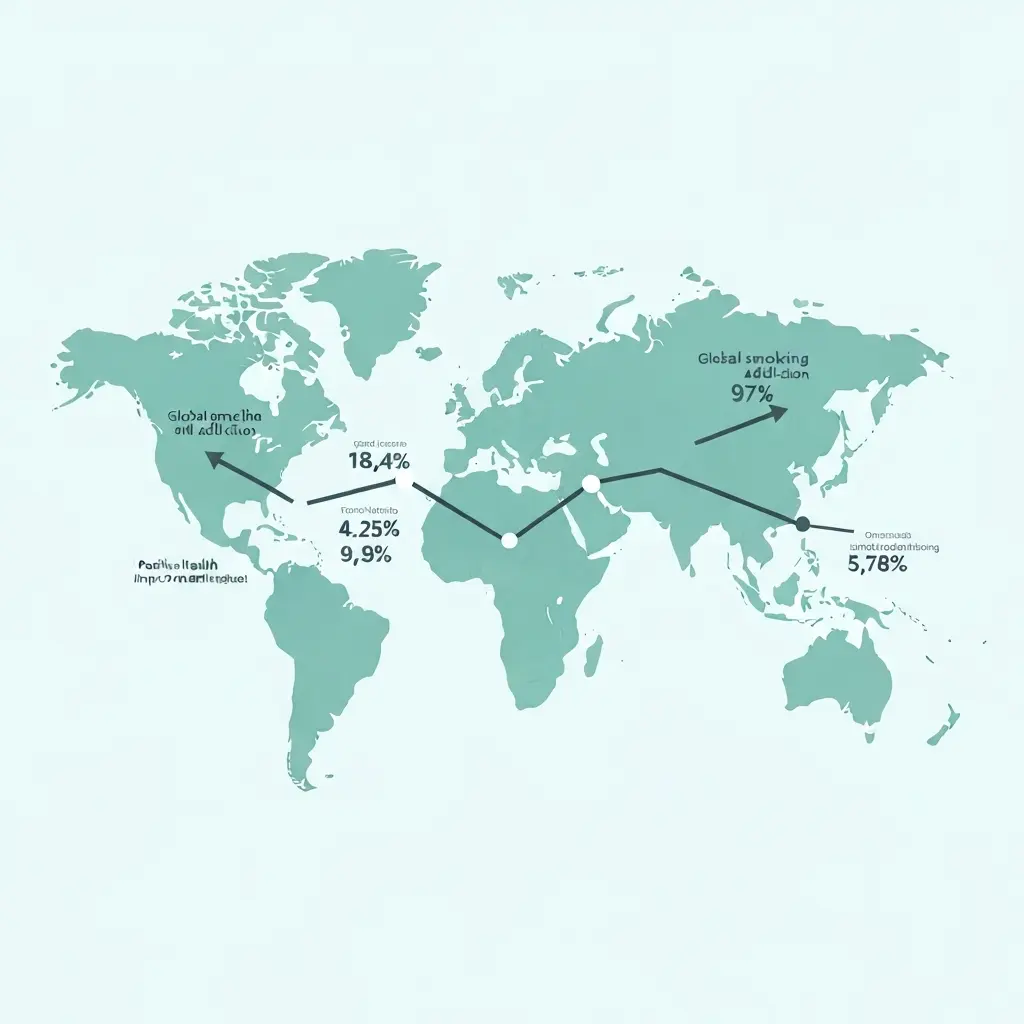
Nicotine Addiction Statistics Worldwide 2026: Global Data and Trends
Nicotine addiction remains one of the world’s most prevalent and costly public health challenges. Understanding nicotine addiction statistics worldwide in 2026 contextualises the individual struggle to quit smoking within a global epidemic — and reveals both the scale of the challenge and the genuine progress being made through cessation support and tobacco regulation.
This data-driven overview synthesises the latest WHO, CDC, and national health authority statistics to provide an authoritative picture of global nicotine dependence in 2026.
Global Tobacco Use Prevalence 2026
Based on WHO Global Report on Trends in Prevalence of Tobacco Use 2000–2025 (updated projections for 2026):
| Metric | 2026 Estimate | Trend vs 2000 |
|---|---|---|
| Total tobacco users worldwide | ~1.3 billion | Down from 1.41 billion (-8%) |
| Age-standardised smoking prevalence (all adults) | ~20% | Down from 33% in 2000 |
| Male smoking prevalence | ~35% | Down from 49% |
| Female smoking prevalence | ~7% | Down from 10% |
| Annual deaths attributable to tobacco | ~8 million | Stable (population growth offsets rate decline) |
| Secondhand smoke deaths per year | ~1.2 million | Declining |
Nicotine Addiction and Dependence Rates
Not all tobacco users are dependent on nicotine to the same degree, but among daily smokers:
- 80–90% of daily cigarette smokers meet clinical criteria for nicotine dependence (DSM-5)
- ~70% report wanting to quit smoking permanently
- ~55% make at least one serious quit attempt per year
- ~4–7% succeed in quitting permanently per unassisted attempt
- The average number of attempts before permanent cessation: 8–14
These statistics underline a critical point: nicotine addiction is not a matter of insufficient willpower. The vast majority of smokers want to quit and try to quit — they are failing because addiction is a powerful neurobiological condition requiring structured support, not just motivation. Properly supported quit attempts (with NRT, medication, and/or app coaching) achieve 3–8x higher success rates than unassisted attempts.
Regional Breakdown: Where Smoking Is Highest
| Region | Smoking Prevalence (Adults) 2026 est. | Trend |
|---|---|---|
| Western Pacific Region (incl. China) | ~28% | Slowly declining |
| South-East Asia | ~25% | Declining |
| European Region | ~25% | Declining |
| Eastern Mediterranean | ~22% | Mixed |
| Americas | ~17% | Declining (strong US/CA decline) |
| Africa | ~12% | Increasing in some sub-regions |
China alone accounts for approximately 300–350 million smokers — roughly 25% of all global tobacco users. The trajectory of tobacco control in China is critically important to global statistics. Japan, Russia, Indonesia, and India together account for a further 200–250 million smokers.
Demographic Trends: Age, Gender, and Socioeconomic Factors
Age: Smoking uptake has declined dramatically among youth in high-income countries. In the US, UK, and Australia, the proportion of adults aged 18–24 who smoke is now lower than any other age group. However, among adults aged 40–65 — those who started smoking before major tobacco control measures took effect — prevalence remains significantly higher. This cohort will be the primary group managing cessation over the coming decade.
Gender: The gender gap in smoking is narrowing. Male smoking rates have fallen faster than female rates globally. In several high-income countries, smoking rates among women aged 25–45 are now approaching or equal to male rates for that age group.
Socioeconomic factors: Smoking is increasingly concentrated in lower socioeconomic groups in high-income countries. In the UK, smoking rates in the most deprived quintile are approximately 3–4x higher than in the least deprived. This socioeconomic gradient makes accessible, low-cost cessation support (such as free apps and NHS services) disproportionately important for health equity.
Quit Attempts and Success Rates Globally
WHO data shows significant variation in cessation behaviour and outcomes by country:
- UK: ~29% of smokers make a quit attempt per year; NHS stop smoking service engagement ~5% of those attempting
- US: ~55% of smokers report wanting to quit; ~31% made a quit attempt in the past year (CDC 2024)
- Australia: 54% of smokers made a quit attempt in 2023, with strong NRT access via subsidy
- Low-income countries: Cessation support infrastructure is far less developed; quit attempt rates and success rates significantly lower
The global picture confirms what individual experience shows: structured support dramatically improves outcomes. Countries with comprehensive cessation infrastructure (UK NHS, Australian NRT subsidy programmes) show higher quit success rates than those relying on unassisted quit attempts. Digital tools are increasingly important for extending this infrastructure to populations without access to in-person services.
Health and Economic Burden of Nicotine Addiction
- Global economic cost of tobacco: The World Bank estimates the annual global economic burden at over $1.4 trillion USD — including healthcare costs, productivity losses, and premature death
- Healthcare system cost: Tobacco-related illness consumes approximately 6% of global health expenditure
- Individual economic burden: A pack-a-day smoker in the UK spends approximately £4,200 per year on cigarettes (2026 prices); in the US, approximately $2,500–$3,500 depending on state
- Cost-effectiveness of cessation: Supporting smoking cessation is one of the most cost-effective public health interventions available — every £1 invested in cessation support saves approximately £10 in future healthcare costs (UK data)
Understanding the personal financial burden of smoking can be powerful motivation to quit — the same behavioural trigger driving the comparison of value-driven tools applies here: knowing the financial stakes motivates investment in effective solutions. The money saved visualisation in the iQuit app shows this cumulative saving in real time.
Frequently Asked Questions
How many people are addicted to nicotine worldwide in 2026?
Approximately 1.3 billion people use tobacco products worldwide as of 2026. Among daily cigarette smokers, 80–90% meet clinical criteria for nicotine dependence. This means approximately 1 billion people globally are dependent on nicotine to some degree. Nicotine dependence is one of the most prevalent substance addictions in human history.
Is global smoking declining in 2026?
Yes. Age-standardised smoking prevalence has declined from about 33% in 2000 to approximately 20% in 2026 — a 39% reduction. The absolute number of smokers has also declined slightly despite population growth. The decline is most rapid in high-income countries with comprehensive tobacco control policies. In some low- and middle-income countries, rates have remained stable or increased.
Which country has the highest smoking rate in 2026?
Several countries have very high rates. Indonesia (approximately 62% of males smoke), followed by Nauru, Montenegro, and several Balkan nations consistently top global rankings. China, while having a lower prevalence rate (~25–30% of adults), has the highest absolute number of smokers globally at approximately 300 million. WHO data for specific 2026 estimates is in the WHO Global Report on Tobacco Trends.
What percentage of smokers successfully quit each year?
Approximately 4–7% of unassisted quit attempts result in 12-month abstinence. With full support (NRT + behavioural support + medication where appropriate), 12-month abstinence rates reach 15–40% depending on the intensity of support. Globally, approximately 25–30 million smokers successfully quit permanently each year — a number that could be dramatically higher with improved access to cessation support.
How much does smoking cost the global economy each year?
The World Bank estimates the annual economic burden of tobacco at over $1.4 trillion USD, including healthcare costs, lost productivity, and premature mortality. This figure exceeds the global GDP of all but the 15 largest economies. The cost-benefit case for tobacco cessation support is extraordinarily strong — one of the most cost-effective public health interventions available globally.
Sources: WHO Global Report on Trends in Prevalence of Tobacco Use 2000–2025; CDC National Health Interview Survey 2024; World Bank — Economics of tobacco control; OECD Health Statistics 2024; WHO Tobacco fact sheet 2024.