
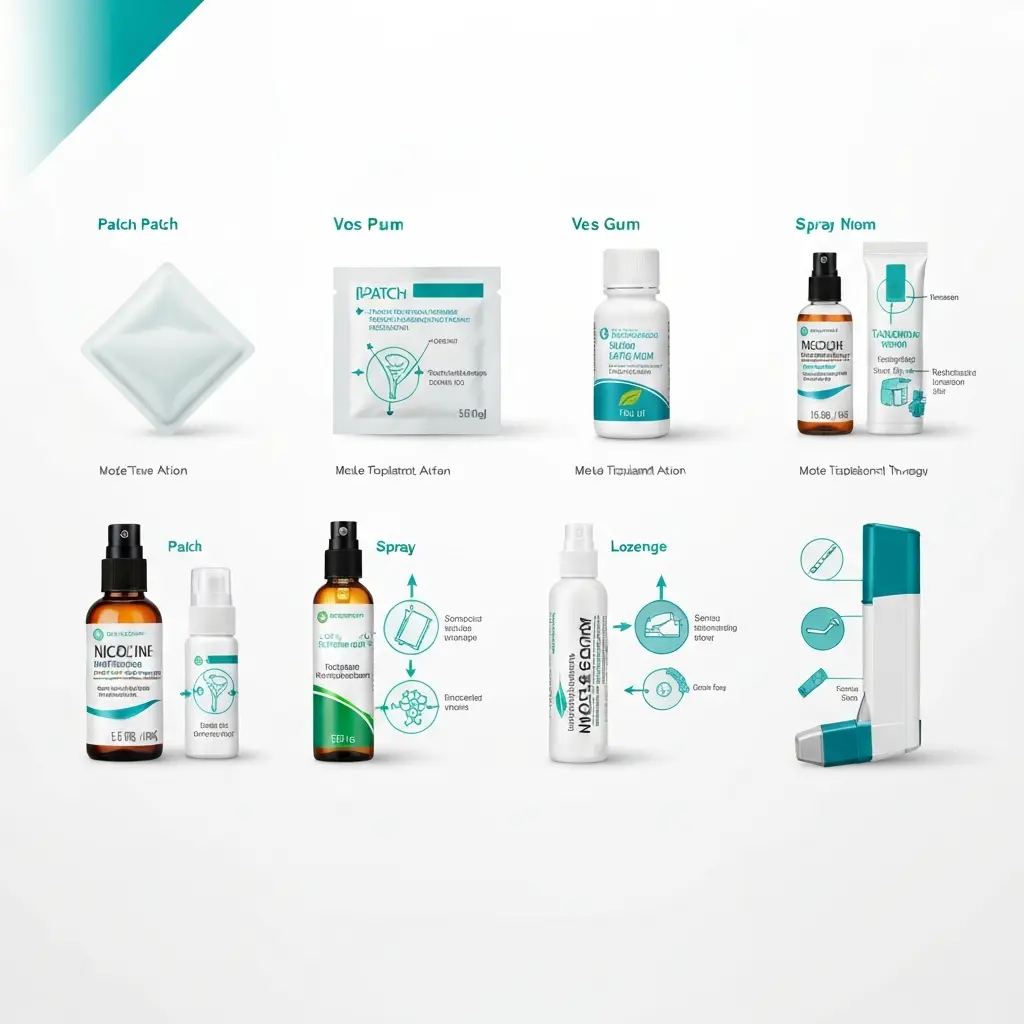
NRT Comparison: Patches vs Gum vs Spray vs Lozenge — Which Nicotine Replacement Works Best for You?
The clinical headline on nicotine replacement therapy is simultaneously reassuring and unhelpful: “All forms of NRT have similar success rates.” The Cochrane Collaboration’s review of 136 trials and 64,000+ participants confirms that patches, gum, nasal spray, lozenges, and inhalers all roughly double the likelihood of quitting compared to no aid. So on pure outcome data, they are broadly equivalent. But the best nicotine replacement therapy options for an individual depend on something clinical trials do not measure: which NRT you will actually use correctly, consistently, and comfortably.
This comparison goes beyond the headline numbers to examine onset speed, compliance rates, lifestyle fit, dosing requirements, side effect profiles, and the critical question the Cochrane review does answer: when does combination NRT significantly outperform single-product use?
For more on this topic, see our guide on best nicotine replacement therapy options compared.
For more on this topic, see our guide on nicotine spray vs nicotine gum.
How NRT Works: The Pharmacology in Plain Language
Nicotine replacement therapy works by supplying the brain’s nicotinic acetylcholine receptors with controlled doses of nicotine — enough to reduce withdrawal symptoms and cravings without the 4,000+ toxic chemicals in tobacco smoke. The goal is not to maintain nicotine dependence indefinitely, but to stabilise the withdrawal process long enough to break the habitual and psychological smoking behaviour.
Different NRT forms differ primarily in:
- Onset speed: How quickly nicotine reaches peak blood levels after administration
- Duration: How long each dose remains effective
- Delivery route: Transdermal (patch), oral mucosa (gum, lozenge), nasal mucosa (spray), airway (inhaler)
No NRT form delivers nicotine as rapidly as cigarettes (which reach the brain within 8–10 seconds). This is intentional — the rapid hit of smoking is part of what reinforces the habit. NRT’s slower delivery reduces withdrawal without replicating the full reinforcement cycle.
NRT Head-to-Head Comparison Table
| NRT Type | Onset Speed | Duration | Compliance | Best Use Case |
|---|---|---|---|---|
| Patch | Slow (hours) | 16–24 hours | Highest | Background steady-state nicotine; foundation of combination therapy |
| Gum | Medium (~20–30 min) | ~30 min active | Good | Flexible acute craving management; familiar format |
| Nasal Spray | Fastest (5–10 min) | ~30 min effective | Lower (irritation) | Intense acute cravings; heavy/highly dependent smokers |
| Lozenge | Medium (~20–30 min) | ~30 min | Good | Discreet use in workplace, social settings |
| Inhaler | Medium (~20 min) | ~30 min | Moderate | Smokers with strong hand-to-mouth habit |
Nicotine Patches: Best for Compliance
The nicotine patch is the most widely prescribed NRT and the one with the highest compliance rates — primarily because the once-daily application fits easily into any routine. Patches deliver a continuous low dose of nicotine transdermally over 16 (waking hours) or 24 hours.
How they work: Applied to clean, dry skin on the upper arm, chest, or back, the patch releases nicotine steadily through the skin into the bloodstream. Plasma nicotine levels stabilise at a lower level than smoking but remain constant enough to prevent the troughs of craving that occur between cigarettes.
Dosing: Patches come in three strengths (21mg, 14mg, 7mg). Heavy smokers (20+/day) start at 21mg for 4–6 weeks, step down to 14mg, then 7mg. The step-down approach gradually reduces dependence.
Side effects: Skin irritation at application site (rotating sites helps), vivid dreams if worn overnight, mild headache during the first week.
Common mistake: Using the wrong strength. A heavy smoker who starts at 7mg patch will experience significant under-dosing and intense withdrawal. Start at the right strength.
Nicotine Gum: Best for Flexible Dosing
Nicotine gum is the most flexible NRT format — available in 2mg and 4mg strengths, usable on-demand to target specific craving moments, and available without prescription everywhere.
Critical technique point: Nicotine gum is NOT chewed like regular gum. The correct technique is “chew and park” — chew briefly until you taste a peppery/minty sensation, then park the gum between cheek and gum to allow absorption. Continuous chewing leads to swallowing nicotine, which causes nausea and reduces efficacy. Most people who report “gum didn’t work” were using it incorrectly.
Dosing: 4mg for smokers of 25+ cigarettes/day; 2mg for lighter smokers. Maximum 24 pieces per day. Do not eat or drink 15 minutes before or during use — acidic drinks (coffee, juice) reduce absorption.
Side effects: Nausea, hiccups, mouth irritation — almost all from incorrect technique rather than the nicotine itself.
Nicotine Nasal Spray: Fastest Acting
The nasal spray is the closest NRT form to the speed profile of smoking. Nicotine is absorbed through the nasal mucosa and reaches peak plasma levels in 5–10 minutes. For heavy smokers whose cravings are intense and rapid-onset, this speed advantage is clinically significant.
Trade-off: Nasal spray has the lowest compliance rates of all NRT forms due to initial side effects — nose and eye irritation, sneezing, and coughing are common in the first week. Most users adapt within 1–2 weeks. Available on prescription in the UK.
Best for: People who smoke immediately upon waking (a marker of very high physical dependence), those who have failed with other NRT forms, and heavy smokers experiencing intense acute cravings that gum/lozenges are too slow to address. For a direct head-to-head on onset speed across all three fast-acting formats — spray, gum, and lozenge — see our dedicated comparison of the fastest-acting NRT options.
Nicotine Lozenges: Most Discreet
Nicotine lozenges dissolve in the mouth, delivering nicotine through the oral mucosa. They are roughly equivalent in onset speed to gum (approximately 20–30 minutes to peak effect) but require no special technique — simply place and allow to dissolve.
Advantage over gum: No chewing technique to get wrong; completely silent and odourless; usable in formal professional settings without attracting attention.
Dosing: 2mg and 4mg strengths, same dosing principles as gum.
Nicotine Inhaler: Best for Habitual Smokers
The nicotine inhaler (or inhalator) mimics the physical act of smoking — a cartridge inside a plastic tube delivers nicotine when puffed. It is the only NRT format that addresses the hand-to-mouth ritual component of smoking, making it particularly valuable for people whose smoking is strongly habit-driven rather than purely nicotine-driven.
Unlike smoking, it does not deliver nicotine to the lungs — the nicotine is absorbed from the mouth and throat. Onset is similar to gum, not as fast as the nasal spray. Available on prescription in the UK.
Why Combination NRT Works Better
The most important practical recommendation in NRT research is the combination approach. Cochrane and NHS data consistently show that combining a long-acting patch (background nicotine) with a fast-acting form (gum, spray, or lozenge for acute cravings) outperforms either product alone:
- Single NRT: ~14% 6-month abstinence
- Combination NRT (patch + fast-acting): ~17% 6-month abstinence
- Combination NRT vs. single NRT: statistically significant advantage across multiple trials
The logic is straightforward: the patch prevents the troughs between cravings, while the fast-acting form handles the peaks. Using only a patch leaves the intense acute craving moments underaddressed; using only gum or spray leaves the background nicotine level fluctuating. The combination fills both roles.
Complement your NRT strategy with a tracking app like iQuit to monitor craving patterns, identify your peak-risk times, and log when you reach for your fast-acting NRT — building a picture of your personal withdrawal landscape that makes week 2 and beyond much more manageable.
Frequently Asked Questions
Which NRT form has the highest success rate?
The Cochrane Collaboration’s review of 136 trials found all NRT forms have broadly similar success rates at 6 months (approximately 12–17%), with no single form statistically superior in head-to-head comparisons. Nasal spray may have a marginal advantage in absolute numbers but has lower compliance. The most effective strategy is combination NRT (patch + fast-acting form), which outperforms any single product by approximately 3 percentage points in absolute terms.
How long should I use NRT for?
Standard NHS and CDC guidance recommends 8–12 weeks of NRT, with a step-down dosing approach if using patches. Some people benefit from longer use — up to 6 months for very heavy smokers or those who have relapsed multiple times. There is no clinical harm in extending NRT use; the risks of continuing NRT far outweigh the risks of returning to smoking.
Can I use NRT while still smoking?
Combination NRT (using NRT while gradually reducing cigarettes before a quit date) is a validated cessation strategy. NHS guidance confirms it is safe to use NRT alongside reducing cigarettes. The goal is to use NRT to cut cigarette consumption in half in the first 4 weeks, then to quit completely. Do not use very high-dose NRT while smoking heavily — this can cause nicotine overconsumption symptoms (nausea, dizziness, headache).
Is nicotine gum bad for your teeth?
Nicotine gum is significantly less harmful to teeth and gums than smoking. The primary dental concern with nicotine gum is mechanical — excessive chewing can cause jaw soreness, and the gum should not be swallowed. Nicotine itself can cause some mild gum constriction, but this is negligible compared to the extensive gum disease damage caused by cigarette smoke. Dentists recommend NRT over continued smoking without reservation.
Does NRT work better with a quit smoking app?
Yes. NRT addresses the physiological nicotine dependence; a quit smoking app addresses the behavioural and psychological triggers that NRT cannot touch. Research consistently finds that combining behavioural support with pharmacotherapy outperforms either alone. An app like iQuit can help you identify your peak craving times (so you use your fast-acting NRT preventively), track your success, and manage the psychological aspects of quitting.
Complete Your NRT Strategy with iQuit
Track your cravings, identify your peak-risk times, and see your NRT working in real time. The iQuit app logs your craving patterns so you can use your NRT preventively rather than reactively — and motivates you through every smoke-free milestone. NRT handles the pharmacology; iQuit handles everything else.