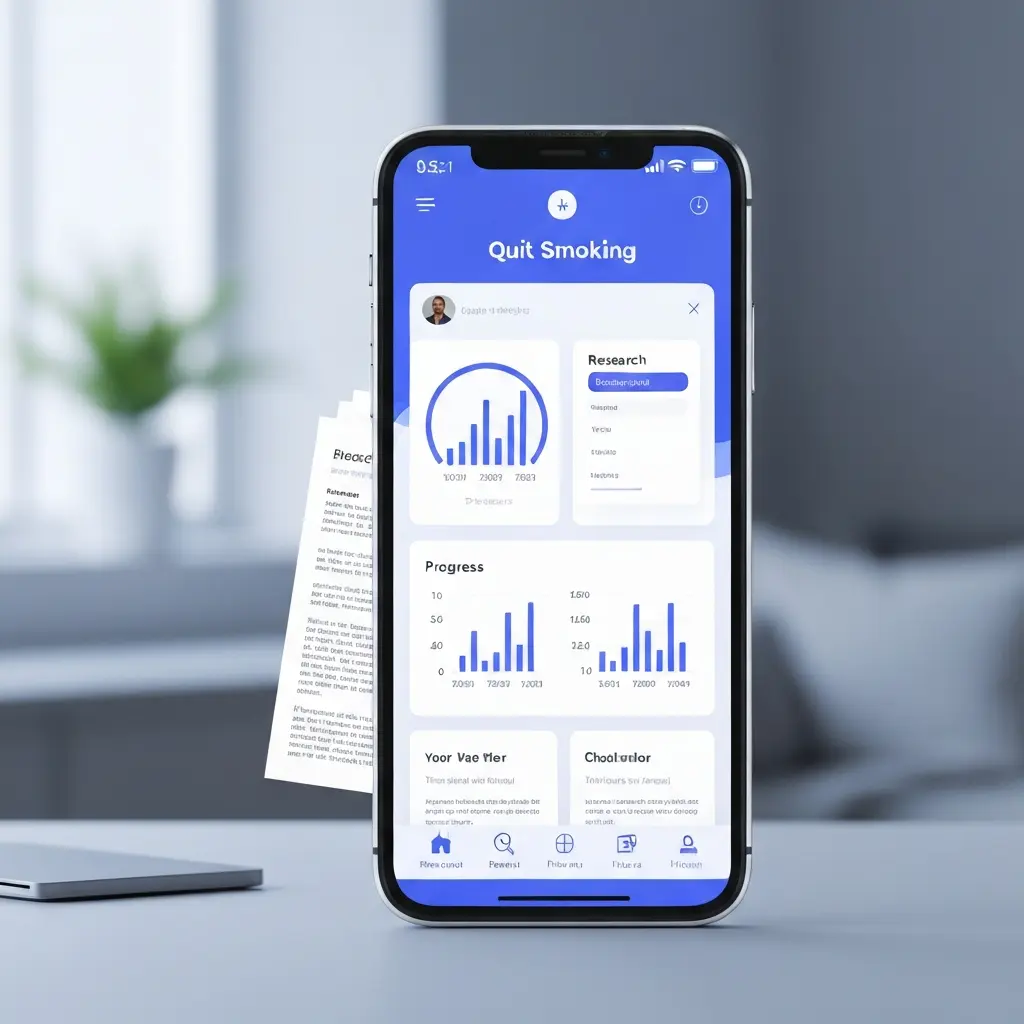
Quit Smoking App Effectiveness: What 2025–2026 Research Actually Proves
Quit smoking apps occupy an unusual position in cessation research: the category is growing faster than the science can evaluate it. The number of people using tobacco-cessation apps was projected to grow from 5 million in 2022 to 33 million by 2026 — yet rigorous quit smoking app effectiveness research data from randomised controlled trials only began accumulating meaningfully in the last five years. What the 2025–2026 evidence base actually shows is considerably more nuanced, and more encouraging, than both the optimistic app marketing and the sceptical dismissal of digital tools as “not real medicine.”
This analysis synthesises findings from a 2025 Nature Human Behaviour network meta-analysis, the New England Journal of Medicine’s 2025 assessment of digital tobacco treatment, multiple individual RCTs, and Cochrane-level systematic reviews.
The Scale of Digital Cessation in 2026
The New England Journal of Medicine’s 2025 contribution to this field — “The Contribution of Digital Treatment to Efforts to Reduce Global Tobacco Use” — opens with the projected user growth from 5 million in 2022 to 33 million by 2026, positioning digital tools as a potential solution to the “support gap” identified in global cessation research: the fact that national cessation services with full or partial cost coverage exist in only 31 countries.
This matters because access to traditional cessation support (NHS Stop Smoking Services, state quitlines, behavioural counselling) is geographically and economically uneven. A well-designed app reaches users in countries where no publicly-funded cessation infrastructure exists. The NEJM analysis frames digital tools not as replacements for evidence-based care but as scalable delivery mechanisms for evidence-based behavioural techniques.
What the 2025 Meta-Analysis Found
The landmark 2025 study published in Nature Human Behaviour conducted a network meta-analysis of 152 randomised controlled trials evaluating digital interventions for smoking cessation. Key findings:
- Personalised interventions significantly improved cessation rates compared with standard care
- Group-customised interventions performed even better than simple personalisation
- SMS and app-based tools showed greater benefits among middle-aged adults specifically, in short- to medium-term programmes (up to 6 months)
- Text message (SMS) interventions had the most consistent evidence base across trials, partly because they have been evaluated longer
- App-specific RCT data is growing rapidly but currently lags behind web/SMS evaluation due to the faster pace of app development vs trial timelines
The authors note an important methodological caveat: digital interventions are an evolving target. An app evaluated in a 2020 RCT may be substantially different from the same app in 2026. This creates an inherent lag between real-world digital capability and the published trial evidence.
Individual RCT Results: The Strongest Evidence
Smoke Free App
The Smoke Free app is among the most rigorously evaluated cessation apps with three independent randomised controlled trials documenting its effects. Across these trials, the consistent finding is that users of Smoke Free are approximately twice as likely to remain quit at 6 months compared to willpower-alone control groups. The app tracks money saved, health improvements, and provides craving support.
NichtraucherHelden (Germany)
A German nationwide parallel randomised controlled trial (published in Nicotine & Tobacco Research, Oxford Academic) found that users of the NichtraucherHelden app achieved double the abstinence rate compared to control group at follow-up. The trial was notable for its large scale and real-world design, making its findings more generalisable than small single-centre studies.
Kwit App
Kwit holds the distinction of being described as the first WHO-validated smoking cessation app, using cognitive behavioural therapy techniques. With 4.5 million users and positive user outcomes, it represents the convergence of clinical methodology with consumer app design.
Just-in-Time Adaptive Intervention (JITAI) Research
A 2025 qualitative process evaluation of the Quit Sense feasibility RCT (published in PubMed) evaluated a smartphone app that provides real-time automated support triggered by location — detecting high-risk environments (such as a pub or usual smoking location) and delivering craving management support precisely when needed. This JITAI approach is theoretically strong: delivering support at the right moment rather than passively.
What App Features Actually Work (and Which Do Not)
A 2023 systematic review and meta-analysis in PMC (The Effectiveness of Smartphone App-Based Interventions for Assisting Smoking Cessation) identified the features most consistently associated with positive outcomes:
Evidence-Supported Features
- Real-time craving management tools (distraction games, breathing exercises, 4D prompts) — most strongly associated with preventing relapse at craving points
- Progress tracking (smoke-free days, money saved, health milestones) — provides ongoing positive reinforcement
- Personalised quit date and plan setting — increases commitment through self-determination
- Push notifications triggered by self-reported craving or time-of-day risk — significantly improves engagement vs passive apps
- CBT-based content addressing cognitive patterns around smoking — drives deeper behaviour change
Features with Less Evidence
- Social community features — mixed evidence; can support or undermine quit attempts depending on community quality
- Gamification alone — increases engagement but not always cessation
- Generic information delivery without interactive elements — not significantly better than a pamphlet
The PMC smartphone framework review (2023) concluded: “Apps with more interactive features and evidence-based components showed better outcomes than passive information apps.” This distinction matters enormously when choosing which app to trust.
Apps vs. Other Methods: Where They Fit in the Evidence Hierarchy
Apps do not replace pharmacotherapy. The evidence hierarchy for smoking cessation, from strongest to most accessible:
- Combination pharmacotherapy + behavioural support (strongest evidence, 20–44% abstinence at 6 months)
- Varenicline alone (33–44% at 24 weeks)
- NRT combination (~17% at 6 months)
- Single NRT (~12–15% at 6 months)
- Behavioural counselling alone (7–16%)
- Evidence-based app (approximately doubles willpower-alone rate of 4–7%, so ~8–14%)
- Cold turkey / willpower alone (4–7%)
The appropriate use of an app in a cessation strategy is as a layer of support — particularly for craving management between NRT doses or counselling sessions. The NEJM 2025 analysis explicitly recommends digital tools as complement to rather than replacement for pharmacotherapy. Used this way, the combination is additive.
Key Apps with Research Backing
| App | Evidence Base | Key Features | Cost |
|---|---|---|---|
| Smoke Free | 3 RCTs (doubled quit rates) | Tracking, craving tools, health data | Free/premium |
| Kwit | WHO-validated; 4.5M users | CBT-based; adaptive programme | Subscription |
| quitSTART (CDC) | Government-backed | Personalised tips, tracking | Free |
| NHS Quit Smoking | NHS clinical guidelines | 28-day programme, clinical advice | Free |
| iQuit | Evidence-based behavioural design | Craving tracker, milestones, savings counter, quit plan | Free/premium |
Frequently Asked Questions
Do quit smoking apps actually work based on research?
Yes, with important caveats. A 2025 network meta-analysis of 152 RCTs found personalised digital interventions significantly improve cessation rates. Multiple individual RCTs have found specific apps (including Smoke Free) double quit rates versus willpower alone. However, the quality of evidence varies enormously by app — passive information apps show little benefit, while interactive, CBT-based apps with real-time craving support show the strongest results.
Are quit smoking apps as effective as nicotine patches?
Not quite — NRT patches achieve ~12–15% 6-month abstinence in trials, while evidence-based apps appear to approximately double the cold-turkey rate of 4–7%, suggesting 8–14% effectiveness as standalone tools. However, apps and NRT are complementary rather than competing: combining an evidence-based app with NRT likely produces better outcomes than either alone, as the app addresses behavioural and psychological triggers while NRT addresses the pharmacological withdrawal.
What makes a quit smoking app evidence-based?
Evidence-based quit smoking apps typically incorporate at least some of the following: cognitive behavioural therapy (CBT) components, real-time craving management tools, personalised quit planning, progress tracking with health and financial milestones, push notifications timed to high-risk moments, and content grounded in clinical guidelines. Apps validated in or aligned with peer-reviewed research trials, or endorsed by health bodies like the NHS or CDC, offer the strongest confidence.
How many people use quit smoking apps in 2026?
The New England Journal of Medicine (2025) projected that the number of tobacco-cessation app users would grow from approximately 5 million in 2022 to 33 million by 2026. This represents one of the fastest growth trajectories in digital health, driven by increasing smartphone penetration in low- and middle-income countries where traditional cessation services are unavailable.
Should I use a quit smoking app alongside NRT or medication?
Yes — this is the approach most supported by the current evidence. Apps address the behavioural, psychological, and situational triggers of smoking (which NRT does not), while NRT addresses the physiological nicotine withdrawal (which apps do not). The NEJM 2025 analysis explicitly recommends digital tools as complementary to pharmacotherapy. Using an app alongside NRT or varenicline combines the strengths of both approaches.
The Research-Backed Way to Use a Quit Smoking App
The evidence points to one conclusion: apps work best when they combine real-time craving support, personalised planning, and progress tracking. The iQuit app is built around exactly these evidence-based components — giving you a craving management toolkit, health milestone tracker, and financial savings counter, all in one place. Use it alongside your NRT for maximum effect.
Download iQuit — the evidence-based approach to going smoke-free →