How iQuit’s AI Coach Handles 3am Cravings: Built for Shift Workers (2026)
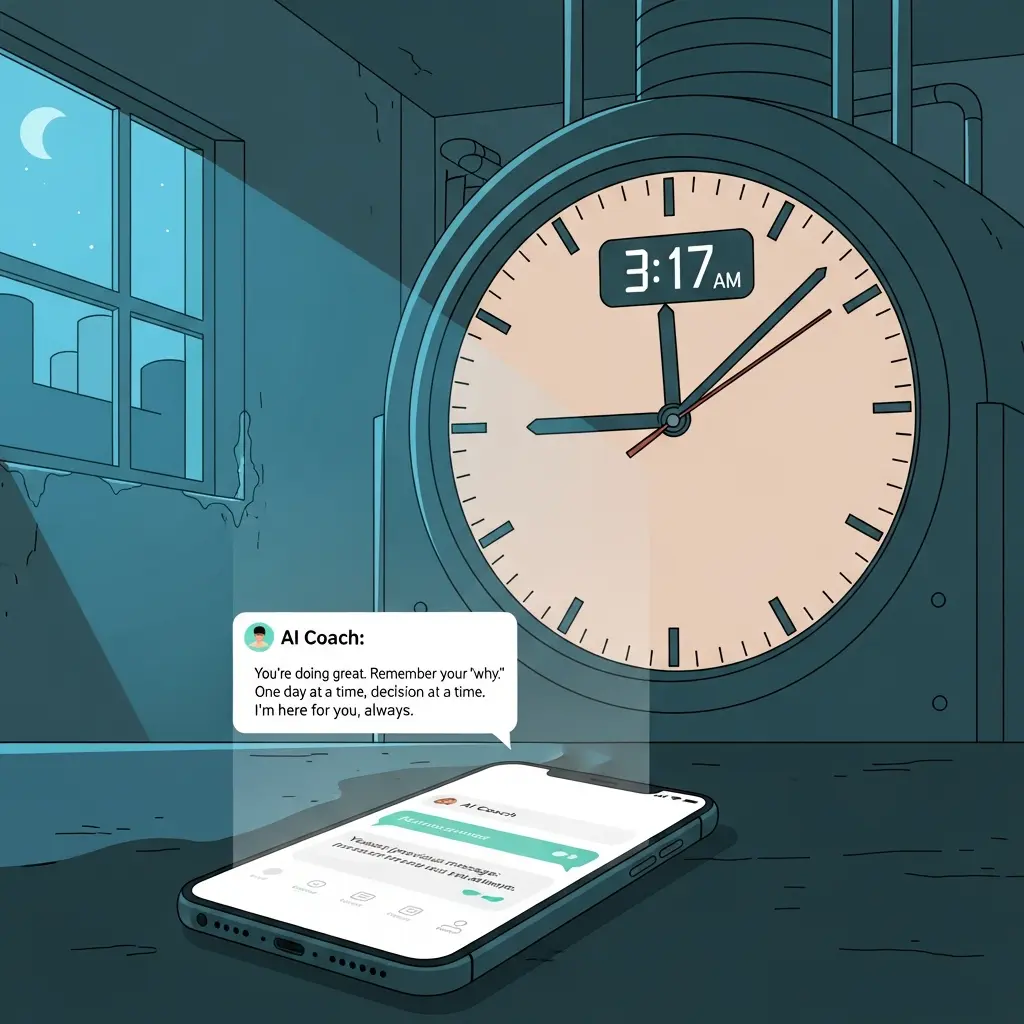
It’s 3:17am. Your break started eight minutes ago, the factory floor is quiet, and the craving hits — sharp, demanding, completely predictable if you’ve been through it before. Every quit-smoking resource you’ve found was written for people who wake up at 7am, commute at 9, and reach for a cigarette after dinner. None of them were built for you. That’s exactly the gap iQuit’s AI coach was designed to fill for the quit smoking app for shift workers who need support that doesn’t punch out when the rest of the world goes to sleep.
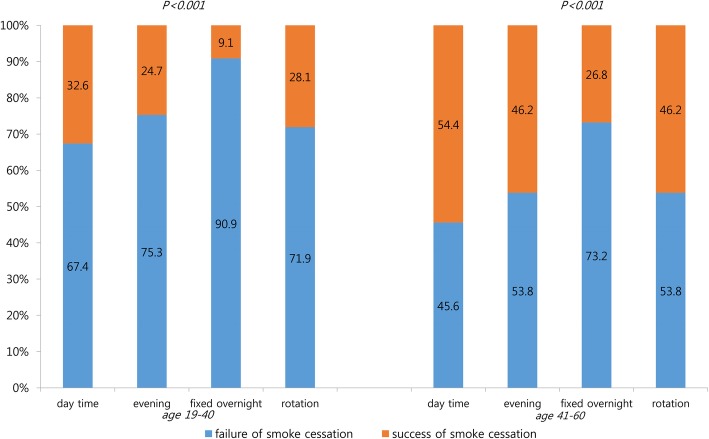
Night and rotating shift workers don’t just smoke more than their day-shift counterparts — they face a profoundly different neurochemical landscape when they try to quit. Disrupted cortisol rhythms amplify withdrawal discomfort. Monotonous overnight tasks intensify nicotine seeking. And when a craving breaks through at 2am or 4am, every human counsellor, every quitline, and every standard app notification is dormant. The consequence: published research in the Journal of Occupational Medicine and Toxicology found that fixed overnight workers have an odds ratio of 3.30 for smoking cessation failure compared to day workers — and among workers under 40, that risk climbs even higher. The 2026 workplace smoking statistics reinforce this: night and rotating shift workers use tobacco at 23–24%, compared to 19% for daytime workers, driven by the same structural pressures this app was built to counter.
This article is for nurses on nights, warehouse operatives, security guards, paramedics, hospitality staff, and anyone whose alarm goes off when the rest of the world is asleep. Here is exactly how iQuit’s AI coach works differently for you — and why 2026 is the year a genuinely shift-aware quit-smoking app finally exists.
Why Shift Workers Struggle to Quit: The Science
Before looking at solutions, it helps to understand why shift workers face such particular difficulty. The barriers are biological, social, and structural — and they compound each other in ways that standard smoking cessation programmes rarely acknowledge.
Symposium featuring occupational health researchers from Harvard University and OHSU on the impacts of shift work on physiology, health, and safety. Source: Oregon Institute of Occupational Health Sciences, OHSU
Circadian Disruption Amplifies Withdrawal
Your body regulates dozens of hormones on a roughly 24-hour cycle. Cortisol — the hormone most associated with wakefulness, stress response, and coping capacity — naturally peaks in the morning and declines through the afternoon. When you work nights, this cycle is repeatedly forced out of sync with your activity pattern. A 2025 review published in the International Journal of Molecular Sciences documented how night-shift work causes profound dysregulation of the hypothalamic-pituitary-adrenal axis — the very system that governs your capacity to tolerate stress, discomfort, and withdrawal.
Nicotine withdrawal is fundamentally a stress event. Your brain has become accustomed to nicotine regulating dopamine and acetylcholine. When you remove it, the resulting discomfort lands on a cortisol system that is already struggling to function at the right time. The withdrawal doesn’t necessarily hurt more — but your resilience to push through it is reduced, and the craving’s emotional weight feels heavier than it would for a day worker with a functioning cortisol rhythm.
Monotony and Isolation Fuel Nicotine Seeking
Research consistently identifies “monotonous night tasks and less stimulation” as drivers of intensive nicotine dependency during overnight shifts. When there is nothing happening, the mind reaches for stimulation — and for habitual smokers, nicotine has been the answer to boredom hundreds of times over. The break room cigarette at 3am is not just a physical craving; it is also the most interesting thing likely to happen in the next two hours.
Fixed overnight workers also face reduced social support for quitting. The same occupational medicine research notes that family support is a significant positive factor for smoking cessation — but fixed night workers often sleep when their family is awake, creating a structural barrier to the emotional encouragement that helps day workers persist through hard moments.
No Support When Support Is Needed
Quitlines close. Counsellors sleep. Even most smoking cessation apps are designed around morning motivation messages, evening check-ins, and a general assumption that “night” means “asleep.” For shift workers, the hardest moments — the 3am break, the 5am lull, the post-midnight vending machine walk — fall precisely in the window where standard support disappears. This is not a minor gap. It is the moment the quit attempt is most likely to fail. The full step-by-step strategy for addressing every stage of quitting as a shift worker — from choosing your quit date around your roster to managing slips on a long stretch of nights — is covered in our companion guide on how to quit smoking on night shift.
The 3am Craving Problem: What Makes It Different
A craving at 3am is not just a craving at an inconvenient hour. Several factors combine to make it uniquely difficult to manage:
| Factor | Why It Makes 3am Harder |
|---|---|
| Depleted willpower | You have already been awake for 6-8+ hours during what your biology considers sleep time. Cognitive self-regulation resources are low. |
| No human support available | Friends, family, counsellors, and quitline staff are asleep. Reaching out is not a realistic option. |
| Break time pressure | You may have 10-15 minutes. There’s no time for a lengthy distraction strategy — you need an immediate, effective intervention. |
| Environmental cues | The same break room, the same colleagues stepping outside, the same smell — identical triggers that previously ended in smoking. |
| Melatonin-dopamine interaction | Research on circadian rhythm and substance use shows melatonin influences reward pathways — when your melatonin pattern is disrupted, nicotine’s reward signal can feel more urgent. |
These factors mean that when a shift worker’s craving peaks at 3am, it arrives with more force, less resilience to resist it, and zero human support in the vicinity. That is precisely why an AI coach that operates around the clock changes the equation so fundamentally.
How iQuit’s AI Coach Works at 3am
iQuit’s AI coach doesn’t have office hours. It is as available at 3:17am on a Tuesday as it is at 11am on a Saturday. But availability alone is not the point — the design decisions behind how it responds to craving moments are what make it genuinely useful for shift workers.
Immediate Craving Intervention in Under 60 Seconds
When you open iQuit during a craving and tap the craving button, the AI doesn’t offer you a wall of text to read. It asks one question — how intense is this, right now? — and then delivers a targeted micro-intervention matched to your current situation. This might be a 4-7-8 breathing sequence with a timer, a brief mindfulness prompt, a reminder of your specific “why” statement, or a distraction challenge calibrated to your remaining break time.
The entire interaction is designed to fit in a break room window. You don’t need to be somewhere quiet, you don’t need Wi-Fi (core features work offline), and you don’t need to read a five-paragraph article about why you shouldn’t smoke. You need something that works in the next four minutes. That is what the AI delivers.
Personalised, Not Generic
The AI coach learns your pattern. It knows that your hardest craving tends to come at the first break of a night shift, not at the end. It notices that you’ve successfully navigated cravings on Wednesdays but struggle on Fridays when the week’s fatigue compounds. Over time, it begins proactively checking in just before your highest-risk windows — a nudge at 2:45am before the break you’ve historically struggled with, rather than a generic morning notification that reaches you while you’re sleeping.
This kind of pattern recognition — what researchers call Just-In-Time Adaptive Intervention (JITAI) — is the same mechanism behind the most effective digital cessation tools. A feasibility trial published in PLOS ONE for Quit Sense, a JITAI smoking cessation app, found that real-time, contextually triggered support was rated as highly acceptable and useful by participants. iQuit applies the same adaptive logic — with the addition of shift-schedule awareness.
Warm, Non-Judgmental Tone at the Hardest Moments
At 3am, after a long shift, the last thing you need is an app that makes you feel guilty for struggling. iQuit’s AI is calibrated to be compassionate rather than corrective. If you tap “I gave in,” the response is not a disappointed statistic — it is a brief, warm acknowledgement, a reminder that a lapse is not a failure, and a single concrete suggestion for the next craving. Progress continues. The streak resets, but the quit attempt does not end.
This matters because the evidence strongly supports that willpower alone is not sufficient for most smokers, and self-blame after a lapse is one of the most reliable predictors of a complete relapse. The AI’s warm recovery response is not cosmetic — it is a clinically grounded feature.
Configuring iQuit for Your Shift Pattern
Standard quit-smoking apps assume you sleep from roughly 10pm to 6am. iQuit does not. During setup, you configure your shift pattern, and the entire app experience — including check-in times, milestone celebrations, and the daily “health update” — adjusts to your schedule.
Supported Shift Patterns in 2026
- Fixed nights — consistent overnight schedule (e.g., 10pm-6am, 11pm-7am)
- Rotating shifts — alternating days, afternoons, and nights on a weekly or bi-weekly cycle
- Continental shifts — 12-hour days/nights with a 4-on/4-off or similar pattern
- Split shifts — two shorter blocks with a mid-day gap
- Day shifts — for users whose schedule is standard but who want tighter craving tracking
When you log a shift, iQuit’s system understands that your “morning” — the transition from sleep to wakefulness — might happen at 8pm. Your milestone notifications arrive when you wake up, not when the app thinks you should be awake. Your daily health stats are calculated against your logged quit time and your sleep period, not a generic 24-hour clock anchored to sunrise. For a real-time view of the health milestones the app tracks — from the first 20 minutes to the 10-year mark — see how iQuit tracks health recovery milestones in real time.
Craving Windows: Teaching the App Your Risk Profile
The app prompts you to identify your two or three highest-risk windows during setup. “First break of a night shift,” “walk to the car park after finishing,” “the hour before a double shift starts” — these become the moments the AI watches most closely. You can update these at any point as your pattern evolves.
The Craving Tracker: Built for Non-Linear Days
Standard smoking trackers count cravings by date and clock time — which creates a confusing picture when your “day” runs from 10pm to 8am. iQuit’s craving tracker works differently. Cravings are logged against your shift period rather than the calendar day, so you can see patterns like “cravings are heaviest in the second half of my shift” rather than a jumble of 2am and 3am data points that look random.
What the Tracker Captures
Each craving log records intensity (1-10), trigger context (boredom, stress, social cue, physical habit, emotional state), shift position (start, middle, break, end), and outcome (managed, partially managed, smoked). Over two to three weeks, a clear picture emerges: your actual craving landscape, mapped to your actual working life.
This data has two functions. First, it shows you that most cravings peak and pass within 3-5 minutes — something that is easy to intellectually know but hard to viscerally believe at 3am. Second, it gives the AI coach the information it needs to personalise your support. An AI coach that knows you always struggle at break two but rarely at break three can be strategically deployed — an automated push notification, a breathing reminder, a encouraging message — precisely when it matters.
Understanding how AI technology processes this kind of pattern data helps explain why the coaching feels increasingly accurate over time. It is not a static ruleset — it is a model updating on your individual trajectory.
What Research Says About App-Based Support
Scepticism about quit-smoking apps is reasonable — many are little more than glorified streak counters. But the evidence for well-designed, AI-powered mobile support is genuinely encouraging, particularly for populations with limited access to in-person services.
A randomised clinical trial published in JAMA Network Open in August 2025 involving 454 low-income smokers found that participants using an adaptive, personalised smoking cessation app (Smart-T, developed at the University of Oklahoma) were nearly twice as likely to have quit at six-month follow-up compared to those using a static tracking app. The key differentiator was real-time adaptive support: the app delivered up to five check-ins per day, generated personalised risk scores based on user responses, and sent tailored interventions — breathing exercises, NRT reminders, motivational content — based on the current craving context. Shift workers share all the characteristics that made this approach effective: unpredictable risk windows, limited peer support, and the need for rapid on-demand intervention.
Separately, research published in Scientific Reports demonstrated that passively collected smartphone movement data could predict smoking lapses with approximately 85% accuracy within a 5-minute window — compared with around 63% accuracy when relying on time-of-day triggers alone. This suggests that the future of AI coaching will involve even earlier, more precisely timed intervention. iQuit’s 2026 platform incorporates elements of this predictive approach, using logged craving patterns and shift data to anticipate high-risk moments rather than only responding after they occur.
For shift workers specifically, the advantage of a feature-rich quit smoking app is not just convenience — it is access equity. A quitline that closes at 9pm is structurally inaccessible to the millions of workers whose hardest moments arrive after midnight.
Practical Craving Strategies for the Night Shift Break Room
Alongside the AI coach, here are evidence-informed strategies that work in the specific constraints of a night shift break room environment — time-limited, sometimes cold, often socially charged with colleagues who may still smoke.
The 5-4-3-2-1 Grounding Technique
Identify five things you can see, four you can touch, three you can hear, two you can smell, one you can taste. This sensory anchor technique interrupts the craving loop by redirecting attention to the present environment. It takes under two minutes and requires nothing but your own senses. iQuit’s AI coach can walk you through it on screen if you need the guidance.
NRT Timing for Night Shifts
If you’re using nicotine replacement therapy (patches, gum, lozenges, or inhalators), timing matters more for shift workers. A patch applied at the start of a night shift delivers nicotine through the quiet small-hours period when your resilience is lowest. Discuss timing with your pharmacist or GP — night-shift NRT optimisation is a legitimate and under-discussed adjustment. Log your NRT use in iQuit so the AI has a complete picture of your nicotine profile.
Reframe the Break Room
If possible, spend at least some of your breaks in a different physical space from where you previously smoked. Environmental cue disruption is one of the most reliable short-term craving reducers. Even moving to a different corner of the same room changes the sensory context enough to reduce the automatic pull of the smoking habit.
Tell One Colleague
You don’t need everyone to know — but telling one trusted colleague on your shift that you’re quitting creates a small accountability anchor at exactly the time of night when you most need it. Most colleagues, even smokers, will be supportive. If they offer you a cigarette, a simple “I’m quitting, cheers though” is sufficient.
Drink Something Cold
Cold water, a cold juice, even a cold non-caffeinated drink engages the vagal nerve response and can blunt the acute peak of a craving within 90 seconds. It is not a cure — but it buys you enough time for the AI coach to deliver a proper intervention.
iQuit’s AI coach is available at 3am, 4am, and every hour between. Download the iQuit — Quit Smoking App and configure it for your shift pattern in under five minutes. Your first craving support session is free, and there is no algorithm that assumes you sleep at night.
Frequently Asked Questions
Is iQuit’s AI coach actually available at 3am?
Yes. iQuit’s AI coach operates 24 hours a day, 7 days a week, with no scheduled downtime. The core craving intervention features — the craving log, the breathing exercises, the personalised micro-interventions, and the motivational content — are available at any hour, including offline mode for environments without reliable connectivity. The AI does not have “business hours.”
Why do shift workers find it harder to quit smoking than day workers?
Multiple factors combine: circadian rhythm disruption reduces stress-coping capacity during withdrawal; monotonous overnight tasks amplify nicotine seeking as a stimulation strategy; social support is harder to access when your schedule is the inverse of everyone else’s; and standard cessation services (quitlines, counsellors, most apps) are designed around daytime use patterns. A peer-reviewed study in the Journal of Occupational Medicine and Toxicology found fixed overnight workers have an odds ratio of 3.30 for failed quit attempts compared to day workers.
Can I set iQuit to match my rotating shift schedule?
Yes. iQuit supports fixed nights, rotating shifts (days/afternoons/nights), continental 12-hour patterns, and split shifts. You can log your upcoming shift rotation and the app adjusts its check-in timing, milestone notifications, and craving monitoring windows to match your actual sleep-wake pattern rather than a default 9-to-5 assumption.
What does the AI coach actually do when I report a craving?
When you log a craving, the AI assesses its intensity, your current time and shift position, and your historical craving patterns. It then delivers a personalised micro-intervention: this might be a timed breathing exercise, a grounding technique, a reminder of your personal quit reason, an NRT prompt, or a distraction challenge. The entire interaction is designed to fit within a short break — typically 2-4 minutes — and works offline.
What should I do if I give in to a craving at 3am?
Log it honestly in iQuit. The app’s response will not be judgmental — it will acknowledge the difficulty, remind you that a lapse during a quit attempt is not a failure, and offer a single concrete next step. Evidence consistently shows that self-compassion after a lapse (rather than self-blame) is associated with better long-term quit outcomes. The AI coach is designed around this principle.
Are there specific NHS or CDC resources for shift workers who want to quit smoking?
The NHS Better Health quit smoking service and the CDC’s Tips From Former Smokers campaign both provide general cessation resources, though neither offers shift-worker-specific tools. The NHS recommends combining behavioural support with NRT as the most effective approach — something iQuit facilitates by integrating NRT logging, behavioural coaching, and pattern-based AI support in a single app accessible at any hour.
Start Your Quit — On Your Schedule
iQuit’s AI coach never sleeps, never judges, and never assumes you keep office hours. Whether you work fixed nights, rotating shifts, or a pattern that changes every week, iQuit adapts to your reality — not the other way around.
Download the iQuit — Quit Smoking App today. Set your shift pattern, identify your highest-risk craving windows, and know that the next time a craving hits at 3am, something effective is waiting in your pocket.