Quit Smoking Apps vs Nicotine Gum: Which Is More Effective in 2026?
When you’re planning your quit strategy, you’ll likely consider both quit smoking apps and nicotine gum as tools. But comparing them directly reveals a fundamental misunderstanding of what each one does — they work on entirely different dimensions of addiction, and the most effective approach uses both together. This guide explains what each tool actually accomplishes, what the evidence shows about effectiveness, and how to combine them for the best results.
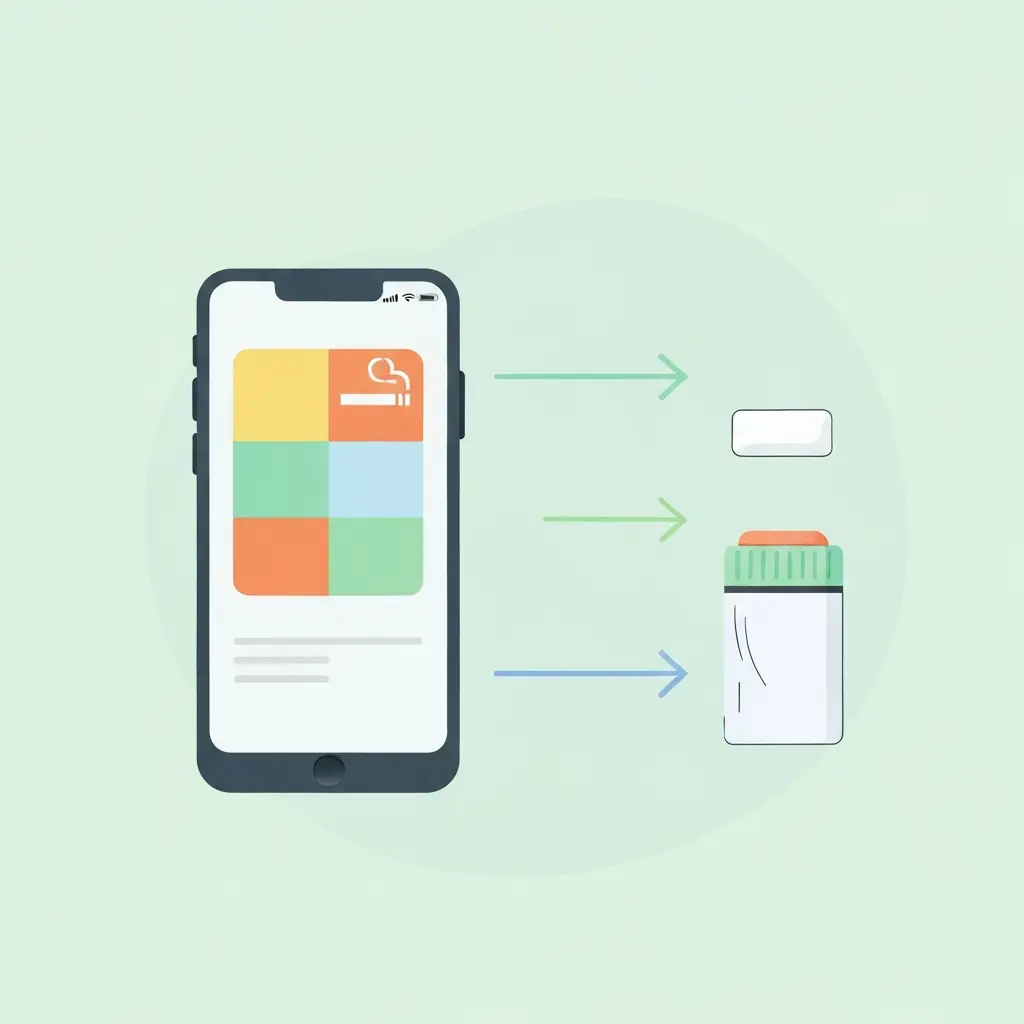
The “app vs. gum” framing is common but somewhat misleading: nicotine gum is pharmacological (it manages the physical, neurochemical dimension of withdrawal), while a quit smoking app is behavioral (it manages the psychological, habitual, and motivational dimensions). Understanding this distinction makes the right strategy obvious: they’re complementary, not competing.
Different Dimensions of Addiction
Nicotine addiction operates on two distinct levels, and effective cessation needs to address both:
The Physical Dimension
Nicotine causes physical dependence through its action on nicotinic acetylcholine receptors. When nicotine is absent, the brain signals distress — cravings, irritability, anxiety, difficulty concentrating, increased appetite. This is withdrawal, and it is a genuine physiological process, not merely psychological.
What addresses it: Nicotine replacement (gum, patches, lozenges) or nicotinic receptor medications (varenicline, cytisine).
The Behavioral/Psychological Dimension
Beyond the physical, smoking is deeply embedded in daily habits and emotional coping. You smoke after meals, with coffee, under stress, out of boredom. These are conditioned responses — the brain has created thousands of associations between situations and smoking over years. Even after physical withdrawal is over, these associations trigger cravings.
What addresses it: Behavioral support — counseling, cognitive behavioral techniques, trigger management, community accountability, progress visualization. This is where quit smoking apps operate.
Nicotine Gum: What the Evidence Shows
Nicotine gum is one of the most studied smoking cessation interventions in medical history. Key findings from the evidence base:
- Efficacy vs. placebo: Cochrane meta-analysis (136 trials, 64,000+ participants) found NRT increases quit rates by 50–70% compared to placebo. This applies to all NRT forms including gum.
- Gum vs. other NRT: In direct comparisons, gum, patches, lozenges, and inhalers show similar efficacy at equivalent nicotine delivery. Choice should be based on preference and smoking pattern.
- 4mg vs. 2mg gum: 4mg gum is significantly more effective for smokers with high dependence (smoke within 30 minutes of waking) — underdosing is one of the most common NRT mistakes.
- When used correctly: The chew-and-park technique is critical. Many people use nicotine gum like regular gum (continuous chewing), which causes stomach upset and reduces nicotine absorption by 70%.
- Duration: Longer use (up to 14 weeks vs. standard 8 weeks) improves quit rates in some studies.
Nicotine gum’s limitation is that it manages the physical craving without addressing the habitual, psychological, and motivational dimensions. This is why gum use alone, without behavioral support, shows meaningful but modest long-term quit rates.
Quit Smoking Apps: What the Evidence Shows
Research on quit smoking apps has accelerated significantly since 2019, with several high-quality systematic reviews now available:
- 2025 Nature Human Behaviour meta-analysis: Interactive apps with personalized features significantly increase abstinence rates compared to control conditions — effect sizes comparable to brief behavioral counseling.
- Cochrane 2019 review: Smartphone interventions may increase quit rates but evidence was more uncertain; identified behavioral feature complexity as a key moderator — more interactive apps outperformed passive apps.
- Key evidence-based features: Real-time craving management, personalized coaching, progress tracking, and social support features are the behavioral components with the strongest evidence base.
- Mechanism: Apps work by providing immediate behavioral intervention at the moment of a craving — exactly when coping strategies are needed but professional support isn’t available. The portability and 24/7 availability is a genuine advantage over in-person counseling.
Apps’ limitation is that they provide no pharmacological support for physical withdrawal. The behavioral coaching delivered during an intense physical withdrawal craving at 48 hours post-quit is less effective without NRT managing the underlying physiological distress.
Direct Comparison
| Factor | Nicotine Gum | Quit Smoking App |
|---|---|---|
| Primary mechanism | Pharmacological — replaces nicotine | Behavioral — coaching and habit support |
| What it addresses | Physical withdrawal and acute cravings | Psychological triggers, habits, motivation |
| Speed of action | 5–10 minutes to reduce craving | Immediate (cognitive distraction), longer for habits |
| Cost | £30–60 for 12-week course (often free via NHS) | Free tier available; premium ~£3–5/month |
| Side effects | Hiccups, jaw soreness, stomach upset if incorrect technique | None |
| Long-term benefit | Primarily first 8–12 weeks | Ongoing support for behavioral habits |
| Evidence quality | Very high (decades of RCTs) | Growing (strong recent evidence) |
The Case for Using Both
The pharmacological + behavioral combination is the most consistently supported approach in cessation science. Multiple studies have demonstrated that combining NRT with behavioral support produces outcomes significantly better than either alone. In controlled trials:
- NRT alone: ~1.5x improvement in quit rate vs. placebo
- Behavioral support alone: ~1.5–2x improvement vs. no support
- NRT + behavioral support: ~3–4x improvement vs. unassisted cold turkey
The reason the combination outperforms the sum of parts is that the two interventions address the phases where each tool is most effective. Gum manages the acute physiological withdrawal of days 1–14; the app manages the behavioral conditioning phase that extends from weeks 2 through months. At day 45, when a situational craving hits after a stressful meeting, there’s no physiological nicotine deficit — but there is a conditioned habitual response. The app’s behavioral tools are what helps there.
The principle of combining complementary tools is well-established across domains — just as AI-powered content tools work best when combined with human strategic oversight, and academic platforms like Tesify complement rather than replace student effort, nicotine gum and quit apps together address the full spectrum of the challenge.
Practical Guide: Using App + Gum Together
Here’s how to integrate both tools effectively into your quit plan:
Week 1 (Days 1–7): Physical withdrawal dominance
- Use nicotine gum (4mg if high dependence) proactively — every 1–2 hours, not just when cravings hit
- Open the iQuit app when a craving occurs — follow the breathing exercise or distraction prompt while the gum begins working
- Log every craving in the app to identify patterns
Weeks 2–4: Transitional phase
- Begin reducing gum frequency (from every 1–2 hours to every 3–4 hours as cravings allow)
- Use the app’s trigger analysis to identify your highest-risk situations
- Prepare specific alternative responses for your top 3 triggers
Months 2–3: Behavioral maintenance
- Gum step-down to 2mg and then as-needed only
- App becomes primary tool — check milestone tracker, use craving tools for situational urges
- Use app community or external support for particularly difficult trigger situations
Frequently Asked Questions
Should I use a quit smoking app and nicotine gum at the same time?
Yes — this is the recommended approach. They address different dimensions of addiction (physical vs. behavioral) and work best together. When a craving hits, use the gum for the pharmacological component and the app for the behavioral coping strategy simultaneously. The combination consistently outperforms either alone in research.
Which is more effective for reducing cravings: an app or nicotine gum?
For acute physical cravings in the first 1–2 weeks, nicotine gum addresses the root cause (nicotine deficiency) more directly. For conditioned psychological cravings after week 3 or 4 (when physical dependence has largely resolved), behavioral app tools are more relevant because there’s no nicotine deficit to address. Over the full quit timeline, both matter at different stages.
How long should I use nicotine gum when quitting?
Standard nicotine gum courses are 8–12 weeks, with a step-down from higher frequency (every 1–2 hours) to lower frequency (every 4–8 hours) and then as-needed. Research shows that continuing NRT beyond the labeled duration is safe and helps some people stay smoke-free. It is always better to use gum longer than to return to smoking.
Does nicotine gum cause dependence?
Long-term dependence on nicotine gum occurs in a minority of users (estimates range from 5–15% of users maintain use beyond 12 months). However, long-term gum use is far safer than smoking — it delivers nicotine without the thousands of toxic chemicals in cigarette smoke. If you find yourself using gum long-term, this is manageable and preferable to relapse; discuss a gradual step-down plan with your healthcare provider.
What is the correct technique for using nicotine gum?
Use the “chew and park” technique: chew slowly 3–5 times until you notice a tingling or peppery sensation, then park the gum between your cheek and gum for 1 minute. Chew again when the sensation fades. Repeat for 30 minutes. Avoid eating or drinking 15 minutes before or during use. Acidic drinks (coffee, juice) significantly reduce nicotine absorption. Continuous chewing (like regular gum) reduces effectiveness and causes jaw soreness and hiccups.
Do quit smoking apps work as well as counseling?
In some comparisons, interactive apps with personalized coaching achieve similar effect sizes to brief counseling interventions (1–4 sessions). Apps have one significant advantage: availability. Professional counseling is typically limited to scheduled sessions, while an app delivers support at the exact moment of a craving — 11pm on day 3, in a social situation, or at a work desk. The best outcome is usually combining app support with at least some professional or NHS guidance.
What are the side effects of nicotine gum?
Common side effects include jaw soreness (from incorrect continuous chewing), hiccups, stomach upset (from swallowing nicotine-rich saliva), nausea, and throat irritation. Most side effects are technique-related and resolve with correct use. Less commonly: headache, racing heart (if using too much). Using the chew-and-park technique correctly eliminates most gastrointestinal side effects.
Can I use a quit smoking app without NRT?
Yes, and you’ll still benefit. A quit app without NRT is significantly better than no support at all, particularly for the behavioral components of quitting. For light smokers with lower physical dependence, app-only support may be sufficient. For moderate-to-heavy smokers, combining the app with at least some form of NRT (or prescription medication) substantially improves long-term outcomes.
The Complete Approach: App + Gum + Plan
The iQuit app is designed to work alongside your NRT — tracking your progress, managing the behavioral and psychological dimensions of quitting, and providing evidence-based craving support when physical withdrawal and habitual triggers combine. Download free and pair it with your nicotine gum for a comprehensive quit strategy.