Quit Smoking Benefits Timeline: Every Milestone From 20 Minutes to 15 Years
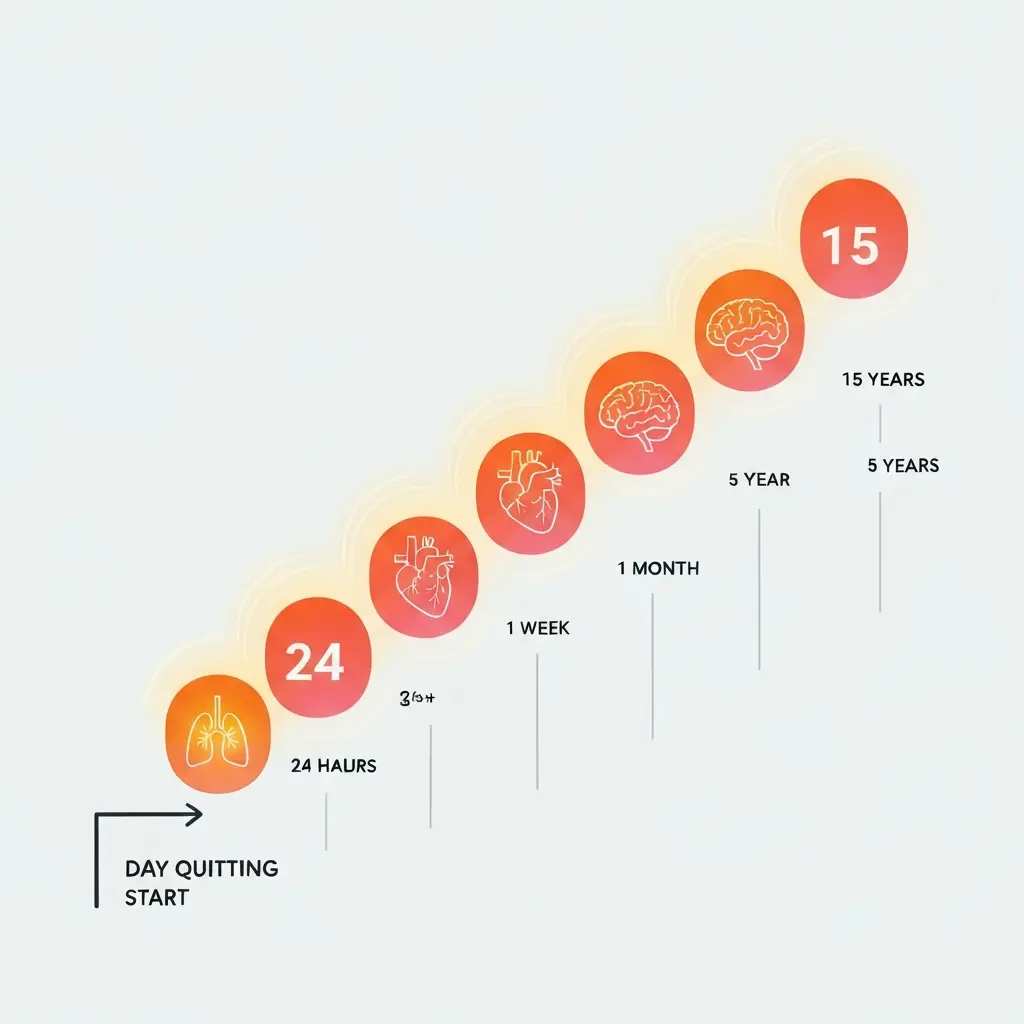
The quit smoking benefits timeline is one of the most compelling documents in all of preventive health. It shows, with surgical precision, that the body’s capacity for healing after you stop smoking is extraordinary — that benefits begin within minutes, accelerate through weeks and months, and compound over years in ways that genuinely rival the damage that smoking caused. This guide presents every documented milestone on that timeline, with the specific biological mechanisms behind each change.
Data sources for this timeline include the Centers for Disease Control and Prevention (CDC), World Health Organization (WHO), American Cancer Society (ACS), NHS, and published research from the American Heart Association. These are not estimates — they are documented outcomes from population-level studies of former smokers measured against never-smokers and continuing smokers.
Immediate Benefits: Minutes to 24 Hours
20 Minutes After Quitting
Heart rate begins dropping toward normal. Blood pressure decreases. Peripheral circulation to hands and feet improves — fingers and toes warm up as blood flow normalizes. These are the fastest health improvements of the entire timeline and they begin with your very last cigarette. Source: CDC
8 Hours After Quitting
Nicotine and carbon monoxide levels in the blood drop by approximately 50%. The remaining carbon monoxide is being displaced from haemoglobin by oxygen, improving the blood’s oxygen-carrying capacity. Source: NHS
24 Hours After Quitting
Nicotine is completely cleared from the bloodstream. Carbon monoxide is fully eliminated. Blood oxygen is at non-smoker levels. Heart attack risk begins dropping — studies show measurable cardiovascular risk reduction within the first 24 hours of cessation. Source: ACS, CDC
One Week Benefits
By one week smoke-free:
- Taste and smell receptors are recovering — food and aromas taste and smell noticeably more vivid
- Cilia in the airways have begun regrowing — tiny hair-like structures responsible for clearing mucus and debris
- Blood pressure has stabilized at meaningfully lower levels than during smoking
- The first critical statistical threshold for cessation success has been crossed: smokers who reach day seven have over 60% higher 12-month abstinence rates than those who relapse in the first week
One Month Benefits
Quit smoking one month benefits include some of the most tangible physical changes of the early quit period:
- Lung function is measurably improving — breathing is noticeably easier, particularly after exertion
- Coughing and shortness of breath are decreasing for most former smokers
- Energy levels have improved — many quitters report feeling substantially more energetic by one month than at any point during their smoking years
- Skin circulation has improved — complexion may be noticeably better, with improved color and reduced dullness
- Money saved: $300–$500 (at typical US cigarette costs for a pack-a-day smoker)
One month is also the milestone where the acute psychological adjustment to being smoke-free begins to complete. The sense of being a “non-smoker” rather than someone “trying to quit” begins emerging for many former smokers around weeks 3–4.
Three Months Benefits
By three months smoke-free, the physical recovery is accelerating:
- Lung function: Increased by approximately 10% compared to quitting day — measurable with spirometry
- Circulation: Significantly improved throughout the body, with hand and foot temperature normalized and exercise capacity noticeably better
- Fertility: For women, fertility has improved (smoking suppresses fertility); for men, sperm motility and density have improved
- Immune function: The frequency of coughs, colds, and respiratory infections begins decreasing
- Mental health: Baseline anxiety and depression scores have typically improved to below smoking-period levels by 8–12 weeks
Nine Months Benefits
At nine months:
- Cilia are fully regenerated and functioning — the airways’ mucus-clearing system is operating normally
- Lung mucus production has normalized — most former smokers experience significantly fewer respiratory infections than during smoking
- Airways are substantially less inflamed — the chronic bronchitis-like inflammation from smoking is largely resolved
- Many former smokers are running, hiking, cycling, or exercising at intensities that would have been impossible at their peak smoking
One Year Benefits
The one-year milestone is a landmark in cessation medicine:
Heart attack risk: Research from the BMJ found heart attack risk drops by approximately 50% within one year of quitting.
Cancer risk: Mouth and throat cancer risk has begun decreasing. Bladder cancer risk is declining.
Money saved: $3,000–$6,500 depending on habit and location — often enough for a significant holiday, investment, or major purchase.
Clinically, 12 consecutive months of abstinence defines you as a former smoker rather than a quitter — an important psychological and statistical threshold. You have also qualified for re-rating as a non-smoker for health and life insurance purposes.
Five Years Benefits
By five years smoke-free:
- Stroke risk: Reduced to the same level as a never-smoker. Source: ACS
- Mouth, throat, esophagus, and bladder cancer risk: Cut by half compared to a current smoker
- Cervical cancer risk: Reduced substantially for female former smokers
- Coronary artery disease: Risk continues declining, approaching never-smoker equivalence for many former smokers
Ten Years Benefits
Ten years of smoke-free living brings:
- Lung cancer risk: Approximately half that of a current smoker — one of the most significant cancer risk reductions on the entire timeline. Source: CDC
- Pancreatic cancer risk: Significantly decreased
- Laryngeal cancer risk: Substantially reduced
- Kidney cancer risk: Declining toward non-smoker levels
Ten years is also the milestone where the cumulative financial savings become genuinely life-changing. A pack-a-day smoker at $12/pack, invested at 7% per year, has approximately $60,000 in savings by year 10 that would not exist if they had continued smoking.
Fifteen Years Benefits
At fifteen years smoke-free, the cardiovascular risk profile reaches its final milestone:
Coronary heart disease risk is equivalent to that of a person who has never smoked. Source: WHO
This is the most powerful statement in the entire quit smoking benefits timeline. After 15 years of abstinence, the cardiovascular system has recovered to a state that is statistically indistinguishable from never having smoked. For someone who smoked for decades, this represents a complete reversal of one of smoking’s most lethal consequences.
How to Celebrate Each Milestone
Milestone celebration is not incidental to cessation success — it is integral to it. Research on habit formation shows that reward at milestone moments reinforces the new identity and behavioral pattern. Here are ways to mark each stage:
- 1 week: A meal at a favourite restaurant — use the week’s cigarette savings
- 1 month: A specific purchase you designated as your one-month goal
- 3 months: A weekend experience — a trip, a concert, a spa day
- 1 year: A major celebration with the people who supported your quit
The iQuit app notifies you at each milestone with a specific, medically accurate celebration — telling you exactly what has changed in your body at this moment. This turns the quit smoking benefits timeline from an abstract list into a personalized, real-time experience of recovery. See our detailed guide to what happens when you quit smoking for the complete health story.
For health advocacy organizations promoting cessation through milestone-based messaging campaigns, CampaignOS automates the delivery of personalized milestone notifications at exactly the right moment for each participant. Research tools like Tesify provide access to the primary literature underpinning each point on this timeline.
Frequently Asked Questions
What happens to your body at one month smoke-free?
At one month smoke-free, lung function is measurably improving, coughing and shortness of breath are decreasing, energy levels are significantly better, skin circulation has improved, and mental health scores have begun improving from smoking-period lows. One month is also typically when the psychological transition to a non-smoker identity begins feeling real rather than effortful.
What are the quit smoking benefits at 3 months?
At three months smoke-free, lung function has increased by approximately 10% (CDC), circulation is significantly improved, fertility has improved (for both sexes), immune function is recovering with fewer respiratory infections, and baseline anxiety and depression scores have typically fallen below smoking-period levels. Three months also marks the point where most quitters experience cravings as occasional and manageable rather than constant.
What are the quit smoking one year benefits?
The most significant one-year benefit is that coronary heart disease risk is halved compared to a current smoker — one of the largest single-year cardiovascular risk reductions of any modifiable risk factor. Additionally, cancer risks have begun declining, $3,000–$6,500 has been saved in cigarette costs, and you qualify for non-smoker health and life insurance rates after 12 months of abstinence.
Does quit smoking timeline apply to all smokers equally?
The timeline milestones apply broadly across former smoker populations, but absolute risk levels vary based on how long someone smoked, how many cigarettes per day, genetics, and other health factors. The percentage risk reductions at each milestone are consistent — a 50% reduction in heart disease risk at one year applies whether you smoked 5 cigarettes or 30 per day. The absolute risk is different, but the relative improvement is consistent.
Celebrate Every Milestone of Your Recovery
iQuit tracks your quit smoking benefits timeline in real time and sends you personalized milestone notifications — turning every stage of recovery into a moment worth celebrating.