
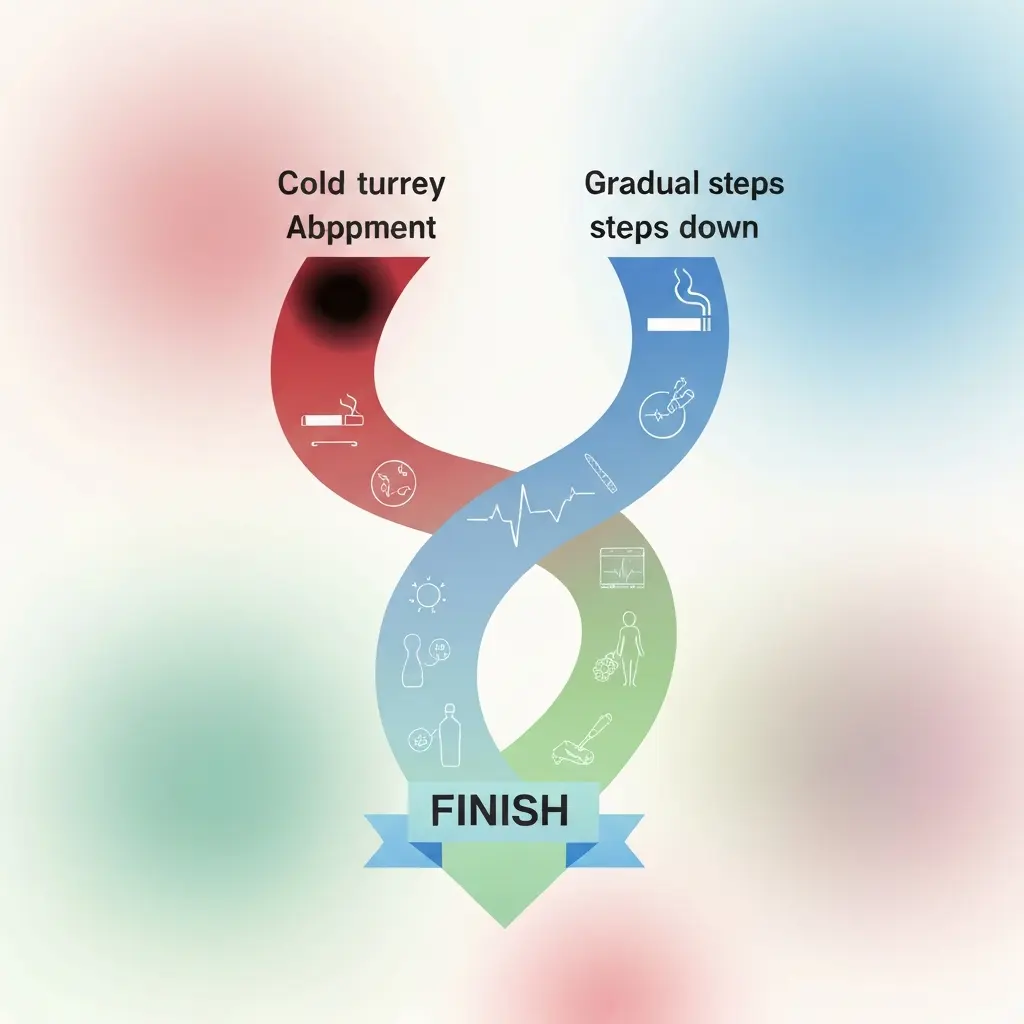
Is It Better to Quit Smoking Cold Turkey or Gradually? What the Science Really Shows in 2026
Is it better to quit smoking cold turkey or gradually? This is one of the most debated questions in smoking cessation, and the answer is more nuanced than you might expect. A landmark randomized controlled trial published in the Annals of Internal Medicine found that abrupt quitting produced a 22% success rate at six months, compared to 15.5% for the gradual reduction group. But success rates alone do not tell the whole story — and for many people, the right method depends on personality, nicotine dependence level, and available support.
This evidence-based guide cuts through the noise, presents the key clinical findings from both approaches, and helps you identify which strategy gives you the best personal odds of becoming smoke-free for good in 2026.
What Do Cold Turkey and Gradual Reduction Actually Mean?
Cold turkey cessation means setting a quit date and stopping all smoking abruptly on that day with no planned transition period. You smoke your last cigarette the night before, and when you wake up the next morning, you are no longer a smoker. This method does not preclude using NRT or medication — it simply means the behavioral act of smoking stops completely on a defined day rather than being tapered.
Gradual reduction means systematically decreasing the number of cigarettes smoked each day over a period of several weeks before a final quit date, or using controlled approaches like scheduled cigarette timing (extending gaps between cigarettes). Some variations involve switching to lower-nicotine cigarettes, though this is no longer recommended because smokers typically compensate by inhaling more deeply.
It is critical to note that most clinical comparisons are between abrupt cessation versus gradual reduction without NRT. When NRT is added to the gradual reduction arm, the differences in outcomes narrow considerably. This context is essential for interpreting the evidence fairly.
What Does the Research Say About Cold Turkey?
The most cited head-to-head trial (Lindson-Hawley et al., published in the Annals of Internal Medicine) randomized 697 smokers to either abrupt cessation or gradual reduction. Both groups received behavioral counseling and NRT. At four weeks, 49% of the abrupt group had successfully quit compared to 39.2% of the gradual group. At six months, 22% of the abrupt group versus 15.5% of the gradual group remained smoke-free. Smokers in the abrupt group were approximately 25% more likely to be abstinent at six months.
A meta-analysis published in Tobacco Induced Diseases found consistent but modest advantages for abrupt cessation across multiple studies. The primary reasons identified for cold turkey’s superior outcomes include: a cleaner psychological break from the smoking behavior and identity, less opportunity for the decision to quit to erode gradually, and the motivational power of a firm commitment on a defined date.
The NHS and most major health bodies recommend the abrupt approach as the standard first-line strategy for most smokers, combined with NRT or medication started on or just before the quit date. However, they acknowledge that the method a person is most willing to attempt is always better than the theoretically superior method they abandon.
Does Gradual Reduction Work as Well?
Gradual reduction is not ineffective — it is modestly less effective than cold turkey in head-to-head comparisons, but it remains far more effective than no structured attempt at all. Importantly, when gradual reduction is paired with NRT and behavioral support, the gap narrows significantly. Research from the Cochrane Collaboration found that using NRT during a reduction phase before quitting improved the probability of achieving abstinence compared to unassisted reduction.
For smokers who are highly dependent on nicotine or who feel psychologically incapable of stopping abruptly, gradual reduction offers a viable on-ramp to quitting. The psychological benefit of building confidence through early reductions, combined with NRT support, can make the eventual quit date more achievable for this group.
Gradual reduction can also be a useful first step for smokers who are “not ready” to set a quit date — it engages them in the cessation process and moves them toward readiness, even if the timeline is longer than cold turkey. Any reduction in smoking is associated with meaningful health benefits, and momentum matters in behavioral change.
How Does Withdrawal Differ Between the Two Methods?
Cold turkey produces a sharper, more concentrated withdrawal experience. Symptoms typically peak around day three and substantially resolve within two to four weeks. The intensity is higher in the acute phase, but the duration of severe discomfort is shorter. Many people who have successfully quit this way describe an almost military mindset: endure the worst for two weeks, knowing it will progressively improve.
Gradual reduction spreads the withdrawal discomfort over a longer period. Each reduction step produces a milder withdrawal response, but the process can feel like repeatedly experiencing withdrawal without ever fully completing it. Some research suggests this can be psychologically draining — the anticipation of complete cessation extends, and motivation can erode over a long reduction period.
Both approaches benefit enormously from NRT management of withdrawal symptoms. The CDC reports that NRT reduces withdrawal severity by 50–60% regardless of whether the cessation approach is abrupt or gradual. This is why most healthcare guidelines recommend NRT as the default accompaniment to both strategies rather than as specific to one.
Which Method Is Better for You Personally?
Cold turkey is likely better for you if: you are highly motivated and have a clear quit date in mind, you have successfully completed other major behavioral changes with a decisive cut, you smoke fewer than 15 cigarettes per day, and you have strong social support. The psychological clarity of a clean break works well for people with a decisive behavioral style.
Gradual reduction may be better for you if: you smoke more than 20 cigarettes per day and feel that cold turkey withdrawal would be unmanageable, you have a history of severe anxiety or depression that could be destabilized by acute withdrawal, previous cold turkey attempts have always ended in relapse before week two, or you are not yet fully committed to a quit date and need a transition process to build confidence.
Regardless of which approach you choose, combining it with evidence-based support — NRT, medication if appropriate, behavioral counseling, and a tracking tool like iQuit — is far more important than the specific cessation style. A person using cold turkey with full support will generally outperform someone using gradual reduction without any support; but both will outperform an unaided quit attempt of either type.
Can You Combine Both Approaches?
Yes — a practical combination that many healthcare providers recommend is a brief pre-quit reduction phase (1–2 weeks) to cut down to 10 cigarettes per day, followed by an abrupt quit date with NRT started on that day. This approach retains the motivational clarity of a fixed quit date while reducing the peak nicotine dependence level you enter the abrupt phase with, potentially softening the initial withdrawal intensity.
The key is setting a concrete quit date no more than two weeks from the decision to quit. Reduction without a firm end date tends to drift indefinitely — the reduction becomes the goal rather than the quit date itself. Using iQuit to track your daily count during the reduction phase and then your smoke-free streak from quit day onward creates a natural transition with continuous data showing your progress.
For context on how behavioral change science applies to health outcomes in 2026, this resource on Marketing Automation for Healthcare 2026 is illuminating. If you’re also exploring how apps and digital nudges support habit change, see this guide on How to Use Push Notifications for Marketing. For more on evidence-based approaches to quitting smoking, see our detailed guide on what is the most effective way to quit smoking.
Frequently Asked Questions
Is cold turkey the most effective way to quit smoking?
Cold turkey produces higher abstinence rates than gradual reduction in head-to-head clinical trials — approximately 22% versus 15.5% at six months. However, the most effective overall approach is any cessation method combined with pharmacotherapy (varenicline or combination NRT) and behavioral support, regardless of whether the quit is abrupt or gradual.
How painful is quitting cold turkey compared to gradual reduction?
Cold turkey produces more intense but shorter withdrawal — symptoms peak around day three and substantially ease by week two to four. Gradual reduction distributes the discomfort over a longer period, with milder but more prolonged symptoms. NRT significantly reduces withdrawal severity with either approach. Most people find cold turkey’s concentrated discomfort more manageable than extended low-level suffering.
Can I use NRT if I quit cold turkey?
Yes — NRT and cold turkey are entirely compatible and the combination is strongly recommended. Cold turkey describes the behavioral cessation (no cigarettes from quit day), while NRT manages the physiological withdrawal. Starting NRT on your quit date or just before it can reduce craving intensity by 50–60% during the most challenging first weeks.
Does cutting down on cigarettes have any health benefits even if you don’t quit?
Some health benefits come from reducing smoking, but they are significantly smaller than the benefits of complete cessation. Smoking dose-response for most diseases — particularly lung cancer, heart disease, and COPD — means there is no fully safe level of smoking. Reduction is valuable primarily as a stepping stone to quitting, not as a long-term goal in itself.
What percentage of people successfully quit cold turkey without any help?
Only 3–5% of unaided cold turkey quit attempts result in long-term abstinence (12 months). This low rate reflects the strength of nicotine dependence, not a failure of motivation. Adding NRT raises this figure to approximately 10–15%, and adding behavioral counseling alongside NRT or medication produces 20–25% long-term success rates.
Is it bad to smoke a few cigarettes while trying to quit gradually?
During a planned gradual reduction phase, controlled smoking within your reduction target is part of the plan. However, any smoking after your quit date significantly increases the risk of full relapse, because nicotine rapidly restimulates reward pathways in the brain. Even a single cigarette after your quit date should be treated as a trigger warning — not evidence that you have failed, but a signal to reinforce your coping strategy immediately.
Which method is recommended by the NHS for quitting smoking?
The NHS recommends setting a quit date and stopping abruptly (cold turkey style) while using NRT or medication from that date. This approach is supported by NICE guidelines and the bulk of clinical evidence. The NHS also provides free stop smoking support through local services, telephone counseling, and the NHS App.
How soon after quitting cold turkey do cravings become manageable?
Cravings typically peak in intensity during days two to three after quitting cold turkey and begin to ease significantly by the end of the first week. By week two, most people report cravings that last 3–5 minutes rather than feeling constant. By week four, the frequency of cravings drops noticeably for most former smokers, though psychological cravings triggered by specific situations can persist for months.
Choose Your Method — Then Give It Everything
Whether you choose cold turkey or gradual reduction, iQuit helps you execute your plan with real-time tracking, craving management tools, and daily motivation. Set your quit date, log your progress, and use the craving timer to get through the moments that feel hardest.
Download iQuit today and take the most important step in the most effective quit attempt you have ever made.