
Quit Smoking Heart Health Statistics: How Your Heart Recovers After Cessation 2026
Cardiovascular disease is the leading cause of death globally — and smoking is one of its most powerful modifiable risk factors. The quit smoking heart health statistics for 2026 show both the substantial cardiovascular burden of smoking and the remarkable speed at which heart health begins recovering after cessation. The cardiovascular case for quitting is one of the most compelling in medicine.
These statistics are sourced from WHO, the American Heart Association, NHS, and peer-reviewed cardiology journals.
How Smoking Damages the Heart: The Statistics
| Cardiovascular Risk Factor | Smoker vs Non-Smoker |
|---|---|
| Heart attack risk | 2x higher |
| Sudden cardiac death risk | 2–4x higher |
| Stroke risk | 2–4x higher |
| Peripheral arterial disease risk | 3–10x higher |
| Aortic aneurysm risk | 3–5x higher |
| Heart failure risk | 45% higher |
Smoking causes cardiovascular damage through multiple mechanisms: nicotine raises blood pressure and heart rate; carbon monoxide reduces oxygen delivery to cardiac tissue; tobacco toxins inflame and stiffen arterial walls; and platelet activation increases clotting risk. The compound effect of all these mechanisms explains why smoking doubles heart attack risk — not through one mechanism, but through many simultaneous cardiovascular insults.
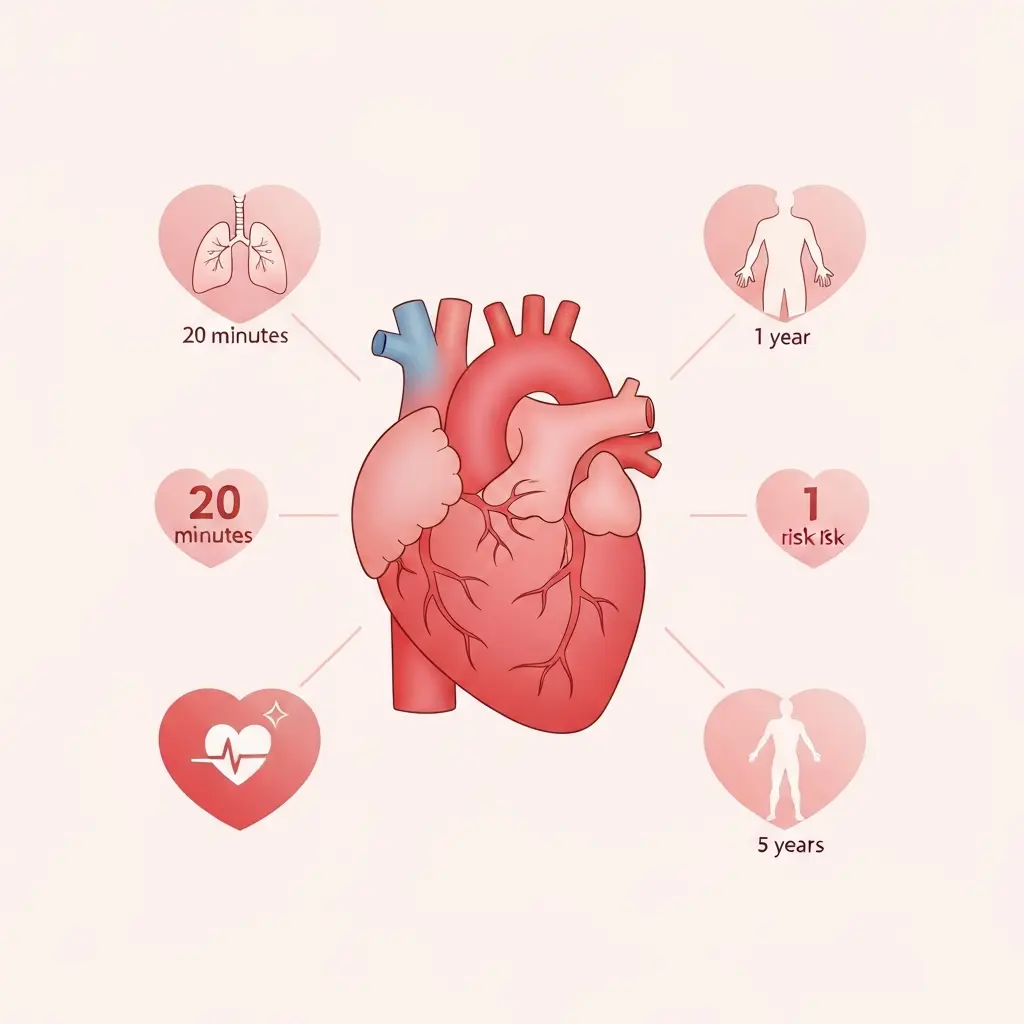
Heart Recovery Timeline After Quitting
The heart begins recovering remarkably quickly after the last cigarette:
| Time After Quitting | Cardiovascular Benefit |
|---|---|
| 20 minutes | Blood pressure and heart rate drop to normal levels |
| 12 hours | Carbon monoxide levels normalise; oxygen delivery to heart tissue improves |
| 2–12 weeks | Circulation improves; endothelial function (arterial lining) begins recovering |
| 3–6 months | Arterial stiffness measurably reduces; platelet aggregation normalises |
| 1 year | Heart attack risk halved vs continuing smoker |
| 5 years | Stroke risk reduced to non-smoker level; atherosclerosis progression slowed |
| 15 years | Heart disease risk approaches lifetime non-smoker level |
Heart Attack Risk Reduction Data
The cardiovascular benefits of cessation are among the best-documented in medicine. Large prospective studies consistently show:
- A 2015 meta-analysis in the Journal of the American College of Cardiology (17,000+ participants) found that heart attack risk fell by 32% within the first year after quitting
- The Nurses’ Health Study (90,000+ women, 20+ year follow-up) found former smokers’ cardiovascular mortality approached non-smoker levels by 15 years post-cessation
- Even for people who have already had a heart attack, quitting smoking is the single most impactful intervention — reducing 5-year mortality by approximately 36% (more than any drug prescribed post-MI)
Stroke Risk Reduction After Cessation
Smoking-related stroke risk is particularly significant because the mechanisms (increased blood viscosity, arterial stiffness, elevated blood pressure) begin reversing quickly after quitting:
- Ischaemic stroke risk approaches non-smoker level within 5 years of quitting (American Stroke Association data)
- Haemorrhagic stroke risk reduction is more gradual but also significant
- The stroke risk reduction from quitting is larger in younger former smokers — for quitters under 45, stroke risk reaches non-smoker levels within 2–3 years
Tracking health milestone data over your quit journey — seeing your cardiovascular health improving day by day — is exactly what apps like iQuit Smoking make tangible. Just as data-driven marketing approaches show measurable improvement metrics, your quit journey has measurable health metrics that motivate continued success. Download iQuit free to track your heart health recovery.
Frequently Asked Questions
How quickly does heart health improve after quitting smoking?
Within 20 minutes of quitting, blood pressure and heart rate drop. Within 12 hours, carbon monoxide levels normalise. Within weeks, circulation improves and endothelial function begins recovering. At 1 year, heart attack risk is halved. At 5 years, stroke risk approaches non-smoker level. At 15 years, overall heart disease risk approaches lifetime non-smoker level.
Does quitting smoking reverse heart disease?
Quitting smoking does not reverse existing atherosclerotic plaques, but it dramatically slows their progression and reduces the risk of acute events (heart attack, stroke). Endothelial function recovers, arterial stiffness decreases, blood pressure normalises, and platelet aggregation reduces — all of which meaningfully lower cardiovascular risk even for those with established heart disease.
What is the most important health benefit of quitting smoking?
For people over 50, cardiovascular risk reduction is often the most immediately impactful benefit — heart attack risk halves within 1 year. For people under 50, the combined cancer and cardiovascular risk reduction over a lifetime is probably most significant. However, the benefit that matters most to an individual depends on their specific risk profile and health history.
Sources: American Heart Association — Smoking and cardiovascular disease statistics 2024; NHS — Benefits of stopping smoking for the heart; Journal of the American College of Cardiology — Cessation and heart attack risk meta-analysis; Nurses’ Health Study cardiovascular outcomes data; WHO Cardiovascular disease fact sheet 2024.