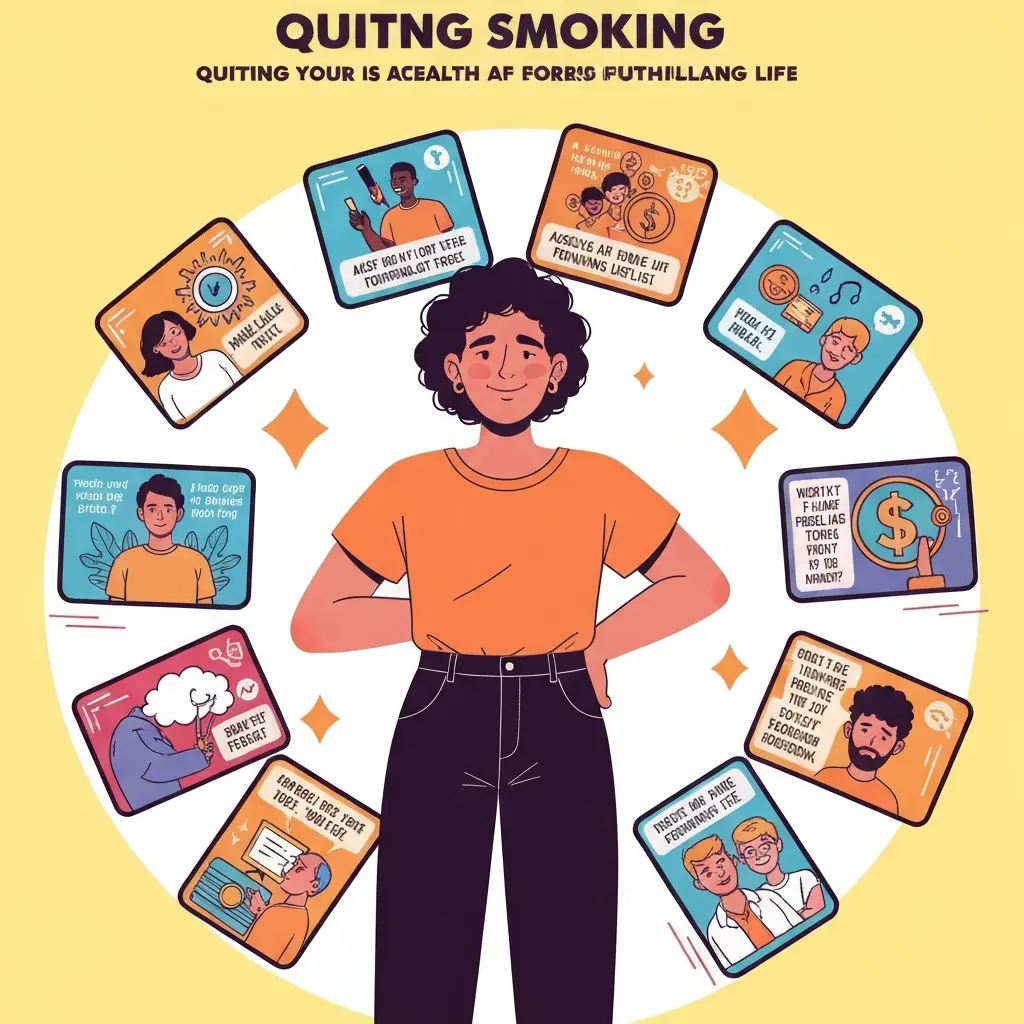
Quit Smoking Motivation: 12 Powerful Reasons to Quit Today in 2026
Finding the right quit smoking motivation is not about reading a list of generic health warnings you have already heard a hundred times. It is about identifying the specific, emotionally resonant reason that makes quitting non-negotiable for you. Research from addiction psychology shows that smokers who quit for deeply personal, emotionally specific reasons maintain abstinence longer than those who quit for abstract health reasons or social pressure.
This guide provides twelve of the most powerful and well-documented motivators for quitting — drawn from CDC research, WHO studies, and the lived experiences of former smokers — organized to help you identify the ones that land emotionally, not just intellectually. Because the quit that works is the one you believe in deeply.
Health Motivations
Reason 1: Your Heart Starts Healing in 20 Minutes
The speed of health recovery after quitting is extraordinary. Within 20 minutes of your last cigarette, heart rate and blood pressure begin normalizing. Within one year, your coronary heart disease risk is half that of a current smoker. Within 15 years, your cardiovascular risk is equivalent to someone who has never smoked.
If you have a doctor’s appointment, a health screening, or any awareness of your cardiovascular risk, this timeline is not abstract — it is a countdown of improvements that begin immediately. Every hour of abstinence is measurable biological progress. See our complete guide to what happens when you quit smoking for the full recovery picture.
Reason 2: Lung Cancer Risk Halves Within 10 Years
Lung cancer is the number one cancer killer globally, and smoking causes approximately 85% of cases. The survival rate for lung cancer at diagnosis is low — but the risk of developing it drops dramatically after quitting. Within 10 years of quitting, your lung cancer risk is approximately half that of a current smoker. Within 15 years, it approaches never-smoker levels. Quitting today does not erase past exposure — but it profoundly changes your future trajectory.
Reason 3: You Will Breathe More Easily — Starting Next Month
Within 3 months of quitting, lung function increases measurably and coughing and shortness of breath decrease. Within 9 months, cilia in the airways have regenerated and are actively clearing debris. Exercise that was impossible or exhausting as a smoker becomes possible again. Climbing stairs without stopping, keeping up with children or grandchildren, enjoying outdoor activities — these physical freedoms begin returning within weeks.
Family and Relationship Motivations
Reason 4: Secondhand Smoke Is Harming the People You Love
Secondhand smoke contains more than 7,000 chemicals, of which at least 70 are known carcinogens. Children exposed to secondhand smoke are at significantly increased risk of sudden infant death syndrome (SIDS), respiratory infections, ear infections, and asthma. Adults regularly exposed show increased rates of lung cancer and heart disease — even if they have never smoked themselves. If you smoke around others, quitting today protects them too — starting from your very last cigarette.
Reason 5: Your Children Will Be More Likely to Smoke If You Do
Children of smokers are significantly more likely to become smokers themselves — research published in JAMA Pediatrics found that children who live with smokers are 3–4 times more likely to take up smoking. Your quit is not just about your health — it is about modelling the future you want for the next generation. This is one of the most powerful quit motivations reported by parents in CDC research surveys.
Reason 6: Relationships Often Improve After Quitting
Smoking affects relationships in ways that are easy to normalize but significant in aggregate: the smell on your breath and clothes, stepping outside during family events, the financial arguments about cigarette spending, and the health anxiety felt by partners who watch someone they love smoke knowing the statistics. Many former smokers report that quitting improved their closest relationships in ways they had not anticipated.
Reason 7: You Will Likely Live Longer to Share More of Your Life
Quitting before the age of 40 reduces the risk of dying from smoking-related disease by approximately 90%. Even quitting at 60 adds an average of 3–4 years to life expectancy compared to continued smoking, according to WHO analysis. More years alive — more time with the people who matter most, for every milestone of their lives.
Financial Motivations
Reason 8: You Are Burning $3,000–$6,000 Per Year
Most smokers are spending between $3,000 and $6,000 per year on cigarettes depending on their location and smoking frequency. That is a vacation, a car payment, a significant investment, or a contribution to a child’s education fund — disappearing in smoke every single year. Over 10 years, invested at the average market return, this becomes $50,000–$80,000 that does not exist because it was spent on cigarettes. Use our money saved calculator to see your personal number.
Reason 9: Your Health Insurance and Life Insurance Will Cost Less
Smokers pay up to 50% more for health insurance under the ACA and 2–3 times more for life insurance than non-smokers. After 12 months of abstinence, you typically qualify to re-rate as a non-smoker, immediately reducing both costs. The financial recovery of quitting is not just about cigarette costs — it extends across your entire financial profile.
Freedom and Quality-of-Life Motivations
Reason 10: You Will Smell Better — Immediately
Cigarette smoke permeates hair, clothes, skin, breath, and living spaces in ways that non-smokers experience strongly but smokers often do not notice due to adaptation. Within days of quitting, your sense of smell recovers (nicotine blunts olfactory sensitivity) and others will notice the change in you immediately. Many former smokers describe this as one of the most surprisingly gratifying aspects of quitting.
Reason 11: You Will No Longer Be Controlled by a Chemical Addiction
Nicotine addiction is a compelling force that shapes where you can go, when you leave social situations, what you do during breaks, how you feel between cigarettes, and how you experience stress. Every smoker knows the planning that goes into ensuring access to cigarettes — the mental space it occupies. Quitting eliminates this psychological burden entirely, reclaiming a form of mental freedom that smokers frequently describe as one of the most valuable and unexpected gifts of cessation.
Reason 12: Your Mental Health Will Improve
Contrary to widespread belief, smoking does not relieve stress — it creates and maintains a stress-and-relief cycle. Nicotine creates baseline anxiety through the withdrawal-reliance loop, then temporarily relieves it, creating the illusion that smoking is calming. Research published in the BMJ found that quitting smoking produces mental health improvements comparable to starting antidepressant medication — including measurable reductions in anxiety, depression, and perceived stress after 6–8 weeks of abstinence. The freedom from nicotine’s neurochemical grip is both physical and psychological.
How to Use Your Motivation to Stay Smoke-Free
Reading a list of motivations is the beginning, not the end. To convert motivation into action:
- Identify your top 2–3 motivations from this list — the ones that produce an emotional response rather than just an intellectual nod
- Make them specific to your life — not “be healthier” but “be able to hike with my daughter without stopping to catch my breath”
- Write them down and place them somewhere you will see them daily — phone wallpaper, car dashboard, bathroom mirror
- Read them at every craving — when a cigarette craving hits, reading your specific motivations reconnects the acute urge to the long-term vision that matters more
- Update them as your life changes — motivations evolve; revisit and refresh yours at each major milestone
The iQuit app allows you to save your personal quit motivations in the app and displays them during craving events — so the reason you are quitting is visible at exactly the moment you most need to remember it. For organizations running motivation-based cessation campaigns, CampaignOS helps deliver personalized motivational content to smokers at the moments when motivational support is most needed. This content is developed with AI-powered writing tools from Authenova to ensure evidence-based accuracy.
Frequently Asked Questions
What is the most effective motivation to quit smoking?
Research shows that the most effective motivations are deeply personal and emotionally specific — not generic health warnings. The most commonly cited powerful motivators in long-term success stories are family-related (wanting to be present for children or grandchildren), health-based (a specific medical diagnosis or scare), and financial (having calculated the actual cost and deciding to stop). The “best” motivation is the one that creates genuine emotional urgency for you specifically.
How do I stay motivated to quit smoking when cravings are intense?
The key is having your motivation visible and accessible before the craving hits, not trying to recall it while in the grip of a craving. Write your specific reasons on your phone’s wallpaper, a physical card you carry, or save them in a cessation app like iQuit that surfaces them during craving events. Also use the 4 Ds technique to survive the 3–5 minute craving peak while your motivation reanchors.
Does motivation fade after quitting smoking?
Yes, initial strong motivation typically fades within the first 3–6 months — this is why it needs to be continually refreshed rather than assumed to remain constant. Building milestone celebration into your quit plan (specific rewards at 1 week, 1 month, 3 months, 1 year) keeps motivation sustained. Tracking health improvements and money saved provides ongoing objective motivation to replace the fading emotional urgency of the initial quit date.
Why is it hard to stay motivated to quit smoking?
Motivation alone is insufficient for quit success because nicotine addiction is neurochemical — it operates at a level below conscious motivation. Dopamine deficiency during withdrawal actively counters motivation by making everything feel less rewarding and more effortful. This is why motivation must be combined with pharmacological support (NRT) and behavioral planning to be effective. Motivation sets the direction; structure and support do the work.
Keep Your Motivation Front and Center
Save your personal quit reasons in iQuit and access them instantly during cravings — turning your motivation into a tool, not just a thought.