Quit Smoking One Week Timeline: What Actually Happens in Your First 7 Days (2026)
The first seven days after quitting smoking are the most physiologically intense stretch of the entire cessation journey. Your body is clearing nicotine, recalibrating neurotransmitter systems, and beginning measurable health repairs — all simultaneously. Understanding the quit smoking one-week timeline, day by day and hour by hour, gives you a crucial advantage: when the discomfort hits, you know it is temporary, predictable, and a sign that your body is healing.
This guide draws on NHS clinical guidance, CDC tobacco cessation data, and published studies in Nicotine & Tobacco Research to give you an honest account of what to expect — including the hard parts — alongside evidence-based strategies for each day. People who know what’s coming are significantly more likely to stay smoke-free through week one.
Day 0 (Quit Day): The First Hours
The moment you smoke your last cigarette, your body begins recovering. This is not motivational rhetoric — it is clinical fact. Within 20 minutes, your heart rate and blood pressure start dropping back toward the ranges of a non-smoker. Within 2 hours, blood nicotine has fallen by 50%, and the first mild withdrawal sensations begin: a vague restlessness, an awareness of the absence of something.
What to do on quit day:
- Remove all cigarettes, lighters, and ashtrays from your home, car, and workplace
- Apply your first nicotine patch (if using NRT) first thing in the morning, before cravings escalate
- Tell someone close to you that today is your quit day — social accountability improves outcomes
- Log your quit start in your cessation app and complete the onboarding profile fully
- Prepare your craving kit: water bottle, gum/lozenge (NRT or sugar-free), stress ball, and a list of 3 distraction activities
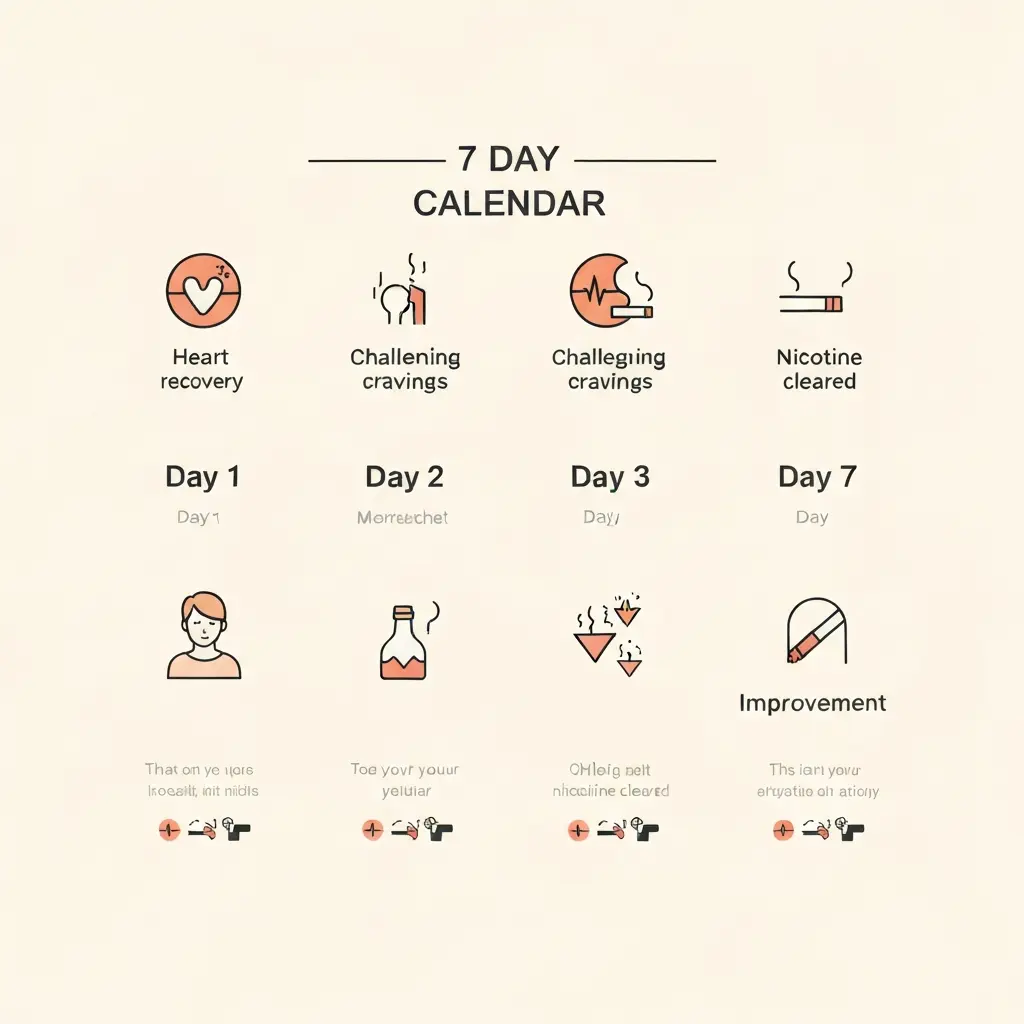
Day 1: Carbon Monoxide Clears
By 12 hours into your quit, the carbon monoxide level in your blood has normalised to non-smoker levels. Your blood can now carry oxygen more efficiently than it could yesterday. This is a real, measurable physiological change happening in your body right now.
What you’re likely experiencing on Day 1:
- Increasing craving frequency — the 5-minute craving wave begins cycling more regularly
- Mild irritability — dopamine levels are adjusting; this is normal and temporary
- Possible headache — as blood flow changes with carbon monoxide clearance
- Restless hands — the physical habit of holding a cigarette
Day 1 strategy: Treat cravings as 5-minute waves to ride, not threats to fight. Each craving that passes without a cigarette is a biological win — your receptors are beginning the downregulation process. Drink water frequently; it helps manage the headache and gives your hands and mouth something to do. Every time you navigate a craving without smoking, log it in your app — you are literally building the data your AI coach needs to personalise your support.
Day 2: The Hardest Day for Most People
Day 2 is statistically the highest-risk day for relapse in the quit smoking one-week timeline. Blood nicotine is at or near zero. The receptor upregulation is at peak mismatch with incoming nicotine input. Everything feels off: sleep was probably disrupted, mood is volatile, and cravings are intense and frequent.
Clinical symptoms typically peaking on Day 2:
- Intense, sharp cravings (8–10 on a 10-point scale for many heavy smokers)
- Anxiety — sometimes significant, as the anxiolytic effect of nicotine is removed
- Irritability and anger — reported as “worst symptom” by 60% of quitters (NCSCT survey)
- Difficulty concentrating — particularly on complex tasks
- Vivid dreams or nightmares — REM rebound is real and intense
Day 2 strategy: This is the day to activate every support layer simultaneously. Take your NRT as directed (do not skip patches). Use the fast-acting NRT (gum or lozenge) for breakthrough cravings — the guideline is one piece every 1–2 hours if needed in the first week. Avoid all known trigger situations if possible. If you’re a student or knowledge worker, know that your working memory is genuinely impaired today — this is temporary and will resolve. Research into how cognitive stress affects behaviour change (including this French study on student burnout and self-regulation) shows that reducing additional cognitive load on your hardest withdrawal days significantly improves quit outcomes.
Day 3: Nicotine Leaves Your Body
By 72 hours, nicotine has cleared your body almost entirely (nicotine is metabolised to cotinine with a half-life of approximately 16 hours). The physical withdrawal has peaked. This does not mean Day 3 feels easy — many people find it still brutal — but it means the physical chemistry is on your side from here. Things are not getting worse; they are getting better.
What’s happening biologically on Day 3:
- Bronchial tubes begin relaxing, making breathing slightly easier
- Lung cilia start regenerating (though increased mucus and coughing may accompany this)
- Taste buds are beginning to regenerate
- Dopamine baseline is starting to adjust toward a new normal
Day 3 strategy: If you make it through Days 2 and 3, statistically your probability of making it to Day 7 jumps significantly. Celebrate making it to Day 3. Tell your app. Tell your accountability person. Do something physically active today — even a 20-minute walk has been shown to reduce craving intensity by 26% (Taylor et al., 2007) and improve mood.
Days 4–5: Slowly Turning the Corner
Days 4 and 5 typically bring the first real, perceptible easing of the acute withdrawal experience. For most people, craving intensity is noticeably lower. Irritability begins resolving. Sleep quality, while still disrupted, starts to improve. This is the stage where you first start to feel that quitting is actually survivable — and that matters enormously for your belief in your ability to continue.
Key developments:
- Craving frequency reduces to roughly every 30–90 minutes for most people
- Taste and smell improvements often become noticeable — food begins tasting different
- Energy levels may begin recovering as cardiovascular efficiency increases
- Habitual triggers (after meals, with coffee, at work breaks) remain high-risk moments
Days 4–5 strategy: Begin actively structuring your daily routine to replace smoking’s time-slots. Where you previously smoked after breakfast, create a new habit: a walk, a brief mindfulness exercise, a phone call. The habitual component of smoking is the hardest to rewire, and Days 4–5 is when to begin the rewiring deliberately.
Days 6–7: The First Real Improvement
By Days 6–7, most people report that they feel meaningfully better than they did on Days 2–3. The physical withdrawal storm has passed for most. Cravings are manageable rather than overwhelming. You’ve proven to yourself that a week without smoking is possible — which is one of the strongest predictors of continued abstinence.
One week health milestones:
- Lung function has improved by up to 30% (NHS data)
- Circulation has improved, reducing cold hands and feet
- The withdrawal symptom severity has halved for most physical symptoms
- Energy levels measurably improved in most people
Days 6–7 strategy: Use your one-week milestone to review what you’ve learned about your triggers. Look at your craving log for the week. When did you most want to smoke? What context were you in? Use this data — with your app’s AI coaching — to plan your defences for Week 2. To see exactly what changes next, our guide on what happens at two weeks smoke-free picks up right where this one leaves off.
Habit formation research consistently shows that the first two weeks are the highest-leverage period for building new automatic behaviours. Whether you’re trying to quit smoking or build academic study habits, the same principles apply. See our complete step-by-step quit smoking plan and this guide for students on building productive routines during high-stress periods for intersecting approaches to behaviour change under pressure.
Your Week 1 Survival Toolkit
Based on clinical evidence, these are the most effective tools for surviving and thriving through Week 1:
- Combination NRT — patch (background coverage) + fast-acting gum or lozenge (breakthrough cravings)
- Cessation app with craving log — iQuit or Smoke Free; log every craving actively
- The 5D technique — Delay (wait 5 minutes), Deep breathe, Drink water, Do something, Distract
- Exercise — even a 20-minute walk reduces craving intensity by ~26%
- Accountability partner — someone who knows your quit date and will check in on Day 3
- Planned trigger avoidance — for Day 2 especially, avoid alcohol and other known triggers
Frequently Asked Questions
What is the hardest day when you quit smoking?
Day 2 and Day 3 are typically the hardest in the quit smoking one-week timeline. By 48–72 hours, blood nicotine is at or near zero and withdrawal symptoms — cravings, irritability, anxiety, and sleep disruption — peak in intensity. The good news is that after Day 3, most people experience a progressive improvement that continues through week 2 and beyond.
How does your body feel after one week without smoking?
After one week smoke-free, most people notice improved breathing (lung function increases up to 30%), better circulation, early improvements in taste and smell, and recovering energy levels. Sleep quality, often disrupted in Days 1–4 due to REM rebound, typically begins improving by Days 5–7. The withdrawal storm has largely passed, and the body is in active repair mode.
How long do cravings last in the first week of quitting smoking?
Individual craving episodes last 3–10 minutes. In the first week, you may experience 10–20 craving episodes per day on Days 1–3, reducing to 5–10 per day by Days 5–7. Each episode passes on its own — the key is not acting on the urge during those minutes. Craving frequency and intensity progressively reduce through weeks 2 and 3.
Is it normal to feel worse on Day 3 of quitting smoking?
Yes — feeling very uncomfortable on Days 2–3 is normal and expected. Day 3 is when nicotine has fully cleared your body and withdrawal symptoms can peak before beginning their gradual resolution. Many quitters describe Days 2–3 as the absolute hardest, followed by noticeable improvement from Days 4–5. This pattern is consistent with the neuroscience of nicotine receptor adaptation.
Get Daily Guidance Through Every Day of Week 1
The iQuit app’s AI coach sends targeted support calibrated to your specific withdrawal stage — including Day 2 and Day 3 surge-response messages when your craving data shows you’re in your hardest window.
Download iQuit free and let the data guide you through the hardest week.