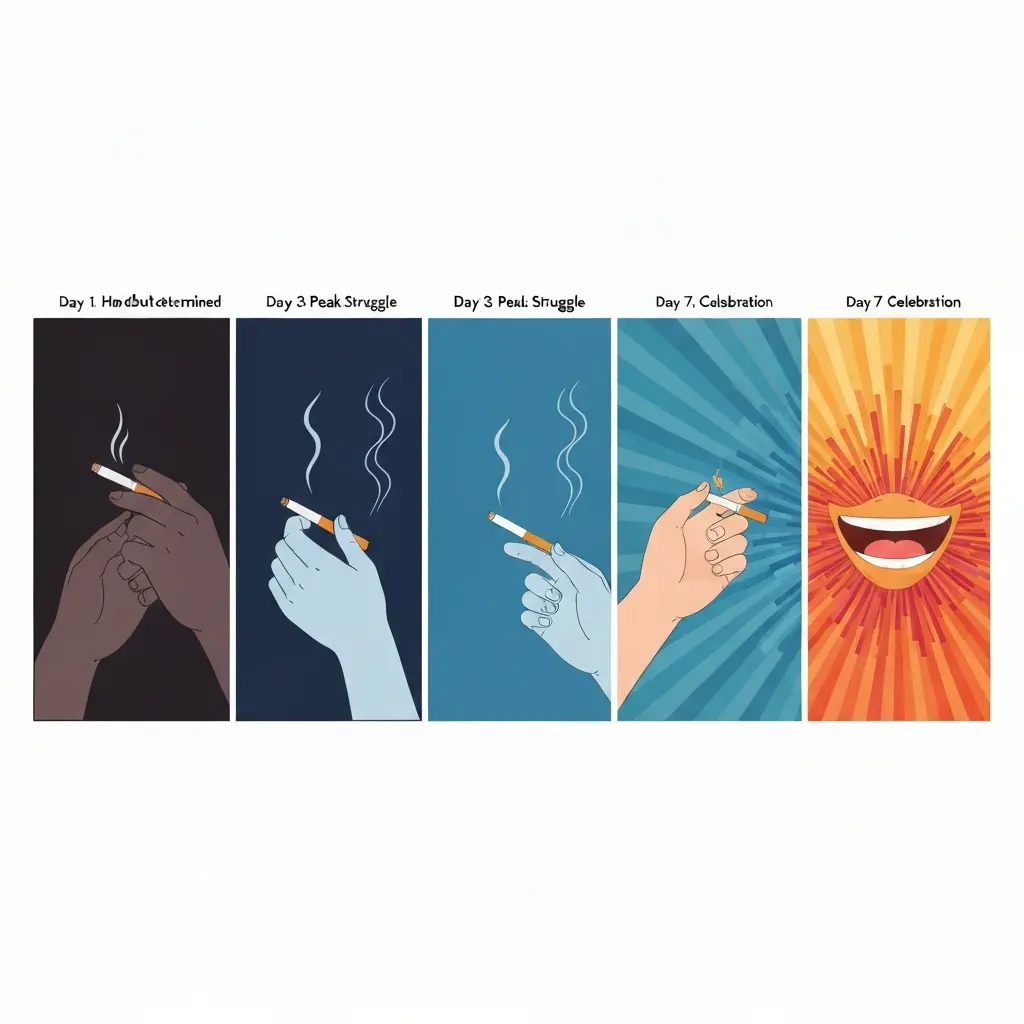
Quit Smoking One Week Timeline: What to Expect Day by Day
The first seven days of quitting smoking are statistically the most important and, for many people, the most difficult. Research shows that making it through the first week increases your 12-month abstinence rate by over 60%. Understanding the quit smoking one week timeline — knowing exactly what to expect on day one versus day four versus day seven — transforms the unknown from threatening to manageable. This guide gives you that day-by-day picture.
Every change described in this timeline is backed by clinical data from the NHS, CDC, and published research in addiction medicine. The symptoms are real. The health improvements are real. And the improvement trajectory — that each day after day three generally feels somewhat better than the last — is also real, even when it does not always feel that way in the moment.
Day 1: Your Quit Day
What to expect physically: Relatively manageable. Nicotine clears gradually, so the first few hours feel more like mild restlessness than acute withdrawal. By the afternoon and evening, cravings become more insistent — occurring every 30–60 minutes and lasting 3–5 minutes each.
What is happening in your body: Within 20 minutes, heart rate normalizes. By 12 hours, carbon monoxide is nearly cleared and blood oxygen is at non-smoker levels. By 24 hours, nicotine is completely out of your bloodstream and your heart attack risk begins dropping.
How to handle it:
- Disrupt every element of your usual morning routine — different time, different drink, different location
- Keep the 4 Ds ready for every craving: Delay, Deep Breathe, Drink Water, Do Something
- Tell at least one person today that you have quit
- Avoid your three highest-risk trigger environments for day 1 if at all possible
- Plan something engaging for the evening — this is typically when cravings are strongest
Day 2: The First Real Test
What to expect physically: Nicotine withdrawal is now in full force. Cravings arrive every 20–30 minutes. Irritability and anxiety increase noticeably. Headaches are common. Sleep may be disrupted — either difficulty falling asleep or early morning waking.
What is happening in your body: Your brain’s dopamine system is recalibrating to function without nicotine stimulation. Dopamine levels are lower than normal, creating the irritability, anxiety, and difficulty feeling pleasure that characterize this phase. This is the biological cause of the mood dip — it is neurochemical, not character.
How to handle it: Day 2 is when NRT earns its keep. If you are using nicotine patches or gum, ensure consistent usage — the patch should be on before you wake up, preventing the acute morning craving that so often triggers relapse. Communicate to the people around you that you are in a difficult withdrawal window and may be short-tempered. Exercise, even briefly, produces dopamine and directly counteracts withdrawal mood effects.
Day 3: Peak Withdrawal
What to expect physically: This is the most intense day for most quitters. Nicotine is completely absent from all receptor sites. The brain is in its maximum withdrawal state: cravings may feel overwhelming, headaches may be at their worst, concentration is difficult, and irritability can be severe. Some people also experience nausea, constipation, and dizziness as the body adjusts.
Critical mindset for day 3: Know that this is the peak. It does not continue escalating from here — it begins easing. Day 4 will be meaningfully better than day 3 for most people. Your only task today is to keep the cigarette count at zero. Do not make any decisions about your quit strategy. Do not evaluate how you feel as a predictor of how the rest of your quit will feel. Just get through today.
Day 3 survival protocol: Maximum craving management. Use every tool available simultaneously: NRT as prescribed, 4 Ds for every craving, exercise, cold water, engagement activities. Avoid alcohol entirely. Tell your support person or accountability partner that today is your hardest day. The iQuit app provides craving relief tools that are accessible in under 10 seconds — open it at every craving event.
Day 4: The Tide Turns
What to expect physically: Most people report a noticeable improvement on day 4 compared to day 3. Cravings remain frequent but are meaningfully less intense. Headaches begin easing. Appetite, which may have been suppressed by nicotine or disrupted by withdrawal, begins normalizing — though appetite increase (common withdrawal symptom) may be more pronounced now.
What is happening in your body: Taste receptors that were partially suppressed by nicotine are recovering. Food begins tasting noticeably more flavorful. Your sense of smell is improving — you may be startled by scents you had not noticed for years. Airways are producing less inflammation; breathing feels marginally easier.
Watch for complacency: Day 4’s improvement can create a dangerous “I’ve got this, one cigarette won’t hurt” thought. This is one of the most common relapse patterns — the “testing” cigarette on day 4 or 5 that restarts the withdrawal clock entirely. Do not test your quit.
Day 5: Early Wins
What to expect physically: Cravings are now shorter and somewhat less frequent. The acute physical crisis of withdrawal is largely behind you. Mood is still variable but beginning to stabilize. Energy levels may feel better — some quitters report feeling noticeably more energetic than their smoking days by day 5, particularly in the morning.
What is happening in your body: Cilia in the airways are actively regenerating. Lung mucus production is normalizing. Circulation has improved measurably — hands and feet are warmer, exercise capacity is slightly better. The incremental improvements are real, even if they do not always feel dramatic.
Celebrate genuinely: Five days smoke-free is an achievement worth acknowledging. You have survived the hardest phase. Tell someone. Access your iQuit milestone tracker and see what your body has accomplished in five days.
Day 6: Building Momentum
What to expect: Cravings continue decreasing in frequency. The psychological habit cravings — automatic urges in response to specific triggers — are now more prominent than the physical withdrawal cravings. This shift is important: you are now managing habit rather than chemical addiction, which is a different (and more psychologically manageable) challenge.
New challenge: Routine triggers that were disrupted in days 1–3 are reasserting themselves as your routines re-establish. The morning coffee trigger may fire more strongly today than day 1. This is normal — your brain is testing the old pathways. Each time the trigger fires without being followed by nicotine, the association weakens further.
Day 7: One Week Smoke-Free
What you have achieved: One week smoke-free represents a statistical watershed. Research consistently shows that smokers who make it through the first seven days are significantly more likely to remain smoke-free at 12 months. You have survived the peak withdrawal, proven to yourself that you can endure a craving, and begun establishing new non-smoking routines.
One week health snapshot:
- Nicotine has been completely absent from your bloodstream for 6 days
- Blood oxygen at non-smoker levels for 6 days
- Heart attack risk measurably lower
- Taste and smell recovering
- Cilia actively regenerating in airways
- Blood pressure and heart rate at healthier levels
Celebrate this milestone meaningfully. Week one is one of the most significant achievements of your quit journey. Give yourself a genuine, specific reward — something you pre-planned as your one-week milestone celebration. You earned it.
For the full health recovery timeline beyond your first week, see our complete guide to what happens when you quit smoking. For detailed withdrawal guidance, see our article on the nicotine withdrawal timeline.
First Week Survival Tips
2. Make it through morning first. Most relapses happen in the morning. Win the morning; win the day.
3. Use NRT consistently, not reactively. Your patch should be on before the first craving, not after it arrives.
4. Exercise every day. Even 15 minutes reduces craving intensity for up to 50 minutes afterward.
5. Avoid alcohol. The first week is not the week to test whether you can drink without smoking.
6. Log every craving. Using the iQuit app to track each craving event shows you — with data — that they are decreasing day by day. The downward trend is real and motivating.
For health organizations supporting participants through the critical first week, CampaignOS enables automated daily check-in messages and survival tip delivery timed to each day of week one — providing the right support at exactly the moment each challenge arrives. This evidence-based content is produced with tools from Authenova.
Frequently Asked Questions
What is the hardest day when quitting smoking?
Day 3 is typically the hardest day of the first week and the overall quit journey. Nicotine has been completely absent from receptor sites for 24+ hours, and the brain’s dopamine system is in its most disrupted state. Cravings, irritability, anxiety, and physical discomfort are all at peak intensity. After day 3, symptoms begin improving progressively. Knowing this in advance — that day 3 is the peak, not the new normal — is itself one of the most useful pieces of knowledge for surviving it.
Does quitting smoking get easier after the first week?
Yes, significantly. The physical withdrawal that characterizes days 2–4 has substantially resolved by day seven. After the first week, cravings are less frequent, less intense, and more manageable. The challenge shifts from physical withdrawal to psychological habit management — which, while still real, is more amenable to behavioral strategies and less overwhelmingly physical than peak withdrawal.
What should I do on my first day of quitting smoking?
On day one: remove all tobacco from your environment, disrupt your morning routine, start NRT if you are using it, tell at least one person that today is your quit day, plan your three highest-risk craving moments and have substitute behaviors ready for each, and avoid your most trigger-heavy environments. Keep your craving management toolkit (4 Ds, breathing techniques, water) readily accessible throughout the day.
How do you get through the first week of not smoking?
The most effective first-week survival approach combines: consistent NRT use (if applicable), the 4 Ds technique for every craving, daily exercise, disruption of routine smoking triggers, accountability to at least one other person, and avoiding alcohol entirely for the first week. Using a cessation app like iQuit to track your progress daily provides the motivating feedback that each day is genuinely better than the last.
Get Through Week One With Expert Support
iQuit tracks your day-by-day progress, sends you daily survival tips, and celebrates every milestone of your first week smoke-free.