Smoking and Cancer Statistics 2026: What the Data Shows
Tobacco is the world’s leading preventable cause of cancer. Understanding smoking and cancer statistics in 2026 provides both the stark reality of tobacco’s harm and the powerful evidence that quitting significantly reduces risk. The data presented here is sourced from WHO, Cancer Research UK, the American Cancer Society, and peer-reviewed oncology journals.
These numbers are not intended to create fear but to create urgency — because every statistic here represents a cancer risk that diminishes significantly when smoking stops. The body’s ability to recover from tobacco-induced carcinogenic damage is remarkable, and it begins the moment you quit.
Lung Cancer and Smoking: 2026 Statistics
Lung cancer remains the most lethal tobacco-related cancer — and the most common cancer globally by mortality:
| Metric | 2026 Data |
|---|---|
| Global lung cancer deaths per year | ~1.8 million (WHO 2024) |
| Proportion of lung cancers caused by smoking | ~85% |
| Lifetime lung cancer risk for male smokers | ~17% (vs 1.3% for non-smokers) |
| Smoker vs non-smoker lung cancer risk ratio | 15–30x higher for smokers |
| 5-year survival rate (all stages) | ~24% (improving due to targeted therapy) |
| UK new lung cancer diagnoses per year | ~48,000 (Cancer Research UK 2024) |
Despite decades of public health efforts, lung cancer survival rates remain disappointingly low compared to other common cancers — primarily because most cases are diagnosed at advanced stages. The UK’s National Lung Cancer Screening Programme (low-dose CT scanning for high-risk former smokers) has shown early-stage detection rates of over 60% in screened populations, highlighting the importance of post-cessation screening for long-term heavy smokers.
Other Tobacco-Related Cancers
Smoking causes or significantly contributes to at least 15 different cancers:
| Cancer Type | Attributable to Smoking | Relative Risk vs Non-Smokers |
|---|---|---|
| Lung | ~85% | 15–30x |
| Oesophageal | ~65% | 7–8x |
| Oral/pharyngeal | ~80% | 6–7x |
| Bladder | ~50% | 4x |
| Kidney | ~30% | 2x |
| Cervical | ~15% | 2x |
| Stomach | ~20% | 1.5–2x |
| Pancreatic | ~25% | 2–2.5x |
Cancer Risk Reduction After Quitting: The Data
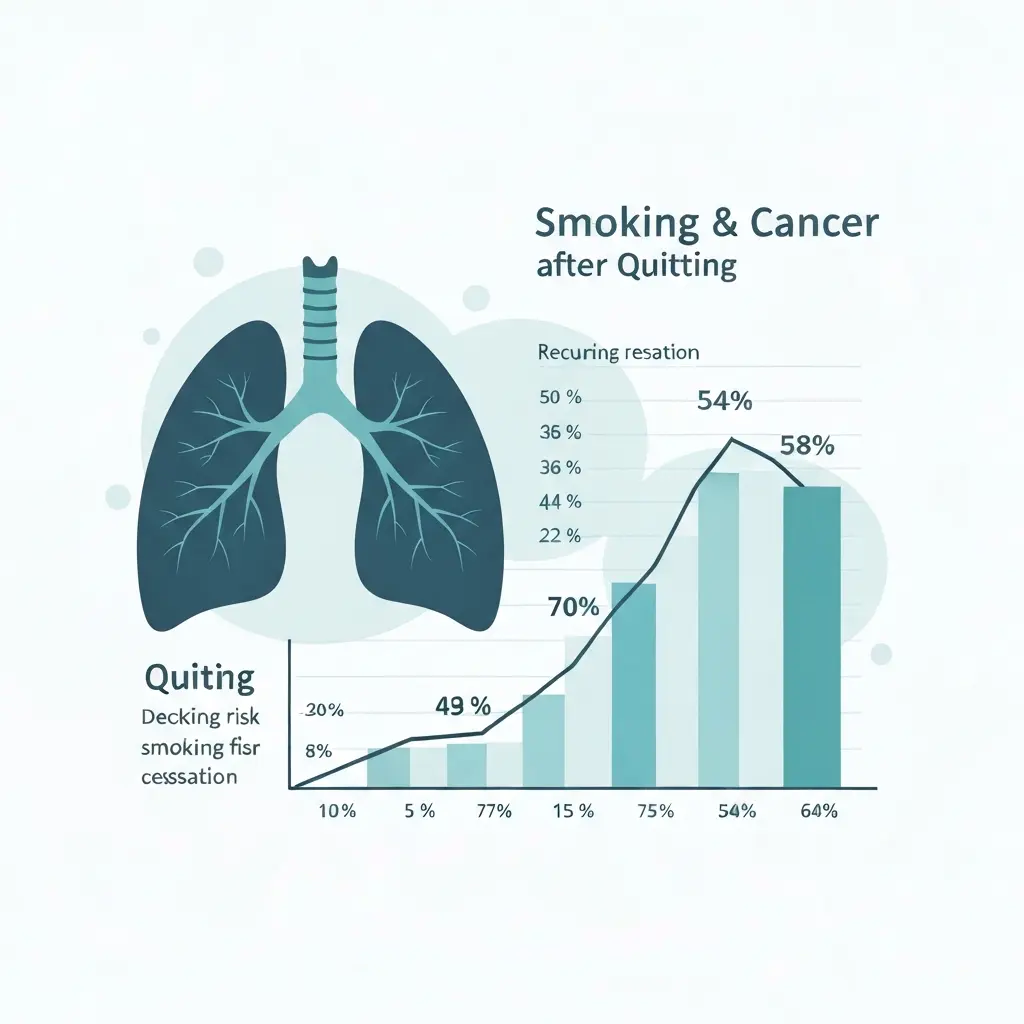
The most important cancer statistics for any smoker are the risk reduction numbers after quitting. These come from large prospective cohort studies tracking hundreds of thousands of former smokers over decades:
- Lung cancer: Risk begins declining within 5 years; halved by 10 years; approaches (but doesn’t fully equal) non-smoker risk at 15–20 years for heavy smokers
- Oral cancers: Risk halves within 5 years of cessation
- Bladder cancer: Risk reduced by approximately 50% within 5 years
- Oesophageal cancer: Risk reduced by ~50% within 5 years
- Overall cancer risk: All tobacco-related cancers show meaningful risk reduction within 5 years of quitting, with continued improvement over time
The Nature Wellcome Sanger Institute study (2020) provided cellular-level confirmation: former smokers’ airways contain cells with normal-range mutation profiles that proliferate after cessation, gradually replacing carcinogenically-damaged cells. The body’s DNA repair and normal cell proliferation mechanisms actively work to reverse tobacco-induced precancerous changes — a genuinely remarkable demonstration of the body’s resilience.
Age at Quitting and Cancer Risk
The earlier you quit, the greater the cancer risk reduction:
| Age at Quitting | Estimated Reduction in Smoking-Related Cancer Risk |
|---|---|
| 30s | ~97% of excess cancer risk avoided (BMJ study) |
| 40s | ~90% of excess cancer risk avoided |
| 50s | ~60–70% of excess cancer risk avoided |
| 60s | ~40–50% of excess cancer risk avoided |
| Any age | Significant reduction vs continuing smoker |
The message is unambiguous: quitting at any age reduces cancer risk significantly. Quitting younger reduces it dramatically. Quitting today is always better than quitting tomorrow. The same risk-by-years-quit pattern shows up for other conditions too — see our data on smoking and dementia risk statistics for how cognitive-decline risk falls the longer you stay smoke-free.
Economic Burden of Tobacco-Related Cancer
The economic cost of tobacco-related cancer is enormous:
- Lung cancer alone costs the UK NHS approximately £2.4 billion per year in treatment
- The US spends approximately $21 billion annually treating tobacco-related cancers
- Tobacco-attributable cancer treatment represents approximately 4–6% of total cancer spending in high-income countries
- Every person who successfully quits smoking saves the healthcare system an estimated £2,000–5,000 in avoided cancer care costs over their lifetime
These numbers illustrate why cessation support — apps, NRT programmes, clinical services — is among the most cost-effective healthcare investments governments can make. The data parallels the evidence on resource efficiency in other optimisation domains: systematic automation of preventive processes always outperforms reactive treatment economically.
Frequently Asked Questions
What percentage of lung cancers are caused by smoking?
Approximately 85% of lung cancers are attributable to cigarette smoking. The remaining 15% occur in non-smokers and are primarily attributed to radon gas exposure, asbestos, air pollution, genetic factors, and secondhand smoke exposure. Lung cancer risk for smokers is 15–30 times higher than for lifetime non-smokers.
Does quitting smoking reduce your cancer risk?
Yes, significantly. Lung cancer risk begins falling within 5 years of quitting and is approximately halved by 10 years. All major tobacco-related cancers (oral, bladder, oesophageal, kidney, pancreatic) show meaningful risk reduction within 5 years of cessation. The reduction continues for 15–20+ years. At any age, quitting produces substantial cancer risk reduction compared to continuing to smoke.
How many cancers are caused by smoking each year?
Globally, tobacco causes approximately 22% of all cancer deaths — representing over 2 million cancer deaths per year. In the UK, approximately 54,000 cancer diagnoses per year are attributable to smoking (Cancer Research UK 2024). In the US, cigarette smoking causes approximately 30% of all cancer deaths (American Cancer Society 2024).
If I smoked for 20 years, what is my cancer risk after quitting?
After 20 years of smoking, quitting still produces substantial cancer risk reduction. Lung cancer risk falls by approximately 50% within 5–10 years of cessation. After 15–20 years of abstinence, your risk approaches (though may not fully equal) that of a non-smoker. Your absolute remaining risk depends on pack-years (packs per day × years smoked), age at quitting, and genetic factors.
Sources: WHO Global Cancer Observatory 2024; Cancer Research UK statistics 2024; American Cancer Society Cancer Facts and Figures 2024; BMJ — Age at smoking cessation and cancer risk reduction; Nature Wellcome Sanger Institute — DNA repair in ex-smoker airways 2020.