Smoking and Mental Health: What the Research Actually Says in 2026
The relationship between smoking and mental health is one of the most widely misunderstood areas in cessation science. Most smokers believe — genuinely and sincerely — that cigarettes relieve stress, reduce anxiety, and help them feel calmer. This belief is so prevalent and so powerful that it becomes one of the primary psychological barriers to quitting. And it is not entirely without basis: nicotine does produce a temporary calming effect. The problem is understanding what it is actually calming.
This guide explains the real relationship between nicotine, smoking, and mental health — including why the “smoking relieves stress” belief is simultaneously true in the short term and deeply misleading in the long term. It also covers what the research says about quitting smoking’s effect on mental health, which is surprising, well-documented, and consistently positive.
The Smoking Relieves Stress Myth — Explained
Here is what actually happens when a smoker lights a cigarette under stress: nicotine reaches the brain within 10 seconds and stimulates acetylcholine receptors and dopamine release, producing a rapid sense of relief from the tension and anxiety that preceded the cigarette. The smoker experiences genuine relief and attributes it to the cigarette.
But what caused the preceding tension? In significant part: nicotine withdrawal. The body’s ongoing demand for nicotine creates a continuous low-level anxiety between cigarettes that is temporarily relieved by each cigarette smoked. The cigarette does relieve anxiety — but only the anxiety it was causing in the first place. Remove nicotine from the equation entirely (which is what happens 6–8 weeks after quitting), and baseline anxiety is lower than it was during smoking, not higher.
This cycle — nicotine withdrawal creates anxiety; smoking relieves it — is indistinguishable from stress relief to the person experiencing it. The experience is genuine. The attribution is wrong. And this misattribution is one of the most powerful mechanisms that keeps people smoking for decades while genuinely believing cigarettes are helping their mental health.
How Nicotine Creates and Maintains Anxiety
Nicotine affects the brain’s anxiety-regulation systems in several specific ways:
- Upregulation of nicotinic acetylcholine receptors: With chronic smoking, the brain increases the number and sensitivity of these receptors. Each time they go unstimulated (between cigarettes), they generate neurochemical signals that translate to restlessness and anxiety.
- HPA axis stimulation: Nicotine stimulates the hypothalamic-pituitary-adrenal axis, increasing cortisol production. Cortisol is the primary stress hormone. Regular nicotine exposure maintains chronically elevated cortisol — a baseline physiological stress state.
- Sleep disruption: Nicotine disrupts sleep architecture, reducing slow-wave and REM sleep. Sleep deprivation is a major driver of anxiety and reduced emotional regulation capacity.
Research from the University College London found that smokers have significantly higher anxiety scores than non-smokers in epidemiological surveys — directly contradicting the subjective experience that smoking relieves anxiety. The mechanism explains the contradiction: smoking is the primary cause of the anxiety it appears to relieve.
Smoking and Depression: A Bidirectional Relationship
The relationship between smoking and depression is complex and bidirectional. Depression increases the likelihood of smoking (dopamine-seeking behavior; nicotine provides temporary mood elevation), and smoking increases the likelihood of depression over time.
How Smoking Increases Depression Risk
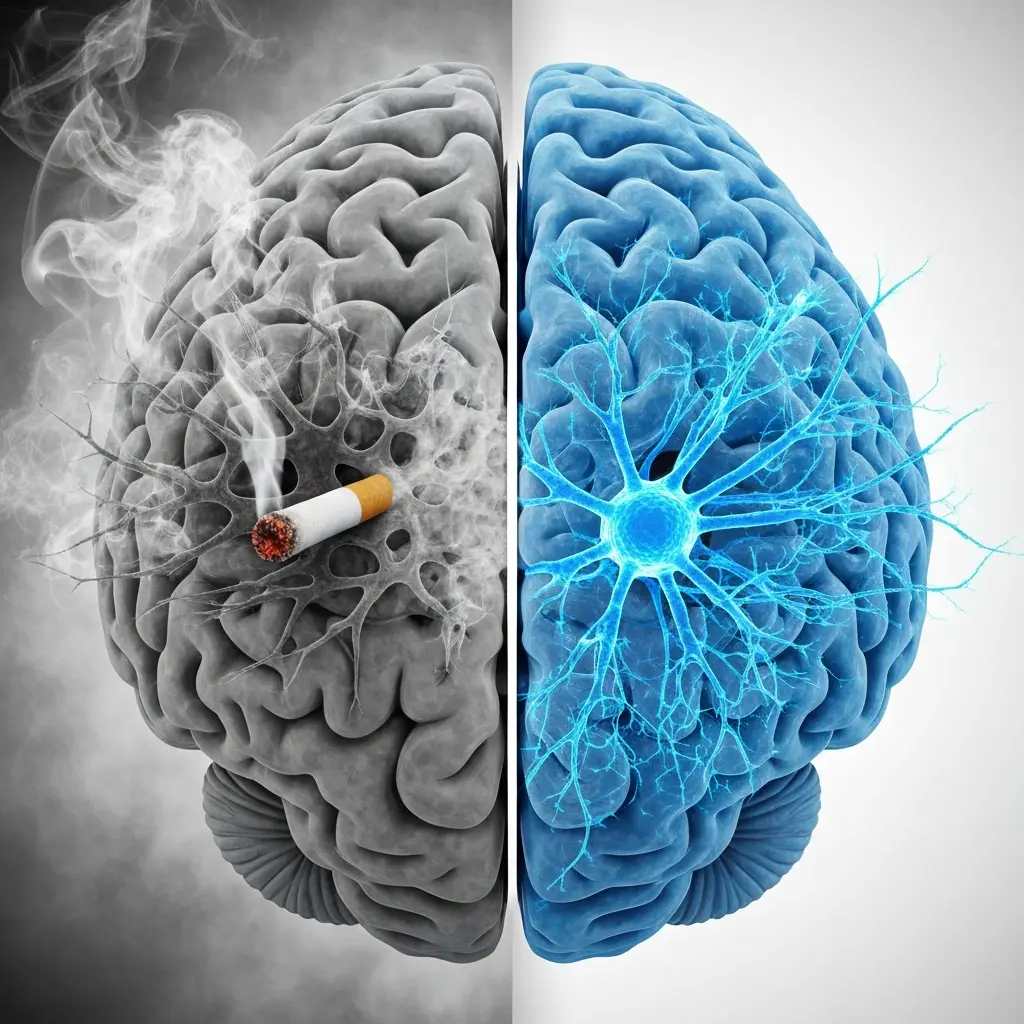
Nicotine produces artificial dopamine stimulation. Over time, the brain’s natural dopamine production decreases (downregulates) in response to the artificial stimulation. This means that between cigarettes — and significantly for months after quitting — dopamine levels fall below normal, creating a baseline of anhedonia (reduced ability to feel pleasure) and depressed mood that is literally caused by the smoking habit.
Smoking as Self-Medication
People with existing depression or anxiety disorders smoke at significantly higher rates than the general population — approximately 36% of adults with mental illness smoke, compared to 14% of the general adult population (CDC). For many, smoking is a form of self-medication for underlying mood dysregulation. This does not mean they cannot quit — but it does mean cessation support must address the underlying mental health condition alongside the nicotine dependence.
What Quitting Does to Mental Health
The evidence on quitting smoking and mental health is remarkably positive — and more robust than most people expect.
A landmark 2014 systematic review and meta-analysis published in the BMJ analyzed 26 studies covering more than 6,000 participants and found that quitting smoking was associated with significant improvements in:
- Anxiety (reduction in anxiety scores)
- Depression (reduction in depressive symptoms)
- Stress (reduction in perceived stress)
- Positive affect (increase in positive mood)
- Quality of life
The magnitude of these mental health improvements was comparable to, or in some studies greater than, the effect of antidepressant medication. Crucially, these improvements were observed not just in smokers with pre-existing mental health conditions but across the general population of quitters.
Weeks 1–3: Mood dip — withdrawal-driven dopamine deficiency can temporarily worsen anxiety and depression
Weeks 4–8: Mood stabilization — baseline dopamine production recovering
Week 8 onward: Measurable improvement in anxiety, depression, stress, and positive affect compared to smoking baseline
Months 3–12: Sustained mental health improvement, with many former smokers describing significantly better emotional wellbeing than during their smoking years
This timeline is critical for people going through withdrawal-related mood dips in weeks 2–4: the temporary mood worsening during early cessation is not a sign that quitting is wrong for your mental health. It is the transition through a valley before a sustained upward trajectory.
Mental Health Conditions and Quitting: Special Considerations
People with depression, anxiety disorders, schizophrenia, bipolar disorder, or PTSD smoke at higher rates and may experience more intense or prolonged withdrawal effects. Special considerations for this group:
- Depression: Monitor closely during the first 4–8 weeks of cessation; bupropion (an antidepressant and cessation medication) may be particularly appropriate as it addresses both simultaneously
- Anxiety disorders: CBT-based cessation support is particularly valuable; the mindfulness component of urge surfing and stress management overlaps with anxiety treatment techniques
- Schizophrenia: Note that smoking affects the metabolism of several antipsychotic medications — cessation may require medication dose adjustments in consultation with a prescribing psychiatrist
None of these considerations mean people with mental health conditions cannot quit smoking — in fact, research shows they benefit as much as or more than the general population from successful cessation. They do mean that cessation planning should involve the treating mental health team where one exists.
Supporting Mental Health During Cessation
Managing the mental health transition during cessation requires proactive support:
- Exercise: Regular aerobic exercise (20–30 min daily) produces endorphins and dopamine, directly counteracting withdrawal-related mood deficits
- Sleep hygiene: Prioritizing sleep quality during cessation supports emotional regulation and reduces anxiety
- Social connection: Isolation worsens mood during cessation; the iQuit community provides peer connection with others who understand exactly what this transition feels like
- Mindfulness: Daily mindfulness practice reduces anxiety and improves emotional regulation capacity, supporting both craving management and mood stability
- Professional support: For smokers with existing mental health conditions, cessation support is most effective when coordinated with their mental health treatment team
The iQuit app incorporates mindfulness-based craving management tools and mood tracking that support mental health awareness throughout the cessation journey. Academic research on smoking and mental health — including the BMJ meta-analysis cited in this article — is accessible through tools like Tesify for health professionals seeking the primary evidence. Content like this is developed using AI-powered health content tools from Authenova to ensure evidence-based accuracy.
Frequently Asked Questions
Does smoking actually relieve stress?
Smoking temporarily relieves the anxiety caused by nicotine withdrawal — creating the experience of stress relief. But nicotine addiction itself creates and maintains higher baseline anxiety levels than non-smokers. Research shows that former smokers have lower anxiety, depression, and stress scores than current smokers after 6–8 weeks of abstinence. The stress relief is real in the moment; the net effect on mental health is negative.
Does quitting smoking improve mental health?
Yes, significantly. A BMJ meta-analysis of 26 studies found that quitting smoking produces improvements in anxiety, depression, stress, and quality of life comparable to or greater than antidepressant medication. These improvements appear after 6–8 weeks of abstinence, following a transitional withdrawal period where mood may temporarily worsen. The mental health benefits of cessation are among the most undersold aspects of quitting.
Can quitting smoking cause depression?
Withdrawal from nicotine can cause temporary depressive symptoms in weeks 1–4 due to dopamine deficiency as the brain recalibrates. For people with a prior history of depression, this can be more severe and may require clinical monitoring and support. However, the research is clear that long-term (beyond 6–8 weeks), quitting smoking reduces depression rather than causing it. The transitional period is real; the long-term trajectory is positive.
Why do people with mental health conditions smoke more?
People with mental health conditions smoke at approximately 2–3 times the rate of the general population. Key reasons include: self-medication (nicotine temporarily relieves some symptoms of anxiety and depression), social and environmental factors (higher rates of smoking in psychiatric institutions and peer networks), shared neurobiological vulnerabilities (dopamine system dysregulation links both nicotine dependence and several mental health conditions), and historical treatment-setting normalization of smoking.
Support Your Mental Health Through Cessation
iQuit’s mood tracking, mindfulness tools, and community support help you navigate the mental health transition of quitting — from withdrawal dip to lasting wellbeing improvement.