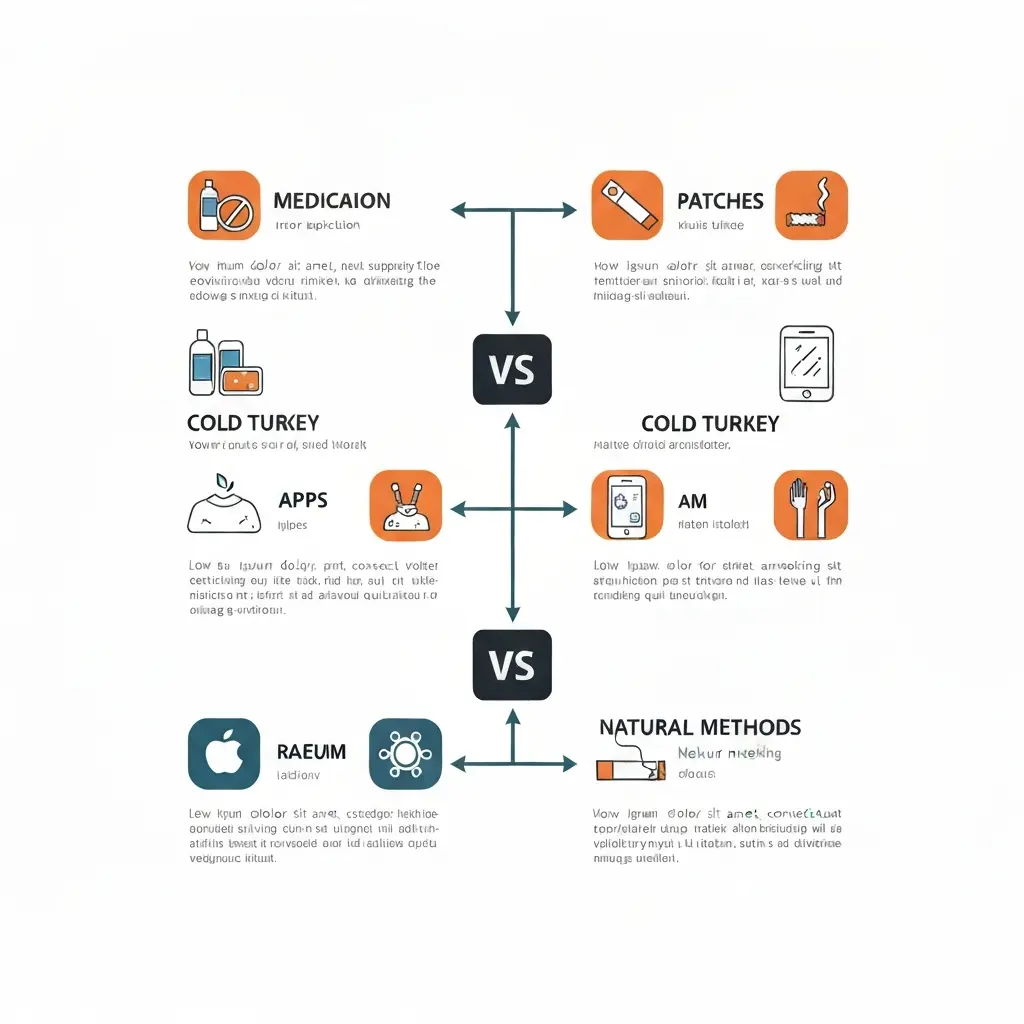
Smoking Cessation Methods Comparison Chart for 2026
If you are trying to figure out the best way to quit smoking, the sheer number of available options can feel overwhelming. Smoking cessation methods range from purely behavioral approaches to pharmacological aids, digital tools, and alternative therapies — and every method has a different evidence base, cost profile, and ideal user profile.
This guide does what most cessation resources do not: it compares every major method head-to-head, using 2026 clinical research data, in a format that helps you choose the right approach for your specific situation. For a broader educational framework, see the evidence-based quit smoking tips guide. For deep dives into individual approaches, see the cold turkey guide, the gradual reduction guide, and the natural cessation guide.
Combination therapy — behavioral counseling plus NRT or prescription medication — consistently produces the highest quit rates in clinical trials: 25–35% at 12 months. No single pharmacological or behavioral method alone matches this combination. The second-best evidence-based approach is varenicline (Champix/Chantix) alone, with 12-month quit rates of approximately 22–25%.
Master Comparison Table
| Method | 12-Month Quit Rate | Cost (Monthly) | Prescription Needed | Best For |
|---|---|---|---|---|
| Cold turkey (unaided) | 3–7% | Free | No | Highly motivated; strong support network |
| Gradual reduction | 5–12% | Low | No | Heavy smokers; anxiety about abrupt quit |
| NRT (single form) | 10–16% | $30–$60/mo | No | Most smokers; any quit method |
| NRT (combination) | 15–25% | $50–$100/mo | No | Heavy smokers; cold turkey or gradual |
| Varenicline | 22–25% | $150–$300/mo | Yes | Most motivated to use medication |
| Bupropion | 15–18% | $50–$150/mo | Yes | Smokers with depression history |
| Behavioral counseling | 10–20% | $0–$200/mo | No | All smokers; amplifies every other method |
| Quit smoking app | 15–22% | Free–$15/mo | No | Tech-comfortable; self-directed |
| Exercise/mindfulness | 15–20% | Low | No | Prefer no medication; anxiety-driven smoking |
| Combination therapy | 25–35% | Varies | Varies | Best outcomes for all smokers |
Success rates represent 12-month continuous abstinence in clinical trial populations. Real-world rates may vary. Sources: Cochrane Reviews 2022–2024, NICE guidelines 2023, WHO cessation recommendations 2024.
Cold Turkey
12-Month Rate: 3–7% unaided; 15–25% with behavioral support and NRT
Cold turkey is the most commonly attempted method and has a modest unaided success rate. The key driver of success is not the method itself but the level of support around it. With behavioral counseling, NRT, and a quit app, cold turkey rates are competitive with medicated approaches.
Best for: Highly motivated smokers who want a clean psychological break and are prepared to invest in support systems. See the full cold turkey survival guide.
Gradual Reduction
12-Month Rate: 5–12% unaided; comparable to cold turkey with NRT support at 6 months
Gradual reduction works by systematically cutting cigarette count before a firm quit date. It reduces peak withdrawal severity and is psychologically accessible for heavy smokers who find cold turkey overwhelming. The critical variable is setting — and keeping — a final quit date. See the gradual reduction step-by-step guide.
Best for: Smokers of 20+ cigarettes per day; those with high anxiety about abrupt cessation; those who have failed cold turkey attempts.
Nicotine Replacement Therapy (NRT)
12-Month Rate: 10–25% depending on type and combination
NRT is the most extensively researched smoking cessation intervention, with over 150 clinical trials in the 2022 Cochrane Review. It roughly doubles quit rates compared to placebo. Available in patch, gum, lozenge, inhaler, and nasal spray forms. Combination NRT (patch + short-acting form) outperforms single-form use significantly for heavy smokers.
Key principle: use NRT for the full recommended duration (8–12 weeks) at the correct dose. Under-dosing and early discontinuation are the most common reasons NRT “fails.”
Varenicline (Champix/Chantix)
12-Month Rate: 22–25%
Varenicline is the single most effective pharmacological cessation agent in clinical trials. It works by partially stimulating nicotine receptors (reducing withdrawal) while blocking nicotine’s full reward effect (reducing satisfaction from smoking). A 2023 Cochrane Review of 27 trials confirmed it outperforms NRT alone and bupropion alone.
Side effects: Nausea (most common), vivid dreams, insomnia. Taking with food and water reduces nausea significantly. The cardiac safety concerns raised in earlier studies have been largely resolved by subsequent large-scale trials.
Best for: Most motivated smokers who are comfortable using prescription medication and have no contraindications.
Bupropion (Zyban/Wellbutrin)
12-Month Rate: 15–18%
Bupropion is an antidepressant that was serendipitously found to reduce smoking urges. It works via dopaminergic and noradrenergic pathways, partially compensating for nicotine withdrawal’s dopamine deficit. It is particularly well-suited for smokers with a history of depression or who are trying to quit during a depressive episode.
Side effects: Dry mouth, insomnia, seizure risk (low but present — contraindicated for those with seizure disorders or eating disorders). Requires a 1-week lead time before the quit date.
Behavioral Counseling and CBT
12-Month Rate: 10–20% alone; amplifies all other methods significantly
Behavioral counseling — including individual therapy, group sessions, quitlines, and CBT-based digital programs — addresses the psychological and habitual dimensions of smoking that pharmacological methods cannot reach. Its most important attribute is that it amplifies every other method it is combined with: NRT + counseling outperforms NRT alone; medication + counseling outperforms medication alone.
Accessible options include free quitlines (1-800-QUIT-NOW in the US), group stop smoking services (NHS in the UK), and app-based CBT programs.
Quit Smoking Apps
12-Month Rate: 15–22% in rigorous trials
Quit smoking apps have emerged as one of the most evidence-supported cessation tools of the past decade. A 2023 Cochrane Review found that app-based interventions produce significantly higher quit rates than no treatment or minimal intervention controls. Apps work by providing behavioral support features — habit tracking, craving management, milestone celebration, community access — at any time and from anywhere.
iQuit combines all of these features with evidence-based CBT exercises, health milestone tracking, and real-time savings calculation. For heavy smokers using NRT or medication, iQuit functions as the behavioral support component that significantly boosts pharmacological success rates.
Natural and Alternative Methods
12-Month Rate: Variable (15–20% with structured behavioral programs)
Natural methods — exercise, mindfulness, dietary changes, herbal support — have the advantage of no side effects and low or no cost. Exercise has the strongest evidence base among natural approaches, with multiple meta-analyses confirming acute craving reduction effects. Mindfulness-based programs (MBSR) have produced quit rates of up to 31% in some trials.
For a complete guide to natural approaches, see how to stop smoking naturally without medication. For natural methods alongside medication, see quitting without medication: practical strategies.
Combination Therapy: The Gold Standard
12-Month Rate: 25–35% (highest of any approach)
The evidence is consistent: combining a pharmacological intervention (NRT or medication) with behavioral support produces substantially better outcomes than either alone. The practical implementation:
- Cold turkey or gradual reduction quit plan + combination NRT + counseling or app = best real-world outcomes
- Varenicline + behavioral app (like iQuit) = the most accessible high-performance combination for most smokers
- Adding exercise and mindfulness to any combination further improves outcomes and reduces relapse risk
How to Choose the Right Method
| Your Situation | Recommended Approach |
|---|---|
| First quit attempt, moderate smoker | Cold turkey + NRT patch + quit app |
| Heavy smoker (20+ cigs/day) | Gradual reduction + combination NRT + behavioral support |
| Multiple failed attempts | Varenicline + behavioral counseling + quit app |
| History of depression | Bupropion or varenicline + behavioral support (consult doctor) |
| Prefer no medication | Exercise + mindfulness + app + NRT (NRT is not a drug in the prescription sense) |
| Budget-constrained | Free quitline + free app tier + exercise |
Frequently Asked Questions
Which smoking cessation method has the highest success rate?
Combination therapy — behavioral counseling or support combined with NRT or prescription medication — has the highest clinical success rates at 25–35% at 12 months. Among single methods, varenicline (Champix/Chantix) has the strongest individual success rate at approximately 22–25% at 12 months.
Is NRT or medication more effective for quitting smoking?
Prescription medication (particularly varenicline) produces slightly higher quit rates than NRT in head-to-head trials. However, combination NRT (patch plus short-acting form) has success rates comparable to medication for many smokers, and is available without a prescription. Both are significantly more effective than either alone when combined with behavioral support.
Do quit smoking apps really work?
Yes — quit smoking apps have a strong and growing evidence base. A 2023 Cochrane Review found that app-based interventions produce significantly higher quit rates than minimal intervention controls, with some trials achieving 15–22% 12-month abstinence rates. Apps are most effective when they include active behavioral support features beyond simple tracking.
What is the cheapest effective smoking cessation method?
Free quitlines (like 1-800-QUIT-NOW in the US) combined with a free quit app and regular exercise is the most cost-effective evidence-based approach. NRT adds modest cost but significantly improves outcomes. In many countries, NRT and even prescription medications are available free or subsidized through national health services.
How do I know which cessation method is right for me?
Consider your smoking intensity (number of cigarettes per day), your previous quit attempts and why they failed, your preferences regarding medication, your budget, and your psychological profile (high anxiety vs. motivated vs. depression-prone). Heavier smokers and those with multiple failed attempts generally benefit most from pharmacological support. A conversation with your GP or pharmacist can help narrow down the best option.
Whatever Method You Choose, Add iQuit
iQuit functions as the behavioral support layer that amplifies every cessation method. Whether you are using NRT, medication, cold turkey, or gradual reduction — iQuit’s craving tools, milestone tracking, and supportive community make every other approach more effective.
Your method choice matters less than your commitment to it. iQuit helps you stay committed.