What Are the Stages of Nicotine Withdrawal? A Day-by-Day Survival Guide for 2026
What are the stages of nicotine withdrawal? Understanding this question precisely — not just vaguely — can be the difference between getting through the hardest days and giving up. Nicotine withdrawal is not a single sustained state of misery; it is a structured, predictable progression that begins within hours of quitting and substantially resolves within four weeks for most people. The CDC, NHS, and academic research published in Psychopharmacology have mapped this process in granular detail, and knowing the roadmap transforms it from an overwhelming ordeal into a manageable sequence of challenges.
This guide gives you the complete, evidence-based timeline — day by day — and practical strategies for each stage based on what the research actually shows works, not just what sounds encouraging.
What Causes Nicotine Withdrawal?
Nicotine withdrawal occurs because the brain has physically restructured itself in response to chronic nicotine exposure. Nicotine binds to nicotinic acetylcholine receptors and triggers dopamine release in the brain’s reward circuitry. Over months and years of smoking, the number of these receptors increases (upregulation) and the baseline dopamine system recalibrates to expect regular nicotine input to function normally.
When nicotine is removed, dopamine levels fall below their adjusted baseline. The result is not just craving — it is a genuine neurochemical deficit that produces real, measurable symptoms including depression, anxiety, irritability, and cognitive impairment. Research published in Neuropsychopharmacology has documented these changes using brain imaging, confirming that withdrawal is a physiological event, not a psychological weakness.
The withdrawal process is the brain reversing its adaptations — gradually restoring normal receptor density and recalibrating dopamine signaling to function without nicotine. This process takes weeks to complete at the cellular level, which is why behavioral cravings can persist even after the acute physical symptoms have fully resolved.
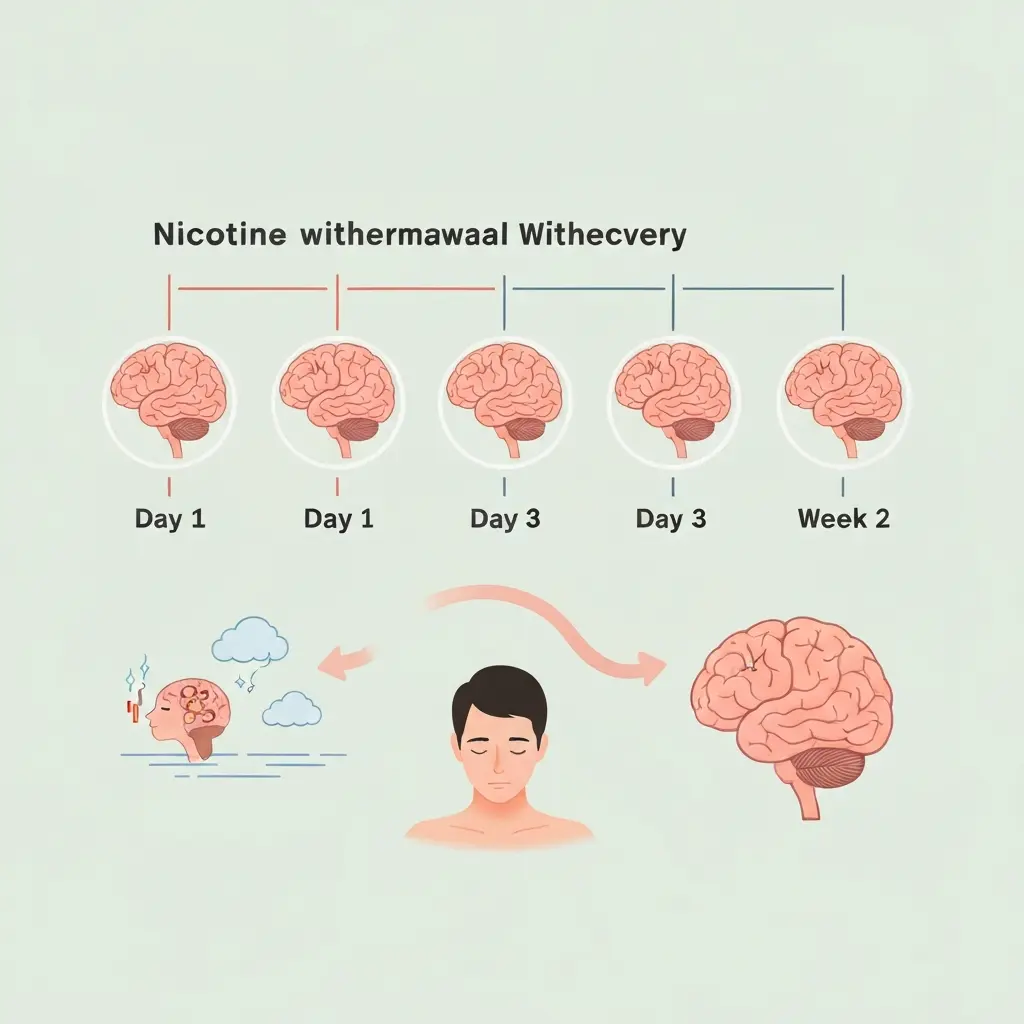
Stage 1: Onset — Hours 4 to 24
Nicotine has a half-life of approximately two hours in the bloodstream. This means nicotine levels begin declining meaningfully within two to four hours of your last cigarette, and you will notice the first withdrawal symptoms within four to six hours for most regular smokers. This is why many heavy smokers feel the urge to smoke immediately upon waking — overnight is already an eight-hour gap.
During the onset stage, the primary symptoms are: the beginning of cravings (persistent thoughts about smoking), mild irritability and restlessness, and a low-level feeling of anxiety or tension. These early symptoms are subtle compared to what follows, but they are real. Many people describe this stage as feeling “off” or as if something is missing, without yet experiencing the more intense symptoms of days two and three.
At 24 hours, nicotine is fully cleared from the bloodstream. This marks the transition from onset to peak — it is the point at which the brain has the smallest amount of external nicotine it has had in a long time, and withdrawal symptoms intensify accordingly. This is also the point at which many people experience their first high-intensity craving episode.
Stage 2: The Peak — Days 2 to 3
Days two and three are, for the majority of quitters, the most challenging period of the entire cessation process. The peak of physical withdrawal occurs around 48–72 hours because this is when the brain’s nicotine receptors, now fully unoccupied, generate the strongest compensatory drive to smoke. If you have been dreading these days, knowing they are the worst — and that they are limited in duration — is crucial preparation.
Peak withdrawal symptoms include: intense craving episodes (each lasting 3–5 minutes, often multiple per hour), headaches (from changes in brain blood flow), insomnia or disrupted sleep, difficulty concentrating (which can feel alarming but is temporary), heightened irritability and short temper, increased appetite, and constipation in some people (nicotine has a laxative effect; its absence reverses this).
CDC data indicates that approximately 60% of people experience significant mood symptoms during this peak period — anxiety, depressed mood, frustration, or anger. These are recognized nicotine withdrawal symptoms listed in the DSM-5, not signs of a mental health condition. They are transient and resolve with continued abstinence. Having someone you trust who understands what you are going through can be enormously helpful during these 48 hours.
The most important fact about day three: each individual craving lasts only 3–5 minutes. If you can identify the craving beginning, note the time, and commit to doing nothing for five minutes, the craving will have passed. This is not folklore — it is measurable craving physiology. The iQuit craving timer is built specifically for this moment: start the timer, focus on breathing or a brief distraction, and watch the craving pass before the timer ends.
Stage 3: Gradual Resolution — Days 4 to 14
From day four onward, the intensity of physical withdrawal symptoms begins to decline for most people. Craving duration shortens. Headaches resolve. Energy begins to return. Sleep quality, which is often severely disrupted during the peak, starts to normalize for most people by the end of the first week — though insomnia can persist longer in some individuals.
The key characteristic of this stage is progressive improvement. Day five is better than day four. Day seven is better than day five. This progression is not always linear — many people experience “ambush cravings” triggered by specific situations (after a meal, with coffee, in a social setting where others smoke) even when the background craving level is low. These situational cravings are behavioral rather than purely physiological, and they require the coping strategies you prepared before your quit date.
By the end of week two, the majority of the physical nicotine withdrawal has resolved. The brain’s receptor density begins to normalize. For many people, the second week is when they first feel genuinely good about their quit attempt — a cautious but real sense of accomplishment. Appetite may still be elevated, but cognitive function largely returns, and the emotional volatility of the peak begins to feel like a past experience.
Stage 4: Psychological Tail-Off — Weeks 2 to 4 and Beyond
The final stage of nicotine withdrawal is dominated by psychological rather than physical symptoms. While the brain’s receptor physiology has largely normalized by week two, the behavioral conditioning of years of smoking remains. Specific situations, emotions, or sensory cues — the smell of smoke, a stress event at work, the end of a meal — can trigger craving responses that feel intense even weeks or months into a quit.
These conditioned cravings are qualitatively different from the physical withdrawal of the first two weeks. They are shorter, less physically overwhelming, and more clearly linked to specific triggers. The research distinguishes between “physical craving” (driven by neurochemical deficit) and “cue-induced craving” (driven by conditioned associations). Most people find cue-induced cravings more manageable once they understand what is happening.
Research from the American Journal of Psychiatry found that psychological craving symptoms can persist in a milder form for up to several months, with most people experiencing only occasional situational cravings by month three. The important clinical point: persistence of these cravings is normal and does not indicate impending relapse. Recognizing them as learned responses — rather than signs of inevitable failure — is a key cognitive reframe that behavioral counseling provides.
What Are the Official DSM-5 Nicotine Withdrawal Symptoms?
The American Psychiatric Association’s Diagnostic and Statistical Manual of Mental Disorders (DSM-5) formally classifies nicotine withdrawal as a diagnosable clinical syndrome. To meet the criteria, a person must cease or reduce tobacco use after heavy or prolonged use and develop four or more of the following symptoms within 24 hours: irritability, frustration or anger, anxiety, difficulty concentrating, increased appetite, restlessness, depressed mood, and insomnia.
Additional withdrawal symptoms not in the DSM-5 criteria but commonly reported include: headaches, coughing (as the lungs clear), constipation, dizziness, sore throat, and nausea. The presence of these symptoms is evidence of a real physiological process, not psychological weakness. It is also evidence that the body’s normalization is underway — withdrawal is the proof that your body is repairing its relationship with neurochemistry.
NRT and varenicline specifically target the DSM-5 core symptoms by partially maintaining nicotinic receptor activation (NRT) or receptor blockade with partial agonism (varenicline). This is why both significantly reduce symptom severity — they address the underlying neurochemical mechanism rather than just managing surface-level discomfort.
How Can You Manage Each Stage of Withdrawal?
For the onset stage (hours 4–24): begin NRT or medication on your quit date without waiting to see if you need it; this proactive approach prevents symptoms from building to peak intensity. Keep yourself occupied, particularly in the first evening — boredom and inactivity are among the highest-risk contexts for early relapse.
For the peak stage (days 2–3): use short-acting NRT (gum or lozenge) for acute craving episodes in addition to any background NRT. Exercise, even briefly — a five-minute walk reduces craving intensity by up to 50 minutes according to research published in Addiction. Avoid alcohol, which significantly reduces inhibitory control and dramatically increases relapse risk. Use the craving timer in iQuit to validate that cravings end — each completed timer is evidence that you can survive the next one.
For the resolution stage (days 4–14): identify your top three trigger situations and practice specific coping responses before you encounter them. Reward your smoke-free days concretely — calculate money saved and plan to spend it on something meaningful. Sleep, nutrition, and hydration matter more than usual during this period, as the body’s stress response is still elevated.
For the psychological tail-off (weeks 2+): expect occasional situational cravings for weeks to months and normalize them rather than treating each one as a crisis. Use behavioral techniques from cognitive behavioral therapy (CBT) — challenge the automatic thought “I need a cigarette” with “I have a craving, and it will pass.” Maintaining your tracking app and smoke-free streak makes each passing week feel like the investment it is.
For deeper reading on supporting your quit journey with technology, see our guide on the most effective ways to quit smoking in 2026. For perspective on how digital health tools are reaching people at the moments they need support most, this resource on How to Use Push Notifications for Marketing is directly relevant to how apps like iQuit deliver timely behavioral interventions. And for additional context on evidence-based digital health communication, see Content Marketing Automation: Tools, Workflows, and ROI.
Frequently Asked Questions
How long do nicotine withdrawal symptoms last?
Physical nicotine withdrawal symptoms peak at days 2–3 and substantially resolve within 2–4 weeks for most people. Psychological symptoms — occasional cravings triggered by specific situations — can persist in milder form for several months. By week four, most people report that acute withdrawal is effectively over, though individual variation is significant.
What is the hardest day of nicotine withdrawal?
Day three is consistently reported as the peak of physical nicotine withdrawal. By this point, all nicotine has cleared from the body and blood, the brain’s dopamine system is at its most depleted relative to baseline, and receptor-driven craving intensity reaches its maximum. Knowing day three is the peak — and that day four will be meaningfully easier — is valuable preparation for getting through it.
When does nicotine withdrawal peak?
Nicotine withdrawal peaks between 48 and 72 hours (days 2–3) after the last cigarette. This timing correlates with the complete clearance of nicotine from the body and the maximum upregulation of nicotinic receptors demanding stimulation. After day three, physical symptoms begin a progressive decline that continues through the first two to four weeks.
Does NRT completely eliminate withdrawal symptoms?
NRT does not eliminate withdrawal symptoms entirely but reduces their severity by approximately 50–60% according to Cochrane meta-analyses. It lowers the peak intensity of cravings, irritability, and anxiety while the brain adjusts to lower nicotine levels. Most people using NRT correctly still experience some withdrawal, but the reduction in severity significantly improves quit success rates.
Can nicotine withdrawal cause anxiety and depression?
Yes — anxiety and depressed mood are DSM-5-recognized nicotine withdrawal symptoms. They arise because the brain’s dopamine and reward systems are temporarily depleted when nicotine is removed. These symptoms are transient and resolve as the brain recalibrates. Research shows that anxiety and depression actually improve substantially in the months following cessation — paradoxically, quitting smoking improves long-term mental health outcomes.
How long does craving last during nicotine withdrawal?
Individual craving episodes during nicotine withdrawal typically last 3–5 minutes. This is a critical piece of information: no matter how intense a craving feels, it is a temporary wave that passes within minutes. Cravings during the peak period (days 2–3) are frequent, potentially every 30–60 minutes, but each individual episode is short. As withdrawal progresses, both frequency and intensity decrease substantially.
Is it normal to feel worse in week 2 than week 1 of quitting smoking?
Some people do experience a secondary dip in mood or increased cravings around weeks two to three — often called the “quit smoking wall.” This appears to be more psychological than physiological: initial motivation has worn off, the immediate crisis of the first week is past, and complacency can set in. It is normal and does not indicate physical relapse risk. Recognizing this pattern in advance and planning for it helps quitters navigate it without returning to smoking.
What helps with nicotine withdrawal headaches?
Nicotine withdrawal headaches occur due to changes in brain blood flow and increased blood pressure variability in the first days after quitting. They typically resolve by the end of week one. Management includes staying well hydrated (dehydration worsens them), using over-the-counter pain relief if needed, applying NRT consistently to reduce the nicotine deficit driving vascular changes, and getting adequate rest — poor sleep amplifies headache severity during withdrawal.
Are nicotine withdrawal symptoms different for heavy smokers versus light smokers?
Yes. Heavy smokers (more than 20 cigarettes per day) typically experience more intense withdrawal symptoms because their brains have adapted to higher, more frequent nicotine doses. The Fagerström Test for Nicotine Dependence is a validated clinical tool that predicts withdrawal severity based on dependence level. Higher dependence scores indicate the need for stronger NRT doses or prescription medication rather than lower-strength over-the-counter products.
Beat Withdrawal One Craving at a Time
iQuit’s craving timer shows you exactly what the research confirms: every craving ends. Track each one as it passes, build your smoke-free streak, and access breathing exercises, distraction tools, and motivational content at exactly the moment you need them most.
Download iQuit today — and give yourself the real-time behavioral support that makes the difference when withdrawal hits hardest.