
How to Stop Cigarette Cravings: 7-Day Relief Plan
How to stop cigarette cravings is the question that wakes you up at 3 a.m., hijacks your focus at work, and makes a gas station stop feel like defusing a bomb. If you’ve tried willpower alone and lost, you’re not weak — you’re fighting a physiological dependency that reshapes brain chemistry. The good news? Cravings peak at 72 hours and rarely last more than 5 minutes each. What you do during those 5 minutes is everything.
This 7-day plan gives you a specific, day-by-day structure to outlast cravings using techniques backed by behavioral science, nicotine replacement therapy research, and real quit-smoking success stories from people who’ve been exactly where you are.
Why Cigarette Cravings Happen (And When They Peak)
Understanding what’s actually happening in your brain makes cravings feel less like personal failure and more like a predictable biological event you can plan around.
Nicotine binds to receptors in the brain’s reward system and triggers a dopamine release — the same chemical tied to pleasure, motivation, and focus. Over time, your brain stops producing baseline dopamine efficiently on its own, making you dependent on cigarettes just to feel normal. When you quit, dopamine levels drop sharply. That withdrawal is what you experience as a “craving.”
The first 3 days are the hardest. This is when physical nicotine withdrawal is at its peak — headaches, irritability, difficulty concentrating, and those relentless urges. By day 5–7, nicotine has fully cleared your bloodstream, but psychological triggers (stress, coffee, social situations) remain powerful for weeks or months.
Here’s the counterintuitive part: the craving itself is not actually getting worse when it feels overwhelming. Research consistently shows that the perception of craving intensity is heightened by anxiety about the craving — a phenomenon called “craving amplification.” Knowing a craving will pass in 5 minutes, whether you smoke or not, is one of the most clinically useful pieces of information you can carry into your first week.
Nicotine Withdrawal & Craving Timeline
| Time After Quitting | What’s Happening | Main Symptom |
|---|---|---|
| 0–24 hours | Nicotine clears from blood; CO levels drop | Intense, frequent cravings |
| 24–72 hours | Peak physical withdrawal | Irritability, headaches, strong urges |
| Day 3–7 | Nicotine fully eliminated; dopamine begins recovery | Cravings shorter but psychologically triggered |
| Week 2–4 | Brain starts recalibrating reward pathways | Situational cravings, mood swings |
| Month 2–3 | Lung cilia regenerate; taste/smell improve | Cravings rare, mostly habit-triggered |
For a deeper look at the psychological and physiological rationale behind quitting stages, the guide on top strategies to quit smoking successfully breaks down triggers and addiction mechanics in detail.
The 7-Day Craving Relief Plan
This plan is built around a simple premise: every day of your first week has a different dominant challenge, and each challenge deserves a specific response. Don’t just white-knuckle it — have a plan.
Day 1: Survive the First 24 Hours
Focus: Remove access, replace the ritual.
Throw out all cigarettes, lighters, and ashtrays. Identify your 3 highest-risk moments today (morning coffee, after lunch, driving?) and pre-plan a substitute for each. Chew gum during coffee. Take a 5-minute walk after lunch. Use a podcast or audiobook in the car. The goal isn’t to feel great — it’s to make it to midnight.
Day 2: Manage Peak Physical Withdrawal
Focus: Hydration and movement.
Physical symptoms hit hardest on day 2. Drink at least 2 liters of water — it speeds nicotine elimination and reduces headache intensity. Do 20 minutes of any physical activity; even a brisk walk releases endorphins that partially compensate for the dopamine dip. If you’re using nicotine replacement therapy (NRT) like patches or gum, today is when you’ll feel the most relief from it.
Day 3: Outlast the Peak Craving Day
Focus: The 5-minute rule.
Day 3 is statistically the hardest. Every craving that hits today will feel urgent and permanent. It’s neither. Set a 5-minute timer each time a craving starts. Do anything — breathe, pace, text a friend, splash cold water on your face — until the timer ends. Most cravings dissolve before the timer does. Log each one you beat. Those logs matter more than you think.
Day 4: Identify and Defuse Triggers
Focus: Pattern recognition.
By day 4, nicotine is leaving your system but your habits aren’t. Start noticing which situations, emotions, or people trigger cravings. Write them down. The effective strategies to help you quit smoking resource covers behavioral swaps in depth — particularly useful when you start recognizing your personal trigger map.
Day 5: Reclaim a Reward
Focus: Positive reinforcement.
Calculate what you’ve saved in cigarette costs so far (the Quit Smoking Save Calculator makes this concrete and motivating). Spend a portion on something you genuinely enjoy. Behavioral science calls this “reward substitution,” and it reinforces the neural pathways that make quitting feel worth it — not just something you’re losing.
Day 6: Handle Social Pressure
Focus: Preparation, not avoidance.
If you’re around smokers today — at work, at home, anywhere — you need an exit script ready. Something simple: “I’m quitting — can you smoke somewhere I can’t see it?” Most people respect this. If they don’t, that tells you something. Today’s mission is staying quit in a social setting, which is a different skill than staying quit alone.
Day 7: Mark the Milestone
Focus: Identity shift.
One week smoke-free is a genuine physiological milestone. Your lung cilia are beginning to recover. Your carbon monoxide levels have normalized. Your heart rate and blood pressure are already trending lower. Today isn’t just about craving management — it’s about starting to see yourself as someone who doesn’t smoke. That identity shift is one of the most powerful long-term predictors of quit success.
How to Deal With Cigarette Cravings in the Moment
The 7-day structure helps with planning, but cravings don’t announce themselves politely. You need fast, effective tools for the moment one hits.
The 4 D’s Method (Evidence-Backed)
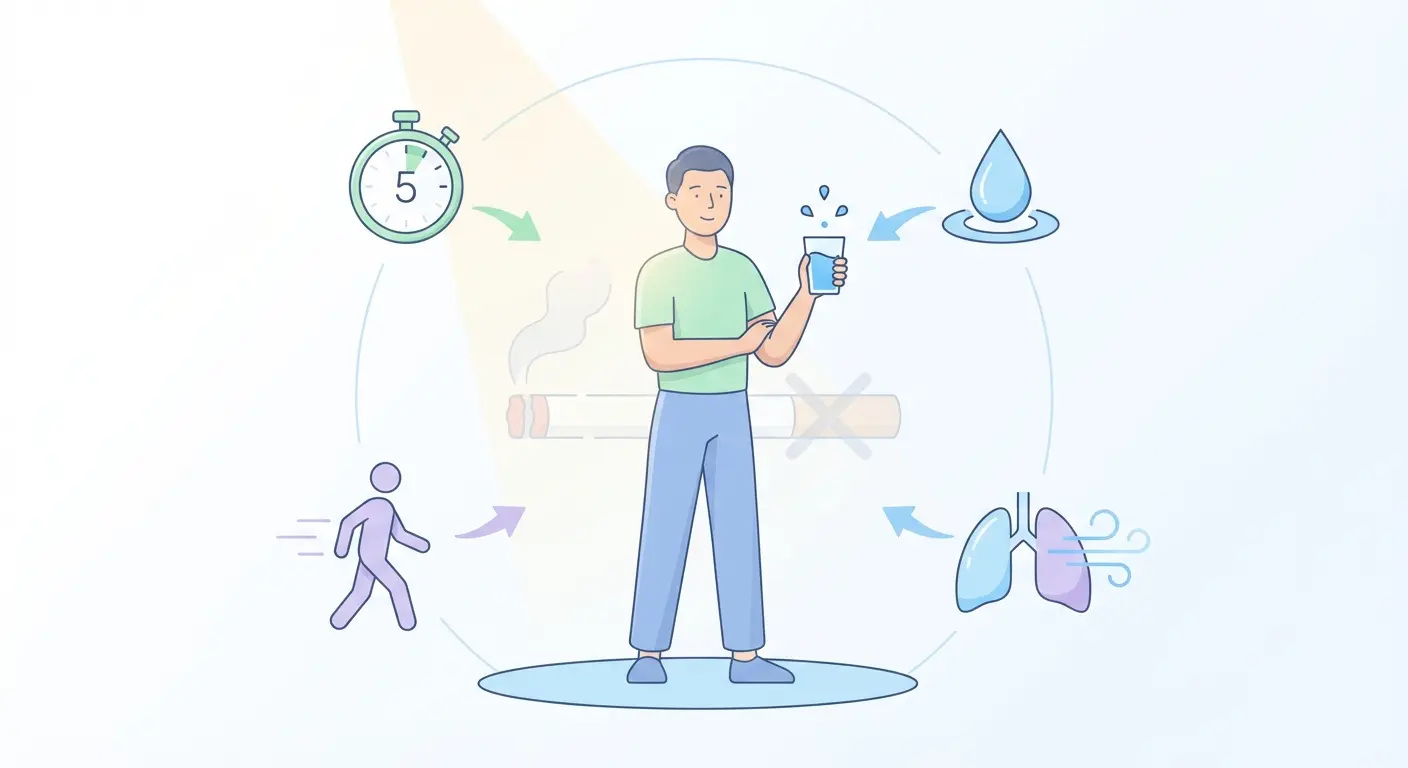
- Delay: Commit to waiting 5 minutes before doing anything. Most cravings collapse in this window.
- Drink water: Cold water slows your breathing, reduces cortisol, and gives your hands something to do.
- Do something: Physical movement — even 10 jumping jacks or a short walk — shifts brain chemistry fast.
- Deep breathe: Box breathing (4 counts in, hold 4, out 4, hold 4) activates the parasympathetic nervous system and directly counters the stress response driving the craving.
The American Cancer Society’s guidance on handling cravings and tough situations also recommends distraction strategies like calling a support person, chewing a cinnamon stick (which mimics the oral fixation of smoking), or cleaning something — all effective pattern interrupts.
Nicotine Replacement Therapy: What the Research Says
NRT (patches, gum, lozenges, inhalers, nasal spray) roughly doubles your quit success rate compared to going cold turkey, according to multiple clinical reviews. A Cochrane review published on PubMed found that nicotine e-cigarettes are more effective than traditional NRT for smoking cessation in some populations, though long-term safety data is still evolving. The core point: using a pharmacological aid isn’t weakness — it’s strategy.
Also worth watching: 7 proven ways to get past nicotine cravings covers additional techniques in a digestible video format, and WebMD’s craving tips video library has short, expert-led clips for multiple craving scenarios.
Quit Smoking Motivation: What Actually Works
Motivation is the piece that feels most personal — and the piece most people get wrong. Relying on general “health is important” messaging doesn’t work when a craving is actually firing. Here’s what does.
Specificity Over Generality
Vague reasons (“I want to be healthier”) don’t activate the brain’s reward system under stress. Specific reasons do. “I want to be able to run with my daughter at her birthday party without stopping” is a reason your brain can picture and feel. Write down your 3 most specific reasons. Keep them on your phone lock screen.
Progress Visibility
Humans are motivated by progress they can see. Tracking the hours smoke-free, the money saved, and the physical health improvements (carbon monoxide levels, heart rate, lung function) makes the abstract concrete. The Smokefree.gov quit plan builder is a free, structured tool that creates a personalized plan including motivation anchors.
The Role of Identity
Research on habit change — particularly James Clear’s work on identity-based habits — shows that people who say “I don’t smoke” instead of “I’m trying to quit smoking” are significantly more likely to stay quit. The language signals a completed identity shift rather than an ongoing struggle. It feels small. It isn’t.
If you’re looking for expanded motivation strategies and behavioral frameworks, the guide on how to quit smoking successfully covers the psychological architecture of long-term quitting in more depth.
Quit Smoking Success Stories That Reframe What’s Possible
Real quit-smoking success stories do something that statistics can’t: they make quitting feel possible for someone who feels like they’re the exception to every rule.
Take the pattern you’ll see in nearly every success story shared in quit communities: the person tried and failed multiple times before succeeding. The CDC’s Tips From Former Smokers campaign — one of the most studied public health interventions in U.S. history — found that on average, people make 8–10 serious quit attempts before achieving long-term cessation. The CDC’s Tips From Former Smokers resource features real stories from real people, many of whom smoked for 20–30 years before quitting for good.
What do these stories have in common? Three things.
- A specific trigger for quitting — not vague health concern, but a single moment that made continuing feel impossible.
- A support structure — whether a quitline, a partner, an app, or an online community.
- A plan for the first week — not just willpower, but a day-by-day strategy for the hardest stretch.
What most people miss in these stories is that the successful quitters didn’t feel more confident or more motivated than you do right now. They just had better systems. That’s the actual insight: quitting isn’t about feeling ready. It’s about having a structure that works even when you don’t feel ready.
Tools, Apps, and Resources Worth Using
The right tools don’t quit for you — but they close the gap between intention and follow-through significantly.
Craving SOS in Your Pocket
When a craving hits at an inconvenient moment, having an immediate resource matters. The quitSTART app from Smokefree.gov is free, evidence-based, and includes craving coping tools accessible in under 30 seconds. For something with broader behavioral science integration, the iQuit app includes a real-time SOS craving button, daily missions tailored to your quit stage, and mood tracking — useful during the first week when emotional volatility tends to peak alongside cravings.
Community and Accountability
Social accountability is one of the most under-used tools in smoking cessation. Whether it’s telling a friend, joining a quit smoking community online, or using an app with accountability circles like iQuit, having someone who knows you’re quitting makes a measurable difference. You’re less likely to relapse when relapse means telling someone you respect.
Track the Financial Reality
Money is concrete in a way that health improvements sometimes aren’t — especially in week one when you don’t feel dramatically better yet. Use the Quit Smoking Save Calculator to see your exact savings by day, week, and year. For a pack-a-day smoker at current average prices, the one-week savings alone typically cover a month of most app subscriptions and then some.
Your 7-Day Craving Survival Checklist
- ☐ Remove all cigarettes, lighters, and ashtrays from your environment
- ☐ Identify your top 3 daily trigger moments and plan substitutes for each
- ☐ Stock up on gum, water bottles, and healthy snacks (oral fixation is real)
- ☐ Download a craving-support app for SOS moments
- ☐ Tell at least one person you’re quitting (accountability partner)
- ☐ Set up NRT if using it — and learn to use it proactively, not reactively
- ☐ Write down your 3 most specific reasons for quitting
- ☐ Track your savings daily — make the financial win visible
- ☐ Plan Day 7 reward before you start Day 1
- ☐ Accept that a bad moment doesn’t have to become a relapse
Frequently Asked Questions
How long do cigarette cravings last after quitting?
Each individual craving episode typically lasts 3–5 minutes, regardless of whether you smoke. Physical withdrawal peaks at 48–72 hours after your last cigarette and largely resolves within the first week. Psychological cravings — triggered by situations, emotions, or habits — can occur for several weeks to months but decrease significantly in frequency and intensity over time.
What is the fastest way to stop a cigarette craving?
The fastest evidence-based method is box breathing combined with cold water — breathe in 4 counts, hold 4, out 4, hold 4, while drinking a glass of cold water. This activates the parasympathetic nervous system within 60–90 seconds, directly countering the stress response that drives most cravings. Physical movement (even 10 jumping jacks) is nearly as fast and effective.
Is it normal to have strong cravings even after a week of not smoking?
Yes, completely normal. After the first week, physical nicotine withdrawal is resolved, but psychological and habit-based cravings continue — often triggered by specific situations (stress, social settings, certain times of day). These are not signs of failure; they’re predictable parts of the brain rewiring process. They decrease consistently over the following weeks.
Does nicotine replacement therapy actually help with cravings?
Yes — NRT (patches, gum, lozenges, inhalers) roughly doubles your quit success rate compared to cold turkey, according to clinical evidence. It works by delivering a controlled dose of nicotine without the 7,000+ chemicals in cigarette smoke, reducing withdrawal intensity. NRT is most effective when used proactively before expected craving peaks, not reactively after one starts.
What’s the hardest day when quitting smoking?
Day 3 is consistently reported as the most difficult day when quitting smoking, as it coincides with peak physical nicotine withdrawal. Nicotine blood levels are depleted, dopamine is at its lowest point, and cravings are both frequent and intense. Having a specific plan for Day 3 — rather than relying on general willpower — significantly improves the chance of getting through it.
How do I deal with cigarette cravings at work or in social situations?
Prepare a simple, direct exit script: “I’m quitting smoking — I need a few minutes.” Step away, use box breathing or a craving-coping app, and return when the craving (usually under 5 minutes) has passed. Telling colleagues you’re quitting creates accountability and usually generates support rather than judgment. Avoiding all social situations isn’t sustainable — managing cravings within them is the skill worth building.
Keep Going: Your Next Steps After Day 7
Making it through the first week is real. It’s not a small thing. But what comes after day 7 is where many people get surprised — the acute physical withdrawal is done, but the habit-based cravings can still catch you off guard weeks later. Knowing how to stop cigarette cravings in the long term requires the same intentional approach that got you through week one.
Here’s what to do next:
- Build your long-term strategy: Read through the effective strategies to help you quit smoking guide to extend your craving toolkit beyond week one.
- Understand what you’re fighting: The top strategies to quit smoking successfully resource covers the long-game psychology — trigger management, relapse prevention, and identity-based change.
- Track your health recovery: If you want to see your progress in real time — money saved, health milestones, craving patterns, mood — the iQuit app gives you all of this with an SOS craving button for moments when this guide isn’t enough.
- Use free government support: The Smokefree.gov quit plan builder is free, research-backed, and helps you build a structured plan that extends well beyond week one.
Every craving you’ve outlasted this week has already changed your brain. Keep going.