How to Stop Cigarette Cravings: Cut Urges 50% in 7 Days
How to stop cigarette cravings is one of the most-searched questions by people who’ve just made the single hardest decision of their adult lives — quitting smoking. And here’s the uncomfortable truth nobody tells you upfront: the craving itself peaks at around 90 seconds and then fades. That’s it. Less time than it takes to microwave leftovers.
The problem isn’t the craving. The problem is what you do during those 90 seconds — and whether you have a plan ready or you’re just white-knuckling it and hoping for the best.
This guide walks you through a practical, evidence-backed 7-day approach that real quitters have used to cut the frequency and intensity of cravings — often by half within the first week.
Why Cigarette Cravings Happen (And How Long They Last)
Nicotine is one of the fastest-acting psychoactive substances there is — it reaches the brain within 10 seconds of inhaling. Each cigarette trains your brain to associate certain situations (morning coffee, stress, after meals) with a dopamine reward. That’s the neural pattern you’re trying to break.
Neuroscientist Andrew Huberman explains in his deep-dive on nicotine’s effects on the brain and body that nicotine binds to acetylcholine receptors, flooding the reward system — and that quitting requires systematically dismantling those associations. It’s not a willpower problem. It’s a neurological rewiring project.
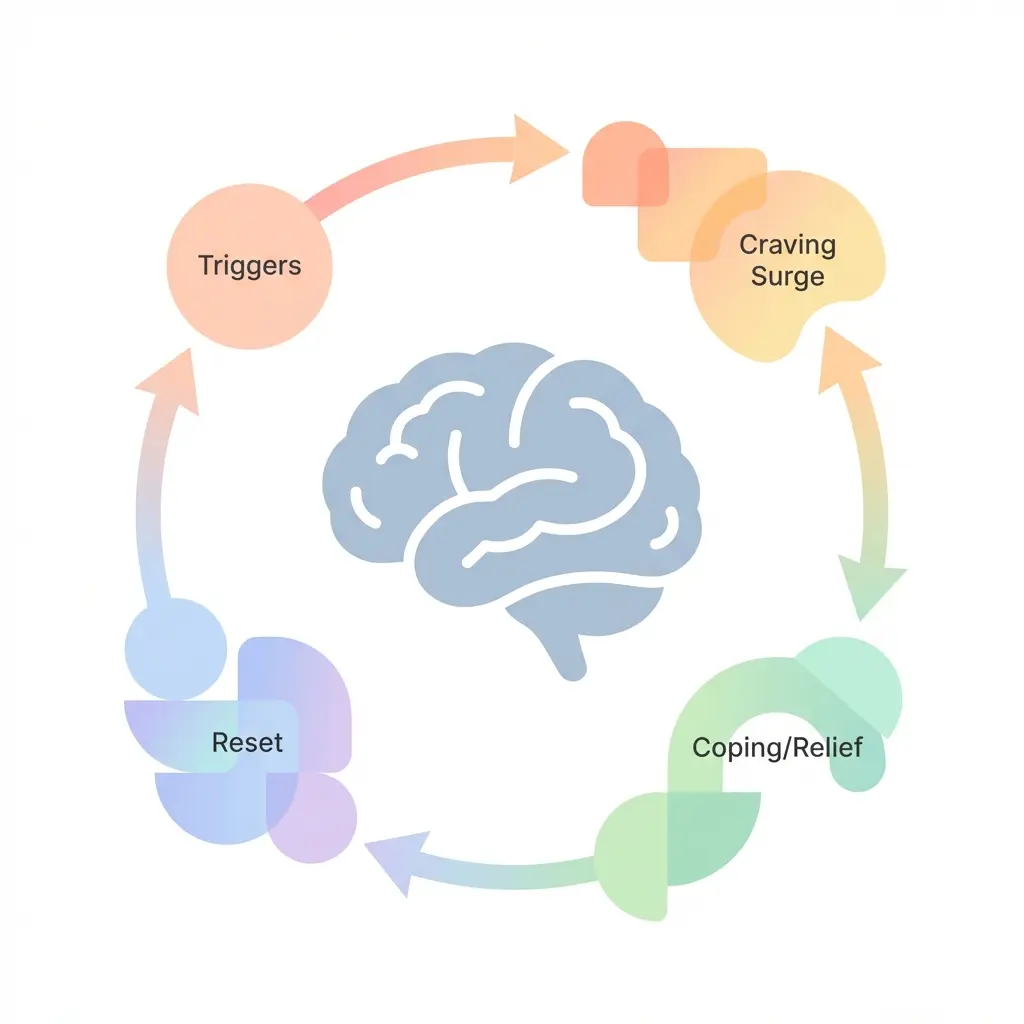
Here’s the counterintuitive part: cravings actually decrease in both frequency and intensity as days pass — but only if you don’t give in. Every time you resist, you weaken the neural pathway slightly. Every time you give in, you reinforce it. The first 72 hours are the hardest because nicotine is still physically leaving your system.
According to the NHS Better Health guide on managing nicotine withdrawal, cravings are strongest in the first 1–3 days and typically become more manageable by the end of the first week. That’s the window this 7-day plan targets.
The 7-Day Plan to Reduce Cravings by 50%
This isn’t a vague “stay positive” plan. Each day has a specific focus that builds on the one before.
Days 1–2: Track Every Craving Without Judgment
Don’t try to fight cravings on day one. Just document them. Write down the time, what you were doing, how intense it felt (1–10), and what you did instead of smoking. This builds pattern awareness — and patterns are what you’ll actually be fighting, not “willpower.”
Days 3–4: Eliminate Your Top Two Triggers
Look at your log. Most people have 2–3 situations that account for 60–70% of their cravings. Morning coffee? Work breaks? Driving? Restructure those moments for 72 hours. Drink tea instead of coffee. Take a different route. Stand somewhere new during breaks. You’re interrupting the physical environment that cues the habit.
Days 5–6: Add a Replacement Behavior
Your brain doesn’t just need the cigarette removed — it needs something to do. Chewing gum, cold water, a 2-minute walk, deep breathing, or even a specific playlist can serve as the new pattern. The National Cancer Institute’s Smokefree guide on managing cravings specifically recommends physical activity as one of the most effective real-time craving disruptors.
Day 7: Celebrate the Data, Not Just the Feeling
Compare day 7 craving logs to day 1. Most people are genuinely surprised. Frequency is down. Intensity is lower. That tangible evidence matters more than motivation because motivation fades — but data doesn’t lie.
What Changes During Your First 7 Smoke-Free Days
| Day | What’s Happening Physically | Craving Pattern | Your Focus |
|---|---|---|---|
| Day 1 | Carbon monoxide leaves body; O₂ rises | Frequent, intense | Track every craving |
| Day 2–3 | Nicotine fully cleared; withdrawal peaks | Most intense period | Identify top triggers |
| Day 4–5 | Taste/smell begin returning; energy dips | Slightly less frequent | Build replacement habits |
| Day 6–7 | Lung cilia begin recovering; breathing easier | Noticeably reduced | Review progress data |
How to Deal With Cigarette Cravings in Real Time
When a craving hits, you have roughly 10–15 seconds before your automatic behavior kicks in. That’s your intervention window.
The most battle-tested real-time method is the 4 D’s — used by smoking cessation coaches and backed by behavioral science:
- Delay: Tell yourself you’ll wait just 10 more minutes. The craving will likely peak and fade within that window. Buying time breaks the automatic response chain.
- Deep Breathe: Take 5 slow, deep breaths — in for 4 counts, hold for 2, out for 6. This activates the parasympathetic nervous system and counteracts stress-driven cravings directly.
- Drink Water: Cold water gives your hands and mouth something to do, and mild dehydration can actually amplify the feeling of a craving. Many ex-smokers carry a water bottle as part of their quit strategy.
- Distract: Move your body or change your environment. Stand up. Go outside. Text someone. Even a 60-second distraction can break the loop.
What most people miss is that cravings are highly location-dependent. If you always smoked at your back door, standing at that door will trigger a craving even 6 months into quitting. Changing your physical environment — even temporarily — is one of the most underrated tools in managing withdrawal.
For deeper context on why these techniques work and how emotional triggers drive smoking behavior, the guide on understanding triggers and quit smoking strategies is worth reading before you hit day 3.
Should You Use Nicotine Replacement Therapy (NRT)?
If cravings are severe enough that the behavioral approaches aren’t enough on their own, NRT is a legitimate option — not a failure. A 2023 Cochrane Review on nicotine replacement therapy confirmed that NRT (patches, gum, lozenges, inhalers) significantly increases quit rates compared to quitting cold turkey alone.
The key insight from that review: combining two forms of NRT (like a patch plus fast-acting gum) works better than either alone. Talk to your doctor or pharmacist — this isn’t a one-size-fits-all decision, and dosage matters more than most people realize.
For a step-by-step breakdown of proven methods including NRT and behavioral strategies, check out these effective strategies to manage withdrawal symptoms and quit smoking.
Quit Smoking Motivation: What Actually Keeps People Going
Motivation to quit smoking is not a constant feeling — it’s a skill you practice. The people who succeed long-term aren’t those who felt most motivated on day one. They’re the ones who knew what to do when motivation disappeared.
Tiffany, a former smoker featured in the CDC’s Tips From Former Smokers campaign, describes quitting as less about willpower and more about building a “toolkit” — specific things she could do in specific moments, not just a general desire to be healthier.
Three motivation anchors that consistently appear in quit smoking success stories:
- Financial reality checks: Use the Smokefree quit smoking savings calculator to see exactly how much money you’d save. For a pack-a-day smoker at $10/pack, that’s $3,650 a year. Seeing a real number — not a vague “save money” idea — creates a concrete reason to stay quit.
- Health milestone tracking: Within 20 minutes of your last cigarette, blood pressure starts dropping. Within 12 hours, carbon monoxide normalizes. Within 1 year, heart attack risk is half that of a current smoker. These aren’t just statistics — they’re things happening in your body right now.
- Community and accountability: People who quit with social support are measurably more likely to stay quit. This doesn’t have to mean group therapy — even a text thread with one person who knows you’re quitting makes a difference.
Here’s where it gets interesting: research consistently shows that negative motivation (“I’m quitting to avoid illness”) fades faster than positive motivation (“I’m quitting so I can run with my kids”). If your reason is fear-based, it’s worth building a positive version of that same reason before you hit day 4 or 5.
Tools That Make a Real Difference
Behavioral strategies work better when they’re supported by systems. The right tools reduce the mental load of quitting — which matters, because mental load is exactly what cravings exploit.
The quitSTART app from the National Cancer Institute is free and designed specifically to track cravings, log mood changes, and provide in-the-moment craving support. It’s not flashy, but it’s built on solid evidence.
For those who want something more structured — with AI coaching, real-time craving support, and progress tracking — the iQuit app combines behavioral science with an emergency SOS craving feature that gives you something to do the second a craving hits. The daily missions and health recovery timeline are particularly useful in that first chaotic week, when it’s easy to feel like nothing is changing.
A Mayo Clinic interview on building a treatment plan to quit smoking emphasizes that combining behavioral tools with medical support (when needed) produces the best outcomes — because most people underestimate how much the physical component of nicotine addiction contributes to failed attempts.
The bottom line: using a tool isn’t weakness. Every person in a quit smoking success story used something — whether it was a support group, an app, NRT, or all three.
Your 7-Day Craving-Reduction Checklist
- Day 1 — Set your quit date and download a craving log app (or use a notebook)
- Day 1 — Identify your top 3 smoking triggers from the past week
- Day 2 — Remove smoking cues from your environment — ashtrays, lighters, cigarettes
- Day 3 — Practice the 4 D’s for every craving — Delay, Deep breathe, Drink water, Distract
- Day 4 — Restructure your top trigger situation (new morning routine, different break location)
- Day 5 — Add one physical craving replacement (gum, water bottle, 2-minute walk)
- Day 6 — Contact one person for accountability — just tell them you’re quitting
- Day 7 — Compare your craving log from day 1 to day 7 and acknowledge the difference
Frequently Asked Questions
How long does a cigarette craving actually last?
Most cigarette cravings peak within 90 seconds and fully fade within 3–5 minutes. The intensity can feel overwhelming in that window, but the craving is temporary — every time. Knowing this duration helps enormously: you’re not fighting an endless urge, you’re waiting out a timed event.
What is the fastest way to stop a cigarette craving in the moment?
The fastest in-the-moment technique is controlled breathing — 5 deep breaths in for 4 counts, hold for 2, out for 6. This directly activates your parasympathetic nervous system, counteracting the stress-craving loop. Pairing this with cold water and a brief change of location works even better.
Can cravings really be cut by 50% in one week?
Yes — for many people, craving frequency drops significantly in the first 7 days, especially once nicotine clears the body (around 72 hours) and trigger-based cravings are actively disrupted. The NHS and NCI both confirm that the hardest period is typically the first 1–3 days, with meaningful improvement by day 7 for most quitters who follow a structured plan.
Should I use nicotine patches or gum to deal with cigarette cravings?
Nicotine replacement therapy (NRT) is clinically proven to improve quit rates, particularly for heavy smokers. A 2023 Cochrane Review found that combining a slow-release form (patch) with a fast-acting form (gum or lozenge) works better than either alone. Speak with a pharmacist or doctor to find the right dose for your smoking level.
What do quit smoking success stories have in common?
Most quit smoking success stories share three elements: a clear personal reason for quitting (beyond just “health”), a specific plan for what to do when cravings hit, and at least one form of social or external support. Very few people who succeed long-term rely on willpower alone — they rely on systems.
Is it normal to have intense cravings weeks after quitting?
Yes, and it’s more common than most people expect. Even after weeks or months smoke-free, situational cravings can be triggered by specific places, emotions, or routines that were previously linked to smoking. These “late cravings” are normal and tend to be shorter and less intense than early withdrawal cravings — though they can feel jarring.
What to Read Next
If this plan resonated with you, these related resources go deeper on the strategies that make the biggest difference in how to stop cigarette cravings for good:
- Understanding your triggers and long-term quit smoking strategies — goes deeper on why addiction works the way it does and how to build lasting behavior change
- Effective strategies to manage withdrawal symptoms — practical, step-by-step methods you can start using today
And if you want a daily structure that holds you accountable — especially through that brutal first week — the iQuit app has an emergency SOS craving tool, health milestone tracking, and a community of people going through the exact same thing. Free to try, and genuinely useful when you’re white-knuckling it at 10pm.