
Teen Smoking Statistics 2026: Prevalence, Vaping, and Youth Cessation Data
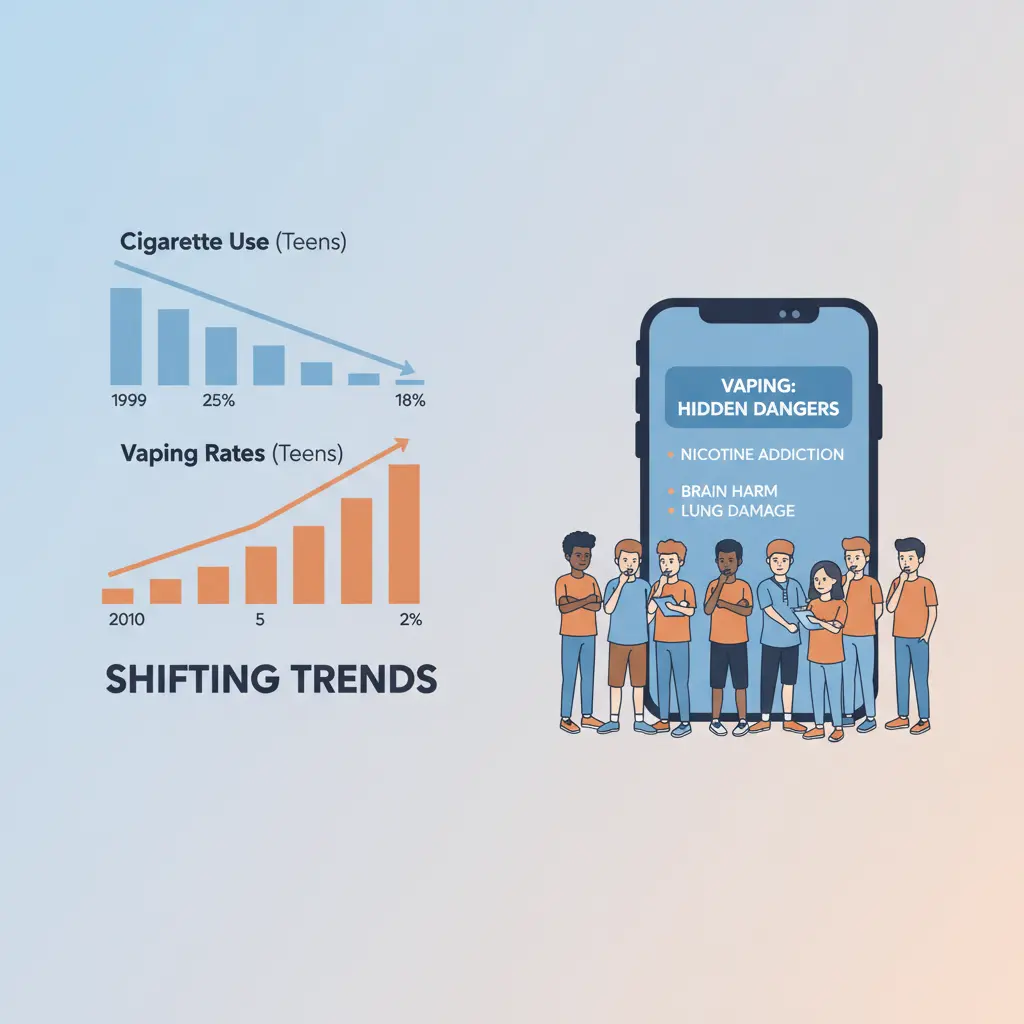
Teen smoking statistics for 2026 tell a complex and rapidly shifting story. Traditional cigarette use among adolescents has fallen dramatically in most high-income countries over the past two decades — a genuine public health success. However, this decline has been partially offset by a surge in electronic cigarette (e-cigarette and disposable vape) use that has introduced a new generation to nicotine dependence at precisely the developmental stage when the brain is most vulnerable to addiction formation.
Understanding the data on youth nicotine addiction — including the distinct risks of adolescent nicotine exposure — matters for parents, educators, health professionals, and young people themselves. This roundup synthesises the most current available data from the WHO Global Youth Tobacco Survey, CDC Youth Risk Behavior Surveillance System, NHS Digital, and peer-reviewed journals through 2026.
1. Global Youth Smoking Prevalence 2026
The WHO Global Youth Tobacco Survey tracks tobacco use in students aged 13–15 in over 120 countries. Key findings from the most recent waves:
- Global youth tobacco use (any form): approximately 12% of 13–15 year olds worldwide
- US high school cigarette use: 5.4% (CDC NYTS 2025) — down from 28% in 1997
- UK 11–15 year olds who smoke regularly: 6% (NHS, 2024)
- Australia 12–17 year olds current smokers: 1.7% (AIHW, 2025) — one of the lowest rates globally
- EU average teen smoking rate: 15% (Eurobarometer Special on Youth, 2024)
- Highest rates: Eastern Europe and parts of Southeast Asia remain above 20% for adolescent tobacco use
The decline in traditional cigarette smoking among youth in high-income countries represents one of the most significant public health achievements of the past 30 years, driven by tobacco taxation, advertising restrictions, plain packaging, and school-based prevention programmes.
2. Youth Vaping and E-Cigarette Statistics
The e-cigarette landscape has transformed the youth nicotine picture fundamentally since 2015. Disposable vapes — brightly coloured, fruit-flavoured, and inexpensive — proved far more appealing to adolescents than the cigarettes that regulation had successfully made unattractive.
| Country | Youth Vaping Prevalence | Year / Source |
|---|---|---|
| United States | 10.2% of high schoolers currently vape | CDC NYTS, 2025 |
| United Kingdom | 20% of 16–17 year olds have tried vaping; 8% current users | ASH, 2024 |
| Australia | 24% of 14–17 year olds have tried vaping | AIHW, 2025 |
| Canada | 21% of grade 10–12 students current vapers | CTADS, 2024 |
| New Zealand | 23% of 14–17 year olds current e-cigarette users | MoH NZ, 2024 |
The rapid escalation of vaping among young people who had never smoked cigarettes — sometimes called the “vaping gateway” — has emerged as a major public health concern. Research suggests that young people who vape are 3–5× more likely to subsequently try cigarettes (NEJM, 2023). For the full national and international vaping prevalence and quit-rate breakdown, see our 2026 vaping statistics and quit rates report.
3. Nicotine Addiction Development in Adolescents
The adolescent brain is uniquely vulnerable to nicotine dependence. The prefrontal cortex — responsible for impulse control and risk assessment — is not fully developed until the mid-20s. The mesolimbic dopamine system (the brain’s reward circuit) is in a heightened state of reactivity during adolescence, making it 3–4× more responsive to nicotine’s dopamine effects than the adult brain.
- Speed of addiction onset: Adolescents can develop dependence symptoms after as few as 1–4 cigarettes (NIDA)
- Daily cigarette threshold for dependence: In adults, typically 5–10/day; in adolescents, dependence symptoms appear at fewer than 1/day
- Permanence of neural changes: Nicotine exposure during adolescence causes lasting changes to prefrontal cortex development that persist into adulthood, affecting attention, impulse control, and vulnerability to other substance use
- Conversion rate: Approximately 32% of adolescents who try any form of nicotine will develop dependence — higher than any other substance (NIDA)
The cognitive development implications of nicotine addiction in young people connect directly to academic performance. Research on adolescent brain development and self-regulation — relevant to both smoking cessation and study habits — is documented across multiple academic writing resources, including German data on cognitive performance and AI use among students, which highlights how impaired self-regulation (from nicotine dependence or other causes) affects academic output.
4. Risk Factors for Youth Tobacco Initiation
Identifying risk factors allows targeted prevention. The strongest predictors of adolescent tobacco and nicotine initiation from the epidemiological literature:
- Parental smoking: Single strongest predictor — children of smokers 2–4× more likely to start
- Peer smoking: Peer influence is the second strongest factor, particularly in the 14–17 age range
- Social media marketing exposure: Vaping content on TikTok, Instagram, and YouTube is strongly associated with youth initiation (JAMA Pediatrics, 2024)
- Mental health conditions: Young people with depression, anxiety, or ADHD are 2–3× more likely to smoke
- Socioeconomic disadvantage: Youth from lower-income backgrounds show significantly higher initiation rates
- Academic stress: High-pressure academic environments are associated with higher smoking and vaping rates — another connection between student wellbeing and tobacco use
5. Health Effects of Adolescent Nicotine Exposure
Adolescent nicotine exposure carries unique developmental risks beyond those seen in adult-onset smoking:
- Lung development: Smoking or vaping during lung development phases (up to age ~25) permanently reduces peak lung function, a major predictor of lifelong respiratory health
- Brain development: Nicotine during adolescence disrupts synaptic pruning and myelination — processes critical for cognitive development
- Cardiovascular: Early-onset smoking is associated with substantially higher lifetime cardiovascular risk than smoking starting in adulthood
- Mental health: Nicotine dependence in adolescence significantly increases adult risk of anxiety disorders, depression, and other substance use disorders
- Lifetime cancer risk: Each decade earlier that smoking begins is associated with substantially higher lifetime lung cancer risk
6. Youth Cessation: What the Data Shows
Youth cessation is less researched than adult cessation, but the evidence is growing. Key findings:
- Young smokers are more likely than adults to want to quit (68% vs 55%, CDC)
- Less likely to use pharmacological support; more responsive to digital and peer-based interventions
- App-based cessation shows particular promise for youth — 34% higher quit rates vs no support in a 2023 UK RCT involving 16–24 year olds
- Text-message interventions have a strong evidence base: 25–30% improvement in youth quit rates
- NRT is less effective in adolescents than adults (lower nicotine dependence, greater psychological component)
- Parental quitting reduces adolescent smoking by 40% through both modelling and reduced household exposure
The last point is particularly powerful: a parent quitting smoking is one of the most evidence-based interventions for preventing youth nicotine initiation. For comprehensive cessation success rate data across all demographics, see our complete quit smoking statistics guide.
Frequently Asked Questions
What percentage of teens smoke in 2026?
Traditional cigarette use among US high school students is 5.4% (CDC, 2025) — a historic low. UK rates are approximately 6% of 11–15 year olds. However, e-cigarette use remains much higher: 10.2% of US high schoolers currently vape, 8% of UK 16–17 year olds are current vapers, and Australian youth vaping has reached 24% trial rates in 14–17 year olds.
How quickly do adolescents become addicted to nicotine?
Research from the National Institute on Drug Abuse shows adolescents can develop dependence symptoms after as few as 1–4 cigarettes. Daily symptom thresholds for dependence are lower in teens than adults, and approximately 32% of adolescents who try any nicotine product will develop dependence — a higher conversion rate than any other substance. The adolescent brain is 3–4× more neurochemically reactive to nicotine than the adult brain.
Does vaping lead to smoking in teenagers?
Research published in the NEJM (2023) found that young people who vaped were 3–5× more likely to subsequently try cigarettes. The “gateway” relationship is not universal, but the data consistently shows that e-cigarette initiation in never-smokers significantly increases subsequent cigarette experimentation. E-cigarettes also establish nicotine dependence independently — young vapers do not need to transition to cigarettes to suffer the addiction and health consequences.
You Quitting Changes Their Odds
A parent who quits smoking reduces their child’s risk of becoming a smoker by 40%. That’s not a small effect — it’s one of the most evidence-backed preventive health interventions a parent can make. The iQuit app makes quitting sustainable with AI personalisation, craving management, and daily motivation.
Download iQuit free. Quit for them. Change their odds.