
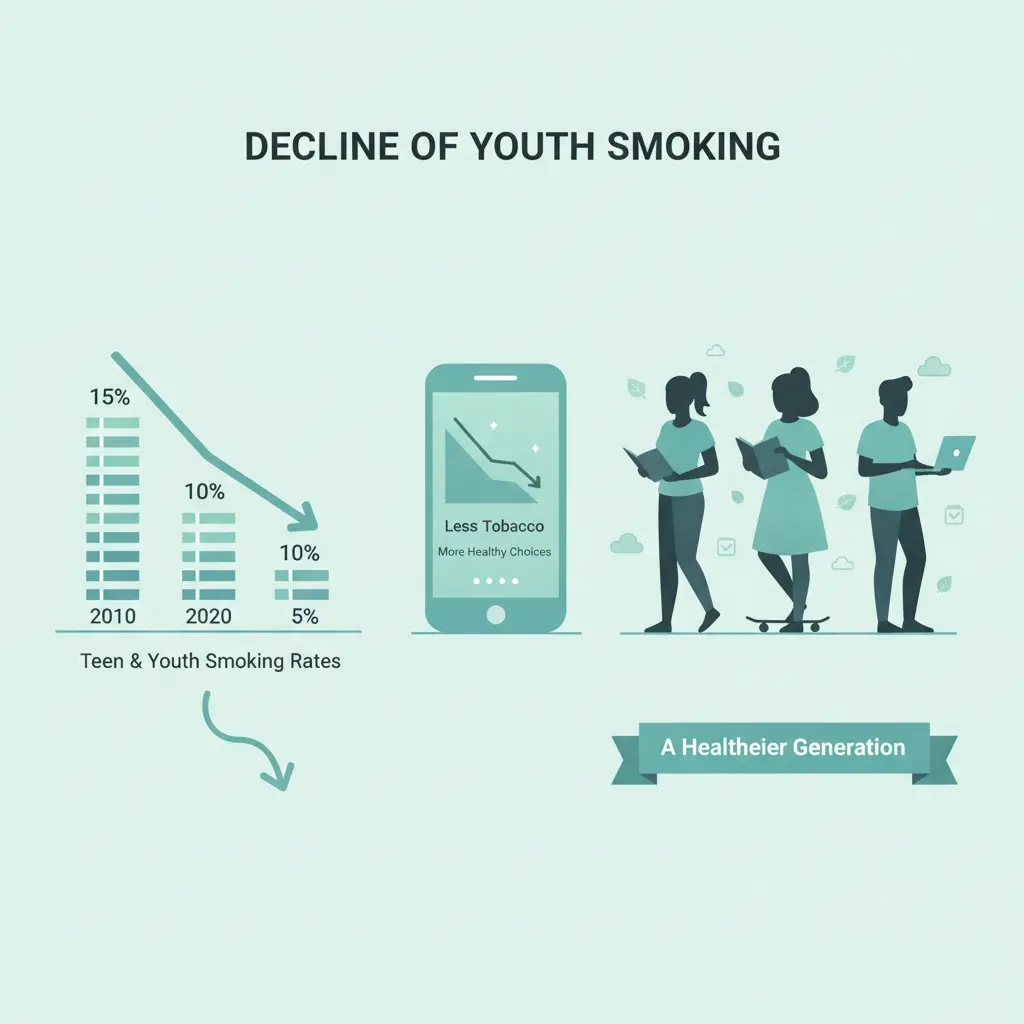
Teen and Young Adult Smoking Statistics for 2026
Teen and young adult smoking statistics for 2026 tell a story of significant progress on traditional cigarettes alongside persistent — and evolving — challenges from alternative nicotine products. The 2024 National Youth Tobacco Survey (NYTS), published by the CDC and FDA, found that youth cigarette smoking reached its lowest level ever recorded in the survey’s 25-year history, with only 1.4% of middle and high school students reporting current use (CDC/FDA, 2024). Yet the same data reveals that 2.25 million young people still use some form of tobacco or nicotine product — and novel products like nicotine pouches are gaining ground.
The stakes are high. Approximately 90% of adult smokers first tried cigarettes before age 18 (CDC). Nicotine exposure during adolescence has documented effects on brain development — the prefrontal cortex is not fully developed until the mid-20s — amplifying the long-term addiction risk of early initiation. Understanding the current landscape is essential for parents, educators, public health practitioners, and young people themselves.
Youth Cigarette Smoking: The 25-Year Decline
The decline in US youth cigarette smoking is one of the most significant public health achievements of the past quarter century. When the NYTS was first conducted in 1999, approximately 28% of high school students were current cigarette smokers. By 2024, that figure had fallen to 1.4% — a reduction of more than 95% in relative terms.
| Year | High School Current Smokers | Middle School Current Smokers |
|---|---|---|
| 1999 | ~28% | ~12% |
| 2011 | ~16% | ~7% |
| 2019 | ~5.8% | ~2.3% |
| 2022 | ~2.5% | ~0.9% |
| 2024 | 1.4% (all students) | Record low |
The Campaign for Tobacco-Free Kids notes that while the 2024 figure represents a 25-year low, approximately 2.25 million middle and high school students still use some form of tobacco product — down from 2.80 million in 2023 (Tobacco-Free Kids, 2024).
All Tobacco and Nicotine Products: 2024 Data
The comprehensive picture of youth nicotine use in 2024, drawn from the NYTS, covers all product categories. While cigarette use has declined dramatically, the product landscape has diversified significantly since 2010.
| Product | 2024 Current Use (%) | 2023 Current Use (%) | Trend |
|---|---|---|---|
| E-cigarettes (vaping) | 5.9% | 7.7% | Decreasing |
| Nicotine pouches | 1.8% | N/A (new measurement) | Increasing concern |
| Cigarettes | 1.4% | ~2.0% | Decreasing |
| Cigars | 1.2% | ~1.4% | Stable/decreasing |
| Smokeless tobacco | 1.2% | ~1.3% | Stable |
| Heated tobacco products | 0.8% | ~0.8% | Stable |
| Hookahs | 0.7% | ~0.9% | Decreasing |
| Pipe tobacco | 0.5% | ~0.5% | Stable |
E-Cigarette and Vaping Statistics
E-cigarettes surged to become the dominant youth nicotine product from approximately 2015 onward, peaking in 2019 when 27.5% of high school students reported current e-cigarette use. Since the FDA took regulatory action and many flavoured e-cigarette products were removed from the market, rates have declined — but remain the highest of any youth tobacco or nicotine product.
Key 2024 e-cigarette data for youth:
- 1.63 million middle and high school students currently use e-cigarettes (down from 2.13 million in 2023).
- 5.9% of all students report current use — still a significant proportion representing millions of young people.
- The most commonly used e-cigarette flavours among youth are fruit, candy/dessert, and mint — products specifically associated with youth appeal and regulatory concern.
- Among current youth e-cigarette users, approximately 25% report using them daily.
- 42.1% of youth who currently use e-cigarettes report moderate-to-severe symptoms of depression and anxiety, compared with 21.0% of non-using youth (CDC, 2024).
The correlation between e-cigarette use and mental health symptoms is bi-directional and under active research investigation. Young people with anxiety and depression may be more likely to use nicotine products for self-medication; conversely, nicotine itself has documented effects on mood regulation and can worsen anxiety in withdrawal. Our dedicated article on smoking and mental health statistics covers this relationship in detail. For parents facing this specific issue at home, our practical guide on helping your teenager quit vaping translates this data into concrete conversation and support strategies.
The Rise of Nicotine Pouches
One of the most concerning 2024 findings is the emergence of nicotine pouches (oral nicotine products placed between the gum and cheek, containing no tobacco leaf) as the second most commonly used nicotine product among US youth, at 1.8%.
Nicotine pouches present a new challenge for youth nicotine prevention because:
- They are smokeless, odourless, and invisible — making use easy to conceal in school settings.
- They are available in a wide variety of sweet and fruity flavours with obvious youth appeal.
- Regulatory frameworks for oral nicotine products lag behind those for cigarettes and even e-cigarettes.
- They deliver high nicotine doses rapidly, increasing addiction potential.
- The absence of combustion leads to misperceptions of low risk among young users.
The rapid emergence of nicotine pouches in youth usage data in 2024 — appearing in NYTS for the first time as a distinct tracked product — is a significant public health signal that regulators, parents, and educators need to address proactively.
Demographic Patterns: Race, Gender, and Grade
Race and Ethnicity
Youth tobacco use shows marked variation by racial and ethnic group, with important implications for targeted prevention efforts:
- Non-Hispanic White students show projections declining from 7.8% to approximately 6.7% by 2025 (PMC forecast, 2025).
- Hispanic students’ overall tobacco use is projected to stabilise at approximately 8.0% in 2025.
- American Indian/Alaska Native youth continue to show disproportionately high tobacco use rates in multiple NYTS cycles.
- Non-Hispanic Black and Asian American youth show lower overall tobacco product use rates than other groups.
Gender
Historically, cigarette smoking was more prevalent among male youth. E-cigarette data shows more gender-convergent patterns, with female youth e-cigarette rates approaching or equalling male rates in recent NYTS cycles. This has important implications for cessation messaging and programme design.
Grade Level
Tobacco use is substantially more prevalent in high school than middle school. The 2024 NYTS data shows high school students account for the large majority of current tobacco product users. However, the critical public health concern is initiation — which research shows often begins in middle school years (ages 12–14), making this an important early prevention window.
Projections for 2025–2026
A 2025 forecasting study published in PMC used NYTS data from 2021–2024 to project youth tobacco use rates forward (PMC, 2025). Key projections:
- Overall youth tobacco product use is projected to continue declining through 2026, driven primarily by further e-cigarette reductions.
- Cigarette use is expected to approach or reach near-zero among youth by 2027 if current trends hold.
- Nicotine pouch and oral nicotine product use is the key uncertainty — projections are uncertain given the recency of the trend and evolving regulatory environment.
- The study highlights that disparities by race, ethnicity, and socioeconomic status are expected to persist even as overall rates decline, requiring targeted policy responses.
Global Youth Tobacco Statistics (WHO, 2024)
The WHO published a Youth Tobacco Factsheet in 2024 documenting global youth tobacco prevalence across surveyed countries. Key findings:
- The prevalence of any tobacco product use among young people ranged from 26.6% in Bulgaria to 1.7% in Uzbekistan across surveyed nations.
- E-cigarette use among youth has increased substantially in every WHO region, creating an emerging global youth nicotine epidemic distinct from traditional cigarettes.
- Many LMICs lack comprehensive youth tobacco data due to surveillance system gaps.
- Countries with the highest youth smoking rates typically have the weakest tobacco control legislation and the lowest tobacco tax rates.
- Age of tobacco initiation: globally, most smokers begin before age 20, and a substantial proportion before age 15.
Why Early Nicotine Exposure Is Especially Dangerous
The health consequences of adolescent nicotine exposure are more severe than equivalent adult-onset exposure, for well-documented neurobiological reasons.
- Brain development: The adolescent brain is still developing, particularly the prefrontal cortex (governing impulse control and decision-making) and the reward circuits. Nicotine permanently alters the density and functioning of nicotinic acetylcholine receptors in ways that increase addiction vulnerability and may impair cognitive development.
- Faster addiction: Adolescents show signs of nicotine dependence at lower consumption levels and after shorter exposure periods than adults. Some teens report symptoms of dependence within days of first use.
- Lifetime risk amplification: Teens who smoke are 3 times more likely to use alcohol, 8 times more likely to use marijuana, and 22 times more likely to use cocaine compared with non-smoking peers (NIDA data).
- Lung development: Smoking during adolescence impairs lung growth and reduces maximum lung function achieved in adulthood — a permanent effect that increases lifetime COPD risk.
- Respiratory infections: Teen smokers have significantly higher rates of bronchitis, pneumonia, and respiratory tract infections than non-smoking peers.
Youth Nicotine Use and Mental Health
The relationship between youth nicotine use and mental health is bidirectional and clinically significant. 2024 CDC data found:
- 42.1% of current youth e-cigarette users report moderate-to-severe symptoms of depression and anxiety — more than double the rate (21.0%) in non-using youth.
- Youth who use nicotine products are also more likely to report poor sleep quality, difficulty concentrating, and lower academic performance.
- A 2020–2023 longitudinal study (ITC Adolescents Tobacco and Vaping Survey, Canada, England, US) found that mental health symptom burden was consistently higher among youth who used nicotine products across all three countries and all survey waves (PubMed, 2024).
These data do not establish causation but underscore the need for integrated mental health and substance use support in youth cessation programmes. Young people seeking to quit nicotine products should have access to mental health screening as part of any cessation intervention.
For the broader data on smoking and mental health across all age groups, see our dedicated article on smoking and mental health statistics for 2026. Understanding the costs these behaviours generate is covered in our smoking-related healthcare costs data. For young adults ready to quit, our evidence-based guide to the most effective ways to quit provides age-appropriate strategies.
Frequently Asked Questions
What percentage of teens currently smoke cigarettes in 2026?
As of the most recent data (2024 NYTS), only 1.4% of US middle and high school students currently smoke cigarettes — the lowest level ever recorded in the survey’s 25-year history. Projections for 2025 and 2026 suggest further decline toward near-zero rates if current trends continue. This represents a dramatic fall from the 28% rate recorded in 1999.
How many teens use e-cigarettes or vapes in 2024?
According to 2024 NYTS data from the CDC and FDA, approximately 1.63 million middle and high school students currently use e-cigarettes (5.9% of all students), down from 2.13 million (7.7%) in 2023. E-cigarettes remain the most commonly used tobacco or nicotine product among US youth by a significant margin.
What is the most popular nicotine product among teens in 2024?
E-cigarettes (5.9%) are by far the most commonly used product, followed by nicotine pouches (1.8%) — which appeared for the first time as the second most common product, surpassing cigarettes (1.4%). This shift toward oral, smokeless nicotine products is a significant emerging trend that parents and educators need to be aware of.
Why is teen smoking so much worse than adult smoking?
Adolescent nicotine exposure is particularly harmful because the brain is still developing until the mid-20s. Nicotine permanently alters developing reward circuits and prefrontal cortex function. Adolescents develop physical dependence faster and at lower consumption levels than adults. Teen smokers also have higher risks of impaired lung development, reduced maximum lung function in adulthood, and substantially higher rates of illicit drug use. About 90% of adult smokers started before age 18.
Is youth tobacco use declining globally?
Progress is mixed globally. In high-income countries with strong tobacco control policies, youth cigarette smoking has declined substantially. However, e-cigarette use has increased in virtually every WHO region. The WHO’s 2024 Youth Tobacco Factsheet found rates ranging from 26.6% (Bulgaria) to 1.7% (Uzbekistan) for any tobacco product use. Many LMICs lack comprehensive youth surveillance data and have weaker tobacco control infrastructure.
Are nicotine pouches dangerous for teens?
Yes. Although nicotine pouches do not contain tobacco leaf and produce no smoke, they deliver high doses of nicotine rapidly and can cause nicotine addiction with all its associated risks — including effects on the developing brain. They are available in sweet/fruity flavours that have obvious youth appeal. The 2024 NYTS data, recording nicotine pouches as the second most common youth nicotine product for the first time, is a significant public health warning sign. Regulatory frameworks for these products are still developing.