What Happens to Your Body When You Stop Smoking? Hour-by-Hour Recovery Guide 2026
What happens to your body when you stop smoking? The answer begins within minutes — not weeks. From the moment you extinguish your last cigarette, your body launches an extraordinary self-repair process that continues for years. Understanding this precise biological timeline is one of the most motivating tools available to anyone quitting smoking, and it is backed by decades of research from the NHS, CDC, and WHO.
This guide gives you the complete picture: every measurable physiological change from the first 20 minutes after quitting to the decade-long reductions in cancer and heart disease risk. Whether you are on day one or year one, knowing what your body is doing right now can help you stay the course.
For more on this topic, see our guide on what happens to your brain when you quit smoking.
For more on this topic, see our guide on why do people start smoking again.
What Happens in the First 20 Minutes to 24 Hours?
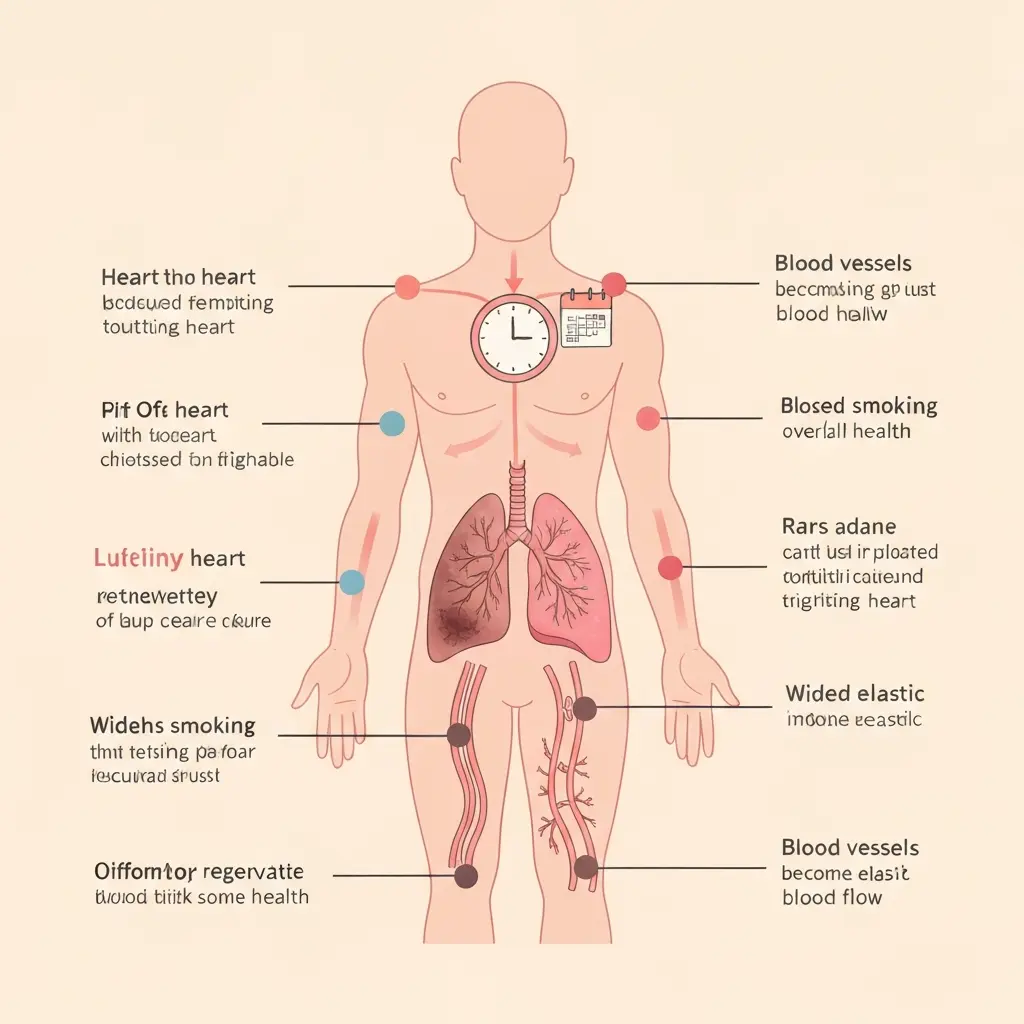
Within 20 minutes of your last cigarette, measurable physiological changes begin. Heart rate and blood pressure — both elevated by nicotine — drop back toward normal levels. This is not symbolic: the heart immediately faces a reduced workload, and blood flow to the extremities begins to improve. The NHS cites this as one of the first signs that the cardiovascular system is beginning to recover.
By the 8-hour mark, your blood oxygen level returns to normal. Carbon monoxide — the toxic gas in cigarette smoke that displaces oxygen in red blood cells — begins to clear from the bloodstream. Nicotine levels in the blood drop by more than half, which is when most people notice the onset of the first withdrawal symptoms: irritability, restlessness, and craving intensity.
At 24 hours, the body contains no measurable nicotine. Carbon monoxide is nearly fully eliminated. Your heart is already at statistically lower risk of a cardiac event compared to when you were smoking. This is a genuine, medically documented benefit that occurs within a single day of quitting. It is also worth noting that this same cardiovascular strain is measurable at even very low daily exposure — research on whether smoking just one cigarette a day is bad for you shows that even a single daily cigarette carries a disproportionately high share of the cardiovascular risk of a full pack, which is why full cessation, not reduction, produces the recovery curve described in this guide.
What Changes During the First Week After Quitting?
At 48 hours, two remarkable processes accelerate. First, damaged nerve endings in the nose and mouth begin regenerating, which is why many people notice an improved sense of taste and smell within two days of quitting. Second, the lungs begin clearing mucus and cellular debris that accumulated during smoking — this often causes a temporary increase in coughing as the airways expel what the cilia could not remove while they were suppressed by tobacco smoke.
At 72 hours (three days), bronchial tubes begin to relax, making breathing measurably easier for most ex-smokers. Energy levels begin to rise. However, this is also the peak of physical nicotine withdrawal symptoms: headaches, intense cravings, insomnia, and anxiety are at their most severe around day three, because the body has fully exhausted its nicotine reserves and the brain is recalibrating its dopamine system.
By the end of the first week, the acute physical withdrawal phase begins to ease. Cravings become shorter in duration — even if not yet less frequent. Many people report that cravings at this stage last only 3–5 minutes, a fact that is enormously helpful to know when a craving feels overwhelming. This is precisely the moment a tool like iQuit’s craving timer becomes invaluable — tracking each craving as it rises and passes.
What Happens to Your Body in the First Month?
Between weeks two and four, circulation continues to improve meaningfully. The heart pumps blood more efficiently, and peripheral circulation in the fingers and toes improves noticeably for many former smokers — hands and feet often feel warmer. Exercise tolerance improves as lung capacity begins to increase and the heart becomes more efficient.
For most people, the worst of the physical nicotine withdrawal resolves by week four. Cravings become less frequent, less intense, and shorter in duration. The CDC notes that approximately 60% of quitters experience anxiety, irritability, and difficulty concentrating during the first four weeks — but these symptoms resolve progressively rather than all at once.
Skin quality begins to improve during this period. Smoking constricts capillaries and reduces collagen production; as circulation normalizes, the skin receives better oxygen delivery and nutrient supply. Many former smokers report a noticeable improvement in skin tone and texture within the first month — an often overlooked but visible sign of the body healing.
How Does Your Body Change in Months 3 to 12?
By the three-month mark, lung function begins to increase measurably. Cilia — the tiny hair-like structures in the airways responsible for clearing mucus and debris — have largely regenerated after being suppressed by tobacco smoke. This leads to reduced coughing, less mucus production, and a gradual reduction in respiratory symptoms including wheezing and shortness of breath.
NHS data indicates that between three and nine months after quitting, lung function can increase by up to 10%. This is a substantial improvement that translates into real-world differences: climbing stairs is easier, exercise capacity increases, and the breathlessness that many smokers normalize as a permanent condition begins to resolve.
At one year post-quit, the risk of coronary heart disease is reduced by approximately 50% compared to an active smoker of the same age. This is one of the most dramatic single-year health improvements measurable by any lifestyle change. The cardiovascular system’s resilience is profound — even decades of damage begin to reverse once the chronic assault of tobacco smoke ends.
What Are the Long-Term Benefits After 1 to 5 Years?
Between one and five years after quitting, stroke risk continues to fall toward that of a non-smoker. Research published in peer-reviewed cardiology journals has documented that within two to five years of cessation, stroke risk reduces to approximately the same level as someone who has never smoked — a remarkable demonstration of the vascular system’s capacity for recovery.
At five years, the risk of mouth, throat, esophageal, and bladder cancer is halved compared to when you were smoking. These reductions are cumulative and continue beyond the five-year mark. The body’s cellular repair mechanisms, no longer fighting the constant mutagenic onslaught of tobacco carcinogens, gradually restore normal cell turnover patterns in tissues that were most affected.
Mental health benefits compound over this period as well. Research published in the journal Psychological Medicine found that quitting smoking produces improvements in anxiety, depression, and overall quality of life comparable to taking antidepressant medication — a counterintuitive finding that contradicts the widespread belief that smoking relieves stress. In reality, the stress relief was the temporary correction of nicotine withdrawal; quitting eliminates the withdrawal cycle entirely.
What Happens to Cancer Risk After 10 to 15 Years?
At 10 years after quitting, the risk of dying from lung cancer is approximately half that of a continuing smoker. The risk of laryngeal and pancreatic cancer also decreases significantly. While the lung cancer risk never returns entirely to that of someone who never smoked — because some cellular damage is permanent — the reduction is medically meaningful and continues to improve with each additional smoke-free year.
At 15 years after cessation, coronary heart disease risk reaches approximately the same level as someone who never smoked. This 15-year milestone is one of the most powerful pieces of evidence for the completeness of cardiovascular recovery possible through cessation. Even people who smoked heavily for decades can achieve near-normal heart disease risk with sustained abstinence.
These long-term milestones are worth tracking — and apps like iQuit are designed to display them in real time, showing you exactly how your health profile is improving as you move through your quit journey. Every smoke-free day is not just a day without harm; it is a day of active biological repair.
Why Does Recovery Feel Difficult at First?
The early discomfort of quitting smoking is a sign that your brain is recalibrating — not that something is going wrong. Nicotine addiction restructures the brain’s reward circuitry over years of use. When nicotine is removed, dopamine levels temporarily fall below normal, producing anxiety, low mood, and an intense drive to smoke. This is the mechanism behind withdrawal, and it is real, physical, and temporary.
Understanding that withdrawal symptoms peak around day three and substantially resolve by week four gives quitters a critical perspective: the suffering has a defined endpoint. Many people relapse during the first 72 hours believing that withdrawal will only get worse — but the neurochemical evidence shows it peaks and then declines. Using NRT or medication to moderate this peak, combined with a support tool like iQuit to track progress hour by hour, transforms the peak from a crisis into a manageable challenge.
For additional context on how AI-driven tools are supporting health behavior change in 2026, see this analysis of Marketing Automation for Healthcare 2026. For a broader perspective on digital-first health communication, this overview of AI Content Marketing in 2026 is worth reading. And if you’re interested in how push notifications can support daily habit building for quit-smoking programs, explore How to Use Push Notifications for Marketing in 2026.
Frequently Asked Questions
How quickly does blood pressure return to normal after quitting smoking?
Blood pressure begins returning to normal within 20 minutes of the last cigarette as nicotine-induced vasoconstriction relaxes. However, full normalization takes longer if underlying hypertension is present, and the long-term reduction in cardiovascular risk builds progressively over months and years of abstinence.
Does lung damage from smoking ever fully heal?
Much of the functional lung damage heals over time — cilia regenerate, mucus clears, and airway inflammation resolves. Structural damage such as emphysema (destruction of air sacs) is largely permanent, but the progression stops immediately upon quitting. Lung function can increase by up to 10% within 9 months, and the rate of decline slows dramatically.
When does carbon monoxide leave the body after quitting smoking?
Carbon monoxide leaves the bloodstream within 8–12 hours of quitting. This is why blood oxygen levels return to normal so quickly. Carbon monoxide has a half-life of approximately 5 hours in the body, meaning levels drop by half every 5 hours and are effectively eliminated within 24 hours.
Does quitting smoking improve mental health?
Yes. Multiple large studies have found that quitting smoking is associated with significant improvements in anxiety, depression, and quality of life — comparable in magnitude to antidepressant medication. The perceived stress-relieving effect of cigarettes is the temporary correction of nicotine withdrawal; removing the withdrawal cycle entirely produces lasting mood improvement.
How long after quitting does heart disease risk halve?
According to the NHS and CDC, the risk of coronary heart disease is reduced by approximately 50% within one year of quitting. After 15 years of abstinence, heart disease risk reaches approximately the same level as someone who has never smoked, according to long-term cardiovascular follow-up studies.
Why do ex-smokers gain weight, and is it permanent?
Nicotine suppresses appetite and increases metabolic rate by approximately 10%. When you quit, these effects reverse, and many people gain 3–5 kg in the first year. However, this weight is not permanent — regular exercise and a balanced diet manage it effectively. The health risks of smoking far outweigh the risks of modest post-cessation weight gain, and the weight typically stabilizes within 12 months.
Does skin improve after quitting smoking?
Yes. Smoking constricts blood vessels in the skin, reducing oxygen and nutrient delivery, and degrades collagen, accelerating wrinkle formation. Within weeks of quitting, circulation improves and skin tone begins to normalize. Over months and years, collagen production recovers and the characteristic “smoker’s complexion” — sallow, dull, and unevenly toned — begins to visibly improve.
What is the first thing that happens when you quit smoking?
The very first physiological change when you quit smoking is a reduction in heart rate and blood pressure within 20 minutes of the last cigarette. This occurs because nicotine’s stimulant effect — which elevates both — begins to wear off as blood nicotine levels drop. It is the first of dozens of measurable health improvements that unfold over the following hours, days, months, and years.
Track Every Milestone of Your Recovery
iQuit shows you your exact recovery timeline in real time — from the moment you quit to the long-term health milestones that await you. Every hour smoke-free is a measurable step toward a healthier body. Watch your health scores improve, track money saved, and get support when cravings hit.
Start your recovery timeline today — download iQuit and see exactly what your body is doing right now.