What Happens to Your Body When You Stop Smoking: Complete 2026 Recovery Timeline
The moment you put out your last cigarette, your body begins repairing itself — faster than most people expect. Understanding what happens to your body when you stop smoking is one of the most powerful motivators for quitting, because the benefits begin in minutes, not months. This complete recovery timeline draws on research from the WHO, American Cancer Society, and NHS to show you exactly what’s changing inside you, right now.
Over 7.2 million people die from tobacco-related diseases each year globally, according to the WHO. Yet the body’s capacity for recovery is remarkable: studies consistently show that even long-term smokers who quit in their 40s recover close to normal life expectancy compared to lifetime non-smokers. The biology of recovery is genuinely inspiring.
First Hours: Minutes to 24 Hours
These immediate changes are happening whether you feel them or not. Carbon monoxide — a toxic gas that binds to hemoglobin more tightly than oxygen — is being flushed from your system, restoring your blood’s ability to carry oxygen efficiently to every organ.
Days 2–7: The First Week
The first week is often the hardest. Nicotine has a half-life of roughly 2 hours, and by day 3, your body has cleared its nicotine stores entirely. This is when withdrawal symptoms peak for most people. It’s also when remarkable things start happening.
Many people describe the first week as a fog. Cravings peak around day 3 and gradually become more manageable. The iQuit app is specifically designed for this period — logging cravings, tracking hours since your last cigarette, and delivering evidence-based coping strategies in the moments they’re most needed.
Weeks 2–4: The First Month
By the end of the first month, most acute withdrawal symptoms have subsided. The brain’s dopamine pathways are beginning to recalibrate, and the intense hourly cravings typical of week one have usually given way to occasional urges triggered by specific situations.
- Circulation continues to improve; walking and exercise feel easier
- “Smoker’s cough” may temporarily worsen as cilia recover and begin clearing accumulated debris
- Resting heart rate decreases measurably
- Taste and smell are noticeably sharper for most people
- Skin tone and hydration begin to improve
The temporary worsening of cough at this stage surprises many quitters — it’s actually a positive sign that the lungs’ cleaning mechanism is back online. It typically resolves within 3–8 weeks.
1–3 Months: Lungs Begin to Heal
At the 1-3 month mark, pulmonary function tests begin to show measurable improvement. A landmark study found that lung function can improve by up to 10% within 9 months of quitting. For people with early-stage COPD, this improvement can be the difference between a progressive disease trajectory and a stabilized one.
Circulation improvements become significant enough to notice during exercise — many ex-smokers describe their first run or bike ride at this stage as a revelation. Just as data-driven tools reveal performance patterns that are otherwise invisible, tracking your fitness improvements as you quit can provide powerful positive feedback loops that reinforce your motivation.
- Lung capacity improves by up to 10%
- Exercise tolerance increases significantly
- Circulation normalizes fully in most people
- Risk of respiratory infections decreases
6–12 Months: Major Milestones
The one-year mark is widely recognized as a major milestone in recovery:
1 Year Smoke-Free
Heart attack risk drops by 50%. After just one year without cigarettes, your risk of coronary heart disease is half that of a continuing smoker — and continues to fall. This single statistic is, for many people, the most powerful reason to stay quit through difficult moments.
At 6 months, the excess risk of certain smoking-related cancers begins to decline. Gum disease risk decreases. Many people report their hair, skin, and nails looking and feeling healthier — smoking accelerates aging through oxidative stress, and 6 months of cessation begins to reverse this visibly.
5 Years: Cancer Risk Drops
After 5 years without smoking:
- Risk of cancers of the mouth, throat, esophagus, and bladder drops by 50%
- Cervical cancer risk returns to that of a non-smoker
- Stroke risk falls to the same level as a non-smoker (this happens within 2-5 years for most people)
- Risk of type 2 diabetes normalizes in most cases
These are not marginal improvements. Halving cancer risk is a profound health outcome — one achieved not through medication, surgery, or expensive intervention, but through abstinence alone.
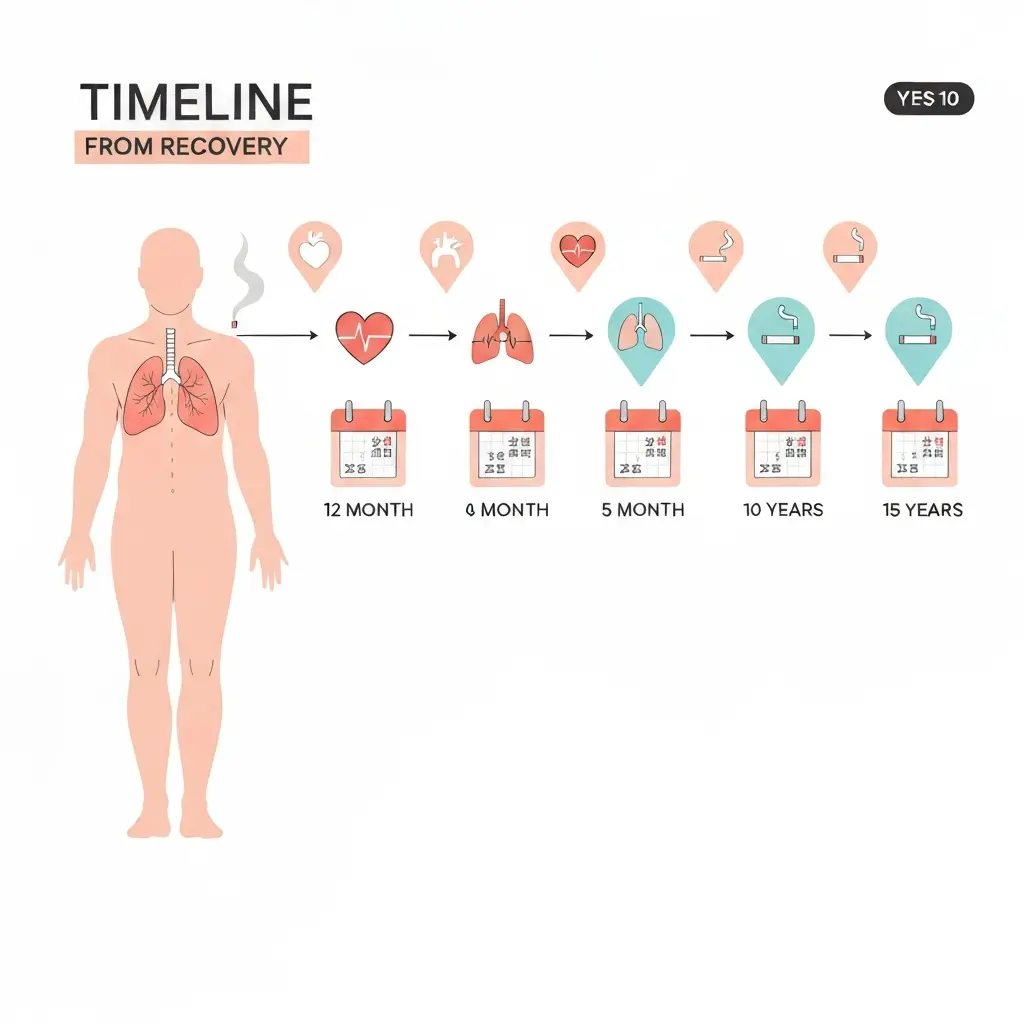
10–15 Years: Near-Normal Risk
10 Years Smoke-Free
Lung cancer risk drops by 50%. Your risk of dying from lung cancer is now half that of someone who still smokes. Pre-cancerous cells in the lungs have largely been replaced by healthy cells.
15 Years Smoke-Free
Heart disease risk equals that of a lifelong non-smoker. At 15 years, your cardiovascular risk profile is essentially the same as if you had never smoked. Fifteen years of recovery effectively erases the cardiovascular damage of decades of smoking.
Body Systems: What Recovers and How
| Body System | Effect of Smoking | When Recovery Begins | Full Recovery Timeline |
|---|---|---|---|
| Cardiovascular | Arterial stiffening, clotting risk | 20 minutes | 15 years to full normalization |
| Respiratory | Cilia paralysis, inflammation | Days 3–7 | 3–9 months for lung function |
| Neurological | Dopamine dysregulation | Weeks 2–4 | 3–12 months |
| Immune System | Chronic suppression | Week 1 | 1–3 months to significant improvement |
| Skin & Appearance | Accelerated aging, poor hydration | Month 1 | Ongoing improvement over years |
| Fertility | Reduced sperm quality, ovarian reserve | Month 1–2 | Significant improvement within 3 months |
What About Withdrawal During Recovery?
The recovery timeline above describes what’s healing — but what about what you’re feeling? Nicotine withdrawal symptoms typically peak at days 2–3 and substantially improve by weeks 2–4. Common symptoms include:
- Irritability and anxiety (days 1–2 weeks)
- Difficulty concentrating (days 1–2 weeks)
- Increased appetite (weeks 1–4)
- Sleep disruption (first 1–2 weeks)
- Headaches (days 1–5)
- Intense cravings (peak days 2–3, then gradually decrease)
These symptoms are temporary and a normal part of recovery. For many people, knowing the timeline — that the worst is usually over by day 3, and substantially better by week 2 — provides crucial resilience. Tracking where you are in the withdrawal timeline with the iQuit app helps contextualize difficult moments as predictable, passing phases rather than permanent states.
Tools for managing complex, goal-oriented processes have evolved rapidly across domains — from how AI writing tools help students navigate thesis milestones to how quit apps guide smokers through withdrawal phases. What they share is the power of visible progress to sustain effort through difficulty.
Frequently Asked Questions
How quickly does blood pressure normalize after quitting smoking?
Blood pressure begins dropping within 20 minutes of your last cigarette as blood vessels dilate. It typically normalizes to healthy baseline levels within 24–48 hours, though long-term arterial health improvements continue for months and years.
Does lung damage from smoking reverse completely?
Lung function improves substantially after quitting — by up to 10% within 9 months according to studies. However, existing structural damage such as emphysema (destroyed air sacs) does not fully reverse. What improves dramatically is the rate of further damage, inflammation, and infection risk. People with early-stage COPD who quit can stabilize their condition significantly.
When does cancer risk start dropping after quitting?
Risk reduction begins as soon as you quit, as cell division patterns start normalizing. Measurable reductions in oral and esophageal cancer risk occur within 5 years. Lung cancer risk drops by 50% at the 10-year mark. While the risk never fully equals someone who never smoked (for heavy, long-term smokers), the reductions are substantial and clinically significant.
Why do I feel worse in the first few days after quitting?
Feeling worse initially is paradoxically a sign your body is working. Nicotine withdrawal creates real physiological and psychological symptoms because your brain has become dependent on nicotine to regulate dopamine. Without it, you feel irritable, anxious, and unable to concentrate until your brain recalibrates — typically 2–4 weeks. Meanwhile, the cough may worsen as cilia begin clearing accumulated debris from the airways.
How does quitting smoking affect skin?
Smoking accelerates skin aging through vasoconstriction (reducing blood flow to skin), oxidative stress, and collagen breakdown. After quitting, blood flow to the skin improves within weeks, delivering more oxygen and nutrients. Most ex-smokers notice improved skin tone and hydration within 1–3 months. Deeper improvements in skin elasticity and reduction of fine lines develop over 1–5 years.
Does quitting smoking help with anxiety and depression?
Despite the perception that smoking relieves anxiety, research consistently shows that ex-smokers report lower anxiety and depression scores than active smokers after a withdrawal period of 6–8 weeks. The anxiety relief from smoking is temporary and largely the relief of withdrawal symptoms — not genuine stress reduction. Long-term abstinence is associated with better mental health outcomes.
How many years of life does quitting smoking add?
Quitting at age 40 adds approximately 9 years to life expectancy compared to continuing to smoke, according to a major BMJ study. Quitting at 30 recovers almost the full decade lost to smoking. Even quitting at 60 still adds several years of life and substantially improves quality of life in those remaining years.
Is weight gain inevitable when quitting smoking?
Weight gain is common (average 4–5 kg) but not inevitable, and it’s important context: smoking itself suppresses appetite and increases metabolism artificially. The modest weight gain from quitting is far outweighed by cardiovascular benefits. Combining a quit plan with light exercise and mindful eating can minimize weight gain while supporting recovery.
Watch Your Body Heal in Real Time
The iQuit app shows you exactly where you are in the recovery timeline — your smoke-free hours, carbon monoxide cleared, money saved, and the specific health milestone you’re working toward. Seeing your progress laid out makes the recovery concrete and motivating. Start your timeline today.