COPD and Smoking Cessation: How Quitting Changes Your Prognosis
A COPD diagnosis can feel devastating — but it does not mean quitting smoking no longer matters. In fact, for anyone with COPD, smoking cessation is the single most impactful medical intervention available. Nothing else — not bronchodilators, not oxygen therapy, not pulmonary rehabilitation — comes close to the effect that stopping smoking has on slowing COPD progression and improving long-term survival.
The science is unambiguous, and this guide brings together the key evidence so that people living with COPD — and their families — understand exactly what cessation can and cannot do, and why the moment to act is now.
How Smoking Causes COPD
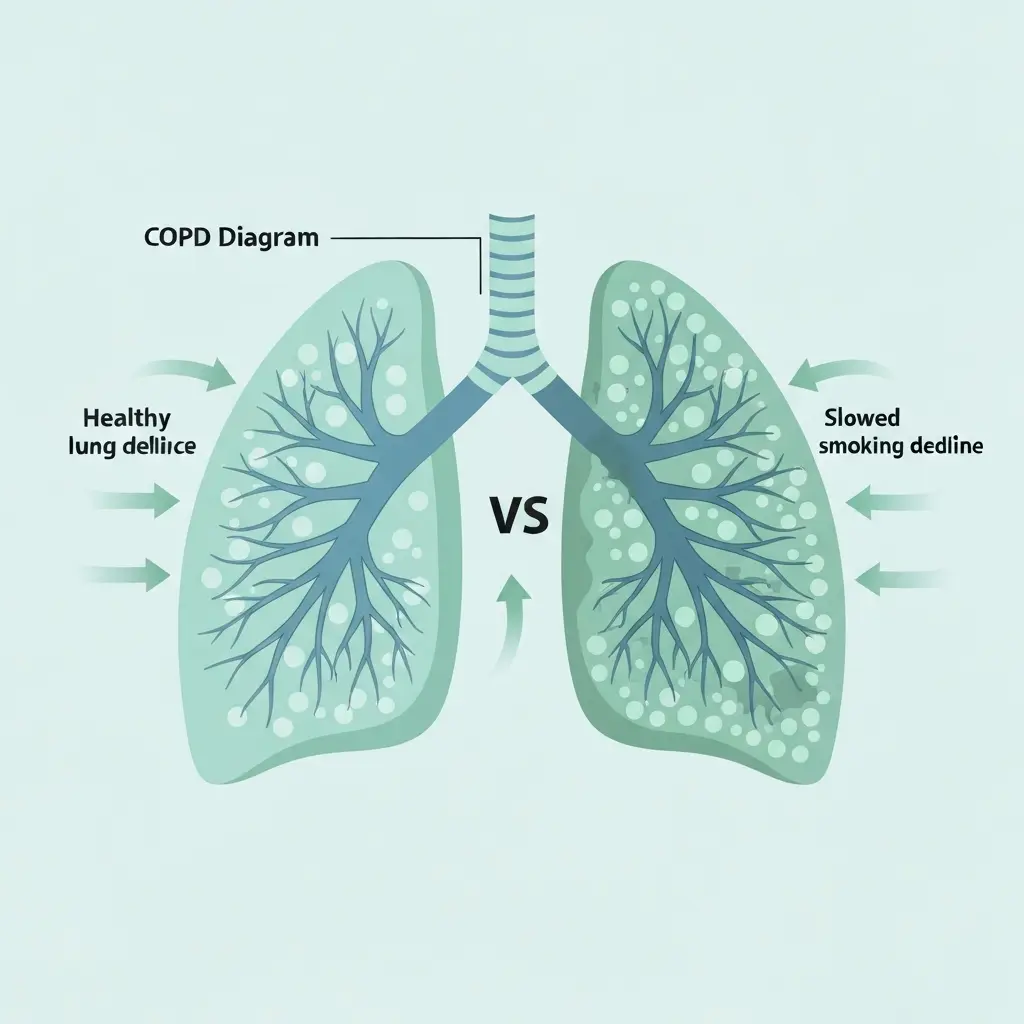
COPD — Chronic Obstructive Pulmonary Disease — is an umbrella term for progressive lung diseases including emphysema and chronic bronchitis. Tobacco smoke is responsible for approximately 85% of COPD cases in high-income countries.
The mechanism is cumulative and destructive:
- Cigarette smoke triggers persistent inflammation in the airways and lung tissue
- Inflammatory cells release enzymes (proteases) that destroy the air sac walls, causing emphysema
- Mucus-producing cells in the airways multiply, causing the chronic bronchitis component
- Cilia — the protective hair-like structures that clear debris — are destroyed, leaving the airways defenseless against infection
- Airway smooth muscle thickens, causing the progressive narrowing that defines COPD
COPD develops silently over 20 to 30 years of smoking. Most people are diagnosed in their 50s or 60s when symptoms — breathlessness, chronic cough, frequent chest infections — become impossible to ignore. By that point, significant irreversible damage has already occurred. But the trajectory is not fixed.
What Quitting Does to COPD Progression
The Lung Health Study — one of the most cited pieces of research on COPD and smoking cessation — followed more than 5,000 smokers with mild-to-moderate COPD over five years. Its findings reshaped medical understanding of cessation’s impact:
| Group | Annual FEV1 Decline | Outcome |
|---|---|---|
| Continuing smokers | ~62 mL/year | Rapid disease progression |
| Quitters (sustained abstinence) | ~31 mL/year | Decline rate matches healthy non-smokers |
| Non-smokers without COPD | ~25-30 mL/year | Normal aging decline |
Sustained smoking cessation cuts the rate of lung function decline in half — to levels comparable to healthy non-smokers. For a COPD patient already facing disease progression, cessation essentially puts the progression on pause at the much slower trajectory of normal aging.
A 2024 systematic review and meta-analysis published in Frontiers in Public Health confirmed these findings, showing that cessation improves not only FEV1 but also exercise tolerance and blood oxygen levels in COPD patients.
The COPD Recovery Timeline After Quitting
Within Days to Weeks
Many COPD patients notice that breathlessness and coughing improve within days of cessation. This rapid improvement comes from reduced airway inflammation — when the constant irritant is removed, the inflammatory response begins to settle almost immediately. Mucus production decreases, making it easier to clear secretions.
Within Six Weeks
Research shows a significant increase in FEV1 — about 184 mL above baseline — at six weeks after cessation in COPD patients. Physical exercise becomes noticeably less exhausting for many patients.
Within One Year
The frequency of acute COPD exacerbations — episodes of suddenly worsened symptoms often triggered by infections — decreases. These exacerbations are among the most dangerous events in COPD, and reducing their frequency is a major clinical goal. Cessation achieves this.
Long-Term
The annual decline in lung function stabilizes at the non-smoker rate. Survival improves significantly compared to continued smoking. Quality of life scores improve across multiple domains.
Symptom Improvements You Can Expect
COPD patients who quit smoking typically report improvements in:
- Breathlessness: Less shortness of breath with activity and at rest, as airway inflammation resolves
- Chronic cough: Frequency and severity reduce as mucus production normalizes
- Chest tightness: Reduces as bronchospasm becomes less frequent
- Infection frequency: Fewer respiratory infections as cilia begin functioning again
- Sleep quality: Improved oxygen levels during sleep reduce nighttime breathing disruptions
- Exercise tolerance: Gradually improves as inflammation and mucus decrease
For a broader perspective on the lung recovery timeline, see our guide on Lung Recovery After Quitting Smoking: What Science Says in 2026.
Impact on COPD Survival
Research published in the European Respiratory Journal found that continued smoking after a COPD diagnosis significantly worsens morbidity and mortality compared to cessation. Patients who quit after diagnosis:
- Have significantly longer survival than those who continue smoking
- Experience fewer hospitalizations for acute exacerbations
- Have a better response to inhaled bronchodilator medications
- Have reduced mortality from cardiovascular disease, a major COPD comorbidity
Even in severe COPD — Stage III or Stage IV — cessation produces measurable survival benefit. There is no stage of COPD at which quitting smoking stops making a difference. The answer to “is it too late to quit?” is always no.
Quitting Smoking With COPD: Strategies That Work
Combination NRT
Evidence shows that combining a long-acting NRT (patch) with a short-acting form (gum or lozenge for breakthrough cravings) is more effective than either alone. For COPD patients, NRT is preferable to smoking, as it delivers nicotine without the combustion products that drive airway inflammation.
Varenicline (Champix/Chantix)
Varenicline is significantly more effective than NRT alone and is well-tolerated in COPD patients. A Cochrane analysis of over 150,000 smokers found varenicline among the most effective cessation aids available.
Pulmonary Rehabilitation Combined With Cessation
For COPD patients, combining smoking cessation with supervised pulmonary rehabilitation — breathing exercises and graded physical activity — produces compounding benefits. Exercise improves exercise tolerance independently of lung function, while cessation halts disease progression. Together, they produce the best outcomes.
Behavioral Support and Apps
Tracking progress and managing cravings with digital support tools improves quit rates across all smoker populations. The iQuit app provides craving management tools, health milestone tracking, and motivational content — accessible support for every stage of the cessation journey.
Understanding the full picture of quitting benefits can also reinforce motivation. See our complete guide on What Happens When You Quit Smoking: Complete 2026 Recovery Timeline.
COPD Does Not Mean It Is Too Late to Quit
The iQuit app gives you science-based tools to manage cravings and track your recovery — one of the most important health decisions you can make after a COPD diagnosis.
Frequently Asked Questions
Does quitting smoking reverse COPD?
Quitting smoking cannot reverse the structural lung damage of COPD — destroyed alveolar walls in emphysema or the thickened airways of chronic bronchitis cannot regenerate fully. However, cessation dramatically slows further progression, reduces airway inflammation, improves symptoms, and cuts the rate of lung function decline in half. For COPD patients, quitting is the most impactful treatment available.
How quickly does breathing improve after quitting smoking with COPD?
Many COPD patients notice improved breathlessness and reduced cough within days to weeks of cessation. At six weeks, measurable improvements in FEV1 — about 184 mL on average in research studies — are documented. The improvements reflect reduced airway inflammation rather than structural repair, which is why they occur relatively quickly. Exercise tolerance typically improves over the following months as the inflammatory environment resolves.
Is it harder to quit smoking with COPD than without?
COPD patients tend to be heavier, longer-term smokers with stronger nicotine dependence, which can make cessation more challenging. However, the strong medical motivation provided by a COPD diagnosis — and the clear evidence of direct benefit — also gives many patients a compelling reason to succeed. Combination cessation therapies (NRT plus behavioral support, or varenicline) are particularly effective in this population. A doctor or respiratory specialist can help design the optimal quit plan for your specific situation.
Does quitting smoking affect COPD medications?
Yes, in a positive way. Research shows that COPD patients who quit smoking have a better response to inhaled bronchodilators and other standard COPD medications. Smoking can reduce the effectiveness of some medications through its effects on lung inflammation and drug metabolism. After cessation, medication efficacy often improves, meaning the same dose achieves better symptom control.
What is the life expectancy change for COPD patients who quit smoking?
Life expectancy data for COPD patients who quit smoking consistently shows significant survival advantage compared to those who continue. The Lung Health Study found substantially lower mortality rates in sustained quitters over a 5-year follow-up. Quantifying the exact years gained is complex because it depends on COPD severity at the time of quitting, age, and other health factors. However, for any individual with COPD, the survival benefit of cessation is among the largest available from any medical intervention.