COPD and Smoking Cessation: What Happens to Your Lungs When You Quit in 2026
If you have been diagnosed with chronic obstructive pulmonary disease (COPD) and you still smoke, you are living with a cruel paradox: the very thing making your condition worse is also one of the hardest things to stop. Nicotine addiction does not politely step aside because a diagnosis has arrived. And yet the evidence on COPD and smoking cessation is unambiguous — stopping smoking is the single most powerful intervention available to anyone with this condition. No inhaler, no medication, no rehabilitation programme comes close to the impact of quitting on slowing disease progression and improving survival.
This guide brings together the best available evidence — from peer-reviewed meta-analyses, WHO guidance, NHS clinical recommendations, and CDC cessation data — to explain precisely what happens to your lungs when you quit smoking with COPD, what to realistically expect during and after cessation, and why — even with severe COPD — it is never too late to benefit from stopping.
What Is COPD and Why Does Smoking Cause It?
Chronic obstructive pulmonary disease is an umbrella term for progressive lung conditions — primarily emphysema and chronic bronchitis — that cause obstructed airflow, breathlessness, and reduced lung function. According to the World Health Organization, COPD is the third leading cause of death worldwide, responsible for 3.23 million deaths in 2019. Approximately 80–90% of COPD cases in high-income countries are attributable to tobacco smoking.
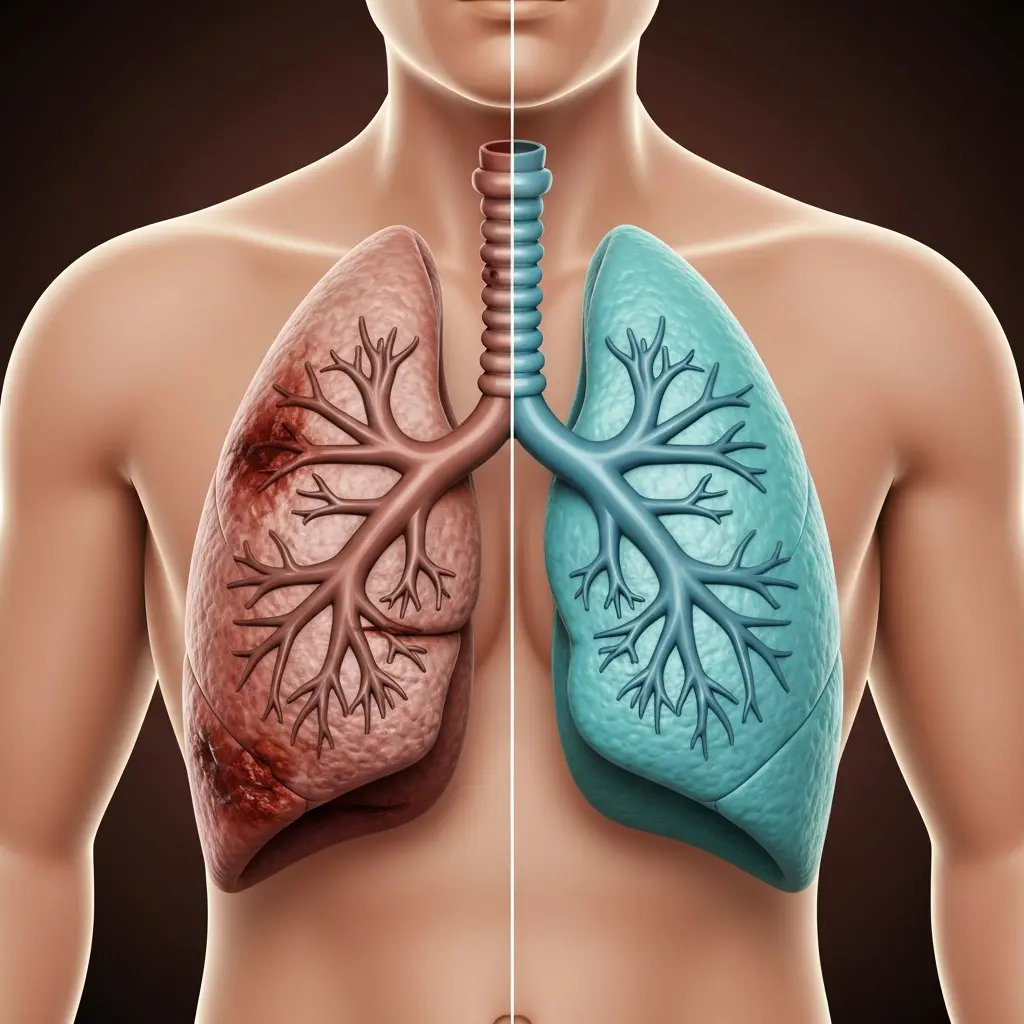
Smoking damages the lungs through several converging mechanisms. Tobacco chemicals trigger chronic inflammation in the airways, causing structural changes including thickening of airway walls and destruction of alveolar tissue (the tiny air sacs responsible for oxygen exchange). The enzyme elastase — released by immune cells responding to tobacco-triggered inflammation — breaks down elastin, the protein that gives lung tissue its elastic recoil. Once alveolar walls are destroyed, the resulting enlarged, less efficient air spaces characteristic of emphysema cannot regenerate. Simultaneously, the chronic airway inflammation of bronchitis thickens mucus secretions and reduces the effectiveness of mucociliary clearance.
The key metric in COPD is FEV1 — forced expiratory volume in 1 second, a measure of how much air you can exhale in one breath. In healthy non-smokers, FEV1 declines gradually with age (roughly 25–30 mL per year after age 35). In smokers with COPD, the decline is dramatically accelerated — typically 40–80 mL per year. This accelerated decline is what smoking cessation directly addresses.
The Lung Function Evidence: What Cessation Actually Does
The foundational study on COPD and smoking cessation remains the Lung Health Study, a large randomised trial involving nearly 6,000 smokers with mild-to-moderate COPD. Its findings — published in the American Journal of Respiratory and Critical Care Medicine — showed that smokers who successfully quit experienced a mean annual FEV1 decline of 31 mL per year, compared to 62 mL per year in those who continued smoking. Cessation halved the rate of lung function decline.
A 2024–2025 systematic review and meta-analysis published through Frontiers in Public Health, covering multiple COPD cohorts, confirmed and extended this finding. Compared with COPD patients who continued smoking, those who quit showed a statistically significant improvement in FEV1% predicted (mean difference of 6.72%, 95% CI 4.55–8.89, p < 0.001). This is not merely slowing the decline — it is an absolute improvement in measured lung function in the months following cessation, likely reflecting resolution of reversible inflammatory obstruction that coexists with the irreversible structural damage of COPD.
A further meta-analysis on lung function improvement following smoking cessation in chronic respiratory conditions (PMC 2025) found that cessation was associated with significant increases in FEV1/FVC ratio in COPD patients, confirming that at least some of the airflow obstruction in COPD is functional rather than structural and therefore reversible upon quitting. This matters clinically: it means that patients who feel their COPD is already “too advanced to improve” are often wrong — meaningful functional gains remain achievable through cessation at all disease stages.
Survival and Exacerbation Reduction
Beyond lung function numbers, the case for cessation in COPD is made most powerfully by survival data. Long-term follow-up from the Lung Health Study demonstrated that smokers with COPD who successfully quit had significantly lower all-cause mortality compared to those who continued. The excess risk of COPD-specific mortality fell substantially in those who achieved sustained abstinence.
COPD exacerbations — episodes of acute worsening that often result in hospital admission and carry their own mortality risk — are also less frequent in patients who have quit. This is because acute exacerbations are frequently triggered by respiratory infections, and former smokers have progressively improving mucociliary clearance (the airway’s natural defence mechanism) and immune function compared to active smokers. Research published in the European Respiratory Journal documented a significant reduction in exacerbation frequency among COPD patients who achieved cessation, with benefits becoming apparent within the first year of quitting.
Quality of life improvements are also substantial. COPD patients who quit smoking report improved exercise tolerance, reduced breathlessness during daily activities, better sleep quality, and reduced depression scores — the last of which relates to the complex relationship between nicotine addiction, COPD-related psychological burden, and mood. Our article on quit smoking and depression covers the mental health dimension in detail.
Recovery Timeline for COPD Patients Who Quit
The recovery timeline for COPD patients who quit smoking differs from that of smokers without COPD in important ways. Some benefits of cessation are universal; others are specific to the COPD context.
| Time after quitting | What changes for COPD patients |
|---|---|
| 20 minutes | Blood pressure and heart rate begin to normalise |
| 12–24 hours | Carbon monoxide eliminated; blood oxygen improves — directly relevant to COPD breathlessness |
| 1–3 months | Cilia regenerate; mucus clearance improves; FEV1 may show a modest absolute gain as reversible inflammation resolves; coughing initially increases then decreases |
| 6–12 months | Rate of FEV1 decline has slowed to approximately half; exacerbation frequency begins to reduce; exercise tolerance measurably improved |
| 1–2 years | Continued slowing of disease progression; significantly reduced exacerbation and hospitalisation risk; quality of life metrics continue to improve |
| 5+ years | Significantly improved survival compared to patients who continued smoking; reduced lung cancer risk (COPD independently raises lung cancer risk; cessation partially offsets this) |
It is important to be honest about what cessation cannot do for COPD. The structural destruction of alveolar tissue — the emphysematous changes — does not reverse. Lung tissue lost to COPD does not regenerate. What cessation does is halt the acceleration of that destruction, allow recovery of reversible functional impairment, and enable the body’s remaining respiratory capacity to work as efficiently as possible. For someone with severe COPD, the difference between controlled decline and accelerated deterioration can mean years of better-quality life.
Why People with COPD Find It Harder to Quit
Multiple studies confirm that COPD patients have significantly higher rates of nicotine dependence and find cessation harder than smokers without COPD. Several factors contribute to this:
- Higher dependence scores: COPD patients consistently score higher on the Fagerström Test for Nicotine Dependence than age-matched smokers without COPD, likely because heavier, longer-duration smokers are more likely to develop COPD.
- Psychological factors: COPD is associated with elevated rates of depression and anxiety, both of which increase smoking behaviour and reduce quit success rates.
- Fear of withdrawal symptoms worsening breathlessness: Some COPD patients worry that the coughing and mucus increase of early cessation will exacerbate their respiratory symptoms. While the early weeks can feel counterintuitive, this is temporary and represents healing.
- Reduced motivation through fatalism: A damaging but common belief among COPD patients is that the damage is already done and quitting will not help. The evidence reviewed above directly contradicts this.
Most Effective Cessation Strategies for COPD
The approach to cessation in COPD patients is broadly the same as in the general population, but with several important emphases. NHS and NICE guidelines, along with GOLD (Global Initiative for Chronic Obstructive Lung Disease) standards, consistently recommend:
Pharmacotherapy first-line
Varenicline (Champix/Chantix) is the most effective single pharmacological cessation aid, with quit rates approximately 2.5 times those of placebo and superior to NRT alone in most head-to-head comparisons. For COPD patients specifically, a meta-analysis found varenicline-based cessation programmes produced significantly higher 12-month abstinence rates than NRT-based programmes. Combination NRT (patch plus a fast-acting form) is a strong alternative where varenicline is contraindicated or not tolerated. Our guide to the best NRT options compared covers all forms in detail.
Intensive behavioural support
Brief advice alone has minimal effectiveness in COPD patients. Structured behavioural support — delivered through a stop smoking service, respiratory nurse, or digital platform — significantly improves outcomes when combined with pharmacotherapy. Motivational interviewing has particular evidence in COPD populations. The combination of behavioural support and medication produces quit rates roughly double those of either approach alone, according to CDC evidence.
Pulmonary rehabilitation timing
There is emerging evidence that cessation combined with pulmonary rehabilitation produces superior outcomes to either intervention alone. COPD patients who quit smoking and undertake supervised exercise and education programmes show greater functional gains than those who only quit. Referral to pulmonary rehabilitation is a clinical recommendation for most patients with GOLD Stage 2 COPD or above.
Digital and app-based support
Structured digital cessation tools — particularly those providing craving tracking, motivational content, and medication reminders — are increasingly recommended as adjuncts to clinical care. For COPD patients managing multiple medications and appointments, integrated tracking can reduce the cognitive burden of cessation. Our overview of the best quit smoking apps in 2026 includes options with features specifically relevant to health-condition cessation.
Pulmonary Rehabilitation and Quitting
Pulmonary rehabilitation (PR) deserves special mention in the context of COPD and smoking cessation. PR programmes — typically 6–8 weeks of supervised exercise, education, and psychological support — are among the most evidence-based interventions in COPD management. They improve exercise capacity, reduce breathlessness, decrease hospitalisation rates, and improve quality of life.
The relationship between PR and cessation is bidirectional. Cessation improves the physiological capacity to engage with and benefit from PR (better oxygen delivery, less airway obstruction). And PR provides a structured environment and social context that supports cessation — patients surrounded by others managing COPD are often highly motivated to stop smoking. For COPD patients who have not yet been referred to PR, discussing this with a GP or respiratory specialist is strongly advised alongside any cessation plan.
For a detailed map of what your body undergoes during early cessation — relevant to understanding the temporary worsening of cough and mucus in the first weeks — see our nicotine withdrawal timeline guide and our in-depth article on lung recovery after quitting smoking.
Frequently Asked Questions
Will quitting smoking improve my COPD if I already have severe disease?
Yes. Even with severe COPD, cessation slows the accelerated rate of lung function decline, reduces exacerbation frequency, and improves survival compared to continued smoking. The structural damage already present does not reverse, but cessation prevents further acceleration of that damage and allows recovery of reversible inflammatory obstruction. No stage of COPD is “too advanced” to benefit from quitting.
How much does quitting smoking slow COPD progression?
The Lung Health Study found that smokers with COPD who quit experienced an annual FEV1 decline of approximately 31 mL/year, compared to 62 mL/year in those who continued smoking — roughly half the rate of decline. A 2024–2025 meta-analysis also found an absolute improvement in FEV1% predicted of approximately 6.7% in COPD patients who successfully quit.
Why does coughing get worse when you first quit smoking with COPD?
When you quit, the cilia in your airways — paralysed by smoking — begin to regenerate and become active again. As they do, they start clearing the accumulated mucus that smoking had trapped in the airways. This causes a temporary increase in productive coughing, often described as a “cleansing” cough. It is a sign of healing, not worsening, and typically resolves within 2–3 months of quitting.
What is the best medication to quit smoking if you have COPD?
Varenicline (Champix/Chantix) has the strongest evidence for cessation efficacy in COPD patients, producing quit rates roughly 2.5 times those of placebo. Combination NRT (patch plus a fast-acting form like gum or lozenge) is also effective. Bupropion is an alternative. The optimal choice depends on individual medical history, tolerability, and contraindications — your GP or respiratory specialist should advise based on your specific situation.
Is it normal to feel more breathless when quitting smoking with COPD?
Some COPD patients report increased breathlessness in the first 1–2 weeks after quitting, partly because the mucus-clearing cough requires effort and partly due to anxiety associated with withdrawal. This is generally temporary. If breathlessness increases significantly, if you develop fever, or if it feels like an exacerbation rather than normal quitting symptoms, contact your GP or respiratory team — COPD exacerbations are medical events that require prompt attention regardless of their cause.
Does quitting smoking reduce lung cancer risk if you already have COPD?
Yes. COPD is itself an independent risk factor for lung cancer beyond smoking history. Cessation progressively reduces lung cancer risk even in COPD patients, though the reduction takes years to manifest fully. By 10 years of abstinence, lung cancer risk falls to approximately half that of a continuing smoker. Combining cessation with regular low-dose CT screening (where clinically indicated) is the most evidence-based approach to lung cancer risk management in high-risk COPD patients.
You deserve support that understands your situation
Quitting with COPD is harder — and more important — than quitting without it. The iQuitNow app provides structured daily support, craving tracking, and evidence-based guidance designed to work alongside your medical care. Pair it with your GP’s cessation support and pulmonary rehabilitation for the most comprehensive approach available. Start tracking your progress today — every smoke-free day is slowing the disease and extending your life.