How to Stay Motivated During the First Month of Quitting Smoking
The first month of quitting smoking is, statistically, the most dangerous time for relapse. Physical withdrawal peaks in the first week, psychological craving patterns remain intense for three to four weeks, and the novelty of the quit decision — which provided initial momentum — fades faster than the difficulty does. Knowing how to stay motivated during the first month of quitting smoking is not a nice-to-have: it is the foundational skill that separates successful quitters from those who restart before they reach 30 days.
The encouraging reality is that motivation is not a fixed personality trait — it is a system that can be built and maintained deliberately. Research from the American Cancer Society and NHS Stop Smoking Services consistently shows that people who use structured motivation strategies are significantly more likely to reach the 30-day mark, after which the probability of long-term success increases dramatically. This guide gives you those strategies in a step-by-step format you can implement from day one.
Why the First Month Is the Hardest — and What Changes at Day 30
Understanding the neurological reality of month one removes a great deal of its power to demoralise you. In the first 72 hours, nicotine leaves the bloodstream completely, and the brain’s dopamine system — which has been augmented by nicotine for months or years — is suddenly operating without its chemical support. Low mood, irritability, difficulty concentrating, and flat affect are not signs of failure. They are signs of a brain recalibrating its own reward chemistry. This recalibration takes three to four weeks.
By day 30, several concrete things change:
- Craving frequency drops by approximately 50% compared to week one
- Craving intensity reduces significantly
- Lung function has measurably improved
- Dopamine receptors have begun rebalancing, making natural pleasures feel more rewarding
- The statistical probability of long-term success roughly doubles
Day 30 is not an arbitrary target — it is the point at which the hardest neurological phase is complete. Getting there is the mission of month one. For a detailed timeline of what is happening to your body during this period, see our guide on what happens to your body when you stop smoking.
Step 1 — Know Your Deep Why, Not Your Surface Why
Time: 20 minutes | Difficulty: Easy
Surface reasons for quitting — “it’s bad for me,” “it’s expensive” — erode quickly under the pressure of a strong craving. Deep, specific, emotionally resonant reasons endure. Research on motivational interviewing for smoking cessation consistently shows that intrinsic motivation (quitting for personal, deeply valued reasons) predicts success far better than extrinsic motivation (quitting because of external pressure).
How to find your deep why:
- Write down three to five reasons you want to quit. Start with whatever comes to mind.
- For each reason, ask “Why does that matter to me specifically?” at least twice. This moves you from the surface reason to the emotional root.
- Example: “I want to be healthier” → “Why? Because I want to be able to play football with my son without losing my breath” → “Why does that matter? Because I don’t want him to see me as weak and sick. I want to be the dad who shows up.”
- The final answer in that chain — “I want to be the dad who shows up” — is your deep why. Write it in simple, personal language.
- Save your deep why list somewhere you will see it every morning: in your quit app, on your phone lock screen, or on a card in your wallet.
Reread your deep why list every single morning for the first 30 days. This takes 60 seconds and reconnects you to your core motivation before the day’s triggers have a chance to erode it.
Step 2 — Track Your Real Progress Every Single Day
Time: 2 minutes daily | Difficulty: Easy
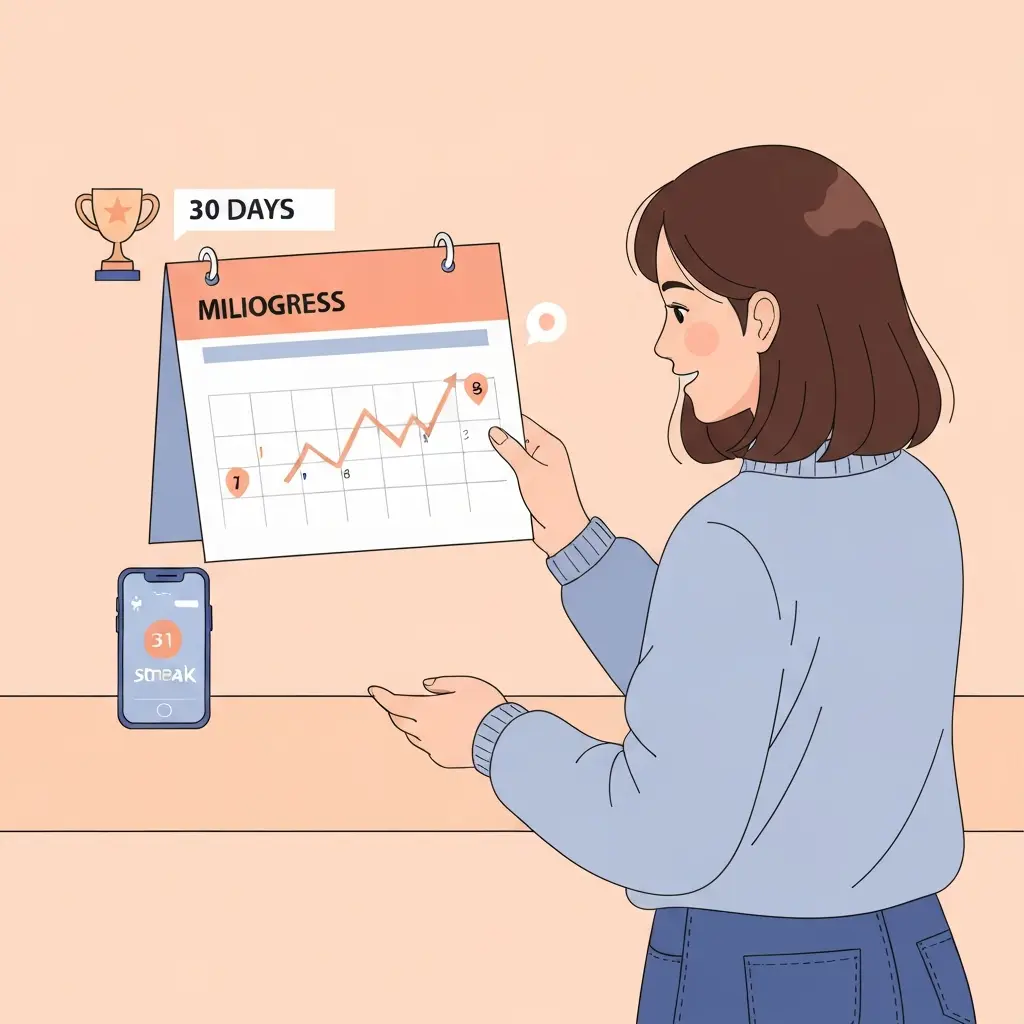
Motivation is sustained by evidence of progress. One of the most powerful motivation tools available to quitters in 2026 is the real-time health and savings tracker built into quit-smoking apps. Seeing “You have been smoke-free for 9 days, 14 hours. Your blood pressure has normalised. You have saved £62” converts an abstract commitment into concrete, visible progress.
What to track daily:
- Time smoke-free: The iQuit app shows this as a running clock — hours and days accumulating in real time.
- Money saved: Calculate your daily cigarette spend and watch it accumulate. One pack per day at typical 2026 UK prices (£14–16) becomes £100 saved at week one, £450 saved at month one.
- Cigarettes not smoked: Each cigarette is not an abstraction — it is a specific number of minutes you are adding back to your life, according to public health calculations.
- Health recovery milestones: Post these on your mirror or phone. 20 minutes: heart rate normalises. 12 hours: carbon monoxide clears. 2 weeks: lung function improving. 1 month: cilia in lungs regenerating.
The purpose of daily tracking is to make invisible progress visible. On days when motivation is low, opening your tracker and seeing real numbers is more effective than any motivational speech.
Step 3 — Build a Milestone Reward System
Time: 30 minutes to plan | Difficulty: Easy
Pre-planned milestone rewards transform the quit timeline from an endurance test into a series of achievable targets. The key to an effective milestone system is specificity: deciding in advance exactly what you will do when you hit each milestone makes the reward feel real and earned, not arbitrary.
Suggested milestone map for month one:
- 24 hours: Your favourite meal or takeaway
- 72 hours (hardest physical withdrawal peak passed): A film at the cinema, or a new book you have wanted
- 1 week: Something physical — a long hike, a spa treatment, a sports session — to celebrate your improving lung function
- 2 weeks: A meal out at a restaurant you’ve been meaning to try
- 1 month: A larger reward funded by the cigarette money you’ve saved — a weekend trip, a significant purchase, an experience
Tell at least one other person about your milestone plan. Social milestones — telling people “I hit one week today” — add the power of public acknowledgement to your internal reward, multiplying the motivational effect. Understanding how to support someone quitting smoking from a supporter’s perspective can also help you brief your own support network on what kinds of acknowledgement are most meaningful to you.
Step 4 — Create an Accountability System
Time: One conversation to set up | Difficulty: Easy
Accountability is one of the strongest predictors of quit success. Research from multiple smoking cessation studies confirms that social accountability — having at least one person who checks in on your progress — significantly reduces relapse rates. This is not about guilt or pressure; it is about the psychological weight that comes from having made a commitment to another person.
Your accountability system needs three components:
- An accountability partner: Choose one person who will check in with you regularly during month one. Be specific about what you want — “Text me on day 3, day 7, day 14, and day 30 and ask how I’m doing.” Don’t leave it to chance or goodwill.
- A public declaration (optional but powerful): Posting on social media that you have quit smoking on a specific date creates a social contract. Many people find this the single most powerful accountability tool they use — the thought of having to post “I started again” is a significant deterrent in high-craving moments.
- An app-based check-in: The iQuit app provides daily engagement prompts that function as a soft form of accountability — logging each day smoke-free creates a streak that becomes increasingly worth protecting.
Step 5 — Plan for Low-Motivation Days Before They Happen
Time: 15 minutes to plan | Difficulty: Easy
Motivation will drop. It is not a question of whether you will have days in month one where you feel exhausted, fed up, and convinced that smoking “just once” would fix everything — it is a certainty. The quitters who succeed plan for this in advance; those who don’t are caught off guard and frame the drop in motivation as a reason to give up.
Create a “low-motivation day protocol” now, while you’re motivated:
- Write down what you will do on a low-motivation day: “I will reread my deep why list. I will open the iQuit app and check my milestone tracker. I will text my accountability partner. I will do 5 minutes of box breathing. I will not make any decision about smoking for 24 hours.”
- Identify your most likely low-motivation triggers: For most people these are: high-stress days at work, bad nights of sleep, boredom at weekends, conflicts with partners or family members.
- Lower your bar on hard days: On a low-motivation day, your only goal is not to smoke. Not to exercise, not to eat well, not to be productive — just not to smoke. Reducing the demand on yourself prevents the cognitive overload that leads to “I’m failing at everything, might as well smoke.”
- Identify your personal high-risk hours: For many people it is the late evening (10–11pm), or the mid-afternoon energy dip (3–4pm). Schedule specific craving countermeasures for these windows before they arrive.
If stress is a major trigger for your motivation dips, the guide on handling smoking triggers at work and social events provides specific strategies for the environments where motivation most commonly collapses.
Step 6 — Shift from “Trying to Quit” to “I’m a Non-Smoker”
Time: Ongoing | Difficulty: Moderate
Language shapes identity, and identity shapes behaviour. Quitters who frame themselves as “trying to quit smoking” are in an ongoing struggle with an addiction they still secretly identify with. Quitters who frame themselves as “a non-smoker who used to smoke” have made an identity-level shift that dramatically reduces the psychological appeal of cigarettes.
Research on identity-based habit change (notably Dr. James Clear’s work on identity systems) shows that the most durable behaviour changes come from an identity shift, not just a behaviour goal. Saying “No thanks, I don’t smoke” instead of “No thanks, I’m trying not to smoke” is not just semantics — it is a daily reinforcement of a new self-concept.
Practical steps to accelerate the identity shift:
- Use “I don’t smoke” language consistently — to yourself and others — from day one, not from some future threshold
- Stop thinking of cigarettes as “mine” — they are not your cigarettes anymore
- Write down three traits of your non-smoker self: “I am someone who looks after my health. I am someone who doesn’t let nicotine make my decisions. I am someone who keeps commitments to myself.”
- When someone offers you a cigarette, the answer is “I don’t smoke, thanks” — not “I’m trying to quit”
Step 7 — Do a Weekly Motivation Review
Time: 15 minutes per week | Difficulty: Easy
A weekly review prevents motivation from drifting without you noticing. Set aside 15 minutes at the same time each week — Sunday evening works well for many people — to answer these questions honestly:
- How many days smoke-free this week? (Check app)
- How much money did I save this week?
- What was my hardest craving moment? What triggered it? What did I do?
- What went well this week that I want to repeat?
- What high-risk situation is coming up next week that I need to prepare for?
- Is my “why” list still resonant? Does it need updating?
This review keeps your quit plan active and adaptive rather than static. Most quit attempts that fail in weeks three and four do so because the quitter stopped actively managing their quit after the initial intense first week. The weekly review maintains that active management with minimal time investment.
Step 8 — Build Relapse Resilience Without Losing Momentum
Time: Mindset shift | Difficulty: Hard (emotionally)
Relapse resilience means the ability to slip — smoke one cigarette — and get back on track immediately rather than giving up entirely. Research from the CDC and NHS shows that the majority of successful long-term quitters had at least one slip before their final successful quit. A slip is only a full relapse if you decide it is.
How to build relapse resilience before you need it:
- Pre-decide your response to a slip: “If I smoke one cigarette, I will: open the iQuit app immediately, log the slip, identify the trigger, set a new quit time for within 24 hours, and text my accountability partner.” Pre-deciding this means you respond automatically rather than spiralling.
- Remove all-or-nothing thinking now: “One cigarette means I’ve failed” is a cognitive distortion that turns temporary slips into permanent relapses. Replace it with: “One cigarette is data. It tells me which trigger I need better defences for.”
- Do not restart counting from zero unnecessarily: Many quit apps allow you to log a slip without resetting your entire progress — check whether yours does. Your 23 days smoke-free before a single cigarette represents real biological progress that does not disappear.
- Use a slip as an information event: What triggered it? What time was it? Was alcohol involved? Was a specific person involved? Log all of it. This data makes your quit plan stronger, not weaker.
For comprehensive guidance on what your body is recovering through during this month, see our evidence-based guide on how to deal with nicotine withdrawal symptoms — understanding the physiological reality often provides motivation that abstract willpower cannot.
Frequently Asked Questions
How do you stay motivated to quit smoking when cravings are intense?
During an intense craving, motivation strategies that require complex reasoning often fail. The most effective approach is to use pre-built automatic responses: open your quit app, do a 3-minute breathing exercise, reread your “why” list, and set a 10-minute timer — telling yourself you will make no decision about smoking until the timer ends. By then, the peak of the craving will have passed. Motivation rebuilds naturally once the craving subsides.
Is it normal to lose motivation in week 2 or 3 of quitting smoking?
Extremely common. Week two and three are often called the “motivation valley” — the initial excitement of quitting has passed, physical withdrawal has improved enough to be less alarming, but the habit triggers remain strong and the reward of quitting feels distant. This is exactly when milestone tracking and accountability systems earn their value. Knowing that this dip is normal and temporary significantly reduces its power to derail you.
What is the best reward to give yourself for quitting smoking?
The most effective rewards are specific, personal, and purchased with the money you saved from not buying cigarettes. This connects the reward directly to the quit and makes the financial benefit tangible. Common powerful rewards include: a trip or weekend away at the one-month milestone, a significant item of clothing or technology, or an experience (concert, spa day, sporting event) that your smoking habit was previously “funding” for cigarettes instead.
How can an app help me stay motivated to quit smoking?
Quit-smoking apps provide four motivation functions: real-time progress tracking (making invisible health recovery visible), daily engagement (giving you a reason to open the app each day, building a streak), in-the-moment craving tools (reducing the frequency of failures that demoralise), and milestone celebrations (marking progress with in-app acknowledgements that reinforce your identity as a non-smoker). Apps like iQuit combine all four in a single tool.
Does motivation to quit smoking get easier after the first month?
Yes, significantly. After 30 days, craving frequency and intensity have both reduced substantially. The neurological recalibration of the dopamine system is largely complete, making natural pleasures more rewarding again. Many ex-smokers report that their motivation at day 45 or 60 is qualitatively different from month one — it shifts from effortful resistance to something more like pride in identity. The first month is the hardest precisely because it is when the biological recovery is most active.
What should I do on day one to set myself up for a motivated first month?
On day one: write your deep why list and put it somewhere visible, activate your quit app and start the milestone timer, tell at least two people it is your quit day, remove all smoking paraphernalia from your home, stock your fridge and desk with healthy craving substitutes, set up notification windows in your app for high-risk times, and identify your accountability partner. Doing all of these on day one — before the first craving hits — means you are managing your motivation proactively rather than reactively.
Track Every Day of Your First Month with iQuit
The iQuit app is built specifically for the first month of quitting smoking — with real-time health milestone tracking, daily guided steps, in-the-moment craving tools, and the kind of daily progress visibility that keeps motivation real when willpower alone is not enough. Start day one with a full toolkit, not just determination.