How to Stay Quit: Long-Term Smoking Cessation Strategies That Work Beyond the First Month (2026)
The first month of quitting smoking gets most of the attention — the withdrawal, the cravings, the survival guides for days one through thirty. But the data shows that relapse risk does not end at one month. Research from the CDC and Cochrane reviews tracks quit attempts over 12 months and beyond, showing that while the risk drops substantially after month one, it remains real through months two to six — and occasional high-stress events can trigger relapses even in year two or three of abstinence. Learning how to stay quit long term is a distinct skill from getting through the first week — and it is one that receives far less practical attention.
This guide addresses the specific challenges of maintaining long-term cessation: the fading of initial motivation, the accumulation of complacency, the unexpected late-stage cravings, and the life events that can undo months of hard work — alongside the specific strategies that address each one.
The Months 2-6 Challenge: When Motivation Fades
The first two weeks of quitting often come with an intense, focused determination fuelled by the novelty of the quit attempt and the very immediate challenge of withdrawal. By month two, this has changed: withdrawal is largely over, the immediate crisis has passed, and quitting begins to feel less urgent. This is precisely when many relapses occur.
Research on quit attempt timelines shows a second cluster of relapse events in months 2-4 that is distinct from the early acute withdrawal phase. The causes are different:
- Reduced vigilance: The crisis is over; the coping strategies that were deployed intensively are being used less
- Complacency: “I’ve cracked it” thinking — the belief that the hard part is finished and no further active effort is required
- Return to high-risk contexts: After avoiding parties, pubs, and stressful situations in weeks one and two, life resumes its normal pattern — and the triggers resurface
- Fading motivation: The initial compelling reasons to quit (a health scare, a birthday commitment, a pregnancy) may feel less immediate
Identity-Based Cessation: The Most Durable Foundation
The most consistent predictor of long-term cessation in the research literature is not motivation, willpower, or even NRT use — it is identity. Ex-smokers who describe themselves as “a non-smoker” rather than “someone who quit smoking” or “an ex-smoker” have significantly higher long-term abstinence rates.
This is not a semantic distinction. It reflects a genuine difference in how the person has integrated the cessation into their self-concept. For a “non-smoker,” a cigarette offer at a party is not a temptation to be resisted — it is simply irrelevant, the way a non-swimmer wouldn’t feel tempted by an invitation to swim laps. For someone still thinking of themselves as “trying to quit,” each cigarette offer is an active test.
Building the non-smoker identity:
- Use first-person present-tense language: “I don’t smoke” not “I’m trying not to smoke”
- Describe the quit to new people in your life without the “ex-smoker” framing: “I don’t smoke”
- Celebrate milestones as evidence of identity, not behaviour: “I’ve been a non-smoker for three months”
- Invest the money saved in something that represents your new identity — health, experiences, goals
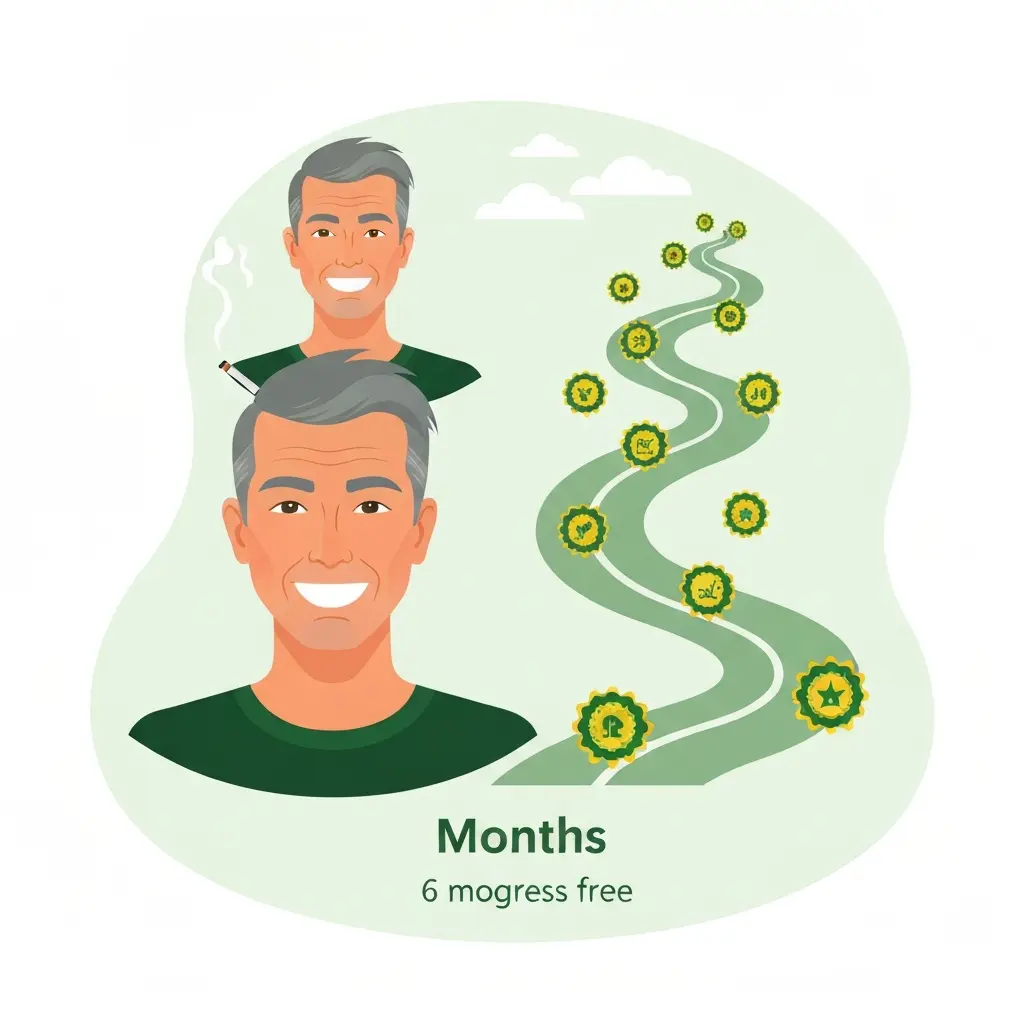
Using Milestone Momentum
The health and financial milestones of long-term cessation are genuinely remarkable. Between month 3 and year 1, a former pack-a-day smoker accumulates thousands of pounds or dollars in savings, experiences measurably improved lung function, sees their heart attack risk halving, and begins the long-term cancer risk reduction process.
Maintaining active awareness of these milestones — through an app, a journal, or regular reflection — keeps the benefits of quitting salient. Loss aversion is a powerful psychological force: seeing that you have accumulated £2,000 in savings makes relapse costly in a tangible, immediate way that the abstract concept of “improved health” does not.
The week-by-week benefits guide and the full quit smoking timeline map these milestones for ongoing motivation.
High-Risk Life Events and How to Survive Them
Certain life events disproportionately trigger late-stage relapses. Research identifies:
- Bereavement: Grief is associated with late-stage relapse even in people who have been smoke-free for 6+ months. The emotional pain and the historic comfort-seeking association with cigarettes converges. Prepare: tell your GP you’ve quit and you have a bereavement — most will provide brief additional support.
- Relationship breakdown: Similar mechanism to bereavement. The stress, the loss, and the historic cigarette-as-comfort pattern.
- Major career stress: Redundancy, serious work conflict, business failure — major professional stressors are late-stage relapse triggers that often surprise quitters who handled minor daily stress easily.
- Sustained insomnia: Extended sleep disruption reduces inhibitory control and increases craving vulnerability.
The strategy for each: have an explicitly articulated plan before the event occurs. “If I experience a bereavement while I’m not smoking, here is what I will do instead of smoking.” Having this plan written down before you need it is far more effective than trying to construct a response in the middle of grief or crisis.
The Complacency Trap
One of the most counterintuitive relapse risks in months three to twelve is success itself. Having gone three months without smoking, some ex-smokers reason: “I’ve clearly got this under control. I could have one cigarette at this party and it wouldn’t lead anywhere.” This logic — testing the previous addiction with a controlled experiment — has a predictable outcome for the vast majority of nicotine-dependent ex-smokers.
The research on controlled smoking for ex-smokers is clear: nicotine receptor sensitivity is still present even after months of abstinence, and a single cigarette can reinstate craving patterns in ways that feel neurologically identical to early-quit withdrawal. “One cigarette” is, for most ex-smokers, not a stable equilibrium state.
The long-term maintenance approach: treat the non-smoker identity as genuinely held, not as a test to run. You don’t need to prove your sobriety by experimenting with it.
Late-Stage Relapses: What Causes Them and How to Prevent Them
If a late-stage relapse occurs, the same principles from early quitting apply with greater speed: treat the slip as data, not failure; reset immediately rather than capitulating to full relapse; reassess your support strategy; and consider whether extended NRT or a booster session with a cessation counsellor is appropriate.
Many people who achieve long-term cessation describe experiencing at least one late-stage slip, sometimes at 4-6 months or even a year in. What distinguishes people who recover from those who fully relapse is the speed and decisiveness of the response. Resetting within 24 hours is far more effective than trying to “finish the pack” before restarting.
Frequently Asked Questions
When am I considered “done” with quitting smoking?
There is no official threshold, but research suggests that after 2-3 years of abstinence, most ex-smokers have a fundamentally different relationship to tobacco — cravings are rare, brief, and easily dismissed. Many cessation researchers use “5 years smoke-free” as a meaningful long-term success marker. However, the identity shift — thinking of yourself genuinely as a non-smoker — is more significant than any time threshold.
Is it okay to use NRT indefinitely to stay quit?
Yes. Both the NHS and CDC confirm that long-term NRT use is far safer than returning to smoking. If NRT helps you maintain abstinence, using it for 12 months or longer is a clinically acceptable approach. Most people naturally find their NRT use declining as cravings reduce — it is not necessary to force a rapid step-down if doing so increases relapse risk.
How do I handle cravings at 6 months or a year?
Late-stage cravings (after 3+ months) are typically brief (under 2 minutes) and specifically situational. The most effective management is simply naming and waiting: “This is a craving triggered by [context]. It will pass.” At this stage, the craving is almost always a conditioned psychological response rather than a physical withdrawal signal. Breathing techniques and brief distraction are usually sufficient. Having your quit app accessible provides an instant reminder of your progress.
Stay Quit with iQuit — Month After Month
The iQuit app is designed for the long game — daily milestone notifications that keep your progress salient, craving tools that work months in as well as day one, and AI coaching that adapts to your quit stage. Your streak is an asset. Protect it.