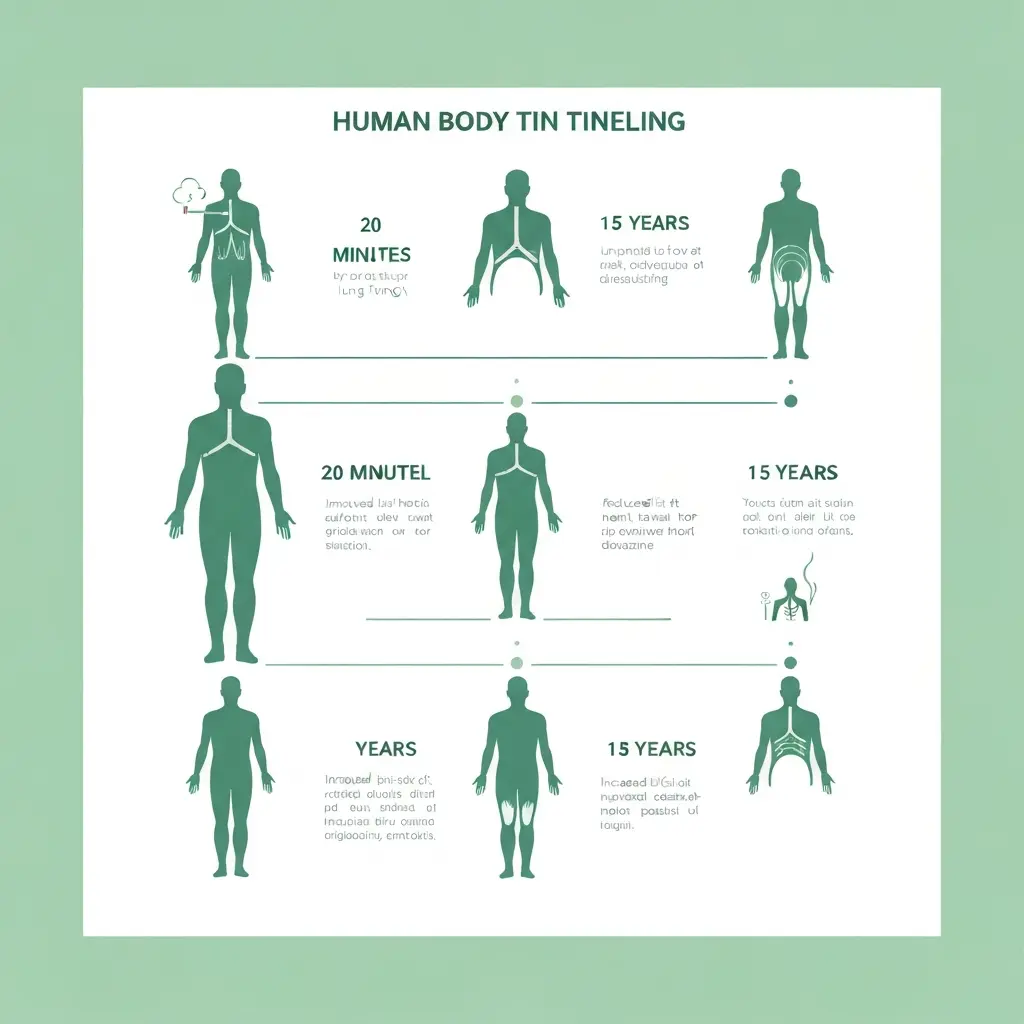
Quit Smoking Timeline: What Happens to Your Body From 20 Minutes to 15 Years (2026)
When you put out your last cigarette, something remarkable begins happening inside your body within minutes. The quit smoking timeline — the sequence of biological changes that unfold from the first 20 minutes to 15 years of being smoke-free — is one of the most compelling arguments for quitting that medicine has to offer. This is not speculation or motivational fiction: every milestone on this timeline is grounded in decades of clinical research from the American Heart Association, the NHS, the CDC, and the World Health Organization.
Whether you quit an hour ago, are planning to quit next week, or are months into your journey and wondering what is still ahead, this guide maps the full arc of your body’s extraordinary capacity to heal.
The First Hours: 20 Minutes to 24 Hours
The human body does not wait to begin recovery. Changes start almost immediately after the last cigarette:
| Time Since Last Cigarette | What Changes |
|---|---|
| 20 minutes | Heart rate and blood pressure drop toward normal levels. Circulation in hands and feet begins improving. |
| 2 hours | Nicotine half-life reached — blood nicotine levels drop by 50%. Early withdrawal symptoms may begin (cravings, mild anxiety). |
| 6-8 hours | Nicotine levels very low in blood. The insulin resistance effect of nicotine begins reversing — blood sugar regulation improves. |
| 12 hours | Carbon monoxide has almost entirely cleared from the bloodstream. Oxygen levels in blood return to normal. Heart does not need to work as hard. |
| 24 hours | Risk of heart attack begins to decrease. Carbon monoxide fully cleared. Nicotine largely cleared from the bloodstream. |
The 12-hour carbon monoxide milestone is particularly significant. Carbon monoxide — the same gas that makes car exhaust deadly — is present in cigarette smoke and binds to haemoglobin in red blood cells 200 times more readily than oxygen. This reduces oxygen delivery to organs. Within 12 hours of quitting, this poisoning begins reversing.
First Weeks: Days 2-14
- Day 2: Nicotine fully cleared from the body. Withdrawal peaks — cravings, irritability, headache, and difficulty concentrating are most intense on this day. Your sense of smell begins returning.
- Day 3: Your bronchial tubes begin relaxing, making breathing slightly easier. Lung capacity begins increasing.
- Days 4-7: Physical withdrawal symptoms ease significantly for most people. Energy levels begin to stabilise. The taste of food becomes noticeably improved.
- Day 14: Circulation has improved measurably. Walking and physical activity feel easier. Cravings are shorter and less intense. Cotinine (the metabolite of nicotine) has cleared from urine for most former smokers.
First Months: Weeks 2-12
Weeks two through twelve mark significant pulmonary recovery:
- Week 2-4: Lung cilia — tiny hair-like structures that sweep mucus and debris out of the airways — begin to regrow. These were suppressed by tobacco smoke. As they recover, smokers often experience an increase in coughing during this period. This is counter-intuitive but positive: the lungs are clearing.
- Month 1: Lung function measurably improves. Shortness of breath on exertion reduces. The complete one-month milestone guide details every change in this window.
- Months 2-3: Circulation improvements translate to better physical performance. Risk of infections like colds and flu decreases as immune function improves. For the full picture, see the 3-month benefits guide.
Year One: The Cardiovascular Turnaround
The one-year milestone is one of the most dramatic on the quit smoking timeline. According to the American Heart Association:
- At 1 year smoke-free, your excess risk of coronary heart disease is reduced to half that of a continuing smoker
- Blood pressure has normalised in most ex-smokers
- Risk of stroke continues declining
- Skin tone, wound healing, and collagen production have improved measurably
The money saved milestone at one year is also striking — a pack-a-day smoker in the UK saves approximately £3,500-4,000 in the first year alone. In the US, the savings are approximately $2,500-3,500 depending on state tobacco taxes.
Years 5-10: Cancer Risk Reduction
The longer-term milestones are where the evidence becomes most compelling for lifelong quitters:
| Milestone | Change in Risk | Source |
|---|---|---|
| 5 years | Stroke risk reduced to that of a non-smoker; mouth, throat, and oesophageal cancer risk halved | CDC / ACS |
| 10 years | Lung cancer death risk halved; risk of pancreatic cancer reduced to near non-smoker level | NHS / ACS |
The 10-year lung cancer milestone is particularly significant. Lung cancer kills more people than any other cancer globally, and smoking accounts for 85% of cases. Halving your risk within 10 years of quitting is a profound health achievement.
Year 15: The Full Recovery
At 15 years of being smoke-free, research from the landmark Doll et al. British Doctors Study (2004) and subsequent CDC analyses shows that an ex-smoker’s risk of coronary heart disease approaches that of a person who has never smoked. This is the endpoint of the cardiovascular timeline — a complete reset of heart disease risk.
Full respiratory function recovery varies by individual and depends on how long and heavily the person smoked. For smokers without significant COPD, lung function largely stabilises after years of quit. For those with smoking-related lung disease, quitting does not reverse structural damage, but it dramatically slows progression and reduces the risk of acute complications.
Is It Ever Too Late to Quit?
The evidence is unambiguous: no. Research published in the New England Journal of Medicine (2023) following 1.5 million participants found that quitting at any age produces meaningful health benefits. Specifically:
- Quitting before age 40 eliminates approximately 90% of the excess mortality risk associated with smoking
- Quitting at age 50 eliminates about 50% of the excess risk
- Quitting at age 60 still meaningfully reduces lung cancer risk and cardiovascular events
Every year of not smoking adds to the trajectory. The guide to health benefits by age breaks down exactly what stopping at different life stages means for outcomes.
Frequently Asked Questions
How long after quitting does the body fully recover?
“Full recovery” depends on which system you measure. Cardiovascular risk approaches non-smoker levels at 15 years. Lung cancer risk is halved within 10 years. Blood pressure and circulation normalise within weeks. For people without pre-existing smoking-related disease, the vast majority of measurable health metrics improve substantially within the first 1-2 years of quitting.
Does the quit smoking timeline apply if I smoked for decades?
Yes, though some timelines are longer for long-term heavy smokers. The early milestones (heart rate, carbon monoxide, circulation) apply regardless of smoking history. The risk reduction milestones for cancer and cardiovascular disease still occur but the absolute starting risk is higher, so proportional reductions translate to greater absolute benefit for long-term smokers who quit.
Why do I feel worse in the first week if my body is recovering?
The body is simultaneously undergoing nicotine withdrawal (a neurological adjustment) and physical recovery (clearing toxins, regrowing cilia, improving circulation). The withdrawal symptoms — cravings, headaches, irritability — reflect the brain adjusting, not the body getting worse. The physical recovery begins immediately; the psychological adjustment takes longer. Both are happening in parallel.
Do quit smoking timeline milestones apply to vape users who quit?
Most of the timeline milestones are specifically documented for tobacco cigarette smokers. Some milestones — like the carbon monoxide clearance at 12 hours — do not apply to vape users (e-cigarettes do not produce carbon monoxide). The nicotine withdrawal timeline is similar. Long-term data on vape cessation health benefits is less established than for tobacco, given that e-cigarettes have been mainstream for less than 20 years.
See Your Timeline in Real Time with iQuit
The iQuit app displays your personal quit smoking timeline — from the 20-minute heart rate drop to your long-term cardiovascular milestones — updated in real time from your quit date. Every milestone you hit is a notification you have earned. Start your timeline today.