How Long Does Nicotine Take to Leave Your Body? 7 Mistakes That Wreck Your Recovery Timeline
You quit smoking. You’ve made it 72 hours. So why does everything still feel so hard? If nicotine is supposedly gone, why are the cravings still ambushing you at 11am on a Tuesday?
This is one of the most frustrating moments in the quitting smoking, withdrawal, and recovery timeline — and it’s caused almost entirely by seven specific misconceptions about how long nicotine and its effects actually take to leave the body. Getting this wrong doesn’t just cause confusion. It causes people to give up, convinced something is wrong with them when nothing is.
Here’s the truth, backed by clinical research, so you can stop second-guessing your recovery — and actually get through it.
What’s Covered in This Article
- Mistake 1: Confusing nicotine clearance with symptom relief
- Mistake 2: Thinking cotinine and nicotine leave at the same time
- Mistake 3: Assuming everyone’s timeline is the same
- Mistake 4: Believing cravings mean nicotine is still present
- Mistake 5: Using NRT and expecting instant clearance
- Mistake 6: Thinking recovery is linear
- Mistake 7: Stopping NRT or medication too early
- Nicotine clearance vs. withdrawal timeline comparison table
- FAQ: Nicotine elimination and quitting smoking recovery
1 Thinking Nicotine Gone Means Withdrawal Gone
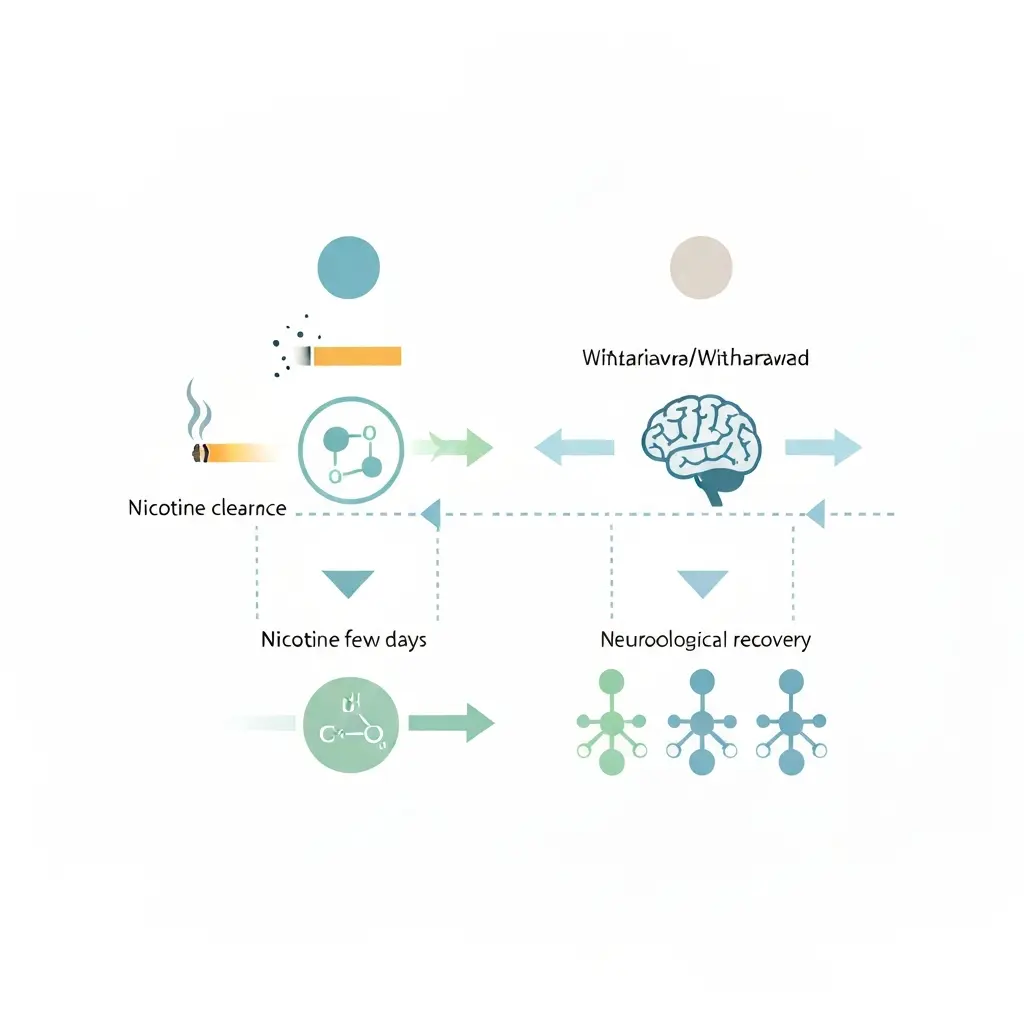
This is the biggest misconception — and it trips up even well-informed quitters. Nicotine leaves your blood within 1 to 3 days of your last cigarette. But your brain doesn’t care. It spent months or years rewiring itself around nicotine’s effect on dopamine receptors, and that rewiring doesn’t undo itself in 72 hours.
The NHS explains that withdrawal symptoms — irritability, anxiety, difficulty concentrating, sleep disruption — typically peak in the first 2–3 days after quitting and can persist for 2 to 4 weeks. Some people experience cravings for months. That’s neurological adaptation, not a sign nicotine is still circulating.
For a full picture of what your brain and body are doing week by week after quitting, the nicotine withdrawal timeline: your week-by-week recovery calendar for the first 12 weeks breaks this down with clinical milestones so you know exactly where you are.
2 Treating Cotinine and Nicotine as the Same Thing
Nicotine breaks down in your liver into a metabolite called cotinine. This is what drug tests actually detect — and it sticks around much longer than nicotine itself.
Cotinine is the primary metabolite of nicotine, produced when the liver processes nicotine via the CYP2A6 enzyme pathway. It has a half-life of approximately 16–19 hours, compared to nicotine’s half-life of just 1–2 hours, meaning it remains detectable in urine for 3–4 days in most people — and up to 10 days in heavy smokers.
This distinction matters most for two groups: people taking nicotine replacement therapy (NRT) who want to know when they’d test clean, and people who quit and are confused about why they still feel effects days later.
If you want the detailed science on nicotine half-life, cotinine detection windows, and how individual factors change these numbers, the complete guide on how long it takes for nicotine to leave your body covers the pharmacology in depth.
3 Assuming Your Timeline Matches Everyone Else’s
You’ve seen the “nicotine out in 3 days” posts online. Here’s the thing — that’s a population average, not a personal guarantee. Multiple biological and lifestyle factors change how quickly nicotine and cotinine are metabolized and eliminated.
| Factor | Effect on Clearance Speed | Clinical Note |
|---|---|---|
| Genetics (CYP2A6 variants) | Slow metabolizers retain nicotine longer | Affects NRT dose response (2023 pharmacogenomics data) |
| Age (50+) | Slower liver metabolism = longer clearance | Half-life can extend by 20–30% in older adults |
| Kidney function | Impaired kidneys slow cotinine excretion | Relevant for smokers with chronic kidney disease |
| Pregnancy | Faster nicotine metabolism (higher CYP2A6 activity) | NRT dosing often needs adjustment in pregnancy |
| Heavy smoking (20+ per day) | Higher baseline cotinine load = longer detection window | Urine cotinine detectable up to 10 days post-quit |
| Menthol cigarettes | Menthol inhibits CYP2A6, slowing nicotine clearance | Particularly relevant in Black American smokers (CDC, 2022) |
Your timeline is yours alone. Comparing your quitting smoking withdrawal experience to a friend’s — or a generic chart — and drawing conclusions from it is a recipe for unnecessary anxiety.
4 Thinking Cravings Mean Nicotine Is Still in Your System
This one genuinely surprises people. By day 4 after quitting, nicotine is essentially gone from your blood. But cravings — sometimes intense ones — can still hit on day 14, day 30, or even day 90. That’s not a nicotine signal. That’s a neurological cue-response pattern.
The brain’s reward circuitry (specifically the nucleus accumbens and prefrontal cortex) has been conditioned to associate specific triggers — coffee, stress, driving, certain times of day — with smoking. A 2022 study published in PMC tracking smoking abstinence symptoms across 67 days found that craving intensity follows a non-linear pattern and is moderated by psychological traits, not just nicotine levels.
Understanding which withdrawal symptoms are neurological vs. physiological — and how long each actually lasts — is covered in detail in the nicotine withdrawal symptoms ranked by severity, duration, and how to relieve each one. It’s the kind of specific breakdown that removes the guesswork.
Tracking your cravings in real time makes them significantly less overwhelming. The iQuit app includes an emergency SOS craving tool that gives you a structured way to get through any individual craving — counting down the minutes, offering distraction tasks, and logging your data so you can see your pattern improve over time. Visibility genuinely changes how cravings feel.
5 Expecting Instant Clearance While Using NRT
Nicotine replacement therapy — patches, gum, lozenges, inhalers, nasal spray — deliberately keeps low levels of nicotine in your system. That’s the mechanism. It prevents the sharp drop in nicotine that drives severe withdrawal symptoms by giving your brain a slower, controlled reduction instead of a sudden cliff.
So if you’re using NRT and wondering why a urine test still shows cotinine, or why you still feel “some” withdrawal — that’s expected and medically intentional. The NHS guidance on managing nicotine withdrawal symptoms recommends using NRT for the recommended 8–12 weeks rather than stopping early when symptoms ease.
6 Expecting Recovery to Be a Straight Line
Here’s where it gets interesting — and where a lot of people decide they’re “broken.” Withdrawal symptoms don’t steadily decrease day by day. They spike, plateau, dip, then spike again. A bad day at week 3 doesn’t erase three weeks of progress. It’s just how neurological adaptation works.
The 67-day abstinence study referenced earlier found that symptoms like negative affect and urges to smoke showed significant individual variability across the timeline — meaning some people felt better by day 14 and others were still working through symptoms at day 45. Both were normal recovery trajectories.
What matters is the overall trend over weeks, not the daily scorecard. A tool that logs your mood, craving intensity, and sleep quality over time — like the journal and mood tracking feature inside the iQuit app — shows you that trend clearly, even when a specific day feels like going backwards.
7 Stopping Medication or NRT When You Feel Better
This is the quitting smoking mistake with the highest relapse cost. People start NRT or prescription cessation medication (like varenicline or bupropion), feel significantly better after 2–3 weeks, and taper off on their own. Then week 4 or 5 hits hard, and they’re back to smoking without the support they’d built.
Clinical guidelines from both the NHS and CDC recommend completing the full recommended course of cessation aids — typically 12 weeks minimum for most NRT formats. Feeling better is a sign the treatment is working, not a signal to stop.
Before stopping any cessation medication, speak with your GP or a quit-smoking specialist. If you’re building your quit plan from scratch, the free Smokefree quit plan builder is a structured, evidence-based starting point that accounts for your medication timeline.
Nicotine Clearance vs. Withdrawal Timeline: What’s Actually Happening
This is the table most health sites don’t include — the side-by-side comparison of physical clearance and symptom timeline, because they’re not the same clock.
| Time After Last Cigarette | Nicotine / Cotinine Status | Typical Withdrawal Experience |
|---|---|---|
| 30 minutes | Nicotine levels dropping rapidly | First cravings beginning |
| 24–48 hours | Blood nicotine nearly cleared; cotinine still present | Irritability, anxiety, difficulty concentrating at peak |
| 3–4 days | Most people: nicotine and cotinine undetectable | Symptom peak — this is the hardest window for most |
| 1–2 weeks | Fully cleared in blood and urine (non-heavy smokers) | Acute symptoms easing; psychological cravings persist |
| 2–4 weeks | Fully cleared for virtually all individuals | Most symptoms resolved; cue-triggered cravings ongoing |
| 1–3 months | No detectable nicotine or metabolites | Intermittent cravings; brain dopamine pathways recovering |
| 3–12 months | N/A | Craving frequency and intensity typically minimal; full neurological rebalancing continues |
Signs Your Quitting Smoking Recovery Is Going Normally
- Cravings last 3–5 minutes then pass, even if they’re frequent
- Sleep is disrupted in weeks 1–2 but stabilizing by week 3
- Irritability is highest in the first week and slowly improving
- You’re having “bad days” that are getting further apart over time
- Physical symptoms (cough, throat irritation) improve within 2 weeks
- Energy and taste/smell are noticeably better by week 2–3
For a visual walkthrough of what happens to your body immediately after quitting, the CDC’s “What Happens When You Stop Smoking” video is a concise, medically accurate 3-minute explainer worth watching in your first week.
Frequently Asked Questions: Nicotine Elimination and Quitting Smoking Recovery
How long does nicotine stay in your blood after quitting smoking?
Nicotine has a blood half-life of approximately 1–2 hours, meaning it’s largely cleared from your bloodstream within 1–3 days of your last cigarette. However, its primary metabolite cotinine persists for 1–10 days depending on how heavily you smoked and your individual metabolism. A standard urine cotinine test detects smoking for up to 3–4 days in most people, and up to 10 days in heavy smokers.
Why do I still have cravings if nicotine has left my body?
Cravings after nicotine clearance are neurological, not chemical. Your brain’s reward system was conditioned to associate specific cues — stress, coffee, certain times of day — with smoking, and those pathways remain active long after nicotine is gone. According to research tracking abstinence symptoms across 67 days (PMC, 2022), craving intensity is significantly moderated by psychological traits and environmental triggers, not just nicotine blood levels.
How long do nicotine withdrawal symptoms last?
Most acute nicotine withdrawal symptoms — irritability, anxiety, difficulty concentrating, and increased appetite — peak within the first 2–3 days after quitting and typically resolve within 2–4 weeks. Psychological cravings can continue for several months in some individuals. The NHS notes that the worst of withdrawal is generally over within a month, though some people experience intermittent urges for longer.
Does nicotine replacement therapy (NRT) delay nicotine clearance?
Yes — and that’s intentional. NRT products (patches, gum, lozenges, inhalers) deliver controlled amounts of nicotine to prevent acute withdrawal, which means nicotine and cotinine remain detectable while you’re using them. This is not a sign that NRT isn’t working; it’s the mechanism. Full nicotine clearance happens after you complete and taper off the NRT course, typically over 8–12 weeks as recommended by the NHS and CDC.
Is it normal to feel worse at week 3 or 4 of quitting smoking?
Yes, and this is more common than most quit guides acknowledge. A bad day or resurgence of cravings in week 3–4 is a known pattern in nicotine withdrawal recovery — it doesn’t mean you’re going backwards. The 67-day abstinence symptom study (PMC, 2022) found significant individual variability in symptom trajectories, with some participants experiencing delayed symptom peaks. The overall trend across weeks matters more than any single difficult day.
How long after quitting smoking do you feel normal again?
Most people report feeling significantly more like themselves within 2–4 weeks of quitting smoking as acute withdrawal resolves. Energy levels, mood stability, and sleep quality typically improve noticeably by weeks 3–4. Full neurological rebalancing — where dopamine receptor sensitivity normalizes — takes 1–3 months. CDC data shows that at the 3-month mark, most former smokers report that cravings have become infrequent and manageable.
What factors make nicotine take longer to leave your body?
Several factors slow nicotine and cotinine elimination: older age (slower liver metabolism), reduced kidney function, genetic variants in the CYP2A6 enzyme that slow nicotine processing, heavy smoking history (higher baseline cotinine load), and menthol cigarette use (menthol inhibits CYP2A6 activity). Conversely, pregnancy speeds up nicotine metabolism due to elevated CYP2A6 activity, which is why NRT dosing often needs clinical adjustment during pregnancy.
When should I seek medical help during nicotine withdrawal?
Contact your GP or healthcare provider if withdrawal symptoms are severely impacting your daily functioning after two weeks, if you experience significant depression or anxiety that doesn’t improve, or if you have a history of mental health conditions (since quitting smoking can temporarily affect mood regulation). Prescription medications like varenicline (Champix/Chantix) or bupropion can significantly reduce withdrawal severity — the CDC recommends discussing these options with a doctor before your quit date.
Track Your Recovery. Know Where You Stand.
Every day you stay smoke-free, your body is doing something measurable. The iQuit app shows you your real-time recovery milestones, lets you track cravings and mood over time, and gives you SOS support the moment a craving hits — so you’re never navigating this alone.
The Bottom Line on Quitting Smoking, Withdrawal, and Recovery Timelines
Nicotine leaves your blood fast. Withdrawal takes longer. Brain recovery takes longer still. And none of those timelines are a reflection of how strong or motivated you are — they’re just biology doing what biology does.
The seven mistakes covered here all come from the same root misunderstanding: treating nicotine elimination as a single event rather than a layered biological process. Once you separate physical clearance from neurological recovery, the quitting smoking, withdrawal, and recovery timeline stops feeling like a betrayal and starts feeling like a map.
If you’re looking for that map in detail — with clinical milestones, week-by-week expectations, and specific symptom guidance — start with the week-by-week nicotine withdrawal recovery calendar and the ranked guide to withdrawal symptoms, their duration, and evidence-based relief strategies.
You’re not behind. You’re not broken. You’re on schedule.
For additional quit support tools vetted by public health authorities, the Smokefree QuitGuide app offers free NIDA-backed resources. Used alongside a structured quit plan, these tools can meaningfully change your odds of permanent success.
Last reviewed: June 2025. Medical information aligned with current NHS, CDC, and WHO guidance on smoking cessation and nicotine pharmacology.