
Nicotine Gum vs Patch vs Lozenge vs Inhaler: Which NRT Form Works Best in 2026?
You have decided to quit smoking — that is one of the most important decisions you will ever make. You have also heard that nicotine replacement therapy (NRT) roughly doubles your chances of success compared to quitting unaided. But standing in the pharmacy aisle, facing a shelf full of gums, patches, lozenges, and inhalers, the question becomes: which form of nicotine gum vs patch vs lozenge vs inhaler is actually right for you? The answer is not one-size-fits-all, and choosing the wrong delivery method for your smoking pattern can quietly undermine an otherwise solid quit attempt.
This guide cuts through the confusion. Using data from the Cochrane Library, NHS clinical guidelines, CDC cessation evidence, and peer-reviewed meta-analyses, we compare every mainstream NRT form side by side — speed of action, success rates, side effects, cost, and which smoker profile each suits best. By the end, you will know exactly which option — or combination — gives you the strongest shot at quitting for good in 2026.
How NRT Works and Why It Helps
When you smoke, nicotine reaches your brain within 10 seconds, triggering dopamine release and reinforcing the habit with powerful neurological rewards. When you quit abruptly, that supply vanishes — and withdrawal symptoms including irritability, difficulty concentrating, cravings, and sleep disruption can begin within hours. NRT addresses this by supplying controlled, lower doses of nicotine through alternative delivery routes, reducing withdrawal severity while you break the behavioural habit of smoking.
According to a landmark Cochrane systematic review covering over 150 trials, NRT increases the odds of successful cessation by approximately 50–70% compared to placebo or no treatment. The NHS recommends NRT as a first-line cessation aid for most adult smokers, and the WHO includes NRT on its List of Essential Medicines. Critically, the evidence shows no single NRT form is universally superior — but each has a distinct pharmacokinetic profile that makes it better suited to particular situations and smoker types.
Understanding the difference between background NRT (steady nicotine delivery over many hours) and acute NRT (fast-acting, craving-specific doses) is the key to using NRT effectively. The patch is the primary background option. Gum, lozenges, and inhalers are all acute options. Nasal spray is also acute but requires a prescription in most countries and is not covered in this comparison.
Nicotine Patch: Steady, Discreet, Simple
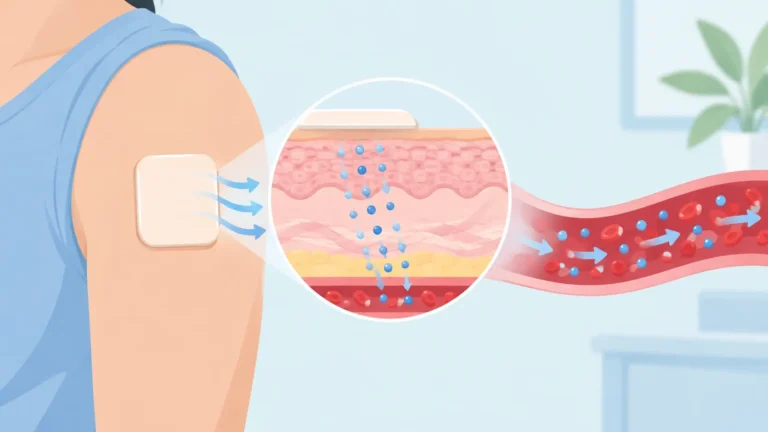
The nicotine patch is the most prescribed NRT worldwide, and for good reason. Applied once daily to clean, dry skin — typically on the upper arm, chest, or back — it delivers a continuous, controlled dose of nicotine transdermally over 16 or 24 hours depending on the brand. Standard starting doses are 21 mg (for smokers of 10 or more cigarettes per day), stepping down to 14 mg after 6 weeks, then 7 mg for the final weeks of a typical 12-week course.
What the evidence shows
Patches produce quit rates of approximately 8–12% at 6–12 months in real-world studies, compared to 4–6% for unaided quitting. Their primary strength is compliance: applying one patch per day is cognitively simple, and the steady nicotine delivery prevents the troughs between cigarettes that drive acute cravings. The patch cannot, however, respond to sudden spike cravings — it was not designed to. This is why many guidelines recommend pairing it with a fast-acting form.
Side effects
The most common side effect is local skin irritation at the application site, affecting roughly 30–50% of users to some degree. Rotating sites daily minimises this. Some users report vivid dreams when wearing a 24-hour patch overnight; switching to a 16-hour patch (removed at bedtime) resolves this for most people. Rarely, patches can cause sleep disturbance, headache, or nausea.
Best for
Patches suit smokers who smoke regularly throughout the day (rather than situationally), who want a low-maintenance option, and who find the ritual of using gum or lozenges inconvenient. They also work well for people in roles where discrete behaviour is important — the patch is completely hidden under clothing.
Nicotine Gum: Fast-Acting and Flexible
Nicotine gum delivers nicotine through the oral mucosa — the lining of your mouth — and is available without prescription in 2 mg and 4 mg strengths. The 4 mg dose is recommended for people who smoke their first cigarette within 30 minutes of waking, a reliable marker of high nicotine dependence. NHS guidance suggests using 8–12 pieces per day during the first weeks, reducing over a standard 12-week course.
The technique matters: this is not ordinary chewing gum. The correct “chew and park” method involves chewing slowly until a peppery taste or tingling sensation appears, then parking the gum between cheek and gum to allow nicotine absorption. Continuous chewing causes swallowing of nicotine into the stomach — where it is poorly absorbed and more likely to cause nausea and hiccups.
What the evidence shows
Cochrane evidence confirms that higher-dose (4 mg) gum produces significantly better quit rates than 2 mg gum in highly dependent smokers. People using nicotine gum consistently show quit rates around 50–70% higher than those on placebo. The gum reaches peak nicotine levels within 20–30 minutes of use — meaningfully faster than the patch, though slower than nasal spray or the inhaler.
Side effects
Jaw ache from extended chewing is the most common complaint. Nausea, hiccups, and throat or mouth irritation occur more often when technique is incorrect. The gum is not suitable for people with dental work, jaw problems, or oesophageal conditions, and should not be eaten with acidic foods or drinks in the 15 minutes before or during use, as acidity reduces nicotine absorption through the oral mucosa.
Best for
Gum suits people who want tactile engagement — something to physically do during cravings — and those whose cravings are tied to specific triggers or situations rather than spread evenly throughout the day. It is portable, available over the counter, and allows precise craving management.
Nicotine Lozenge: Smoke-Free and Hands-Free
Nicotine lozenges dissolve slowly in the mouth over 20–30 minutes, releasing nicotine through the oral mucosa in a pattern similar to gum but without the chewing action. They are available in 1 mg, 1.5 mg, 2 mg, and 4 mg strengths depending on market. The 4 mg dose is again recommended for highly dependent smokers. Guidelines suggest 8–12 lozenges daily, with a gradual step-down over 12 weeks.
What the evidence shows
Head-to-head comparisons between lozenges and gum show broadly equivalent quit rates when used correctly. A 2023 Cochrane meta-analysis confirmed that lozenges improve quit rates by around 50–60% versus placebo. The lozenge offers a meaningful practical advantage over gum: it requires no chewing technique, it is silent and unobtrusive, and it can be used by people with dental issues that make gum unsuitable.
Side effects
Nausea, hiccups, and heartburn are the most frequently reported side effects — particularly if the lozenge is moved around too much or chewed rather than allowed to dissolve. Like gum, lozenges should not be used alongside acidic drinks. Some people report mouth sores with extended use, usually from a combination of nicotine contact and dry mouth.
Best for
Lozenges are ideal for people who cannot or prefer not to chew gum, those in environments where gum-chewing is inappropriate (professional settings, for example), and smokers who want a discreet acute NRT option. They are also well-suited to people in the later phases of a quit attempt who are stepping down to lower nicotine doses.
Nicotine Inhaler: Replaces the Ritual
The nicotine inhaler — sometimes called the nicotine inhalator in the UK — is a plastic device that holds a nicotine cartridge. Drawing air through it delivers nicotine vapour to the oral mucosa (not the lungs — it is not a deep inhalation device). Each cartridge delivers approximately 80 puffs of nicotine. In most markets the inhaler requires a prescription, making it less accessible than gum, patches, or lozenges.
What the evidence shows
Cochrane evidence confirms that nicotine inhalers improve cessation rates by 50–80% compared to placebo, consistent with other NRT forms. What makes the inhaler distinctively valuable is behavioural: the hand-to-mouth ritual of smoking is deeply conditioned in many smokers, and the inhaler partially satisfies that behavioural element while delivering nicotine. For people who strongly miss the physical act of smoking, the inhaler can reduce the overall psychological burden of quitting in ways a patch or lozenge cannot.
Side effects
Local irritation of the mouth and throat is the most common side effect, alongside coughing and runny nose — typically more pronounced in the first few days of use as mucous membranes adjust. Unlike cigarette smoke, the vapour does not reach the lungs deeply, and the inhaler carries no combustion-related risks. Cold temperatures reduce nicotine delivery efficiency; inhaler users in colder climates may need to keep cartridges warm.
Best for
The inhaler is particularly well suited to people who miss the physical act of smoking as much as the nicotine itself — those who describe themselves as “hand and mouth” smokers. It is also a useful option when step-down from patches begins and behavioural cravings reassert themselves.
Head-to-Head Comparison Table
| Feature | Patch | Gum | Lozenge | Inhaler |
|---|---|---|---|---|
| Delivery type | Background (slow, steady) | Acute (craving-triggered) | Acute (craving-triggered) | Acute (craving-triggered) |
| Onset time | 2–4 hours to peak | 20–30 minutes | 20–30 minutes | ~15–20 minutes |
| Prescription needed? | No (OTC) | No (OTC) | No (OTC) | Yes (most markets) |
| Approx. monthly cost (UK) | £25–40 | £30–50 | £25–45 | £30–50 (Rx) |
| Quit rate vs placebo | +50–70% | +50–70% | +50–60% | +50–80% |
| Key limitation | Cannot address acute spikes | Requires correct technique | Nausea if chewed | Cold reduces efficacy |
| Best for | Heavy, regular smokers | Situational/trigger smokers | Dental/professional settings | Hand-mouth ritual smokers |
Combination NRT: The Evidence-Backed Upgrade
The single most important finding in the NRT literature for practical quit planning is this: combining a nicotine patch with a fast-acting NRT form produces meaningfully better outcomes than using any single NRT alone. According to Cochrane and CDC evidence, combination NRT achieves quit rates of approximately 17% at 6 months, compared with roughly 14% for single-form NRT.
The logic is straightforward. The patch handles baseline withdrawal — the low-level irritability, difficulty concentrating, and restlessness that arise from nicotine absence. The acute NRT form handles spike cravings — the intense, sudden urges triggered by specific situations, emotions, or environmental cues. Trying to manage spike cravings with a patch alone is like trying to brake suddenly with a car that only has cruise control.
The NHS Stop Smoking Service routinely recommends combination NRT as a standard approach for heavier smokers (more than 10 cigarettes per day). A practical starting combination is a 21 mg 24-hour patch plus 4 mg gum or lozenge as needed. The iQuitNow app can help you track your craving patterns and decide whether combination NRT is right for your situation — learn more about the best quit smoking apps for 2026.
Which NRT Form Is Right for You?
Rather than recommending a single “best” NRT form, the evidence supports a profile-based approach. Ask yourself three questions:
- How dependent am I? If you smoke your first cigarette within 30 minutes of waking, you are highly dependent and need higher doses (4 mg gum/lozenge or 21 mg patch to start). Consider combination NRT.
- What kind of smoker am I? If you smoke throughout the day regardless of circumstances, a patch-centred approach suits you. If you smoke heavily in specific situations (after meals, with coffee, under stress), acute NRT forms are your priority.
- What lifestyle factors apply? Dental issues make lozenges or the inhaler better than gum. A professional environment where discretion matters favours the patch or lozenge. Strong oral fixation or hand-to-mouth habit points toward the inhaler or gum.
It is also worth knowing what combinations work poorly: two fast-acting NRT forms together (e.g., gum plus lozenge simultaneously) do not produce additive benefits and increase side effect risk. The evidence-backed approach is one background form (patch) plus one acute form (gum, lozenge, or inhaler).
For a broader view of all cessation options — including prescription medications such as varenicline — see our complete quit smoking methods comparison. If you are unsure whether NRT or another approach is right for you, our guide to the best NRT options compared provides additional detail. And if you are weighing NRT against a digital support approach, our quit smoking apps vs nicotine gum comparison breaks down the evidence on both sides.
Frequently Asked Questions
Is nicotine gum or a patch more effective for quitting smoking?
Neither is universally more effective — both increase quit rates by 50–70% versus no treatment. The patch suits smokers who need steady background nicotine, while gum suits those managing situational or spike cravings. Combining both (combination NRT) produces better outcomes than either alone, with quit rates around 17% at 6 months according to Cochrane evidence.
How long should I use NRT for?
Most NRT courses run 12 weeks with a step-down protocol (reducing dose gradually). NHS guidelines now allow longer courses if needed — there is no strong evidence that extended NRT use causes harm, and stopping too early is a significant cause of relapse. Your GP or stop smoking service can advise on duration based on your dependence level.
Can I use NRT if I am pregnant?
Yes, under medical supervision. The NHS and NICE guidelines support NRT use in pregnancy when the alternative is continued smoking, which carries much greater risks. Intermittent forms (gum, lozenge) are generally preferred over patches during pregnancy, but your midwife or GP should be involved in that decision.
What happens if I smoke while using a nicotine patch?
Smoking while wearing a patch increases nicotine levels in your body but the risk of serious harm is lower than once believed. However, smoking while on NRT is counterproductive to your quit attempt and signals that your NRT dose may need reviewing. If you slip up, remove the patch, wait for nicotine levels to settle, and consider combining NRT forms with behavioural support before your next attempt.
Is the nicotine inhaler better than gum for people who miss the act of smoking?
For smokers who find the behavioural ritual of smoking particularly difficult to replace, the inhaler often performs better psychologically. It partially satisfies the hand-to-mouth conditioned behaviour while delivering nicotine through the oral mucosa. Cochrane evidence shows it is as effective as other NRT forms pharmacologically, with the added benefit of addressing the ritual element of the habit.
Where can I get free NRT in the UK?
In England, NRT is available free on prescription through the NHS Stop Smoking Service and some GP practices. In Scotland, Wales, and Northern Ireland, local stop smoking services also provide free or subsidised NRT. Contact your GP, local pharmacy, or NHS 111 for referral to your nearest stop smoking service.
Ready to choose your NRT and start your quit?
The iQuitNow app helps you track cravings, monitor your nicotine reduction, and stay accountable — whether you are using NRT, quitting cold turkey, or combining approaches. Pair NRT with structured digital support for the best chance of lasting success. Explore free quit smoking resources or download iQuitNow to get started today.