
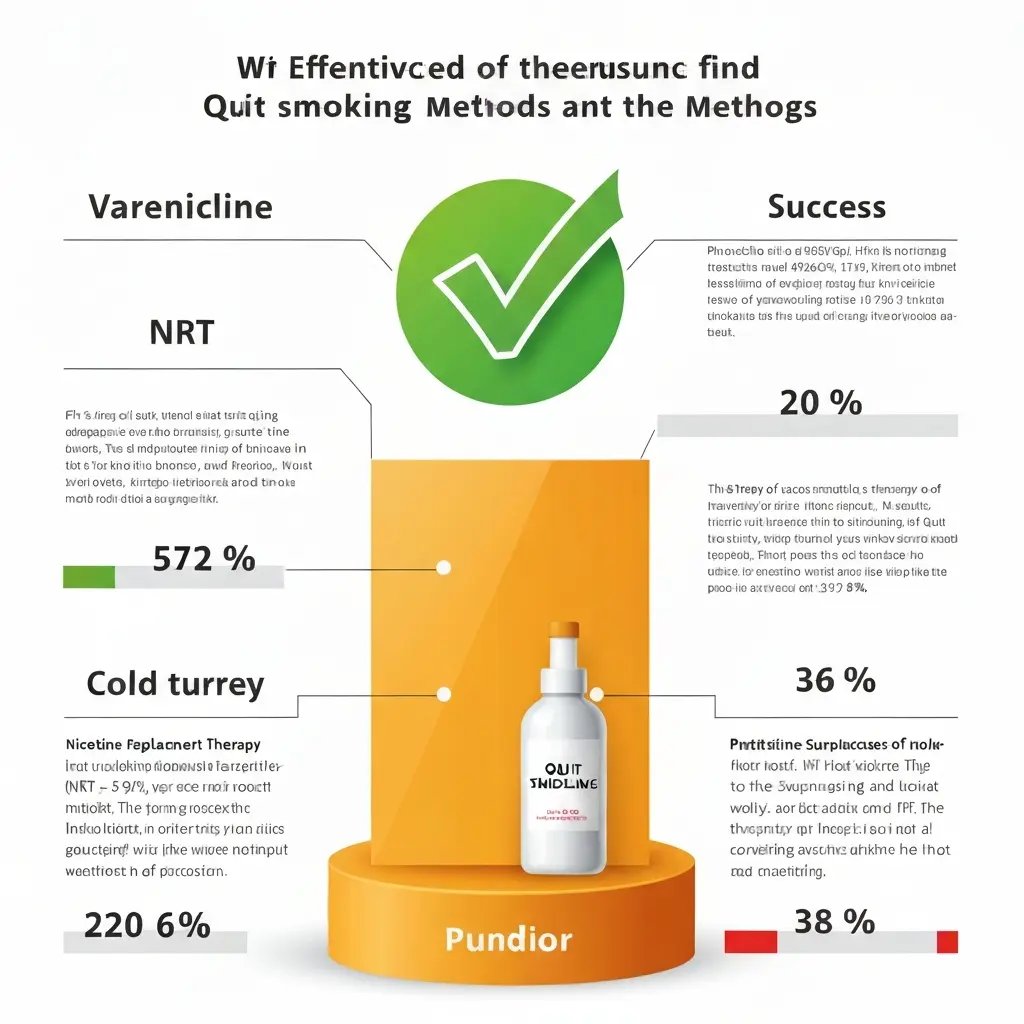
Quit Smoking Methods Ranked by Success Rate: The Complete Comparison for 2026
Choosing the right quit smoking method can double, triple, or quadruple your odds of long-term success. The difference in 6-month quit rates between unaided willpower (3–7%) and the best pharmacological and behavioural combinations (35–40%) is not a minor variation — it is the difference between a 1 in 20 chance and a 2 in 5 chance of permanent cessation. This comprehensive comparison ranks every major quit smoking method by evidence-backed success rates, explains the science behind each, and helps you identify the combination most likely to work for your specific situation in 2026. For the full statistical picture behind these figures — 60+ sourced data points — see our quit smoking success rates by method: 2026 statistics guide.
All success rates cited are from peer-reviewed clinical trials, Cochrane systematic reviews, and NHS/CDC clinical guidance.
Success Rate Ranking Table
| Method | 6-Month Quit Rate | Evidence Source | Prescription Needed? |
|---|---|---|---|
| Combination: Varenicline + NRT | ~40–45% | Multiple RCTs, Cochrane 2022 | Yes (varenicline) |
| Varenicline alone | ~27–30% | EAGLES trial, Cochrane 2022 | Yes |
| Combination NRT (patch + fast-acting) | ~26% | Cochrane NRT review (136 trials) | No (OTC) |
| Bupropion alone | ~19% | Cochrane 2020 | Yes |
| Single NRT form (patch only) | ~18–22% | Cochrane NRT review | No (OTC) |
| Cold turkey + behavioural support | ~22% | Russell et al. 2016 | No |
| Gradual reduction + behavioural support | ~15–16% | Russell et al. 2016 | No |
| Willpower alone (cold turkey, no support) | 3–7% | Multiple meta-analyses | No |
Cold Turkey: Strengths and Limitations
Cold turkey — stopping abruptly with no pharmacological support — is the most commonly used quit method globally. Its appeal is psychological: it represents a clean break, requires no prescription, and costs nothing. The 2016 Russell et al. trial confirmed that abrupt cessation outperforms gradual reduction even without medication support (22% vs 15.5% at 6 months).
However, unaided cold turkey’s 3–7% long-term success rate makes it the least effective single strategy in the evidence base. This is not a criticism of those who attempt it — it reflects the neurobiological difficulty of the task, not a character failing. For people who prefer the cold turkey approach, adding behavioural support (counselling, quitline, app) raises success rates to ~22%, and adding NRT raises them further.
See the full guide: quit smoking cold turkey 72-hour survival guide.
Nicotine Replacement Therapy (NRT): Forms and Evidence
NRT is the most widely used pharmacological cessation aid, available without prescription. The Cochrane NRT meta-analysis of 136 trials (64,000+ participants) is the most comprehensive evidence review in cessation medicine and confirms: all NRT forms roughly double quit rates vs placebo.
NRT Forms Compared
| Form | Onset | Best Use | Notes |
|---|---|---|---|
| Patch (16hr/24hr) | 30–60 min | Background symptom management | Most convenient; remove at night if vivid dreams |
| Gum | 1–5 min | Breakthrough cravings | “Chew and park” technique required |
| Lozenge | 2–5 min | Breakthrough cravings; discreet | Allow to dissolve, do not chew or swallow |
| Inhaler | 2–5 min | People who miss the hand-to-mouth ritual | Available as NHS prescription or OTC |
| Nasal spray | Under 1 min | High dependence, rapid craving needs | Fastest-acting NRT; prescription in some countries |
Varenicline (Champix/Chantix): The Most Effective Single Agent
Varenicline is a partial agonist at nicotinic acetylcholine receptors — it simultaneously partially activates the receptor (reducing withdrawal) and blocks the full activation that smoking would produce (reducing smoking’s reward). This dual mechanism makes it the single most effective pharmacological cessation agent in the evidence base.
The EAGLES trial — 8,058 participants, the largest psychiatric safety trial in cessation medicine — confirmed: varenicline outperforms NRT, bupropion, and placebo; and is safe for people with mental health conditions. Quit rates with varenicline are approximately 27–30% at 6 months, versus 18–22% for NRT alone.
Varenicline requires a prescription in all markets. The standard course is 12 weeks, with a 1-week titration period (starting at 0.5mg once daily, building to 1mg twice daily).
Bupropion (Zyban): The Antidepressant That Helps Quitting
Bupropion is an atypical antidepressant that was discovered to aid smoking cessation. Its mechanism in cessation is not fully understood but involves both dopaminergic and noradrenergic effects — partially addressing the dopamine deficit of nicotine withdrawal. Cochrane 2020 evidence shows approximately 19% quit rates at 6 months — better than placebo, slightly less effective than varenicline. Particularly appropriate for smokers with comorbid depression.
Combination Approaches: The Highest Success Rates
The most effective cessation strategy for most smokers is a combination of pharmacological and behavioural support. The highest documented single-trial quit rates come from:
- Varenicline + behavioural counselling: ~35–40% at 6 months
- Combination NRT + behavioural counselling: ~25–30% at 6 months
- Varenicline + combination NRT (for very high dependence): Up to 40–45% in some trials
Adding a quit smoking app to any of these approaches adds incremental benefit — providing craving management, progress tracking, and motivation between counselling sessions. The iQuit app is designed to complement pharmacological support with 24/7 behavioural tools.
Digital and App-Based Support: The Emerging Evidence
Digital cessation support — including smartphone apps, text message programmes, and web-based tools — is now an established evidence-based category. A CDC review found that digital interventions provide benefit compared to minimal support controls. Apps are most effective as part of a comprehensive strategy, not as a standalone replacement for pharmacological support.
For more, see our guide on the best quit smoking apps in 2026.
Which Method Is Right for You?
The best method depends on your dependence level, previous quit attempts, and personal preferences. Whatever route you choose, pairing it with a structured step-by-step quit plan significantly improves your odds of staying the course through the hardest weeks.
- First quit attempt, light smoker (fewer than 10/day): Single NRT form + behavioural support/app is a reasonable starting point
- Moderate smoker (10–20/day) or previous NRT failure: Combination NRT (patch + fast-acting) or step up to varenicline discussion with GP
- Heavy smoker (20+/day) or multiple failed attempts: Varenicline + combination NRT as the evidence-based first choice; consider NHS Stop Smoking Service
- Comorbid depression or anxiety: Discuss varenicline or bupropion with GP; both are safe and effective for people with mental health conditions
Also read: smoking cessation methods comparison chart and how to quit smoking: the complete guide.
Frequently Asked Questions
What is the most effective quit smoking method?
The most effective quit smoking approach is a combination of varenicline (or combination NRT) with intensive behavioural support (counselling or Stop Smoking Service). This combination achieves 6-month quit rates of 35–40% in clinical trials. Varenicline alone achieves ~27–30%. Single NRT alone achieves ~18–22%. Unaided willpower achieves ~3–7%. The larger the support package, the better the outcome.
Is varenicline safer than NRT?
Both varenicline and NRT have strong safety records. The EAGLES trial (8,000+ participants) specifically examined varenicline’s psychiatric safety and confirmed it does not increase psychiatric adverse events compared to NRT, bupropion, or placebo — including in people with serious mental health conditions. Varenicline may cause nausea in some users (taking it with food minimises this). Both are considered safe and well-tolerated when used as directed.
What is the best NRT for heavy smokers?
For heavy smokers (20+ cigarettes per day), the evidence supports: combination NRT using a high-dose patch (21mg/24hr or 25mg/16hr) alongside fast-acting NRT (gum, lozenge, or inhaler) for breakthrough cravings. Heavy smokers may also benefit from the nasal spray as the fastest-acting NRT option. Many NHS and evidence-based guidelines now recommend combination NRT over single-form NRT for heavy smokers.
Does gradual reduction work better than cold turkey?
No. The best head-to-head evidence (Russell et al. 2016, Annals of Internal Medicine) found that abrupt cessation (cold turkey) achieved higher 6-month quit rates than gradual reduction, even when both groups received the same level of behavioural support (22% vs 15.5%). Abrupt cessation works better because it requires a clean break and clear commitment, whereas gradual reduction maintains a complex, managed relationship with cigarettes that is harder to sustain.
Whatever Method You Choose, iQuit Has Your Back
iQuit is designed to support every quit method — cold turkey, NRT-assisted, or combination approaches. Track your progress, manage cravings, get AI coaching, and watch your health and savings improve from Day 1.