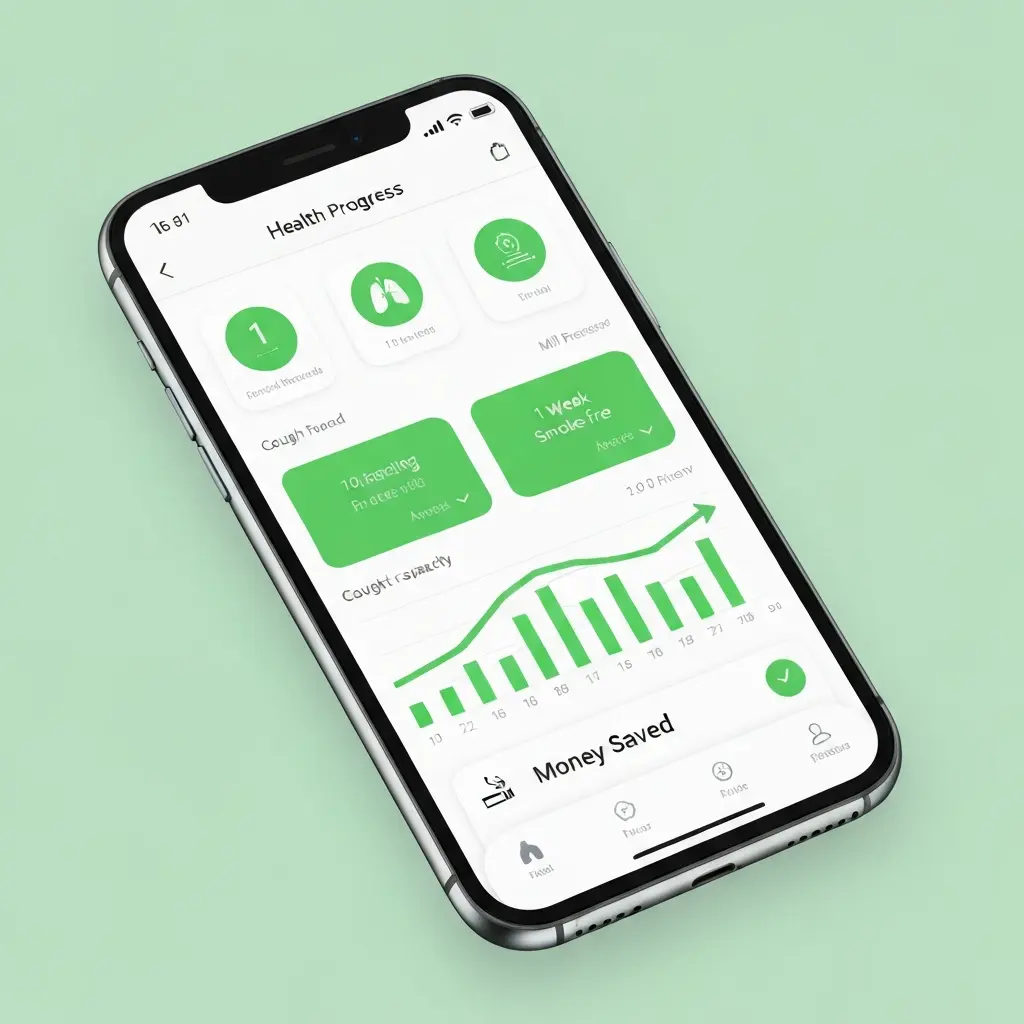
Quit Smoking App Complete Guide: Features, Science, and How iQuit Helps You Succeed in 2026
If you’ve searched for a quit smoking app recently, you already know the market is crowded. There are dozens of options, each promising to be the one that finally helps you stop. The problem isn’t a lack of apps — it’s knowing which features actually change behavior, which ones are just window dressing, and whether a digital tool can genuinely compete with willpower, medication, or therapy. This guide answers all of that, backed by research and real-world use cases, with a close look at what makes iQuit different from everything else out there in 2026.
Quitting smoking is one of the hardest things a person can do. Nicotine rewires the brain’s reward pathways, meaning cravings are not a character flaw — they’re a physiological response. The best quit smoking apps don’t just count days; they address the full picture: habit loops, emotional triggers, financial motivation, health recovery, and the social dimension of quitting. This guide is your complete reference for understanding what a quit smoking app can and cannot do, and how to choose the one that fits your quitting style.
Why Quit Smoking Apps Actually Work
Skepticism about app-based quitting is understandable. A phone app can’t prescribe Varenicline or sit with you through a 3 AM craving spiral. But the science behind behavioral change tools is solid, and digital delivery has real advantages: apps are available 24/7, cost far less than formal therapy, and can personalize support in ways that a printed pamphlet cannot.
A 2020 Cochrane review examined smartphone smoking cessation interventions and found that people using dedicated quit apps were significantly more likely to achieve abstinence at six months compared to minimal or no intervention. A 2023 study in Nicotine & Tobacco Research found that app engagement metrics — specifically craving log frequency and daily check-ins — were predictive of 90-day abstinence. The apps that worked weren’t necessarily the most feature-rich; they were the ones people actually used every day.
This matters because the mechanism is behavioral, not pharmaceutical. Apps work by:
- Creating a daily accountability ritual (opening the app reinforces quitting identity)
- Providing immediate coping tools when cravings hit
- Making progress visible (days smoke-free, money saved, health improvements)
- Replacing the cigarette-as-stress-relief habit with a healthier digital behavior
- Connecting quitters to community, reducing social isolation
The 7 Core Features Every Good Quit Smoking App Must Have
Not every app delivers on its promise. Here are the seven features that separate a genuinely useful quit smoking app from a glorified day counter:
1. Quit Date and Streak Tracking
The foundation. A precise countdown from your quit moment — hours, minutes, cigarettes not smoked — creates a tangible sense of progress. The key here is granularity: showing “6 days, 14 hours, 23 minutes” is psychologically more powerful than just “Day 6.”
2. Craving and Trigger Logging
Cravings typically peak at 3–5 minutes. An app that lets you log a craving the moment it hits — and records context like time of day, location, mood, and activity — builds a data-rich picture of your personal habit triggers. Over two to three weeks, patterns emerge that make it easier to anticipate and pre-empt the hardest moments.
3. AI-Powered Coach
A rule-based chatbot that sends generic encouraging messages is not the same as an AI coach that adapts to your history. True AI coaching analyzes your craving patterns, quit history, and engagement to deliver personalized coping strategies in real time. This is the single feature that has advanced most dramatically in the past two years.
4. Health Recovery Timeline
Within 20 minutes of quitting, heart rate and blood pressure drop. Within 12 hours, carbon monoxide levels normalize. Within one year, heart attack risk drops by half. Showing quitters exactly what is happening inside their bodies — with evidence-based milestones unlocking as they hit them — transforms an abstract goal into a series of concrete wins.
5. Money Saved Calculator
For most smokers, cigarettes cost between $2,500 and $5,000 per year depending on country and brand. Watching that number grow in real time — $4.50 saved today, $31.50 this week, $1,642 this year — is viscerally motivating. The best apps let you earmark that money toward a real goal: a holiday, a piece of equipment, a fund for your kids.
6. Emergency Craving Tools
Breathing exercises, distraction games, motivational content, and instant AI responses for the moments when a craving is overwhelming. These need to be reachable in one or two taps — not buried behind menus.
7. Milestone Rewards and Gamification
Badges, achievement unlocks, and visual progress indicators activate the same dopamine pathways that nicotine hijacked. Done thoughtfully (not gimmicky), gamification keeps engagement high through the hardest phase: weeks two through four, when the initial rush of quitting fades and the slog begins.
AI Coaching: The Feature That Changes Everything
The most significant development in quit smoking technology in the past few years is the leap from scripted notifications to genuinely adaptive AI coaching. iQuit’s AI coach is built around conversational support that adapts based on your quit history, your craving patterns, and the time of day you’re most vulnerable.
What does that mean in practice? If your logs show you consistently crave cigarettes after lunch on weekdays, your AI coach can proactively check in at 12:45 PM with a coping strategy tailored to that specific trigger — not a generic “stay strong!” message. If you’ve been logging stress-related cravings, the coach shifts toward relaxation techniques. If you’ve had a relapse, it responds with compassion and a structured reset plan rather than silence or shame.
This kind of dynamic, context-aware support has historically required a human counselor or therapist. AI makes it scalable and available at 3 AM when your human support network is asleep.
For a deeper dive, see our article on AI quit smoking coaches and how they work.
How a Craving Tracker Breaks the Habit Loop
Charles Duhigg’s habit loop model — cue, routine, reward — explains why smoking is so persistent. The cigarette isn’t really about nicotine after the first few weeks; it’s about the cue-response pattern that surrounds it. Morning coffee, work stress, social drinking: these are cues that have been trained to trigger the smoking routine.
A craving tracker disrupts this loop by making the unconscious conscious. When you log a craving — including where you are, what you’re doing, and how you feel — you insert awareness between the cue and the response. That gap is where change happens. Over time, the data shows you exactly which cues are most dangerous for you, allowing proactive planning for high-risk moments.
iQuit’s craving tracker goes further by analyzing logged data and surfacing insights: “You log more cravings on Thursday evenings — this often correlates with end-of-week stress. Here’s what’s helped other users in this pattern.” That kind of pattern recognition is impossible with pen and paper but natural for a well-designed app.
Learn more about how daily tracking improves outcomes in our guide to quit smoking tracker apps and daily tracking.
Health Milestones: Why Seeing Progress Matters
One of the most demoralizing aspects of quitting smoking is that the benefits feel invisible for a long time. You don’t feel your lung cilia regenerating. You can’t see your arterial walls recovering. The body is quietly healing, but without a way to witness it, quitters lose motivation.
Health milestone tracking solves this by translating the biochemistry of recovery into human-readable events:
| Time Since Quitting | What’s Happening |
|---|---|
| 20 minutes | Heart rate and blood pressure begin to drop |
| 12 hours | Carbon monoxide in blood drops to normal |
| 2 weeks | Circulation improves, lung function increases |
| 1 month | Cilia in lungs begin to recover |
| 1 year | Risk of heart attack halved |
| 5 years | Risk of stroke equal to non-smoker |
| 10 years | Lung cancer risk halved |
iQuit unlocks these milestones in real time as users pass them, turning each one into a moment of celebration. Hitting “Day 1 — Carbon monoxide normalized” at 12 hours feels fundamentally different from just watching a counter tick over.
Money Saved: The Underrated Motivator
Financial motivation is more powerful than most quitting resources acknowledge. A pack-a-day smoker in the US spends roughly $3,000–$4,000 per year on cigarettes. In the UK and Australia, that number climbs above £4,000 and AU$7,000 respectively. Watching those savings accumulate in real time — tied to a specific purchase goal — creates a concrete, daily reason to stay smoke-free that health benefits alone don’t always provide.
iQuit’s savings calculator lets you set a goal — a weekend trip, a new laptop, a contribution to savings — and tracks how quickly your cigarette money is funding it. This goal-linking feature is psychologically distinct from just displaying a number. It makes the financial reward tangible and specific, which behavioral economists consistently find more motivating than abstract savings figures.
For full calculations by country and smoking frequency, see our quit smoking money saved calculator and our breakdown of cost of smoking per year by country and brand.
Community and Accountability Features
Social support is one of the most well-evidenced predictors of successful quitting. People who quit with support — from partners, friends, support groups, or online communities — consistently outperform solo quitters. The challenge for most people is that their social circle often includes smokers, and quit attempts can create friction in those relationships.
Community features in quit smoking apps create a parallel support system: other people on the same journey, available at any hour, without the social complexity of real-world relationships. iQuit’s community forums and shared milestone celebrations give quitters a sense of belonging and shared purpose that is genuinely hard to replicate elsewhere.
How iQuit Brings All of This Together
iQuit was built from the ground up around one premise: quitting smoking is a behavior change challenge, not just a willpower challenge. Every feature in the app maps to a specific evidence-based behavioral mechanism.
The AI coach handles personalized, context-aware support. The craving tracker identifies and weakens habit loops. Health milestones make invisible recovery visible. The savings calculator converts every cigarette not smoked into financial progress. The community provides social accountability. And the overall design prioritizes daily engagement — because consistency, not intensity, is what predicts long-term success.
iQuit is available on Android via the Google Play Store. The core quit tracking, craving tools, and health timeline features are free to use.
How to Choose the Right Quit Smoking App for You
With so many options available, narrowing down is easier if you start from your own quitting style:
- If you’re data-driven: Prioritize apps with detailed craving logs, pattern analysis, and health stats dashboards. iQuit and Smoke Free excel here.
- If you’re motivated by money: Look for a savings calculator that lets you set purchase goals, not just display a number.
- If you’ve tried and relapsed before: AI coaching that adapts after a relapse — without judgment — is critical. Generic apps often go silent after a relapse, which is exactly the wrong response.
- If you want community: Look for active forums or accountability features, not just a passive leaderboard.
- If you want free: iQuit offers full core functionality without a paywall. See our guide to the best free stop smoking apps in 2026.
Frequently Asked Questions
Do quit smoking apps actually work?
Yes — research consistently shows that dedicated quit smoking apps improve cessation rates compared to no support. A Cochrane review found that app users were significantly more likely to remain abstinent at six months. Apps work best when used daily and combined with other support where available.
What features should I look for in a quit smoking app?
The seven most important features are: streak tracking, craving logging with pattern analysis, AI coaching, health milestone tracking, a money saved calculator, emergency craving tools, and community features. Apps with all seven have the strongest behavioral science backing.
Is iQuit free to use?
Yes. iQuit’s core features — including quit tracking, health milestones, craving tools, and the savings calculator — are free. The app is available on Android via Google Play.
How is AI coaching different from regular app notifications?
Regular notifications are generic and scheduled regardless of your situation. AI coaching adapts to your craving history, time of day, emotional state, and quit progress. It provides context-aware support — for example, checking in proactively at times when your data shows you’re most vulnerable.
What happens if I relapse while using a quit app?
Good quit apps treat relapse as part of the journey, not a failure. iQuit’s AI coach responds to logged relapses with compassion and a structured reset plan. Your history and progress data are preserved, and the app helps you identify what triggered the relapse to prevent it next time.
How long does it take for a quit smoking app to make a difference?
Most users report that craving tracking starts yielding useful pattern insights within 2–3 weeks of consistent logging. The first major behavioral shift — weakened cue-response cycles — typically occurs in weeks three and four. Health milestones and financial progress are visible from day one.
Should I use a quit smoking app alongside NRT or medication?
Yes — apps and NRT (nicotine replacement therapy) or cessation medication are complementary, not competing. Medication addresses the physiological side of addiction while the app handles the behavioral and psychological dimensions. Combined approaches have the highest success rates.
Ready to Quit with iQuit?
iQuit is a free quit smoking app with an AI coach, craving tracker, health milestones, and a savings calculator — everything covered in this guide, in one place. It’s available now on Android.