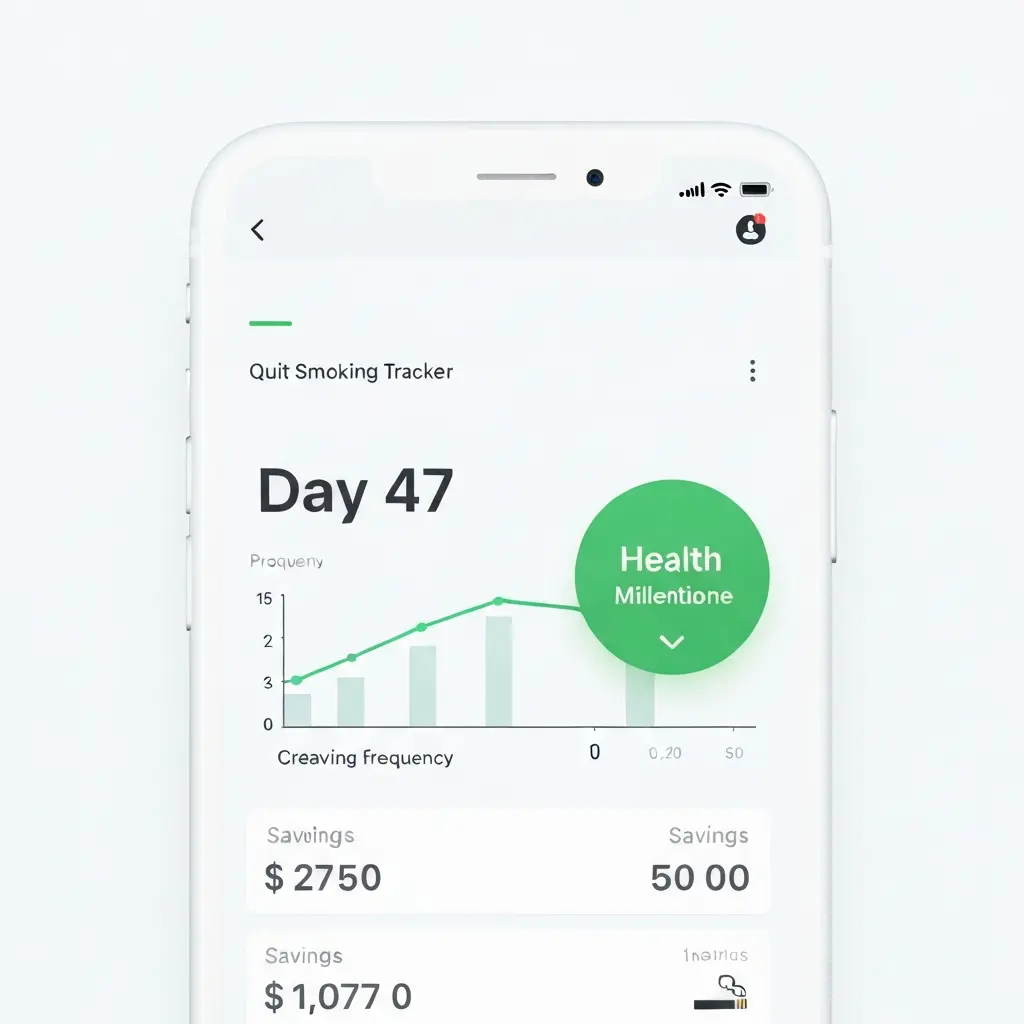
Quit Smoking Tracker App: How Daily Tracking Increases Your Chances of Success
The research is consistent: people who track their quit journey daily are significantly more likely to remain abstinent at six and twelve months than those who don’t. This isn’t a coincidence of personality type — it’s a direct causal relationship. Daily interaction with a quit smoking tracker app creates a behavioral feedback loop that weakens habit patterns, strengthens quitting identity, and provides real-time data that makes the invisible visible.
But not all tracking is equal. A basic day counter gives you a streak to protect — motivating, but limited. A genuinely useful quit smoking tracker app captures craving context, identifies trigger patterns, tracks health recovery milestones, and monitors the financial progress that makes quitting tangible. This guide explains how daily tracking works, why it predicts success, and what to look for in a tracker app in 2026.
Why Daily Tracking Predicts Quit Success
A 2023 study in Nicotine & Tobacco Research found that daily check-in frequency and craving log entries were among the strongest app-based predictors of 90-day abstinence — more predictive than app download alone, and more predictive than time-in-app. It’s not how long you use the app; it’s whether you use it every day.
The mechanism is behavioral. Daily tracking does several things simultaneously:
- Creates a non-smoking ritual: Opening the app each morning to check your streak, savings, and health progress is a positive behavior that replaces the morning cigarette ritual
- Reinforces quitting identity: Each check-in says, consciously or not, “I am a person who is quitting smoking” — and identity-based behavior change is more durable than willpower-based change
- Generates data: Every logged craving contributes to a pattern dataset that eventually yields actionable insights
- Provides a daily win: Every day smoke-free is a milestone that compounds into the larger goal
What a Good Tracker Records (Beyond Just Days)
A basic quit tracker records one thing: how many days since your last cigarette. This is useful — streaks are psychologically powerful — but it’s only the beginning of what a comprehensive tracker should capture.
A fully featured quit smoking tracker app records:
| Data Type | What It Captures | Why It Matters |
|---|---|---|
| Quit streak | Days, hours, minutes since quitting | Creates a loss-aversion motivator (don’t break the streak) |
| Craving logs | Time, location, activity, mood | Identifies personal trigger patterns |
| Craving intensity | Self-reported severity (1–10) | Shows whether cravings are weakening over time |
| Health milestones | Physiological recovery events | Makes invisible recovery visible and celebratory |
| Money saved | Real-time financial accumulation | Provides concrete daily financial motivation |
| Cigarettes not smoked | Total cigarettes avoided since quit | Accumulates into a striking total (thousands of avoided cigarettes) |
| Mood and energy | Daily self-reported wellbeing | Identifies patterns linking mood to craving risk |
How Craving Pattern Data Changes Behavior
The most powerful thing a tracker does over time is surface patterns that were previously invisible. Most smokers have no idea how predictable their craving cycles are until they see the data.
Common patterns that emerge after 2–4 weeks of consistent craving logging:
- Time-of-day clustering (peak craving windows you can pre-empt)
- Location associations (specific places trigger above-average craving frequency)
- Activity correlations (post-meal, post-meeting, driving — highly individual)
- Emotional triggers (boredom, stress, social anxiety — specific and addressable)
- Declining intensity over time (one of the most motivating things a tracker can show is that cravings are getting weaker)
When the app surfaces insight like “Your Tuesday afternoon cravings are 3x your baseline — often after back-to-back meetings,” it transforms a vague struggle into a specific, plannable challenge. You can prepare a coping strategy for 3 PM Tuesdays specifically, rather than staying generally vigilant all week.
This is the mechanism behind iQuit’s craving tracker, which analyzes logged data to provide pattern insights your AI coach then uses to deliver proactive support. For more on how the AI coach uses this data, see our article on the AI quit smoking coach.
The Psychology of Streaks: Why They Work
The “Don’t Break the Chain” technique — popularized by productivity writers but rooted in behavioral psychology — works because of loss aversion. Humans are more motivated to avoid losing something they already have than to gain something new. A 21-day quit streak is something you own. Breaking it requires actively choosing to throw away 21 days of accumulated progress.
The key design choice is displaying the streak with precision. “21 days, 4 hours, 37 minutes” is substantially more powerful than “Day 21” because it makes the investment granular and specific. Each minute that passes is a minute of progress that would be lost to a relapse.
Good tracker apps compound the streak psychology with milestone rewards: unlocking a new health milestone at Day 21 makes the streak feel doubly valuable. You’re not just maintaining a number — you’re protecting a set of earned achievements.
iQuit’s Tracker: What It Measures and Why
iQuit’s tracking system is designed around the data types that matter most for sustained abstinence. Here’s what it tracks and why each element was included:
- Quit streak with minute-level precision — maximizes the loss-aversion effect
- Cigarettes not smoked — accumulates into a striking number (a pack-a-day smoker hits 1,000 avoided cigarettes at 50 days)
- Craving logs with contextual tags — time, location, activity, mood — builds the pattern dataset that feeds AI coaching
- Craving intensity scoring — shows the downward trend in craving severity that typically becomes visible after week two
- Health milestones with biology explanations — each unlock comes with a brief explanation of what’s actually happening in your body
- Real-time savings display — linked to a personal goal for maximum motivational impact
Every data point in iQuit serves either the pattern analysis that powers AI coaching or the progress visibility that sustains motivation. There’s no filler tracking.
For the full overview of iQuit’s feature set and the science behind each one, see our complete guide to quit smoking apps.
How to Build a Daily Tracking Habit
The biggest obstacle to effective tracking is inconsistency. Here are five strategies that help:
- Anchor the app to an existing habit. Open iQuit every morning when you drink your first coffee, brush your teeth, or commute. Pairing the new behavior with an existing ritual removes the need for willpower.
- Log cravings immediately, not retrospectively. The context data is most accurate when captured in the moment. Keep the app accessible — home screen or notification panel.
- Set a daily reminder for one consistent check-in time. The morning check-in is the most powerful — seeing your streak and savings before the day starts reinforces your quit identity throughout the day.
- Treat logging as a coping tool, not a chore. When a craving hits, logging it is both the data-capture step and the beginning of the coping response. The act of logging creates a pause between the craving cue and the behavioral response.
- Celebrate milestones when they unlock. Don’t scroll past a health milestone notification. Pause, read it, share it if you feel like it. The milestone unlocks work as reinforcement — they need a moment of attention to have their full effect.
Frequently Asked Questions
Does using a quit smoking tracker app actually improve success rates?
Yes — research links daily tracking frequency directly to improved abstinence rates. Consistent craving logging and daily check-ins are among the strongest app-based predictors of 90-day and 6-month abstinence in published studies.
What should I track in a quit smoking app?
The most valuable data to track: quit streak (days/hours/minutes), craving logs with context (time, location, mood, activity), craving intensity, health milestones, and money saved. Craving context logs are particularly valuable because they generate the pattern data needed for personalized AI coaching.
How often should I use a quit smoking tracker?
Daily is the minimum for effective pattern analysis. Log every craving when it occurs, check your streak and progress at least once daily (morning is most effective), and review any AI insights or milestone unlocks when they appear.
What does iQuit’s quit smoking tracker include?
iQuit tracks: quit streak with minute precision, cigarettes not smoked, contextual craving logs (time/location/mood/activity), craving intensity scores, real-time health milestones with biology explanations, and goal-linked savings tracking. All features are free on Android.
What happens to my tracking data if I relapse?
In iQuit, a relapse doesn’t erase your history. Your craving pattern data, health milestones, and progress are preserved. The app helps you reset your quit date while using your previous data — which is now more valuable than ever, because it shows the patterns that led to the relapse — to set up a stronger next attempt.
Start Tracking with iQuit — Free on Android
iQuit’s tracker captures everything that matters: your streak, your cravings, your patterns, your health, your savings. Daily tracking is the behavior that predicts success — and iQuit makes it frictionless.