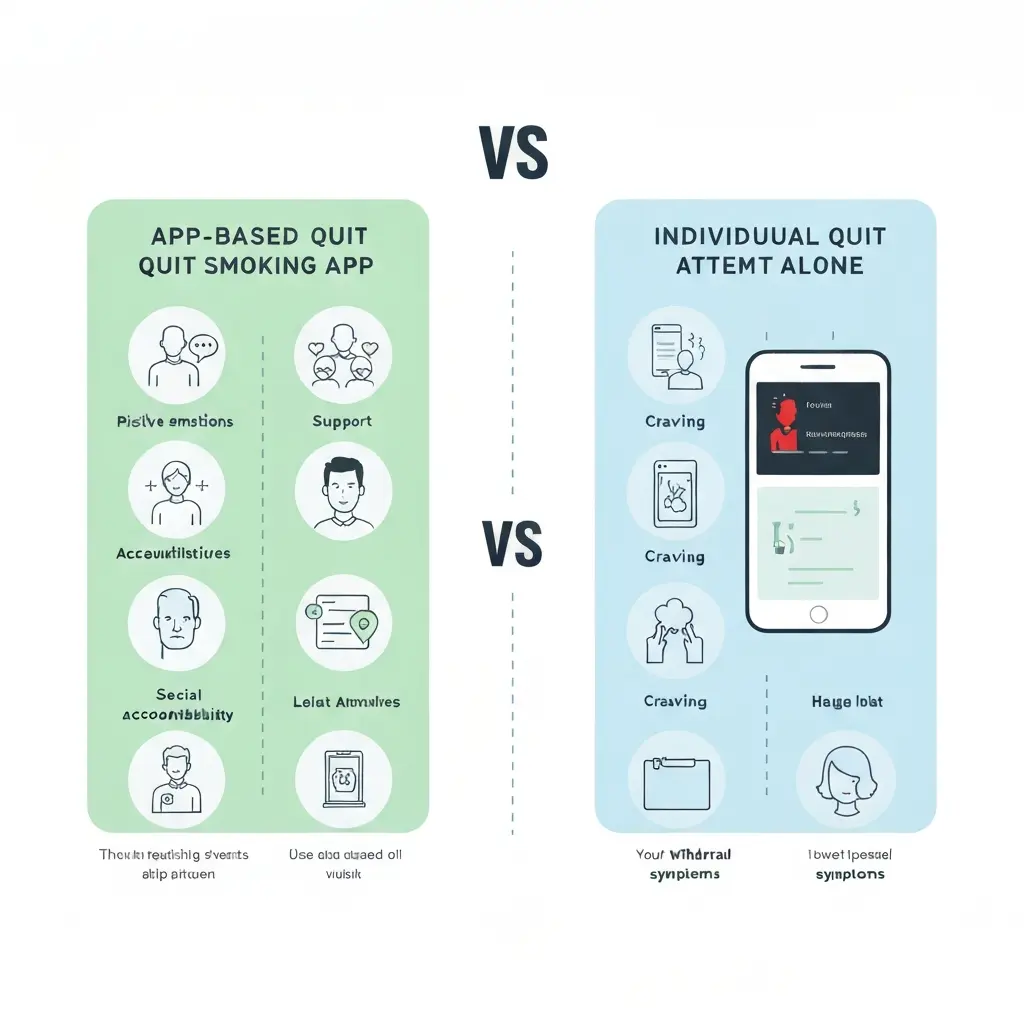
Quit Smoking App vs Going It Alone: Which Approach Wins in 2026?
Many smokers approach quitting the same way they’ve approached it before: with determination, a quit date, and the belief that this time the willpower will hold. This “going it alone” approach — no app, no NRT, no professional support — is the most common quit method and also the one with the lowest success rates. But is a quit smoking app genuinely different? Or is it just another version of the same approach with a screen added?
The answer, backed by a growing body of research, is that quit smoking apps vs going it alone is not a close contest — but only if you use an app with the right features and use it consistently. This guide explains exactly what the evidence shows and why it matters.
The Numbers: Quit Rates With and Without Apps
| Approach | 12-Month Abstinence Rate | Source |
|---|---|---|
| Unaided (willpower only) | ~3-5% | CDC / Cochrane |
| App only (no NRT, no medication) | ~6-8% (best apps) | JMIR 2023 meta-analysis |
| NRT alone | ~10-15% | Cochrane NRT review |
| App + NRT | ~15-22% | JMIR / NHS Digital |
| App + NRT + counselling | ~25-40% | NHS Stop Smoking Services data |
These numbers show two things clearly: apps are better than nothing, and apps work best in combination with other support. The jump from 3-5% (unaided) to 6-8% (app only) represents a real and meaningful improvement — particularly when you consider that millions of people make unaided attempts every year.
Why Going It Alone Fails Most of the Time
Unaided quit attempts fail almost entirely in the first two weeks. The reasons are structural, not motivational:
- No craving management support: When a craving peaks, the unaided quitter has no immediate tool to manage it. The craving wins.
- No accountability mechanism: Nothing makes the relapse “visible” or creates a record to break. Each cigarette is private and consequence-free in the moment.
- No support between 11pm and 7am: Human support — friends, family, quitlines — has limited hours. Cravings do not.
- No positive feedback loop: Without tracking, the daily progress is invisible. “It’s been 12 days” doesn’t feel concrete the way seeing 12 days on a screen with 12 milestones listed does.
- Misunderstanding of craving duration: Most unaided quitters believe their cravings will escalate until they smoke. The craving timer — showing 3-5 minutes — is only available in an app.
What an App Actually Adds
The mechanisms by which a well-designed quit smoking app improves outcomes are specific and evidence-backed:
- Just-in-time craving intervention: Active craving management tools (breathing, timer, distraction) deployed at the moment of peak craving. Research on JITAI (just-in-time adaptive interventions) confirms this is one of the most effective behavioural change mechanisms available.
- Progress visibility: Streak counters, milestones, and savings trackers make invisible progress concrete and loss-framed (protecting the streak). This is more motivationally compelling than knowing you’ve been smoke-free for some days in the abstract.
- 24/7 availability: AI coaching available at any hour — eliminating the support gap that causes many night-time relapses.
- Extinction facilitation: Craving logging creates a record of cravings survived, providing experiential evidence that “I can outlast a craving” that builds over time.
- Motivation maintenance: Daily engagement with the app maintains the salience of the quit decision. Without this, the original motivation naturally fades as immediate life demands compete.
For the full evidence base on app effectiveness, the quit smoking app effectiveness research guide covers all major studies.
Passive Apps vs Active Apps: A Critical Distinction
Not all apps are equal. Research consistently shows that “passive” apps — those that only track days and savings without providing interactive craving support — produce significantly worse outcomes than “active” apps with coaching, craving management tools, and adaptive features.
If you’ve tried a quit smoking app before and didn’t find it helpful, consider whether the app was passive (just a counter) rather than active (craving tools, AI coaching, breathing exercises). The difference in outcomes is large. The guide to features that actually matter covers exactly this distinction.
The Best Combination: App + What Else?
The data is clear: apps work best as part of a multi-layer strategy. The optimal combination:
- App (daily): Tracking, craving management, milestone motivation, AI coaching
- NRT or medication: Manages the physical withdrawal component that apps cannot address
- Social support: Telling key family or friends, joining online community
- Quitline (optional): Free human coaching for structured support sessions
Each layer addresses a different component of the cessation challenge. Apps address the behavioural and motivational components. NRT addresses the physiological. Social support addresses accountability and crisis management. For the step-by-step approach to setting up all these layers, the complete quit smoking plan guide walks you through each one.
Frequently Asked Questions
Can I quit smoking with just an app and no NRT?
Yes — approximately 6-8% of people using a good quit smoking app without NRT achieve 12-month abstinence. This is significantly better than unaided willpower (3-5%). For lighter smokers or those with lower physical dependence, an app alone may be sufficient. For heavier smokers, adding NRT dramatically improves the odds. Either way, an app is better than nothing.
Does it matter which app I use?
Yes — significantly. Research shows that apps with active craving management tools, AI coaching, and milestone tracking produce better outcomes than basic tracking apps. The specific features that drive outcomes are: real-time craving support (not just logging), daily engagement mechanisms (streaks, notifications), and personalised coaching. A passive app that only counts days is only marginally better than no app at all.
I’ve tried apps before and still relapsed. Is it worth trying again?
Absolutely. Each quit attempt, including those with app support, builds towards eventual success — the average is 8-14 attempts before long-term abstinence. If you relapsed before, consider: Was the previous app passive or active? Were you using NRT alongside it? Did you engage with craving tools actively, or just track? Changing any one of these factors can meaningfully change the outcome of the next attempt.
Don’t Go It Alone — Download iQuit
The iQuit app is designed to be the active, AI-powered support system that passive trackers aren’t. Craving tools, milestone notifications, money tracking, and 24/7 AI coaching — all free. Don’t make your next quit attempt alone.