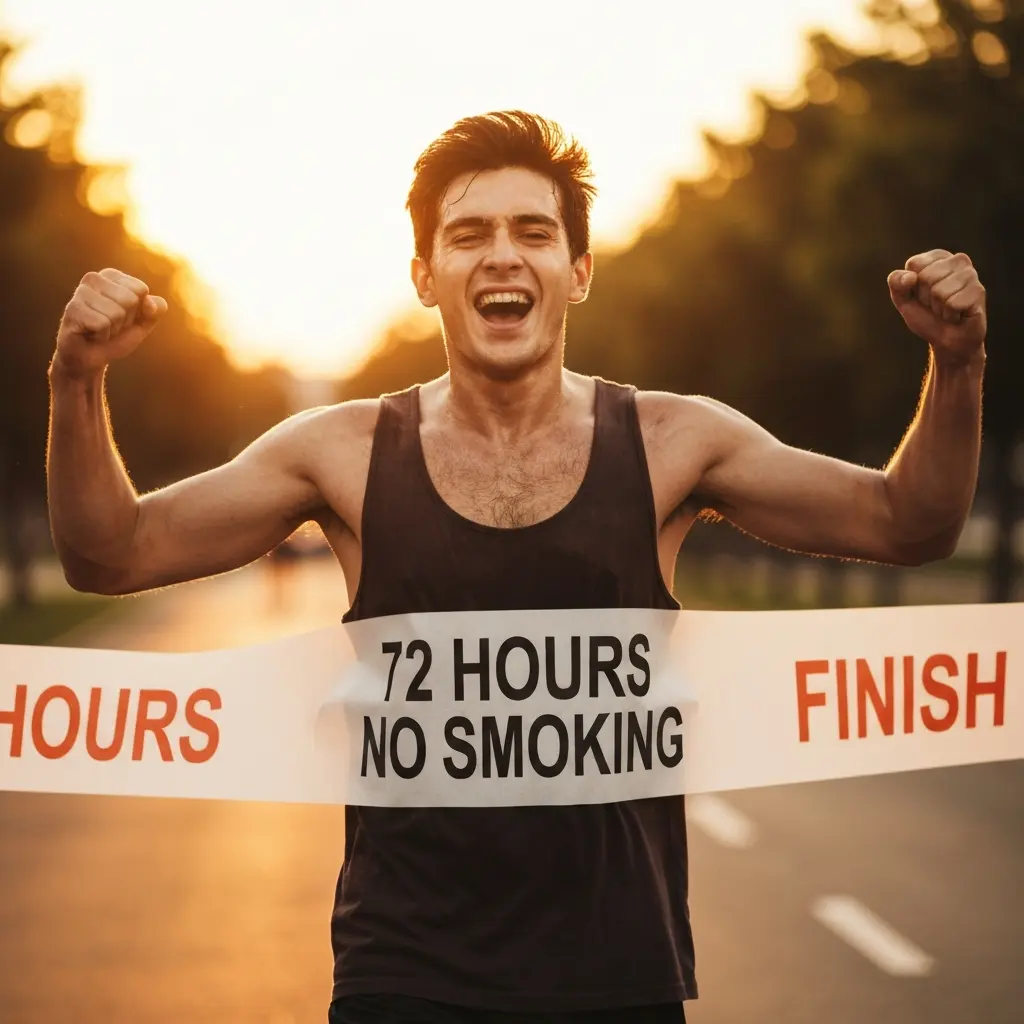
Quit Smoking Cold Turkey: The 72-Hour Survival Guide for 2026
Quit smoking cold turkey and you are choosing the most direct path through nicotine withdrawal — no gradual wind-down, no slow reduction, just a definitive stop. It is also the most commonly attempted quit method globally, with approximately two-thirds of all quit attempts using the cold turkey approach. And a landmark 2016 clinical trial — the most rigorous head-to-head comparison of cold turkey versus gradual reduction — found that cold turkey achieved a higher 6-month abstinence rate (22%) than gradual reduction (15.5%), even when neither group used pharmacological support.
If you are going cold turkey, this guide gives you everything you need to survive the hardest 72 hours — the period when nicotine levels hit zero, withdrawal symptoms peak, and the risk of giving up is at its highest. Every strategy here is evidence-based, practical, and designed to get you through to Day 4 — the turning point after which the worst is behind you.
What “Cold Turkey” Actually Means
Cold turkey refers to stopping smoking abruptly — setting a quit date and stopping completely on that date, without any period of gradual reduction or simultaneous nicotine replacement. The term itself comes from the idea that the skin of someone in acute withdrawal resembles the goose-bumped skin of a cold turkey carcass — a graphic but memorable image.
Strictly speaking, cold turkey can be attempted with or without pharmacological support. Using NRT or varenicline from quit day while stopping smoking abruptly is technically “medically assisted abrupt cessation” — and it is the approach with the highest success rates. Pure cold turkey — abrupt cessation with no pharmacological support whatsoever — is what most people mean by the term, and it is this approach that the 2016 Russell et al. study found outperformed gradual reduction.
The Evidence for Cold Turkey: What Research Shows
The 2016 Russell et al. trial (published in Annals of Internal Medicine, confirmed in PMC) randomly assigned smokers to either abrupt cessation (“cold turkey”) or gradual reduction over 2 weeks. Both groups received comparable behavioural support. Result: 4-week abstinence was 49% in the cold turkey group versus 39% in the gradual reduction group. At 6 months, cold turkey still led: 22% vs 15.5%.
The PMC analysis of this research concluded that abrupt cessation is preferable to gradual reduction for most smokers. The likely reason: gradual reduction requires the smoker to maintain a complicated modulated relationship with cigarettes, whereas abrupt cessation allows full commitment to non-smoker identity and clear rules (“zero cigarettes” is psychologically clearer than “four fewer than yesterday”).
However — and this is crucial — adding pharmacological support to cold turkey raises success rates to 35–40%, compared to 22% for unaided cold turkey. The best evidence-based approach is: abrupt cessation + NRT or varenicline + behavioural support. Pure cold turkey is better than gradual reduction — but supported cold turkey is better than pure cold turkey.
Hours 0–12: Your First Smoke-Free Morning
The first 12 hours are manageable for most people — the motivation of your quit decision is fresh, and nicotine blood levels are dropping but have not yet reached zero. Use this window of relative manageability to establish your strategy for what follows.
What to Do in Hours 0–12
- Change your morning immediately: If you normally smoke with your first coffee, change the coffee ritual completely on Day 1 — different room, different mug, different activity. Break the conditioned response before it fires.
- Eat breakfast: Blood sugar stability significantly reduces irritability and craving intensity. Do not skip breakfast.
- Remove all remaining cigarettes: Any cigarettes, lighters, or paraphernalia that survived your pre-quit clearout need to go now.
- Start tracking: Download a quit smoking app and log your quit time. Seeing “4 hours, 0 cigarettes, heart rate normalising” provides immediate positive feedback in a period when most effects are invisible.
- Tell someone your quit date: Text or call your accountability person and tell them Day 1 has started.
What You Will Feel in Hours 0–12
Mild to moderate cravings, arriving roughly every 30–60 minutes. Slight restlessness. Possible mild headache from initial blood vessel dilation. Manageable. This is the gentlest phase of what comes next.
Hours 12–24: The First Full Day Hardens
By mid-afternoon on Day 1, the withdrawal experience intensifies for most quitters. Nicotine blood levels are around a quarter of smoking-day levels and falling fast. The brain’s reward circuitry is beginning to register the deficit. This is where planning pays off.
Managing Hours 12–24
- The 5-minute rule: When a craving hits, set a timer for 5 minutes. Each craving, on average, lasts only 3–5 minutes. You only have to not smoke for 5 minutes at a time.
- Stay out of high-risk locations: If the pub after work is a smoking trigger, skip it for Day 1 without exception.
- Exercise after work: A 20-minute walk, run, or gym session in the early evening significantly reduces afternoon craving intensity and improves sleep quality that night.
- Avoid alcohol: Alcohol reduces inhibition and is one of the most powerful relapse triggers. Day 1 evening is not the time for it.
- Plan the evening: Unstructured evening time after dinner is high-risk. Have a specific activity planned: a film, a social call, a walk, a task. Idle evenings are dangerous in Day 1.
Day 2: Holding the Line
Day 2 is when the decision to go cold turkey is most severely tested for many people. Blood nicotine is now near zero. The brain’s withdrawal response is in full force. Irritability, difficulty concentrating, and craving frequency are all higher than Day 1.
The critical message for Day 2: this is the expected experience, not a sign of failure. Day 2 is supposed to feel like this. It is the bottom of the valley — not a wall you cannot get past, but a valley you are passing through. Every former smoker who quit cold turkey passed through this same valley.
Day 2 Specific Strategies
- Warn people close to you that you may be irritable today — and that it is temporary and not personal
- Have multiple fast-acting craving management tools ready: breathing exercises, cold water, a short walk, a distraction task
- Check your progress in your quit app — “36 hours, carbon monoxide cleared, circulation improving” — the data is motivating
- If you are struggling severely, this is the moment to reconsider whether adding NRT would help — there is no shame in using every available tool
Day 3: Peak Withdrawal — and the Beginning of the Turn
Day 3 is universally described as the hardest day by former cold turkey quitters. Nicotine is completely cleared. The brain is at its maximum signal-distress level. Every symptom — cravings, irritability, insomnia, difficulty concentrating — is at its peak intensity.
But Day 3 is also the turning point. The brain’s recovery begins here. The acute neurochemical crisis has peaked. From tonight, the worst is technically over. Getting through Day 3 is the single most important thing you can do in your quit attempt. Everything after it is progressively easier.
Day 3 Survival Plan
- Plan every single hour. Unplanned time on Day 3 is dangerous. Build a full-day schedule and stick to it.
- Use intensive physical exercise if possible. A long run, a hard gym session, a swim — intensive physical activity on Day 3 is one of the most effective withdrawal management strategies available without medication.
- Sleep as much as you can. Withdrawal is exhausting. If you can nap or sleep early, do so — the body heals during sleep.
- Reach out for support. Call your NHS Stop Smoking Service, a quitline, a supportive friend, or use your quit app’s community feature. This is the moment that support networks exist for.
- Reward yourself tonight. If you get to the end of Day 3 without smoking, do something genuinely rewarding: a favourite meal, a film you have wanted to see, something that acknowledges that you just did something extraordinarily hard.
Day 4: The Corner Turns
If you have reached Day 4 without smoking, you have done the hardest thing. The neurochemical peak has passed. The brain’s recovery process is underway. Cravings are becoming less frequent — still present, but arriving every 2–3 hours rather than every 30 minutes. Headaches are typically gone. The fog is beginning to lift.
Day 4 and beyond is about consolidation rather than crisis management. The physical withdrawal is easing; the psychological work of managing conditioned triggers is beginning. See our guides on managing smoking triggers and how to deal with cravings for the strategies that work best in this phase.
Cold Turkey vs. NRT: Making the Right Decision for You
The evidence strongly supports using pharmacological support alongside any quit attempt. However, some people prefer cold turkey — philosophically committed to a clean break, or having had negative experiences with NRT. Both are valid starting points. The key questions:
- Have you tried cold turkey before and relapsed? Adding NRT or varenicline is strongly recommended for subsequent attempts.
- Do you smoke within 30 minutes of waking? This is a marker of high dependence and a strong predictor of benefit from pharmacological support.
- Do you smoke more than 20 per day? Pharmacological support is likely to make a significant difference.
For a full comparison of cessation methods, see our smoking cessation methods comparison and our complete guide to quitting smoking.
The iQuit app is designed to support both cold turkey and NRT-assisted quit attempts — tracking your progress, providing craving management tools, and celebrating every hour you stay smoke-free.
Frequently Asked Questions
Is cold turkey the best way to quit smoking?
Cold turkey (abrupt cessation) is more effective than gradual reduction when both are done without pharmacological support — achieving 22% vs 15.5% 6-month abstinence in the landmark 2016 Russell trial. However, cold turkey with pharmacological support (NRT or varenicline) achieves 35–40% success rates, significantly better than unaided cold turkey. So cold turkey beats gradual reduction — but adding medication to cold turkey delivers the best outcomes.
How long does cold turkey withdrawal last?
Cold turkey withdrawal peaks at days 2–3 when nicotine blood levels reach zero. Physical symptoms (cravings, irritability, headaches, insomnia) substantially resolve within 3–4 weeks. Psychological cravings triggered by conditioned habits can persist for months but decrease steadily in frequency and intensity. By month 4–6, most cold turkey quitters describe being fully comfortable as non-smokers.
What can I eat to help with cold turkey withdrawal?
Foods that help during cold turkey withdrawal include: crunchy vegetables (carrot sticks, celery — provide oral stimulation), fruits (natural sugars support mood), dairy products (milk reportedly makes cigarettes taste worse), and foods rich in vitamin C (smoking depletes vitamin C levels, which rapidly normalise after quitting). Eat regular, balanced meals to maintain blood sugar stability — blood sugar drops amplify irritability and cravings.
What is the hardest day of cold turkey?
Day 3 is typically the hardest day of cold turkey withdrawal. By this point, nicotine is completely cleared from the blood and brain, and withdrawal symptoms — cravings, irritability, insomnia, difficulty concentrating — are at peak intensity. However, Day 3 is also the turning point: from Day 4 onward, symptoms progressively ease. Completing Day 3 is the single most important milestone in a cold turkey quit attempt.
Can I use NRT if I’m quitting cold turkey?
Yes. Using NRT alongside abrupt cessation is not a contradiction — it is actually the recommended approach for most smokers. Abrupt cessation (stopping smoking completely on quit day) combined with NRT from quit day achieves significantly higher success rates than cold turkey without any pharmacological support. The goal is to stop tobacco; NRT is a tool to help you do that, not a continuation of smoking.
Track Every Hour of Your Cold Turkey Quit
iQuit shows you exactly what is happening in your body every hour — from the 20-minute heart rate drop to the 72-hour carbon monoxide clearance. Knowing you are making progress when symptoms feel worst is one of the most powerful motivators in those critical first 72 hours.