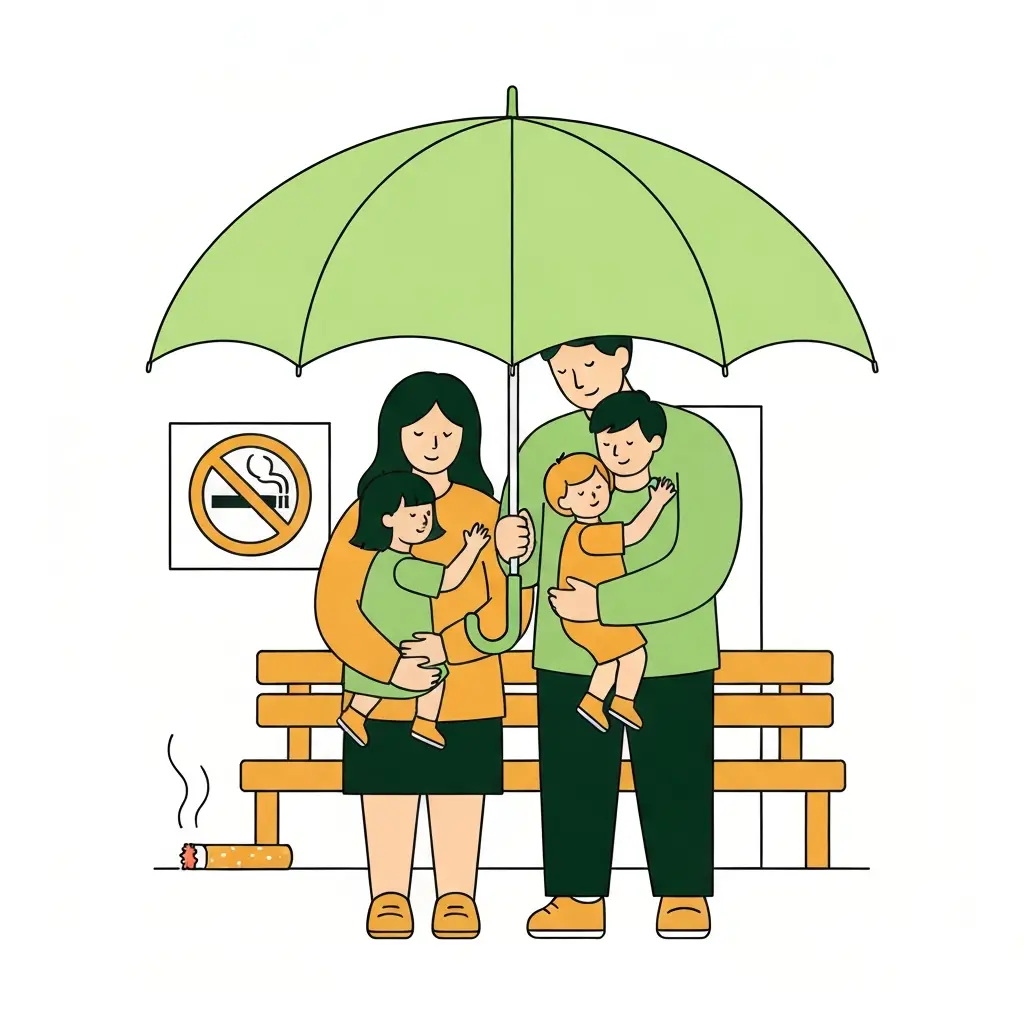
Quit Smoking for Your Family: How Secondhand Smoke Affects Those You Love and How to Take Action (2026)
Quitting smoking for your family is consistently one of the most powerful and durable motivations in cessation research — more persistent over time than quitting for personal health, finances, or even medical advice. When the reason is abstract (“it’s bad for me”), it competes with immediate craving relief. When the reason is embodied in a person you love, it creates a motivational structure that is emotionally self-reinforcing. And the data on what secondhand smoke does to the people around you makes that motivation visceral.
This guide draws on WHO, NHS, CDC, and published epidemiological data to give you an honest picture of what cigarette smoke — even when you smoke “outside” or “not in front of them” — does to those closest to you. It then provides the evidence-based tools to translate that knowledge into sustainable quit motivation and, when the cravings hit, an anchor stronger than willpower alone.
Secondhand Smoke and Children: The Evidence
Children are disproportionately harmed by secondhand smoke because of their higher respiratory rate (they breathe more air per kilogram of body weight than adults), their developing immune and respiratory systems, and the number of hours they spend in close proximity to smoking adults — typically at home. The evidence is unambiguous:
- SIDS (Sudden Infant Death Syndrome): Babies exposed to smoke have 2–5× higher risk of SIDS (WHO). This risk applies to smoke exposure during pregnancy and after birth.
- Respiratory infections: Children of smokers have 70% more lower respiratory infections than children in smoke-free homes (NHS)
- Asthma: Secondhand smoke is both a cause and trigger of asthma. Children exposed have 40% higher asthma rates and more severe attacks
- Middle ear disease: Smoking parents are strongly associated with glue ear (otitis media with effusion), the leading cause of childhood hearing loss and speech delay
- Academic performance: Children with asthma and recurrent ear infections show measurably impaired school attendance and academic performance — a connection that links smoking indirectly to educational outcomes. This parallels findings in Spanish academic research on how health factors affect university outcomes.
- Modelling: Children of smokers are 2× more likely to become smokers themselves — the single strongest predictor of adolescent smoking onset
Secondhand Smoke and Your Partner
For an adult partner living with a smoker, the evidence is equally clear:
- Lung cancer: Non-smoking spouses of smokers have a 20–30% higher lung cancer risk than those in smoke-free households (International Agency for Research on Cancer)
- Heart disease: Living with a smoker increases a non-smoker’s heart disease risk by 25–30% (Circulation, 2023)
- Stroke: Regular secondhand smoke exposure increases stroke risk by approximately 25%
- Fertility: Secondhand smoke exposure reduces female fertility and increases miscarriage risk — relevant for couples planning children
- Mental health: Partners of smokers report higher rates of anxiety related to their partner’s health risks and lower relationship satisfaction in survey data (BMJ, 2021)
Thirdhand Smoke: Why “Smoking Outside” Isn’t Enough
Many parents believe that smoking outdoors adequately protects their children. The evidence on thirdhand smoke — the residual toxic chemicals that remain on surfaces, fabrics, hair, and skin after smoking — challenges this assumption. Nicotine and carcinogens deposited on surfaces react with indoor air pollutants (particularly nitrous acid) to form tobacco-specific nitrosamines (TSNAs), some of the most potent known carcinogens.
These chemicals persist for months on carpets, furniture, walls, and car interiors. A child crawling, playing on, or touching these surfaces, and then putting their hands in their mouths, receives a measurable dose of carcinogens that outdoor smoking does not prevent. For a detailed breakdown of thirdhand smoke risks, see our complete thirdhand smoke guide.
Why Family Motivation Outperforms Other Motivations
A landmark 2020 study published in Addiction followed 3,200 smokers through a quit attempt and tracked motivation types against 12-month outcomes. Family-related motivations — “quitting to protect my children,” “quitting because my partner asked me to,” “quitting to be alive for my family” — were associated with significantly better 12-month abstinence rates than health-only or financial motivations. The researchers concluded that socially embedded motivation — motivation anchored in specific, named relationships — creates a form of commitment mechanism that activates in craving moments in a way that abstract health reasoning does not.
Neuroscience offers a complementary explanation: the brain regions activated by thoughts of loved ones at risk (the insula, anterior cingulate cortex) are also implicated in pain aversion and self-protection. Framing a craving moment as a choice between a cigarette and your child’s lung health activates a more powerful motivational circuit than thinking about abstract future cancer risk.
This principle — that concrete, relationship-based goals outperform abstract ones — appears across behaviour change contexts. Research on academic goal-setting (see this guide to building motivation for thesis writing) shows the same pattern: students who name specific people they’re writing for show better persistence than those motivated by abstract grade goals.
How to Quit Using Family as Your Anchor
The most effective way to use family motivation is to make it specific and sensory — not abstract. Follow these steps:
- Write a letter to a specific family member (your child, your partner) explaining why you’re quitting for them. Be specific about what you want to be alive for — their graduation, their wedding, watching them have children. Keep this letter somewhere you can reach it in a craving moment.
- Create a visual anchor: Put a photo of that person as your phone wallpaper. When a craving hits and you reach for your phone, you see them instead of a blank screen.
- Tell your family you’ve quit: Social commitment — making your quit public within your household — is one of the strongest evidence-based predictors of quit success. Children who know you’re quitting for them often become effective accountability partners.
- Use your cessation app’s motivation section: The iQuit app allows you to set a personalised quit reason with a photo attachment. When you open the app during a craving, your anchor is the first thing you see.
- Calculate the family impact, not just the health impact: You are not just protecting your own health. You are removing your children’s exposure to a class-A carcinogen from their daily environment. You are reducing your partner’s cardiac risk. These are concrete, real actions taking place with every hour you stay smoke-free.
For the broader picture of quitting as a positive life transformation — not just a health intervention — see our collection of real quit smoking success stories and our 30-day psychological playbook for staying motivated.
Frequently Asked Questions
Is quitting for family a good reason to quit smoking?
Yes — it’s among the most durable quit motivations. Research published in Addiction (2020) found that family-related quit motivations were associated with significantly better 12-month abstinence rates than health or financial motivations alone. Relationship-embedded motivation activates stronger neurological commitment circuits than abstract reasoning and tends to sustain through the hardest craving moments.
Does smoking outside protect your children from secondhand smoke?
Not fully. Outdoor smoking substantially reduces but does not eliminate exposure. Thirdhand smoke — the residual toxins that deposit on your clothing, hair, and skin when you smoke — is carried indoors and can expose children to carcinogens through surface contact. A car or home that has been smoked in retains measurable chemical contamination for months even after smoking stops. The only fully protective measure is quitting entirely.
How does secondhand smoke affect children’s health?
Secondhand smoke exposure in children is associated with 70% more lower respiratory infections, 40% higher asthma rates, 2–5× higher SIDS risk (in infants), increased middle ear infections, and a 2× higher likelihood of becoming smokers themselves. The WHO states there is no safe level of secondhand smoke exposure for children. These risks apply regardless of whether smoking occurs in the same room.
What is the best way to use family motivation when quitting smoking?
Make the motivation specific and sensory rather than abstract. Write a letter to a specific family member naming what you want to be alive and healthy for. Use their photo as your phone wallpaper. Tell your children (if old enough) that you’re quitting for them — this creates accountability and shared investment. Set your personalised quit reason in your cessation app so it’s the first thing you see when a craving triggers you to open it.
Quit for the People Who Matter Most
Set your personalised family motivation in the iQuit app — choose a photo, write your reason, and let the AI coaching system use it to strengthen your resolve exactly when cravings are hardest.
Download iQuit free. Quit for them. Stay quit for yourself.