Quit Smoking Motivation: The Science of Staying Driven When It Gets Hard
Every smoker who has tried to quit knows this moment: you’re a week in, feeling shaky, and the motivation that felt so clear on quit day has begun to blur. The reasons you quit — health, family, money, self-respect — are still there. But so is the craving, and right now the craving is louder. Quit smoking motivation isn’t just the spark that gets you started. It’s the specific, cultivated, maintained psychological resource that determines whether you stay quit through week two, month three, and year one.
The good news: motivation is not a fixed personality trait. It is a dynamic psychological state that can be strengthened, rebuilt after a bad day, and systematically protected against the specific forces that erode it during smoking cessation. This guide draws on the latest research in motivational psychology, neuroscience, and behavioral science to give you a concrete, evidence-based framework for maintaining your quit motivation — not just feeling it on the good days, but actively sustaining it through the hard ones.
Why Quit Smoking Motivation Fades — and the Science Behind It
Motivation for quitting smoking doesn’t fade because you’re weak. It fades because nicotine addiction has physically altered your brain’s reward circuitry. When you smoke, nicotine triggers a surge of dopamine — the neurotransmitter that signals reward and drives motivation. Over months and years of smoking, your brain has calibrated its baseline around nicotine. Without it, the brain’s dopamine system temporarily underperforms, making activities that used to feel rewarding feel flat, and making the memory of smoking feel more rewarding than it actually was.
Penn State University research found that people with the weakest neural reward responses were also the least willing to abstain from smoking even when offered financial incentives — demonstrating that motivation to quit is, in part, a neurobiological phenomenon, not a character weakness. Understanding this is important because it reframes motivation maintenance as a practical, learnable skill rather than a test of willpower.
The critical implication: your motivation needs active maintenance. Left unattended, the neurobiological withdrawal pressure will erode it. Actively tended — with the right techniques — it compounds over time and becomes self-reinforcing.
Building an Unshakeable Personal Why
Research on motivation in smoking cessation consistently finds that intrinsic motivation — quitting for deeply personal, internally meaningful reasons — produces better long-term outcomes than extrinsic motivation (social pressure, rules, requirements). A 2021 phenomenological study in ScienceDirect found that the most durable quit motivations were connected to identity (“I want to be the kind of person who doesn’t smoke”) rather than external consequences.
The practical implication: your “why” needs to be personal, specific, and emotionally resonant. Generic motivations (“smoking is unhealthy”) fade. Specific, personal motivations with vivid emotional content endure.
Try this exercise: Write down three reasons you want to quit. For each one, ask “why does this matter to me?” at least three times to reach the core motivation. For example:
- “I want to improve my health” → Why? → “So I can run without getting winded” → Why does that matter? → “So I can keep up with my kids at the park” → Why? → “Because being present and active with them is what matters most to me.”
That final statement — the specific, personal, emotionally loaded one — is your real why. Write it on a card. Put it in your phone wallpaper. Read it every morning. That is your motivational anchor.
Future-Self Visualisation: The 2026 Technique That Works
One of the most exciting findings in cessation motivation research in 2026 comes from Virginia Tech, where researchers are testing a method that prompts participants via app to imagine how their future selves will benefit from healthier behaviour — things like a positive health checkup or being more physically active. Participants receive daily prompts to visualise a specific, concrete future scene rather than an abstract health outcome.
The technique works because the brain processes vividly imagined future experiences in some of the same neural networks as present experience. When your future smoke-free self feels real and immediate, the decision to not smoke today aligns with it — rather than feeling like a sacrifice.
To apply this: spend 5 minutes each morning visualising a specific scene from your smoke-free future. Not “I’ll be healthier” — but a specific moment, like running a 5K at a particular park, or sitting at your 60th birthday party feeling strong and clear-lunged, or playing football with your grandchildren without getting breathless. Make it sensory: what do you see, hear, feel? The more vivid and specific, the more neurologically powerful.
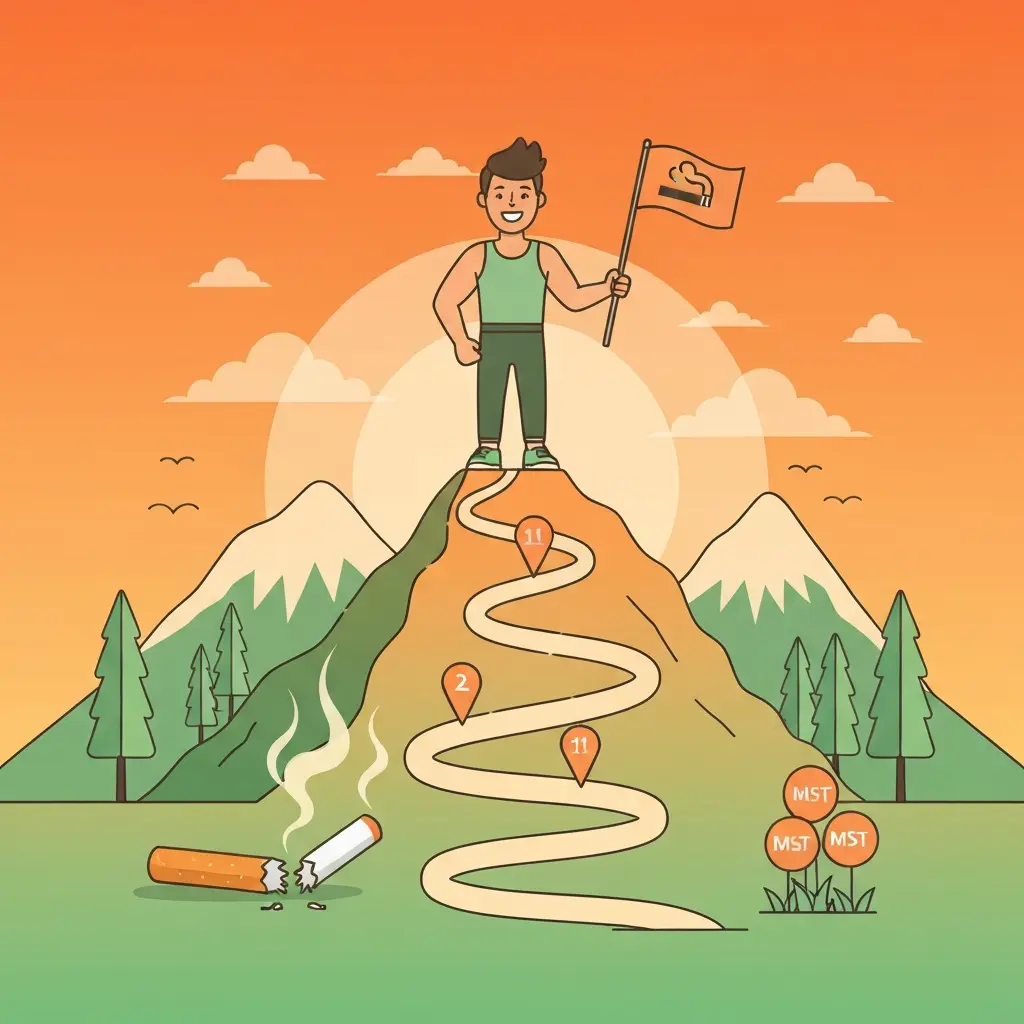
Milestone-Based Motivation: The Power of Small Wins
Motivation research consistently shows that progress towards a goal is itself motivating — and that this effect is most powerful when the progress is visible. This is why milestone-based quitting strategies outperform simple willpower-based ones.
Effective milestones for quit smoking motivation:
- Time milestones: 24 hours, 72 hours, 1 week, 2 weeks, 1 month, 3 months, 6 months, 1 year
- Health milestones: 20 minutes (heart rate drops), 12 hours (blood CO normalises), 2 weeks (circulation improves), 1 year (heart attack risk halved)
- Financial milestones: £50 saved, £100 saved, £500 saved — each associated with a specific, planned treat
- Cigarettes not smoked: Watching this counter climb is tangible proof of effort accumulated
The key is to celebrate each milestone deliberately. Not just notice it — celebrate it. Tell someone. Buy yourself something small. Post it in the iQuit community. Each celebration releases a small dopamine reward, reinforcing the neural pathway that associates “not smoking” with “feeling good” — the exact association that smoking itself has been building for years.
How Social Support Amplifies Your Motivation
A 2024 BMC Public Health study on cessation motivation found that social support — particularly from people who have quit or are quitting — was one of the strongest predictors of sustained motivation. This effect works through multiple mechanisms:
- Accountability: When others know you’re quitting, quitting becomes part of your social identity
- Vicarious success: Seeing others succeed at later stages of quitting makes your own success feel achievable
- Emotional support: Having somewhere to go when a craving is unbearable reduces the chance of relapse
- Normalisation of difficulty: Learning that cravings and bad days are universal — not personal failures — preserves motivation through hard periods
Telling family and friends you’re quitting is valuable. But the iQuit community adds something family can’t always provide: people who are in exactly the same experience right now, at the same stage, fighting the same cravings. That specificity of shared experience is uniquely powerful.
How to Rebuild Motivation After a Setback
A slip — or even a full relapse — is not the end of your quit. The NHS and leading cessation researchers are clear: most successful long-term quitters made multiple quit attempts before succeeding. Each attempt builds knowledge and skill. Motivation can be rebuilt, and it rebuilds faster each time because you know more about yourself.
After a setback:
- Do not treat it as failure. Treat it as data. What triggered the slip? What time, what emotion, what situation?
- Reset your quit date immediately — within 24 hours if possible. The longer the gap between a slip and a new quit date, the harder it is to rekindle motivation.
- Revisit your personal why. Read your motivational anchor. Update it if it’s become stale — motivations evolve, and your current why may be more powerful than the one you started with.
- Use the community. Post about the slip. You will receive support, not judgement, and that social reconnection can restore motivation faster than any solo strategy.
- Analyse and adapt. Use iQuit’s craving log to identify the specific trigger that caused the slip, and build a specific counter-strategy for that trigger before your new quit date.
For a detailed guide to restarting after a relapse, the article quit smoking after relapse — restart guide covers every step. For the craving management side, how to stop smoking cravings provides 10 evidence-based techniques you can deploy immediately.
How iQuit Supports Your Motivation Every Day
iQuit is designed around the motivational science outlined in this guide. Every feature reinforces a specific motivational mechanism:
- AI coach: Provides context-specific motivational support when cravings hit — addressing the situation you’re in, not a generic prompt
- Health milestone timeline: Makes invisible recovery visible, creating a continuous stream of milestone-based motivation
- Money counter: Makes financial progress tangible and real-time, feeding the “progress is motivating” effect
- Community: Provides vicarious success, accountability, and emotional support
- Craving tracker: Turns each craving logged (and survived) into data and evidence of your own capability
The combination of these features addresses motivation at the neurobiological level (visible milestones), the psychological level (community and identity), and the practical level (craving management tools). See the complete guide to quit smoking apps for a full breakdown of how these features work together.
Frequently Asked Questions
How do I stay motivated to quit smoking when cravings are strong?
When cravings are strong, the most effective strategies are: (1) open your quit app immediately and use the craving tool before reaching for a cigarette; (2) revisit your personal “why” — read your motivational anchor; (3) use the 5Ds: Delay, Distract, Drink water, Do something else, Deep breathe; (4) connect with the community — posting about a craving is one of the most effective ways to get through it. Cravings peak and pass within 5–10 minutes, and each one you survive is evidence of your own capability.
What is the best motivational strategy for quitting smoking?
Research shows the most effective motivational strategy combines a clear, personal, emotionally resonant “why” with future-self visualisation, milestone celebrations, and social support. No single technique is universally best — the key is layering multiple approaches so that motivation is maintained even when one source temporarily weakens.
Is it normal to lose motivation to quit smoking after a few weeks?
Yes — this is one of the most common and most misunderstood experiences in smoking cessation. The neurobiological withdrawal from nicotine temporarily depresses the brain’s reward system, making everything feel less rewarding and the memory of smoking feel more appealing. This is not a sign that you’re not strong enough — it’s a predictable phase that passes. Active motivational strategies, community support, and an AI coach are most important precisely during this phase.
Can motivation to quit smoking be rebuilt after a relapse?
Absolutely — and research shows that most successful long-term quitters made multiple attempts before succeeding. A relapse is not a failure but a learning experience. Reset your quit date within 24 hours, revisit your personal why, analyse what triggered the slip, and adjust your strategy. iQuit’s craving tracker makes this analysis straightforward, and the community provides the support to restart without shame.
How does iQuit help with quit smoking motivation?
iQuit supports motivation through multiple evidence-based mechanisms: AI coaching that provides personalised support when cravings hit; health milestone tracking that makes invisible recovery visible; a live money savings counter that shows tangible financial progress; craving pattern analysis that turns every logged craving into data and evidence of capability; and a community that provides accountability, vicarious success, and emotional support.
Keep Your Motivation Alive With iQuit
Motivation to quit smoking doesn’t have to be something you feel alone. iQuit’s AI coach, milestone system, and community are designed to support and sustain your drive every day — through the cravings, the setbacks, and all the way to your first smoke-free anniversary. Download iQuit and build your motivation system today.
Join the community at iquitnow.life