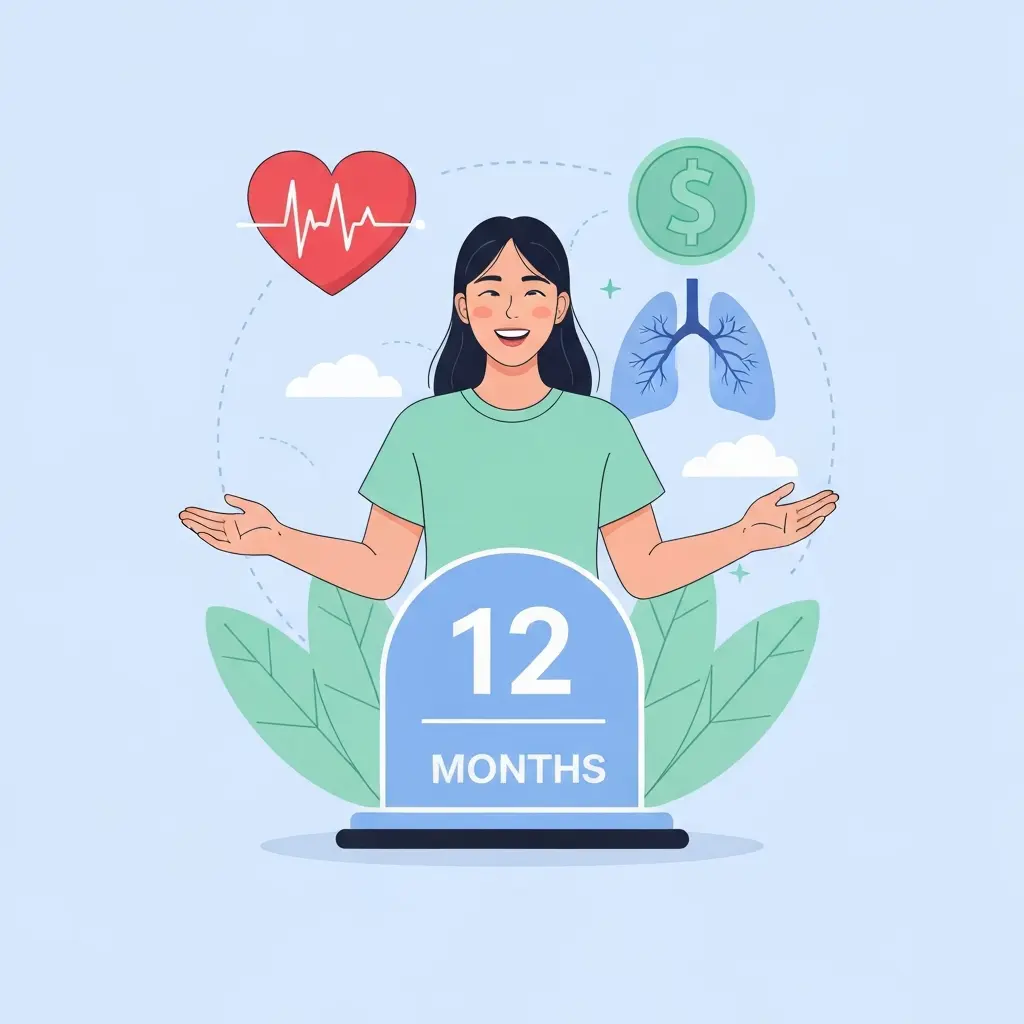
Quit Smoking One Year Benefits: Your Complete Health Transformation
One year without a cigarette is not just a personal achievement — it is a biological transformation backed by decades of medical research. The quit smoking one year benefits are so significant that reaching this milestone can genuinely be described as a turning point from which the trajectory of your health dramatically changes. Heart disease risk drops by half. Lung function approaches non-smoker levels. And the statistical likelihood that you will stay quit permanently rises sharply.
Whether you are approaching this milestone or planning your quit journey from the start, understanding what waits at the 12-month mark gives you something powerful to aim for — and to celebrate when you arrive.
Heart Disease Risk at One Year
The headline statistic at one year smoke-free: your risk of coronary heart disease is approximately 50% lower than it was when you were smoking. This is one of the most significant risk reductions documented in medical research, occurring within just 12 months of cessation.
According to the CDC, the cardiovascular improvements driving this reduction include:
- Blood pressure normalized to pre-smoking levels
- Arterial plaque progression halted and beginning to reverse
- Blood clotting risk significantly reduced
- HDL (good cholesterol) increased toward healthier levels
- Heart rate variability improved, indicating better cardiac autonomic function
- Reduced systemic inflammation, a key driver of arterial disease
To put this in human terms: if you smoked for 20 years and quit, your heart disease risk is already comparable to someone who smoked for only 10 years — 12 months after your last cigarette.
Lung Function at One Year
One year into your smoke-free life, your lungs have undergone a profound restoration process. The American Lung Association documents the following improvements by the 12-month mark:
| Lung Recovery Milestone | Timeline |
|---|---|
| Cilia begin regenerating | Within 24–72 hours |
| Lung function increases up to 30% | 2–12 weeks |
| Cilia fully functional; mucus clearance normalized | 1–9 months |
| Chronic cough and breathlessness substantially reduced | 3–6 months |
| Lung function approaches non-smoker baseline | 12 months |
A word of honesty from the research: if smoking caused structural damage such as emphysema or significant COPD, that specific damage is not fully reversible. However, even in those cases, cessation at one year has halted further decline and substantially slowed disease progression compared to continued smoking.
For most ex-smokers without pre-existing lung disease, at one year the difference in daily breathing experience — climbing stairs, exercising, sleeping — is profound. Many describe it as getting a new set of lungs.
Cancer Risk Reduction
Cancer risk reduction takes longer to accumulate than cardiovascular improvements, but by one year the process is well underway. According to the American Cancer Society:
- Mouth and throat cancer risk begins declining after one year of cessation
- Esophageal cancer risk reduction is measurable at one year
- Bladder cancer risk has already begun decreasing
- Lung cancer risk reduction builds year over year, reaching about half a smoker’s risk at year ten
The underlying mechanism is DNA repair. Smoking causes direct DNA damage in cells throughout the body. Once the source of that damage is removed, the body’s DNA repair mechanisms work to correct mutations before they progress to cancer. One year provides substantial time for this process to advance.
Senses, Skin, and Appearance
The quit smoking one year benefits extend well beyond internal medicine. By 12 months:
Taste and Smell
The nerve endings in your nasal passages and taste buds that smoking damaged have fully regenerated. Food tastes richer and more nuanced. Smells — of fresh coffee, rain, flowers, your home — are vivid in a way many ex-smokers describe as rediscovering a lost sense.
Skin
Improved circulation has been delivering more oxygen and nutrients to your skin for 12 months. The dull, grayish complexion associated with smoking has given way to healthier tone. Collagen synthesis has improved, reducing the rate of smoke-related skin aging. Wound healing is faster. Many ex-smokers report that their skin looks noticeably younger at one year.
Teeth and Gums
Gum disease — significantly accelerated by smoking — begins reversing. Staining from tar compounds is no longer being replenished. Many ex-smokers opt for professional whitening at the one-year mark, and gum health measurably improves.
Mental Health and Energy
One of the most underreported quit smoking one year benefits is the mental health improvement. Research published in JAMA Network Open found that individuals who quit smoking experience significant reductions in depression, anxiety, and stress — with effect sizes comparable to antidepressant medication.
At one year:
- Brain dopamine function has fully normalized (the three-month recovery is complete)
- The false belief that cigarettes helped with stress has been replaced by evidence of your own coping skills
- Identity as a non-smoker is solid and self-reinforcing
- Energy levels throughout the day are consistently higher
- Sleep quality has improved, since smoking disrupted sleep architecture
The Financial Transformation
The financial quit smoking one year benefits are among the most immediately tangible. A pack-a-day smoker in the US spends approximately $3,000 to $5,000 per year on cigarettes, depending on location. At one year smoke-free:
| Daily Cigarettes | Estimated Annual Savings |
|---|---|
| 10 (half a pack) | $1,500 – $2,500 |
| 20 (one pack) | $3,000 – $5,000 |
| 40 (two packs) | $6,000 – $10,000 |
These savings do not include reduced healthcare costs, lower insurance premiums, and the economic value of the additional years of healthy life. The iQuit app’s savings calculator tracks this in real time — watching the number grow is one of the most motivating features many users report.
What Comes After Year One
Reaching one year is extraordinary — but the trajectory continues upward for years:
- 5 years: Stroke risk equals that of a never-smoker
- 10 years: Lung cancer risk is about half a current smoker’s; other cancer risks continue declining
- 15 years: Risk of coronary heart disease matches a person who never smoked
Each year, the gap between you and a current smoker widens. Every year you stay quit is a year your body continues to heal.
If you are still in the earlier stages of your journey, our guides on Quit Smoking One Month Benefits and Quit Smoking 3 Months Benefits give you a detailed look at what to expect along the way.
Track Your Path to One Year Smoke-Free
The iQuit app shows your real-time health milestones, money saved, and days smoke-free — making every step toward the one-year mark visible and motivating.
Frequently Asked Questions
What is the most important health benefit of quitting smoking after one year?
The most medically significant quit smoking one year benefit is the 50% reduction in coronary heart disease risk compared to a current smoker. This is a dramatic, measurable drop in the leading cause of death among smokers, occurring within just 12 months of cessation. Lung function recovery and cancer risk reduction are also substantial at one year.
Are one-year quit smoking benefits permanent?
The benefits are cumulative and largely permanent as long as you remain smoke-free. Each year adds to the recovery. However, if someone were to resume smoking, the benefits would begin to reverse — which is why the one-year milestone is so important to protect. Once reached, the habituation to being a non-smoker is strong enough that relapse rates drop dramatically.
Do people who smoked for decades see the same one-year benefits?
Yes, though the baseline differs. Long-term heavy smokers may have more accumulated damage, meaning some metrics start from a lower point. But the trajectory of improvement is similar — and in many cases the absolute health gains are even larger, because there is more damage for the body to reverse. Research consistently shows that quitting at any age produces significant measurable benefits within one year.
Will I still get cravings after one year?
Most people at one year experience only occasional cravings, typically triggered by specific situations such as high stress or being around smokers. These cravings are typically brief and much less intense than in the early weeks. Many one-year ex-smokers describe cravings as occasional passing thoughts rather than compelling urges. The habit circuits laid down by years of smoking do not fully disappear, but they lose their power significantly over time.
How does the one-year milestone affect life expectancy?
According to WHO research, people who quit smoking at age 30 gain approximately 10 years of life expectancy. At 40, quitting gains about 9 years. At 50, 6 years. Even at 60, cessation adds 3 years. These gains compound because each year of not smoking prevents further heart disease progression, lung decline, and cancer risk accumulation. The one-year mark is when these statistics become tangible.