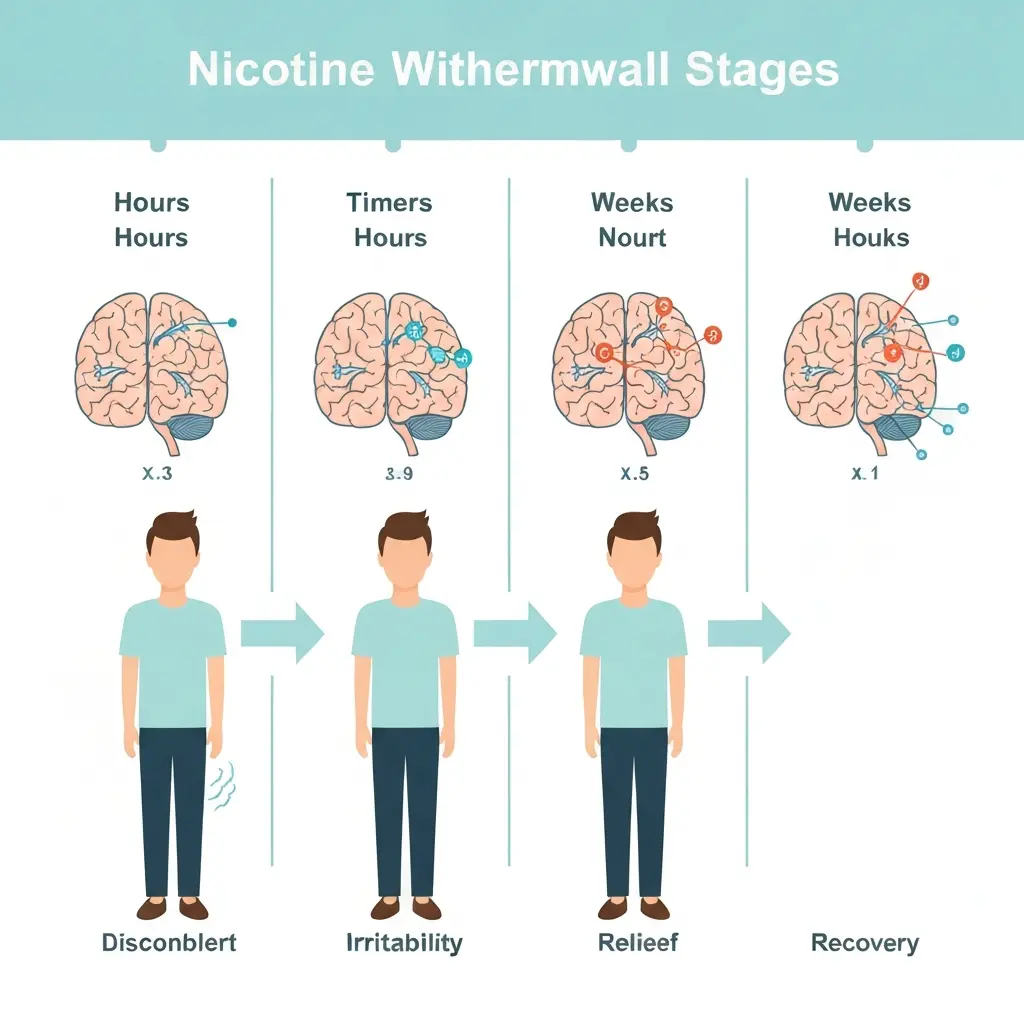
What Are the Stages of Nicotine Withdrawal? A Complete Hour-by-Hour Answer (2026)
Nicotine withdrawal unfolds in predictable stages, and knowing exactly what to expect at each stage is one of the most powerful tools you have in your quit attempt. The stages of nicotine withdrawal begin within two hours of your last cigarette and — for most symptoms — resolve within two to four weeks. The acute phase is genuinely uncomfortable, but it follows a known timeline that you can plan around, manage, and outlast.
This guide draws on WHO guidance, NHS clinical resources, and peer-reviewed research from Nicotine & Tobacco Research and the Cochrane Tobacco Addiction Group to give you a medically accurate, practical picture of what your body and brain are doing at every stage — and what actually helps.
Why Withdrawal Happens: The Neuroscience
Nicotine binds to nicotinic acetylcholine receptors (nAChRs) throughout the brain, triggering dopamine release in the nucleus accumbens — the brain’s reward centre. With regular smoking, the brain upregulates these receptors (creates more of them) to compensate for constant nicotine stimulation. When nicotine is removed, this upregulated system fires with insufficient input, producing the characteristic withdrawal syndrome: craving, anxiety, irritability, and cognitive disruption.
This is not a failure of willpower. It is a physiological response to the sudden removal of a substance the brain has incorporated into its normal functioning. The American Psychiatric Association classifies nicotine withdrawal as a genuine medical syndrome (DSM-5 292.0). Understanding this helps reframe the discomfort of withdrawal as a biological process with a known resolution timeline — not a personal failing.
The same neurological mechanisms that make quitting smoking difficult also affect concentration and working memory in other high-pressure contexts. Research documented in German academic AI usage statistics shows that cognitive load and stress substantially reduce self-regulatory capacity — the same capacity needed to resist a cigarette craving. Managing withdrawal stages is, in part, a cognitive management challenge.
Stage 1: Hours 0–8
The nicotine half-life in blood is approximately 2 hours. For a regular smoker, this means that by 2 hours after the last cigarette, blood nicotine has dropped by 50% and the first symptoms of withdrawal begin.
Symptoms you may notice:
- Mild restlessness or fidgetiness
- Awareness of the absence of a cigarette (not yet intense craving)
- Slight increase in appetite
- Mild difficulty concentrating
Peak intensity: Low. Most people manage this phase without intervention.
Duration: Hours 0–8.
What helps: Nicotine replacement (patch or gum) can prevent symptom escalation if started immediately at quit time. Keeping your hands busy and avoiding your highest-risk trigger environments is helpful.
Stage 2: Hours 8–72 (The Hardest Days)
This is the phase most people describe as “the worst.” By 8–24 hours, blood nicotine is near zero in heavy smokers. The upregulated receptor system is now firing with no input, producing the full acute withdrawal syndrome.
Symptoms in Stage 2:
- Intense cravings — peaking at approximately 10–20 minutes per craving episode
- Irritability and anger — often the most disruptive social symptom
- Anxiety — can be severe enough to mimic a panic attack in some individuals
- Difficulty concentrating — working memory impairment of approximately 15% in controlled studies
- Sleep disturbance — vivid dreams common; nicotine normally suppresses REM sleep, which rebounds dramatically
- Increased appetite — nicotine normally suppresses appetite; 2–4kg weight gain is average in first month
- Headaches — related to cerebral vasodilation as nicotine’s vasoconstrictive effects cease
Peak intensity: High. This is the stage most associated with relapse.
Duration: Hours 8–72 for peak symptoms; improvement begins after Day 3 in most people.
What helps: Combination NRT (patch + fast-acting gum or lozenge), active craving management using the 5D technique (Delay, Deep breathe, Drink water, Do something, Distract), and logging every craving in your quit app to identify your specific trigger pattern.
Stage 3: Days 3–14
By Day 3, the acute physical storm begins to ease. Nicotine receptors begin downregulating back toward normal baseline. However, the psychological dimension of withdrawal — habitual triggers, emotional associations, and the restructuring of daily routines — often intensifies as the physical urgency fades.
What changes:
- Physical craving intensity decreases, but frequency can remain high
- Mood stabilises gradually — irritability usually significantly improved by Day 7
- Cough and mucus production may temporarily increase as cilia in airways regenerate (this is recovery, not illness)
- Appetite remains elevated; this is the highest-risk period for compensatory eating
- Sleep quality begins improving (usually by Day 5–7)
Duration: Days 3–14.
What helps: Continue NRT as directed; introduce exercise (even 20 minutes of brisk walking significantly reduces craving intensity and duration); use app-based craving diary to identify and plan around your top 3 trigger contexts.
Stage 4: Weeks 2–12
By the end of week 2, most people notice a significant improvement in daily quality of life. Most physical symptoms have resolved. The challenge in this stage is habitual and psychological: learning to navigate situations that were previously always accompanied by smoking.
Key developments:
- Cravings reduce to a few per day, then a few per week
- Taste and smell continue improving
- Breathing capacity measurably increases (lung function can improve up to 30% by 2 weeks)
- Energy levels typically increase as cardiovascular efficiency improves
- The longest NRT taper period — reducing dose gradually is important to prevent abrupt discontinuation symptoms
Long-Term: Beyond 3 Months
After 3 months of continuous abstinence, the vast majority of physical and most psychological withdrawal symptoms have resolved. Nicotinic receptor density has largely normalised. However, cue-triggered cravings — where a specific environmental stimulus (a smell, a place, a social situation) provokes a brief, intense craving — can persist for years.
These long-term cue-triggered cravings are a normal feature of addiction recovery. They typically last under 5 minutes and respond well to the same craving management techniques used in the acute phase. Keeping a cessation app installed through year one specifically to handle these cues is supported by evidence — relapse risk events often cluster around the 3-month, 6-month, and 1-year marks. See our complete nicotine withdrawal timeline for a full year-by-year perspective.
Symptom Management by Stage: Quick Reference
| Stage | Primary Symptoms | Evidence-Based Management |
|---|---|---|
| Hours 0–8 | Mild restlessness, mild craving | Start NRT; remove cigarettes from environment |
| Hours 8–72 | Intense craving, irritability, anxiety, sleep disruption | Combination NRT, 5D craving technique, stay hydrated |
| Days 3–14 | Habitual cravings, appetite increase, cough | Exercise, craving diary, high-protein snacks |
| Weeks 2–12 | Trigger-based cravings, occasional low mood | NRT taper, mindfulness, cessation app |
| 3 months+ | Occasional cue-triggered cravings | Craving surfing, keep app installed, lifestyle resilience |
For detailed techniques for each symptom, see our evidence-based withdrawal management playbook.
Frequently Asked Questions
What are the four stages of nicotine withdrawal?
Stage 1 (0–8 hours): mild discomfort as blood nicotine drops. Stage 2 (8–72 hours): peak acute symptoms including intense cravings, irritability, anxiety, and sleep disruption. Stage 3 (Days 3–14): gradual easing of physical symptoms; habitual and psychological cravings remain. Stage 4 (Weeks 2–12): most symptoms resolved; trigger-based cravings continue to reduce. Long-term cue-triggered cravings can persist but diminish in frequency and intensity.
When is nicotine withdrawal the hardest?
Days 2–5 are typically the most physically intense for most people. Peak craving severity usually occurs 24–72 hours after the last cigarette. Days 3–4 are often when relapse risk is highest because the acute discomfort is maximal while the physical health improvements are not yet perceptible. Having a prepared craving management plan for this window is critical.
How long do nicotine withdrawal symptoms last?
Most physical withdrawal symptoms resolve within 2–4 weeks. Psychological symptoms, including habitual cravings triggered by specific contexts, can persist for months but diminish continuously. According to NHS guidance, most people find withdrawal symptoms manageable after 2 weeks and nearly resolved by 4 weeks. NRT can significantly reduce symptom intensity during the acute phase.
Can NRT prevent nicotine withdrawal stages?
NRT does not prevent withdrawal but substantially reduces its severity. By maintaining a lower baseline nicotine level, NRT allows the brain to adapt more gradually rather than facing abrupt removal. Combination NRT (patch plus fast-acting form) is more effective than monotherapy and is associated with approximately 2× the quit rate of unassisted attempts in clinical trials.
Are nicotine withdrawal symptoms dangerous?
For most healthy adults, nicotine withdrawal symptoms are uncomfortable but not medically dangerous. However, people with certain conditions — particularly bipolar disorder, schizophrenia, or those on certain medications — may experience more significant mood disruption and should quit with medical supervision. Anyone who experiences severe chest pain, severe depression, or suicidal ideation during quitting should seek medical attention promptly.
Navigate Every Stage With AI Support
The iQuit app tracks your withdrawal stage, adjusts its coaching messages to what you’re experiencing right now, and sends targeted support during your highest-risk hours. You don’t have to guess which stage you’re in — iQuit tells you, and tells you what to do about it.
Download iQuit free and start your stage-by-stage guided quit.